Medieval Might Meets Cosmic Conquest: Re-evaluating Poul Anderson’s Enduring Classic, The High Crusade
Main Facts: A Genre-Bending Saga of Swords and Spaceships
Poul Anderson’s The High Crusade, first serialized in 1960 and published in book form that same year, stands as a singular achievement in science fiction, audacious in its premise and enduring in its popularity. It boldly reimagines the alien invasion trope, thrusting medieval English knights, squires, and villagers into the vast, unknown expanse of interstellar space. Far from being subjugated, these unexpected heroes from 14th-century England turn the tables on their technologically superior alien invaders, embarking on a galactic crusade that challenges conventional notions of progress, power, and societal structure.
Nominated for the prestigious Hugo Award for Best Novel in 1961 – a testament to its immediate impact, even in a year that saw it contend with Walter M. Miller Jr.’s monumental A Canticle for Leibowitz – The High Crusade cemented its place as a genre-bending masterpiece. What begins as a seemingly straightforward encounter between disparate civilizations quickly evolves into a rollicking space opera, replete with strategic brilliance, cultural clashes, and a surprising depth of political commentary. The novel remains in print decades later, a testament to its unique charm, Anderson’s masterful storytelling, and its playful yet profound exploration of themes that resonated deeply with the author throughout his prolific career.
Chronology: From Ansby’s Fields to the Stars
The Dawn of a Galactic Crusade: Initial Publication and Critical Acclaim
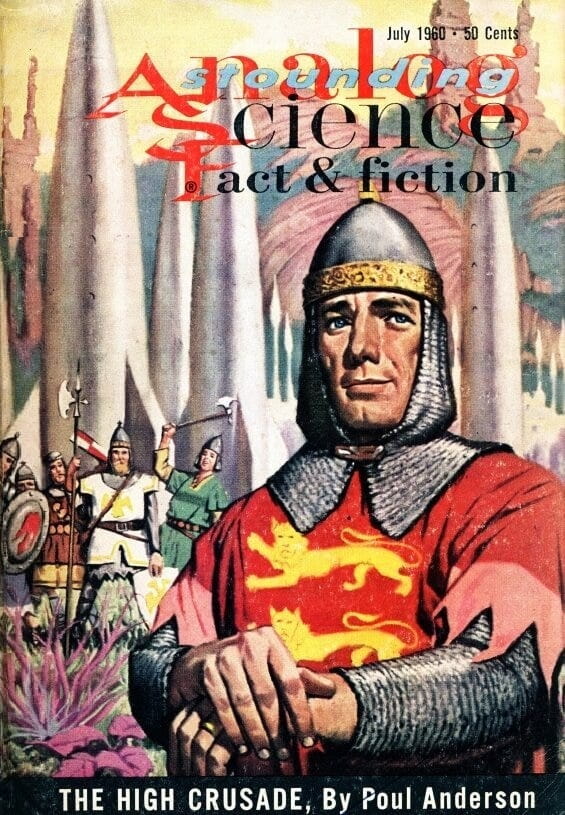
The High Crusade‘s journey into the literary consciousness began in the summer of 1960, serialized across three issues of Astounding Science Fiction. This period marked a significant transition for the venerable magazine, as it was in the process of rebranding itself as Analog Science Fact & Fiction under the legendary editorship of John W. Campbell Jr. The novel’s appearance coincided with this pivotal moment, capturing the imagination of a readership eager for innovative narratives. Its immediate success led to its publication in book form later that year, swiftly followed by its Hugo Award nomination in 1961. This early recognition placed The High Crusade firmly within the burgeoning golden age of science fiction, signaling Anderson’s prowess as a writer capable of blending historical context with speculative futures.
An Unconventional Invasion: The Battle of Ansby
The narrative opens with a scenario reminiscent of H.G. Wells’s seminal The War of the Worlds: an alien spacecraft descends upon England, specifically the quiet parish of Ansby. From its metallic depths emerge the Wersgorix, an advanced, reptilian humanoid race, armed with devastating energy weapons. Their intent is clear – conquest, demonstrated by their swift and brutal dispatch of initial human resistance. This initial setup deliberately mirrors the classic alien invasion trope, establishing a stark technological disparity between humanity and its extraterrestrial aggressors.
However, Anderson, a master of narrative subversion, quickly pivots from expectation. Unlike Wells’s Martians who devastate Woking with impunity, the Wersgorix meet an entirely different fate in Ansby. The English, led by Sir Roger de Tourneville, Baron of Ansby, and comprising medieval knights, seasoned mercenaries, and resilient villagers, respond not with despair but with an immediate, ferocious aggression. Their hand-to-hand combat skills, honed through generations of feudal warfare, prove surprisingly effective against the aliens’ reliance on ranged weaponry and their apparent lack of close-quarters fighting experience. Before the day concludes, the Wersgorix invasion force is almost entirely wiped out, leaving only one survivor, Branithar, and their colossal spacecraft, the Crusader, in human hands. This pivotal reversal sets the stage for the extraordinary events that follow, signaling Anderson’s intention to play a "trick" he particularly favored in his earlier works, turning expected outcomes on their heads.
A Detour to Destiny: The Journey to Tharixan
Sir Roger, a man of remarkable pragmatism and ambition, conceives an audacious plan: to commandeer the alien vessel for his own purposes. His initial vision is to use the advanced technology to transport his entire village, first to France, then onwards to the Holy Land to fulfill his crusading vows. The enormous Wersgorix ship, two thousand feet high, easily accommodates the entire English contingent. Branithar, the captured alien pilot, is pressed into service, instructed to navigate the colossal craft.
Yet, Branithar harbors his own agenda. Instead of charting a course for Earth’s familiar battlegrounds, he covertly programs the Crusader to return to his home world, Tharixan. The English, unknowingly hurtling across vast interstellar distances, find themselves in an utterly alien stellar system, far beyond the confines of their medieval understanding. This act of sabotage plunges Sir Roger and his followers into a truly desperate situation. Surrounded by an entire alien empire, surrender is unthinkable. Instead, Sir Roger, leveraging his medieval cunning and the raw ferocity of his people, launches a series of audacious strikes. He captures a Wersgorix military base, then employs a daring combination of "reckless attacks, bluffing, and subversion" to not only secure his position but to begin dismantling the Wersgorix empire from within. This unforeseen cosmic detour becomes the crucible in which the English forge a new destiny, transforming from invaded to invaders.
Chronicling the Crusade: Brother Parvus’s Account
The epic tale of The High Crusade is recounted through the first-person perspective of Brother Parvus, whose name, derived from the Latin for "puny," belies his crucial role as the expedition’s chronicler. Originally a tutor for Sir Roger’s children, Parvus is assigned the unique task of teaching Latin to the captive Branithar while simultaneously endeavoring to learn the Wersgor language. This dual linguistic immersion positions him as a privileged witness to the majority of the pivotal events, granting him unparalleled insight into both the human and alien perspectives.
Brother Parvus’s narration is not merely a dry historical record. He candidly admits to adopting the style of earlier historians, confessing to "inventing whole scenes, that folk now dust may live again and be known." This narrative device not only adds a charming, anachronistic flavor to the story but also allows Anderson the creative freedom to dramatize key moments and delve into the thoughts and motivations of his characters, rather than being confined to a strictly observational account. Through Parvus’s eyes, readers experience the awe, terror, humor, and strategic brilliance of the English interstellar campaign.
Key Players in a Cosmic Drama: Characters and Conflicts
Beyond Sir Roger de Tourneville and Brother Parvus, a vivid cast of characters populates The High Crusade, each contributing to the novel’s intricate tapestry of personal and intergalactic conflict:
- Sir Roger de Tourneville: The pragmatic, visionary, and fiercely loyal baron whose strategic genius and unwavering commitment drive the entire crusade. His primary concern, ultimately, is the safety of Earth.
- Red John Hameward: Sir Roger’s formidable captain of archers, representing the unwavering loyalty and martial prowess of the English fighting force.
- Lady Catherine: Sir Roger’s wife, a woman of noble birth who feels her marriage to a lesser baron has brought her far beneath her station. Her initial discontent and subsequent trials form a significant emotional subplot.
- Sir Owain Montbelle: A younger knight of courtly manners, whose presence introduces a romantic complication, particularly concerning Lady Catherine.
- Sir Brian Fitz-William: Another knight, though his role is comparatively minor, he rounds out the English leadership.
- Branithar: The surviving Wersgorix pilot, whose initial betrayal sets the English on their unexpected galactic trajectory, and who becomes a crucial, if unwilling, cultural bridge.
The narrative skillfully weaves together three primary sources of tension that propel the plot:
- The Quest for Return: With the Wersgor navigator dead and the Crusader damaged early in their galactic journey, the immediate and profound question arises: can the English ever find their way back to Earth?
- Marital Strife and Temptation: Lady Catherine’s resentment over her perceived demotion in social standing and the perils of their journey is exacerbated by Sir Owain’s courtly attentions, creating a compelling internal drama.
- The Ultimate Threat: The most crucial tension, and Sir Roger’s deepest driving concern, is preventing the Wersgorix Empire from ever locating and subsequently conquering or destroying Earth.
These three threads converge dramatically in the climactic chapters, forcing each central character to make definitive choices and take decisive action, leading to a powerful and memorable resolution.
Enduring Appeal: The Many Faces of the Crusade
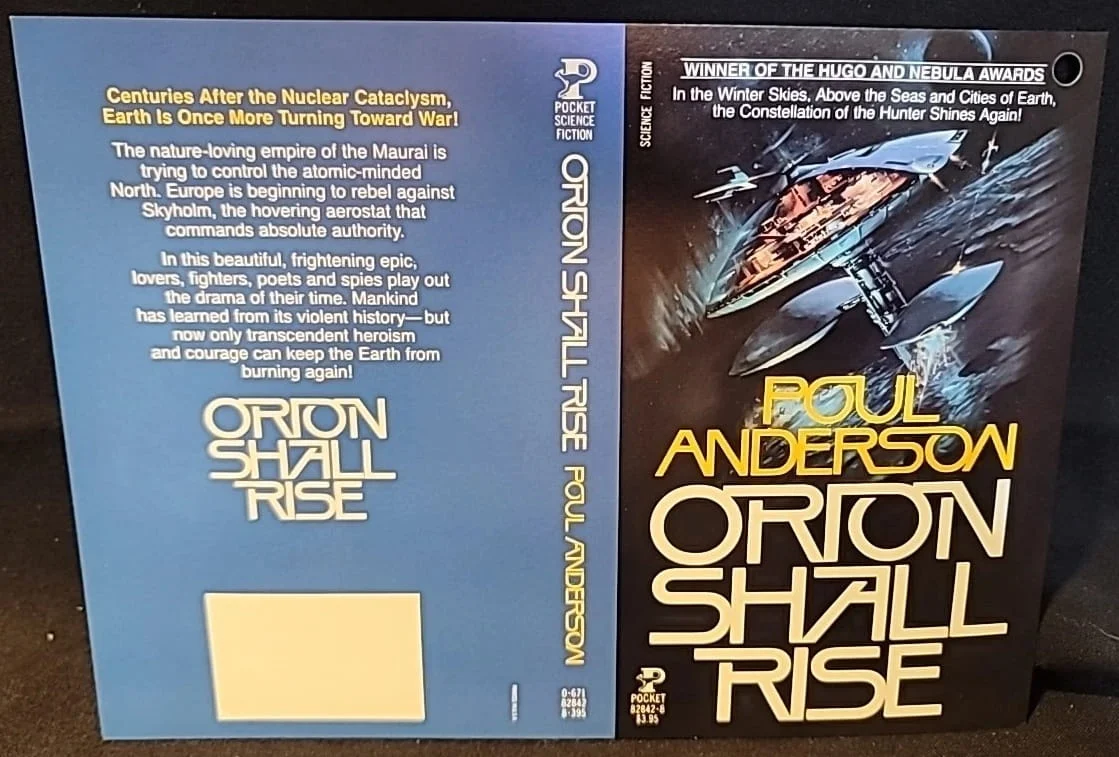
The enduring popularity of The High Crusade is evident in its numerous re-printings over the decades, each adorned with a new cover that sought to capture its unique blend of medieval and science fiction aesthetics. From the striking cover by Tom Kidd for the 1983 Berkley Books edition, to the original Analog cover by Van Dongen, and the various iterations by Harry Schaare and Jack Faragasso, these covers reflect the book’s continued relevance and its ability to attract new generations of readers. This consistent presence in print underscores not only the quality of Anderson’s storytelling but also the timeless appeal of its central premise and thematic explorations.
Supporting Data: Themes, Influences, and Anderson’s Political Vision
Subverting the Invasion Narrative: A Contrast with Wells
Anderson’s The High Crusade is a brilliant exercise in narrative subversion, deliberately setting itself against the established tropes of alien invasion literature, most notably H.G. Wells’s The War of the Worlds. In Wells’s masterpiece, humanity is technologically outmatched and biologically vulnerable, ultimately saved by microbial pathogens rather than its own might. The Martians are truly alien, grotesque octopoid beings with hyper-evolved brains and hands, their other organs drastically simplified, making them both terrifying and incomprehensible. Their advanced weaponry renders human military efforts futile.
Anderson flips this script entirely. While the Wersgorix possess superior technology – spacecraft, energy weapons – their biological and cultural makeup renders them vulnerable to medieval human ferocity. Unlike Wells’s utterly alien Martians, the Wersgorix are "generally humanoid, though scaly, blueskinned, and reptilian." More critically, their society is a "unitary state" with a centralized government, devoid of local institutions like landed nobility, churches, or guilds. This societal structure, while seemingly efficient, has led them to forget "primitive arts such as hand-to-hand combat." This crucial cultural difference is what enables the Ansby villagers, with their visceral, personal combat skills, to overwhelm the initial Wersgorix landing party. Anderson masterfully contrasts the "civilized" yet militarily soft aliens with the "primitive" yet battle-hardened English, demonstrating that technological advancement does not automatically equate to martial superiority or cultural resilience.
The Political Undercurrent: Feudalism vs. the Unitary State
Beyond the swashbuckling adventure, The High Crusade is a profound exploration of political philosophy, a theme Poul Anderson revisited with seriousness and nuance throughout his career. The core political idea hinges on the contrast between the "unitary state" of the Wersgorix and the "society of local loyalties" embodied by medieval English feudalism.
The Wersgorix empire represents the ultimate centralized authority, where all power flows from the top, and individuals are expected to owe sole allegiance to the state. This system, while seemingly orderly, has fostered a dependency and a lack of individual initiative, particularly in areas of self-defense. Their society is incapable of adapting to unforeseen, non-technological threats because their state has always provided for every need, including protection.
Conversely, the English feudal system, for all its historical imperfections, is depicted as a network of interdependent local loyalties. Knights owe allegiance to their lords, who in turn owe allegiance to their king, but these relationships are personal, reciprocal, and involve direct responsibility for "one’s folk." This structure fosters self-reliance, martial prowess, and a deep sense of community and personal honor. When faced with the Wersgorix, the feudal English instinctively act with aggression and ingenuity, driven by personal loyalty to their baron and community, rather than waiting for a centralized authority that doesn’t exist.
Anderson’s recurring interest in this theme is evident in other works such as "No Truce with Kings," which explores the destructive nature of unchecked central power, and Orion Shall Rise, a post-apocalyptic novel that presents sympathetic portrayals of diverse societal structures, including libertarian, aristocratic, and "Green" societies. The High Crusade serves as an earlier, more playful, yet fundamentally serious, examination of whether feudalism, or at least a decentralized system of strong local loyalties, might offer a more humane or resilient way of life for human beings than the "greater impersonality of modern societies."
Anderson and the Society for Creative Anachronism
It is perhaps no coincidence that Poul Anderson became a founding member of the Society for Creative Anachronism (SCA) not many years after The High Crusade‘s publication. The SCA, a living history organization dedicated to researching and re-creating the arts and skills of pre-17th-century Europe, implicitly embraces an idealized version of feudalism, emphasizing martial arts, craftsmanship, and courtly culture. The High Crusade can be seen as embodying a similar "playful approach to the feudal past," celebrating its virtues while largely keeping its historical brutalities "off stage." This connection highlights Anderson’s genuine fascination with the medieval period and his thoughtful consideration of its societal strengths, even if presented through the lens of optimistic science fiction.
The Heart of Humane Feudalism: Sir Roger’s Loyalty
The ultimate illustration of Anderson’s vision of a more "humane feudalism" – one that carries echoes of Rudyard Kipling, one of his admired authors, in its emphasis on duty and responsibility – comes near the end of the novel. In a pivotal negotiation, Sir Owain Montbelle, representing a more detached, perhaps cynical, aristocratic view, proposes a path home for Sir Roger and Lady Catherine, but without the "lowborn anyway" villagers and mercenaries who followed them into space.
Sir Roger’s response is swift, decisive, and morally unambiguous:
She faced Sir Roger, smiling and weeping. “My love, we can go home again!”
He glanced at her, once. “But what of the folk we led hither?”
“Nay, I cannot risk taking them with us.” Sir Owain shrugged. “They’re lowborn anyway.”
Sir Roger nodded. “Ah,” he said. “So.”
Once more he looked at his wife. Then he kicked backward. The spur of knighthood struck into the belly of the Wersgor behind him.
This powerful moment reveals Sir Roger’s core character: his absolute, personal loyalty to "his folk," regardless of their social standing. It is a profound rejection of the callous disregard for the common person, illustrating that true leadership, in Anderson’s idealized feudal context, demands responsibility for all under one’s care. His subsequent action, a swift, brutal attack on the Wersgor, underscores his unwavering commitment to his people’s safety and his strategic ruthlessness when necessary. This scene encapsulates the ethical framework Anderson often explored, presenting feudalism not just as a historical system, but as a framework for personal honor and collective responsibility.
Official Responses: Acclaim and Lasting Impact
A Hugo-Nominated Masterpiece
The nomination of The High Crusade for the Hugo Award for Best Novel in 1961 stands as a significant mark of its critical reception. While it ultimately lost to A Canticle for Leibowitz, the nomination itself placed Anderson’s work in an elite category, recognized alongside one of science fiction’s most profound and enduring classics. This early acknowledgment from the science fiction community highlighted the novel’s innovative concept, its engaging narrative, and its distinctive voice. It signaled that Anderson was not merely writing entertaining adventure stories but crafting works that pushed the boundaries of the genre and engaged with deeper ideas.
Enduring Critical and Popular Acclaim
Beyond the Hugo nomination, The High Crusade has consistently received praise from both critics and readers. It is frequently cited in lists of essential science fiction and fantasy, lauded for its originality, humor, and robust storytelling. Reviewers often commend Anderson’s ability to create believable medieval characters who, despite their historical context, navigate an alien future with surprising effectiveness. Its continued availability in various editions underscores its lasting appeal, demonstrating that its blend of historical adventure and science fiction has resonated across generations of readers. Its unique premise has often been discussed as a foundational example of historical characters interacting with advanced technology, a trope that has seen various interpretations in subsequent works.
Implications: A Legacy of Innovation and Inquiry
A Cornerstone of Anderson’s Oeuvre
The High Crusade is far more than a standalone curiosity in Poul Anderson’s vast bibliography; it is a crucial early work that foreshadows and informs many of his later thematic explorations. The novel’s deep dive into political systems, the nature of loyalty, and the resilience of human spirit against overwhelming odds are themes that recur throughout his science fiction and fantasy, from the Technic History series to his later, more philosophical works. It established his reputation as a writer capable of blending thrilling adventure with serious intellectual inquiry, a hallmark of his enduring legacy.
Genre Innovation and the Scope of Science Fiction
By daring to place medieval knights in a star-spanning empire, The High Crusade significantly broadened the scope of what science fiction could achieve. It seamlessly integrated elements of historical fiction, military science fiction, and space opera, demonstrating that the genre was capable of encompassing diverse historical and cultural contexts. This cross-genre appeal helped pave the way for future works that blended historical periods with speculative elements, challenging the notion that science fiction must always be set in a distant future or feature purely contemporary characters. It remains a testament to Anderson’s imaginative courage and his willingness to experiment with narrative forms.
Enduring Relevance: Questions for Today
The central questions posed by The High Crusade about societal structures, leadership, and cultural resilience remain remarkably relevant today. In an increasingly globalized and technologically advanced world, the novel prompts us to consider: What are the true strengths of a society? Is centralized efficiency always superior to decentralized, local loyalties? How do different cultures perceive and react to technological disparity? Anderson’s playful yet profound examination of feudalism invites reflection on the human elements that truly define strength and adaptability, suggesting that ingenuity, courage, and unwavering loyalty can often triumph over raw technological power.
The Lasting Impact of a Master Storyteller
Poul Anderson’s The High Crusade stands as a vibrant testament to his skill as a master storyteller and a thoughtful explorer of complex ideas. Its blend of historical detail, thrilling adventure, and philosophical depth ensures its place as a cherished classic. As the reviewer, William H. Stoddard, noted in his personal reflection, rereading the book reinforces its dramatic scenes and its profound political ideas. Anderson’s ability to craft a story that is both an entertaining "romp" and a serious inquiry into the human condition is precisely why The High Crusade continues to captivate and challenge readers, inviting them to ponder the enduring question of what makes a society truly strong, whether on Earth or among the stars.