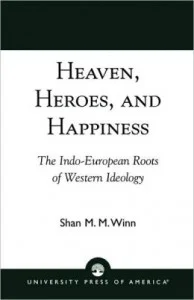
The Echoes of Antiquity: Shan Winn’s "Heaven, Heroes, and Happiness" Unearths Indo-European Roots of Western Ideology
FOR IMMEDIATE RELEASE
[City, State] – [Date] – In an age marked by rapid technological advancement and cultural shifts, understanding the deep historical currents that shape contemporary thought is more crucial than ever. A new critical examination of Shan Winn’s seminal work, "Heaven, Heroes, and Happiness: The Indo-European Roots of Western Ideology," sheds light on the profound and often unacknowledged continuities between the worldviews of Bronze and Iron Age Europeans and our modern Western societies. While popular discourse often emphasizes the stark differences between ancient and modern eras, Winn’s book, reviewed here in detail, meticulously argues for an enduring legacy that transcends millennia, influencing everything from our social structures to our religious concepts.
Main Facts: Unearthing the Enduring Legacy
Shan Winn’s "Heaven, Heroes, and Happiness" presents a compelling case for the indelible impact of Proto-Indo-European (PIE) culture on Western civilization. Far beyond merely contributing the linguistic bedrock for nearly all modern European languages, the PIE peoples, originating from the Pontic-Caspian steppe, bequeathed a foundational ideological framework that continues to resonate today. The book’s central thesis posits that key aspects of our societal organization, mythological narratives, and even philosophical underpinnings can be traced directly back to these ancient nomadic pastoralists.
At the heart of Winn’s argument lies the concept of a tripartite hierarchical structure, a social and cosmological model that appears almost universally across Indo-European societies. This structure divides society into three distinct tiers: the rulers and priests, the warriors, and the commoners (farmers, merchants, craftspeople). Winn, drawing significantly from the work of pioneering scholars like Georges Dumézil, demonstrates how this specific societal division was mirrored in the divine realms, with gods and goddesses often categorized according to these three functions. This deep-seated organizational principle, while not strictly adhered to in modern states, remains a crucial, often subconscious, reference point in Western societal design.
Furthermore, the book explores how even seemingly radical philosophical and religious movements, such as the teachings of the Iranian prophet Zarathustra, were built upon existing Indo-European mythical themes. Zarathustra’s profound influence on later monotheistic religions, particularly Christianity, underscores the pervasive and adaptable nature of these ancient ideological raw materials. Winn’s work thus serves as an essential introduction to the intricate world of Indo-European studies, revealing how their worldviews and ways of life have persisted, subtly shaping our present.
Chronology: From Steppe Nomads to Global Influence
The journey of Indo-European influence begins not in the established civilizations of antiquity, but in the vast, windswept grasslands of the Pontic-Caspian steppe, a region spanning parts of modern-day Ukraine, Russia, and Kazakhstan. It was here, during the Bronze Age, roughly between 4500 and 2500 BCE, that the Proto-Indo-Europeans emerged as a distinct cultural group. These were not sedentary urban dwellers but innovative nomadic or semi-nomadic pastoralists whose mastery of horse domestication and the wheeled cart revolutionized transportation and warfare. These technological advancements provided them with unprecedented mobility, enabling them to expand rapidly across Eurasia.
The Great Migrations and Cultural Diffusion (c. 3000 – 1000 BCE):
Beginning around the late 4th millennium BCE, the Proto-Indo-Europeans embarked on a series of migrations that profoundly reshaped the demographic and cultural landscape of a vast swathe of the world. Known as the "Indo-European expansion" or, more specifically through the influential Kurgan hypothesis, these movements saw different branches of the PIE family spread westward into Europe, southward into Anatolia and the Iranian plateau, and eastward into Central Asia and the Indian subcontinent.
- Western Europe: Waves of migrations brought Indo-European languages and cultures to the regions that would become Celtic, Italic, Germanic, and Balto-Slavic speaking areas. These interactions with existing indigenous populations often resulted in a complex blend of cultural exchange and, at times, conquest.
- Southern Europe: The ancestors of the Greeks arrived in the Aegean, while Italic tribes settled the Italian peninsula, laying the groundwork for classical civilizations.
- Anatolia: The Hittites, one of the earliest documented Indo-European groups, established a powerful empire in Anatolia (modern-day Turkey) by the 17th century BCE.
- Iranian Plateau and India: Indo-Iranian branches moved south, giving rise to the ancient Persian (Iranian) and Indo-Aryan (Vedic Indian) cultures. These groups left behind a rich literary and religious heritage, including the Avesta and the Vedas, which provide invaluable insights into early Indo-European thought.
By the end of the Bronze Age and into the Iron Age, virtually the entirety of Europe, alongside significant parts of the Near East and South Asia, had been profoundly shaped by Indo-European influence. The Celts, Slavs, Greeks, Romans, Germanics, Persians, and Vedic Indians, despite their diverse manifestations, all shared a common linguistic and, crucially, ideological ancestry derived from this Bronze Age model.
Evolution of Ideologies into Historical Eras:
As these distinct cultures developed, their shared Proto-Indo-European heritage continued to evolve. The tripartite structure, for instance, found expression in:
- Vedic India: The rigid caste system (Brahmin, Kshatriya, Vaishya, Shudra) bears a clear resemblance to the three functional divisions, with Brahmins (priests) and Kshatriyas (warriors) occupying the top two tiers.
- Ancient Rome: The early Roman society was structured around three main tribes (Ramnes, Tities, Luceres), and its most prominent gods (Jupiter, Mars, Quirinus) were later interpreted by Dumézil as embodying the three functions of sovereignty, war, and fertility/prosperity.
- Germanic and Norse Societies: The Eddic poems and sagas reflect a societal ideal of jarls (nobles/rulers), karls (freemen/warriors/farmers), and thralls (slaves), and their pantheon often categorizes deities into similar functional roles (e.g., Odin as sovereign, Thor as warrior, Freyja/Freyr as fertility deities).
The continuity, as Winn meticulously chronicles, is not merely superficial but runs deep, shaping the very conceptual categories through which these societies understood themselves and the cosmos.
Supporting Data: Deep Dive into Indo-European Ideology
Shan Winn’s exploration of Indo-European roots draws on a wealth of scholarly research, meticulously presenting examples that demonstrate the persistent nature of these ancient ideas.
The Tripartite Functional Ideology: Georges Dumézil’s Enduring Framework
One of the most compelling pieces of supporting data for Winn’s thesis is the work of French comparative mythologist Georges Dumézil (1898-1986). Dumézil was the first to systematically identify and analyze the "three functions" (or tripartite ideology) as a fundamental organizational principle in Indo-European societies and mythologies. His theory, widely accepted within Indo-European studies, posits that these societies structured their pantheons and social hierarchies around three core functions:
-
Sovereignty (First Function): Encompassing both sacred and temporal rule, justice, and priestly authority. Deities associated with this function often include:
- Roman: Jupiter (king of gods, associated with law and order).
- Vedic: Varuna (cosmic order, justice) and Mitra (contracts, alliances).
- Norse: Odin (wisdom, magic, kingship) and Týr (law, justice).
- Social Reflection: Priests, kings, judges, legislators.
-
Military Force (Second Function): Pertaining to warfare, courage, defense, and martial prowess. Deities embodying this function include:
- Roman: Mars (god of war).
- Vedic: Indra (warrior god, slayer of Vritra).
- Norse: Thor (strength, protector of Midgard).
- Social Reflection: Warriors, soldiers, nobility with military duties.
-
Fertility, Prosperity, and Production (Third Function): Concerned with agriculture, wealth, abundance, health, and general well-being. Deities associated with this function are often fertility gods or divine twins:
- Roman: Quirinus (associated with the Sabine people, agriculture, and the Roman populace).
- Vedic: The Nasatya twins (Ashvins, associated with healing, fertility, and prosperity).
- Norse: Freyja and Freyr (fertility, harvest, wealth).
- Social Reflection: Farmers, merchants, craftspeople, commoners.
Winn effectively demonstrates how this tripartite cosmology underpinned not just social divisions but also influenced ritual practices, epic narratives, and even philosophical concepts of order and chaos across diverse Indo-European cultures. While modern Western societies have evolved beyond rigid caste systems, the echoes of these functions can still be observed in the traditional separation of governmental powers (executive, legislative, judiciary, often with a military arm) and the societal reverence given to distinct professional categories.
Zarathustra and the Monotheistic Bridge:
Another compelling example cited by Winn is the figure of Zarathustra (Zoroaster), the ancient Iranian prophet who lived in the second millennium BCE. His teachings, which developed into Zoroastrianism, represent a profound ethical and theological shift, often considered one of the earliest forms of monotheistic or dualistic religion. However, Winn, like many scholars, argues that Zarathustra did not emerge in a vacuum. He was a priest within an Indo-European society, and while his philosophy was in many ways a radical departure, he consciously or unconsciously utilized existing Indo-European mythical themes as "raw materials."
For instance, the central dualism of Zoroastrianism—the eternal conflict between Ahura Mazda (Wise Lord, representing truth, order, light) and Angra Mainyu (Evil Spirit, representing falsehood, chaos, darkness)—can be seen as an evolution of older Indo-European cosmological struggles between benevolent and malevolent forces, or order and disorder. The concept of a cosmic battle between good and evil, a final judgment, and a messianic figure (Saoshyant) all found their seeds in earlier Indo-European mythic cycles.
The profound influence of Zoroastrianism on later Abrahamic religions, particularly Judaism and Christianity, cannot be overstated. Concepts such as a singular, transcendent God, angelic beings, a devil figure, heaven and hell, resurrection, and a final judgment all have parallels in Zoroastrian theology. This connection highlights how Indo-European ideological frameworks, even when transformed by revolutionary prophets, continued to shape religious thought, eventually contributing significantly to the foundational narratives of Western monotheism.
Other Recurring Indo-European Motifs:
Beyond tripartism and specific religious influences, Indo-European mythologies share a surprising number of recurring themes and symbols that underscore their common heritage:
- Dragon/Serpent Slaying Myth: The hero (often a thunder god) battling a chaotic, chthonic serpent or dragon figure is ubiquitous. Examples include Indra slaying Vritra in Vedic tradition, Thor battling the Midgard Serpent (Jörmungandr) in Norse myth, Apollo defeating Python in Greek mythology, and even the later Christian narrative of St. George and the Dragon. This myth often symbolizes the establishment of cosmic order from primeval chaos.
- Cosmic Tree: A central tree connecting different realms of the cosmos (e.g., Yggdrasil in Norse mythology, the Ashvattha tree in Vedic texts) is a common motif.
- Divine Twins: Pairs of heroic or divine brothers, often associated with horses and healing (e.g., the Ashvins in Vedic tradition, Castor and Pollux in Greek/Roman myth).
- Sacred Kingship: The idea that a king’s rule is divinely sanctioned and tied to the well-being of the land and its people.
These shared motifs demonstrate a deep structural and thematic unity across Indo-European cultures, reinforcing Winn’s argument for an enduring, shared ideological heritage.
Official Responses: Navigating Scholarly Debates
Winn’s work, while compelling in its affirmation of Indo-European continuity, necessarily engages with and critiques established scholarship in the field. He stands firmly on the widely accepted theories of Georges Dumézil but critically examines the more contentious propositions of Marija Gimbutas.
The Accepted Legacy of Georges Dumézil:
Georges Dumézil’s tripartite functional theory is a cornerstone of modern Indo-European studies. His meticulous comparative analysis of mythologies, social structures, and divine pantheons across diverse Indo-European traditions (Roman, Vedic, Norse, Celtic, Iranian) provided a robust framework for understanding their shared ideological underpinnings. Dumézil’s methodology, focused on structural parallels and functional equivalences rather than mere superficial resemblances, allowed scholars to discern deep-seated patterns. Winn’s ready acceptance of Dumézil’s ideas reflects the broad consensus within the academic community regarding the soundness and explanatory power of the three functions theory. It is seen as a crucial tool for interpreting the complex tapestry of Indo-European culture.
Marija Gimbutas and the "Old Europe" Controversy:
The scholarship of Marija Gimbutas (1921-1994), particularly her "Old Europe" hypothesis, presents a more complex and often contentious area. Gimbutas, a Lithuanian-American archaeologist, proposed that prior to the arrival of the Indo-Europeans, Europe was inhabited by "Old European" cultures (roughly 7000-3500 BCE) characterized by:
- Peaceful and Egalitarian Societies: Lacking evidence of widespread warfare or hierarchical social structures.
- Matriarchal or Matrilineal Organization: With women holding significant social and religious authority.
- Great Goddess Worship: Centered around a veneration of a life-giving, regenerative female deity.
- Agrarian Lifestyles: Focused on sustainable farming and communal living.
- Highly Complex Art and Symbolism: Evidenced by rich archaeological findings of figurines and ritual objects.
According to Gimbutas, the arrival of the "big, bad Indo-Europeans" from the steppe, whom she often characterized as patriarchal, warlike, and hierarchical "Kurgan peoples," led to the violent subjugation and eventual eradication of this peaceful "Old European" way of life. The Indo-European invasions, in her view, ushered in an era of patriarchy, warfare, and male-dominated deity worship, fundamentally altering the trajectory of European civilization.
Critique of Gimbutas by Winn and Others:
While Gimbutas’s work undoubtedly stimulated significant interest in pre-Indo-European Europe and contributed to feminist archaeology, it has faced substantial criticism. The author of the original article, and implicitly Winn to some extent, highlights several key issues:
- Oversimplification and Dichotomy: Critics argue that Gimbutas created an overly stark and idealized dichotomy between a utopian "Old Europe" and a destructive Indo-European "patriarchy." Archaeological evidence for universal peace, matriarchy, or a single, dominant Great Goddess in pre-Indo-European Europe is far from conclusive and often relies on selective interpretation.
- Lack of Definitive Evidence for Matriarchy: While evidence suggests some pre-Indo-European societies may have had more egalitarian gender roles or matrilineal descent, definitive proof of widespread matriarchy (women holding primary political power) is scarce.
- Projection of Modern Ideals: As the original article’s author notes, Gimbutas’s narrative resonated strongly with late 20th-century liberal and progressive movements, offering a "supposedly historical utopian model." This suggests that her interpretation may have been influenced by contemporary social desires rather than purely objective archaeological analysis.
- Indo-European Complexity: The portrayal of Indo-Europeans as uniformly patriarchal and destructive oversimplifies their complex cultures, which certainly included female deities, diverse social structures, and varying degrees of peaceful or warlike interactions.
Winn’s Engagement with Gimbutas:
Winn’s handling of Gimbutas’s work is a notable point of critique. The reviewer observes that Winn "mostly accepts Gimbutas’s work uncritically," particularly in his tendency to assume that any Indo-European goddesses must be "holdovers from Gimbutas’s Old Europe." This implies a problematic assumption: that Indo-Europeans were so "cartoonishly patriarchal" that they were incapable of developing their own indigenous female deities or incorporating them into their pantheons. This stance potentially undermines the internal complexity and evolution of Indo-European religious thought, reducing their goddesses to mere remnants rather than acknowledging their agency in creating and adapting divine figures.
However, the reviewer also notes a crucial exception: Winn "does make one passing reference to the obvious, almost Zoroastrian dualism inherent in Gimbutas’s vision." This insight suggests that Winn, despite his general acceptance, is not entirely blind to the binary, almost Manichaean nature of Gimbutas’s "good vs. evil" narrative between Old Europe and the Indo-Europeans. This brief moment of critical reflection from Winn himself offers a glimpse into the ongoing scholarly negotiation between acknowledging innovative theories and maintaining rigorous academic scrutiny.
Implications: Understanding Our Present Through the Past
Shan Winn’s "Heaven, Heroes, and Happiness" carries significant implications for our understanding of contemporary Western society, extending far beyond academic circles. By meticulously tracing the Indo-European roots of Western ideology, the book offers a powerful lens through which to examine our own world.
Deconstructing Western Identity:
The most profound implication is the revelation that many of our deeply ingrained societal structures and conceptual frameworks are not purely products of classical antiquity or the Enlightenment, but have much older, often unconscious, origins. Understanding the tripartite structure, for instance, helps us to critically analyze the persistence of hierarchical thinking, the division of labor, and even the symbolic roles assigned to different social strata in modern societies. While democracy and egalitarian ideals have challenged rigid class systems, the underlying functional divisions (government/law, military/security, economy/production) remain fundamental to how we organize ourselves. Recognising this ancient blueprint can foster a deeper appreciation for the historical trajectory of Western identity and how it has been shaped over millennia.
The Enduring Power of Myth and Narrative:
The book underscores the enduring power of myth and narrative in shaping human societies. The recurring Indo-European motifs—the hero’s journey, the cosmic battle against chaos, the significance of divine figures associated with specific functions—are not merely ancient stories. They are archetypal narratives that continue to inform our literature, cinema, and even our understanding of heroism, morality, and the human condition. By identifying these deep roots, Winn helps us see how seemingly new cultural expressions often draw from a vast, ancient wellspring of shared human experience.
Challenging Eurocentrism and Promoting Comparative Study:
While focusing on the "Western" aspects of Indo-European ideology, the book implicitly challenges a narrow Eurocentric view of history. By demonstrating the shared heritage of European, Iranian, and Indian cultures, it highlights the interconnectedness of global civilizations and encourages a broader, comparative approach to understanding human cultural development. It reminds us that "Western" thought is not an isolated phenomenon but part of a larger, more ancient Indo-European continuum that spans vast geographical and temporal distances.
Informing Modern Debates:
The scholarly debates surrounding figures like Gimbutas, as discussed by Winn, also have broader implications. They illustrate the challenges of interpreting archaeological and historical data, the potential for academic theories to be influenced by contemporary social and political movements, and the importance of rigorous, multi-disciplinary critique. This serves as a vital lesson for navigating modern discussions, encouraging a critical examination of sources and underlying assumptions in any field.
The Value of Historical Continuity:
Ultimately, "Heaven, Heroes, and Happiness" enriches our understanding of continuity in human history. It reminds us that while societies evolve, some fundamental patterns of thought, organization, and belief are remarkably resilient. This perspective offers a sense of connection to our distant ancestors and provides a richer context for understanding the complexities of our present world. Despite some reservations regarding his treatment of Gimbutas, Shan Winn’s work stands as an invaluable contribution to Indo-European studies, serving as an excellent introduction for anyone seeking to unravel the deep historical currents that continue to shape Western ideology. It is a highly recommended read for those eager to explore the profound echoes of antiquity in our modern lives.