The Weight of Silence: A Deep Dive into Mollie Ray’s ‘Giant’ and the Language of Graphic Medicine
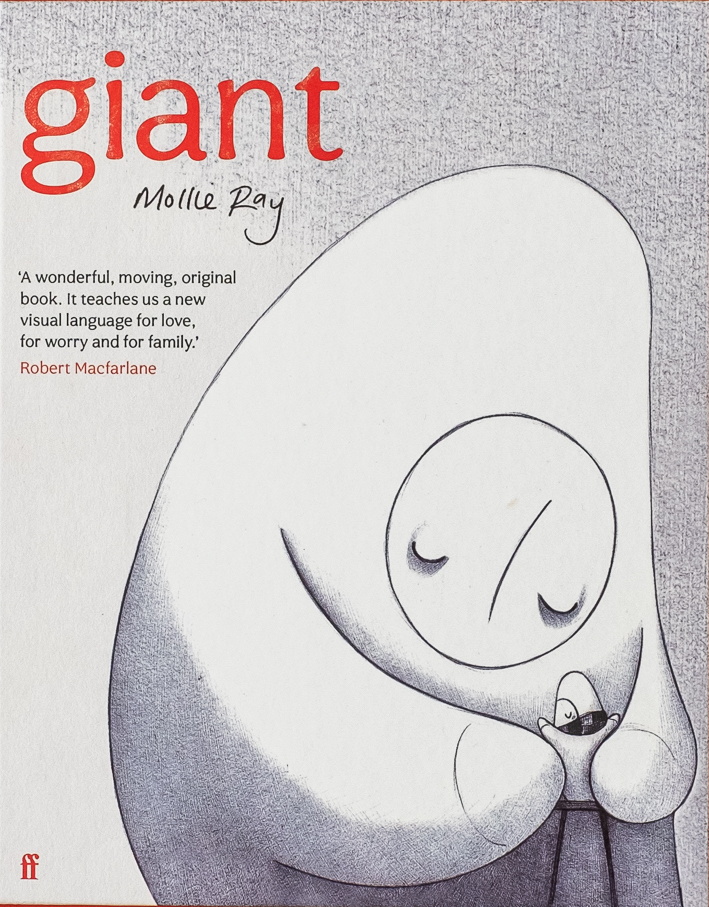
The landscape of the contemporary graphic novel is often defined by its ability to bridge the gap between the unspeakable and the visual. In her poignant and technically masterful debut, giant (Faber & Faber, 2025), British illustrator Mollie Ray achieves a rare feat: she communicates the crushing gravity of a terminal or chronic health crisis without a single word of dialogue. By utilizing the metaphorical transformation of a child into a literal giant, Ray captures the "too-bigness" of a cancer diagnosis—the way it occupies every room, consumes every conversation, and alters the physical and emotional architecture of a family.
Main Facts: The Silent Scale of ‘Giant’
Giant is a wordless graphic novel that follows a close-knit family through the upheaval of a sudden medical emergency. Published by the prestigious Faber & Faber, the book has garnered immediate attention for its unique medium and its unflinching look at the "Graphic Medicine" genre—a field where comics are used to explore themes of healthcare and illness.
The most striking technical aspect of the work is its medium: the entire 200-plus page book was drawn using "biro," the British term for a standard ballpoint pen. This choice of tool is significant; the ballpoint pen is a medium of permanence and pressure, offering little room for error and requiring immense patience for the heavy shading and cross-hatching that give the book its depth.
The central conceit involves a young boy who, overnight, grows to a gargantuan size. While the narrative remains metaphorical for the majority of the page count, the back matter reveals the literal inspiration: a cancer diagnosis. Through this lens, the "giant" becomes a stand-in for the tumor, the treatment, and the sheer, overwhelming presence of a life-threatening illness that the family cannot look away from.
Chronology: From Domestic Harmony to Medical Uncertainty
The narrative structure of giant is a masterclass in pacing, moving from the rhythmic comfort of domestic life to the fractured, slow-motion reality of a hospital waiting room.
The Before: Fragility and Foreshadowing
The book opens with a sense of warmth and density. Ray populates the first few pages with a wall of family photographs, immediately establishing a history of love and connection. We see a large family dinner, celebrating the return of an artist sibling—presumably a surrogate for Ray herself—who has just graduated.
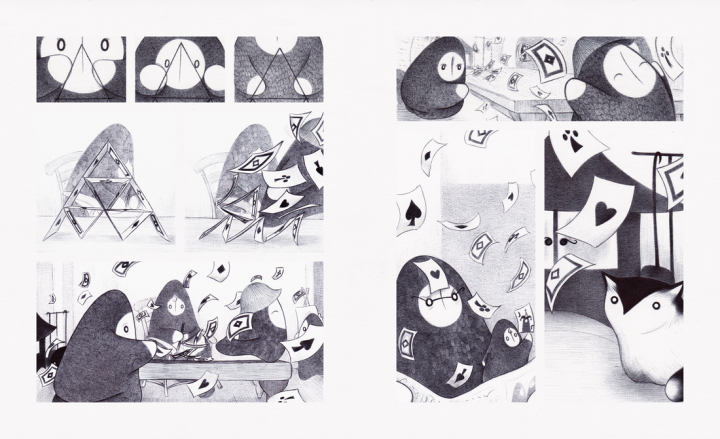
The activities that follow are mundane yet sacred: knitting, reading, and the construction of a house of cards. This house of cards serves as the primary motif of the book’s first act. It represents the delicate balance of a healthy life—a structure that takes immense effort to build but can be toppled by a single breath. When the cards inevitably fall, they swirl across the panels in a chaotic dance, a visual foreshadowing of the disruption that occurs while the family sleeps.
The Change: The Overnight Shift
The transition is jarring. When the family wakes, one of the children has grown so large that he can barely fit within the confines of his bedroom. The physical "bigness" of the child serves as an immediate, visceral representation of a diagnosis. It is a change that cannot be hidden, ignored, or easily accommodated.
Ray’s choreography of the family’s reaction is silent but deafening. We see the confusion, the frantic attempts to adjust the physical space of the home, and the eventual transition into the medical system. The "giant" is no longer just a boy; he is a patient, a problem to be solved, and a source of profound, communal grief.
The Middle: The Interminable Wait
The second act of the book captures the "liminal space" of healthcare. Ray uses recurring imagery to simulate the passage of time:
- The Envelope: A clinical white envelope travels through multiple pages, symbolizing the agonizing wait for biopsy results or test data.
- The IV Drip: Intercut shots of a slowly emptying IV bag serve as a metronome for the story, marking the slow, medicinal drip of hospital life.
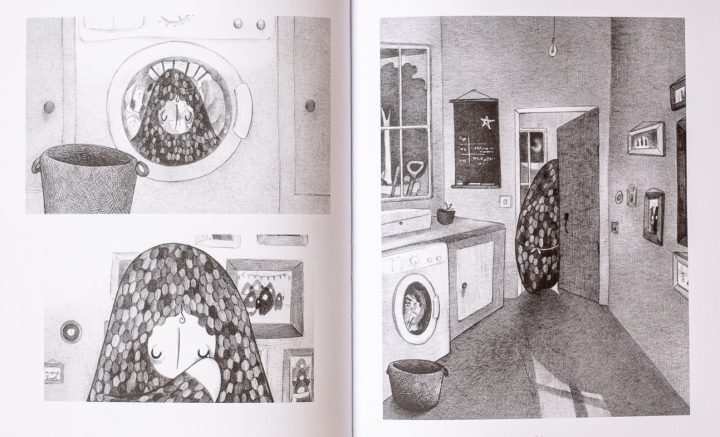
- The Washing Machine: In one of the book’s most celebrated panels, the mother’s grieving face is reflected in the circular window of a washing machine—a symbol of the domestic chores that must continue even when the world is ending.
Supporting Data: Technical Mastery and Visual Metaphor
To understand the impact of giant, one must analyze Ray’s specific artistic choices. The decision to use ballpoint pen (biro) is not merely a stylistic flourish; it is a thematic anchor.
The Biro Technique
The ballpoint pen is an unforgiving medium. Unlike pencil, it cannot be erased. Unlike digital art, it cannot be "undone." This mirrors the reality of a medical diagnosis—once the news is delivered, it cannot be unlearned. Ray’s use of heavy shading creates a world that feels "lived-in" and tactile. The rounded, pear-shaped figures, reminiscent of Russian matryoshka dolls, give the characters a soft, vulnerable quality that contrasts with the sharp, clinical reality of the hospital equipment.
Composition and Space
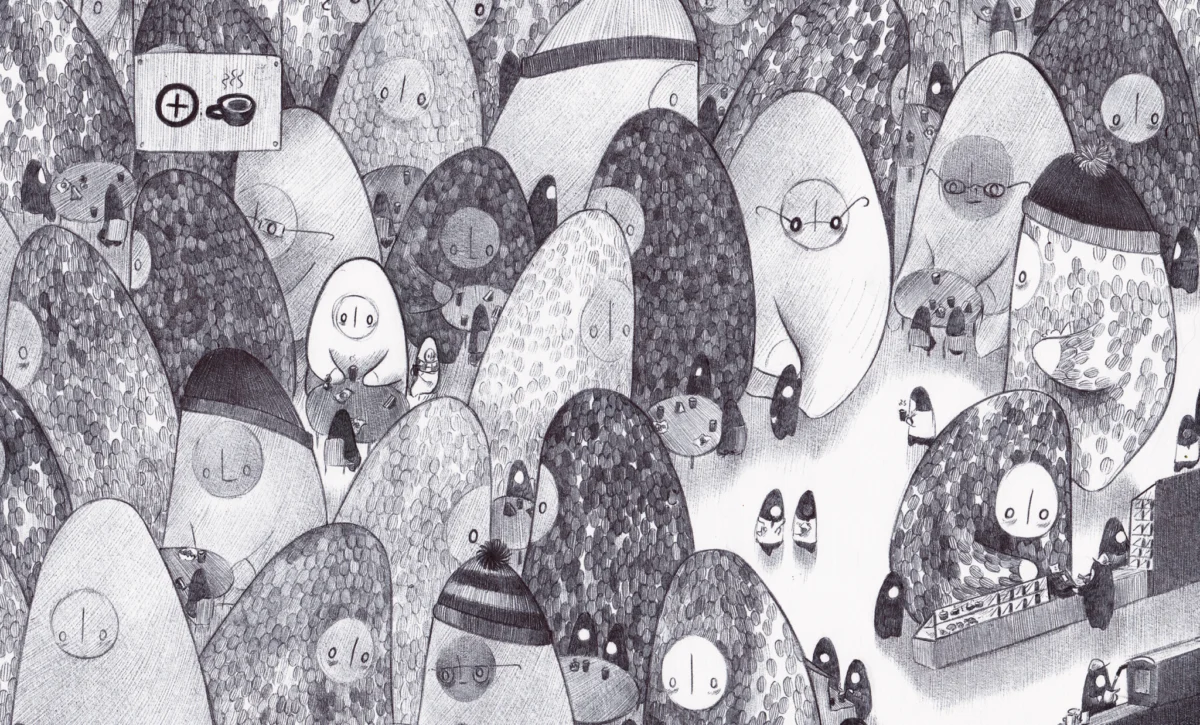
Ray utilizes the "gutter" (the space between panels) to manage the reader’s emotional intake. In scenes of high anxiety, the panels become crowded and claustrophobic. In scenes of reflection, she allows for wide, double-page spreads. Pages 156-157, featuring a crowded hospital cafeteria, stand out as a pivotal moment of "shared suffering." By populating the scene with dozens of distinct figures—each showing signs of their own personal "giants"—Ray moves the story from a private tragedy to a universal human experience.
Animal Sentience
The book also tracks the family’s pets, specifically the family cat and a bowl of fish. The cat acts as a silent witness and a source of comfort, often appearing in the periphery of the most painful scenes. These non-human elements ground the story in a natural world that continues to turn despite the human crisis occurring within the house.
Official Responses and Critical Context
Upon its release, giant has been hailed by critics and health professionals alike for its contribution to "Graphic Medicine." While traditional literature relies on the precision of words to describe pain, Ray argues—through her art—that some pains are too large for words to contain.
Faber & Faber, a publisher known for its literary pedigree, has positioned the book as a "crossover" work that appeals to both traditional graphic novel readers and those interested in the intersection of art and empathy. Early reviews have compared Ray’s wordless storytelling to the likes of Shaun Tan (The Arrival) and Raymond Briggs (The Snowman), noting that her ability to evoke sound and emotion through silent panels is a rare gift.
The medical community has also noted the book’s utility as a tool for "narrative medicine," helping caregivers and family members visualize the often-invisible weight of supporting a loved one through a long-term illness.
Implications: The Universal Language of the "Giant"
The implications of Mollie Ray’s work extend far beyond the pages of a single graphic novel. Giant serves as a profound meditation on several key themes:
1. The Inadequacy of Language
By choosing silence, Ray highlights how medical jargon often fails to capture the emotional reality of illness. Terms like "stage four," "malignant," or "prognosis" are clinical; the image of a child becoming too large for his own bed is emotional. The book suggests that when we are faced with the "giant" of grief, our most profound communications happen through touch, presence, and shared silence.
2. The Resilience of the Family Unit
The recurring motif of the "house of cards" is perhaps the book’s most hopeful element. While the cards are frequently knocked over, they are also perpetually picked up. Ray does not shy away from the frustration and irritation that come with caregiver burnout, but she ultimately emphasizes solidarity. The scene where the artist sibling shaves their head in solidarity with the "giant" is a powerful testament to the ways families attempt to distribute the weight of a burden that cannot be removed.
3. The Democratization of Art
By using a common biro pen, Ray sends a subtle message about the accessibility of expression. One does not need expensive tools to tell a story of immense depth; one only needs the patience to observe and the courage to render the truth.
Conclusion
Mollie Ray’s giant is a landmark achievement in visual storytelling. It is a book that demands to be read slowly, allowing the eye to linger on the intricate cross-hatching and the subtle shifts in facial expressions. In an era of digital noise, Ray has created a silent masterpiece that speaks volumes about the fragility of life and the enduring strength of the human spirit. It is not just a book about cancer; it is a book about the "giants" we all must eventually face, and the beauty of the people who help us carry them.