The Biology and Burden of the Ocampa: Analyzing Star Trek’s Most Ephemeral Species

In the vast, multi-generational tapestry of the Star Trek universe, species are often defined by their longevity. The Vulcans live for centuries, the Klingons boast lifespans that endure through decades of combat, and the god-like Q exist entirely outside the constraints of time. However, in the pilot episode of Star Trek: Voyager, audiences were introduced to a species that challenged the very concept of a "lifetime."
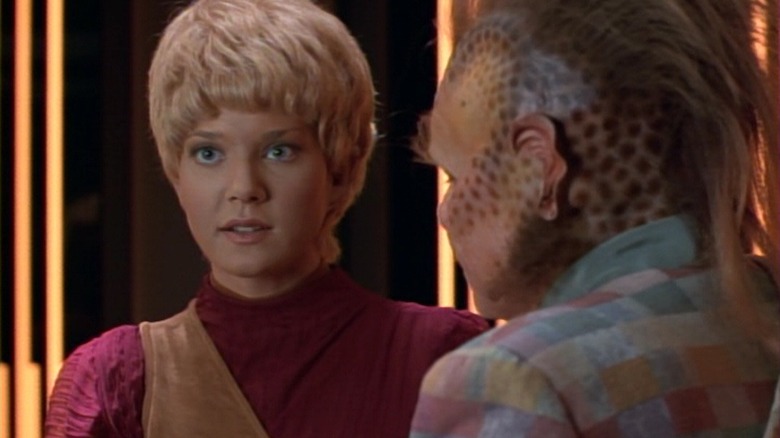
The Ocampa, a humanoid race native to the Delta Quadrant, possess a natural lifespan of a mere nine years. This biological ticking clock serves as more than just a plot point; it is a profound philosophical inquiry into what it means to live, learn, and love when one’s entire existence is compressed into less than a decade. Through the character of Kes, played by Jennifer Lien, Star Trek attempted to explore the Ocampan condition, though the execution of this arc remains one of the most debated elements of the franchise’s history.
Main Facts: The Tragedy of Ocampa V
The Ocampa were not always a subterranean, short-lived species living under the protection of a cosmic benefactor. Their history is defined by a catastrophic encounter with an extra-galactic race known as the Nacene.
The Atmospheric Disaster
Approximately 500 Ocampan generations ago, the Nacene—explorers from another galaxy—accidentally destroyed the atmosphere of Ocampa V. Their technology inadvertently depleted the planet’s nucleogenic particles, which were essential for the formation of rain. Within a short period, the lush world was transformed into a global desert, incapable of supporting life on its surface.
The Gilded Cage
To atone for this ecological genocide, two Nacene remained behind. One, known as the "Caretaker," established a massive underground city for the Ocampa. He provided everything the species needed to survive: energy via a sophisticated spatial array, food, water drawn from deep subterranean wells, and a life of leisure. For over two millennia, the Ocampa lived in a state of arrested development, their every need met by a "god" who treated them more like cherished pets than a developing civilization. This dependence resulted in the atrophy of their natural psychic abilities and a cultural stagnation that persisted until the arrival of the USS Voyager in 2371.
Chronology: From Dependency to Evolution
The narrative arc of the Ocampa, specifically through the lens of the character Kes, follows a trajectory from sheltered innocence to terrifying cosmic power.

2371: The Breaking of the Seal
When the USS Voyager was pulled into the Delta Quadrant by the Caretaker, the Ocampa were facing an existential crisis. The Caretaker was dying and had no successor. Kes, an Ocampan with an uncharacteristic streak of curiosity and rebellion, had escaped the underground city only to be captured by the Kazon-Ogla. Her rescue by Captain Kathryn Janeway and the subsequent death of the Caretaker forced the Ocampa to face a future without their provider. While most Ocampa remained underground with enough supplies to last a few years, Kes chose to join the Voyager crew.
2372: The Discovery of Potential
In the episode "Cold Fire," Voyager encountered a second Ocampan colony living on a station helmed by Suspiria, the female Nacene who had left Ocampa V centuries earlier. These Ocampa, led by a man named Tanis, had learned to harness their latent telepathic and telekinetic powers. They had also found ways to extend their lifespans beyond the nine-year limit. This encounter revealed that the Ocampa’s short lives were, in part, a result of the Caretaker’s "protection," which had allowed their biological and mental potential to wither.
2374: The Great Transition
By the fourth season, Kes’s mental powers began to destabilize her physical form. In the episode "The Gift," she underwent a radical cellular evolution. As her brain reached a state of hyper-activity, she began to phase out of linear reality. To save Voyager from the kinetic energy she was emitting, she used her powers to hurl the ship 9,500 light-years closer to Earth before transcending into a non-corporeal state of being.
Supporting Data: The Biological Imperative
The Ocampan biology is a study in accelerated maturation. Because their time is limited, every biological milestone is compressed into a timeframe that seems impossibly brief to humans.
The Nine-Year Cycle
To a human, nine years is childhood. To an Ocampa, it is a complete journey from birth to senescence. This necessitates a rapid learning curve. Ocampa possess eidetic memories and the ability to process information at a rate significantly higher than most Alpha Quadrant humanoids. This allowed Kes to become a proficient medical assistant under the Doctor’s tutelage in less than a year.
The Elogium
The Ocampan reproductive cycle, known as the Elogium, typically occurs between the ages of four and five. It is a one-time event; if an Ocampa does not conceive during this period, they lose the ability to reproduce forever. This biological reality creates immense social pressure. In the episode "Elogium," Kes enters this state prematurely due to the influence of space-dwelling lifeforms, forcing her and her partner, Neelix, to make a lifetime decision about parenthood within a matter of hours.

Cognitive Evolution
The Ocampan brain is their most powerful organ. While the Caretaker’s era saw these brains used for little more than basic social interaction, their true potential involves the manipulation of matter and energy. Through the "Exosia" (a spiritual realm of subspace), Ocampa can theoretically achieve a form of immortality, suggesting that their nine-year lifespan is not a biological hard-cap, but rather a starting point for a more advanced stage of existence.
Official Responses and Meta-Commentary
The creation and eventual departure of the Ocampa from Star Trek: Voyager was influenced heavily by behind-the-scenes production decisions and the evolving vision of the showrunners.
The Jennifer Lien Departure
By the end of Season 3, Voyager was struggling in the ratings. The producers felt the need to inject new energy into the cast, leading to the introduction of Jeri Ryan as Seven of Nine. Budgetary constraints meant that one regular cast member had to be let go. Despite the Ocampa’s unique premise, the writers felt they had "run out of stories" for Kes.
Executive Producer Rick Berman and showrunner Brannon Braga have noted in various interviews that the character of Kes was difficult to write for because her "gentleness" often left her sidelined in high-stakes action episodes. The decision to write her off was controversial among the cast; Kate Mulgrew (Captain Janeway) famously expressed her displeasure, feeling that the loss of the "student/mentor" relationship between Janeway and Kes robbed the show of its heart.
The Neelix Controversy
One of the most persistent criticisms from the Star Trek fan base involves the romantic relationship between Kes and Neelix. At the start of the series, Kes was two years old. While she was biologically and mentally an adult by Ocampan standards, the chronological age gap created an uncomfortable dynamic for many viewers. Modern retrospectives often cite this as a failure of the writers to fully reconcile the "nine-year lifespan" concept with the realities of human social taboos.
Implications: The Philosophical Weight of Short Lives
The Ocampa serve as a poignant metaphor for the human condition. While our lives are significantly longer than nine years, the Ocampan perspective forces us to confront the "shortness" of any life when measured against the age of the universe.
The Cost of Security
The Ocampa’s history is a cautionary tale regarding the dangers of a "nanny state." By providing for every need, the Caretaker effectively lobotomized a race of powerful psychics, turning them into a species that had forgotten how to dig for their own water or think for themselves. Their nine-year lifespan was a tragedy not because of its length, but because of the lack of agency within it.
The Burden of Knowledge
For Kes, the Ocampan lifespan meant that she had to live "faster" than everyone else. She saw her friends on Voyager as people who moved in slow motion, geographically and emotionally. Her eventual evolution into a non-corporeal being suggests that the Ocampa were never meant to be mere "mortals," but were instead a species intended to "burn bright and fast" before ascending to a higher plane.
Conclusion
The Ocampa remain one of the most intellectually fascinating species in the Star Trek canon. Though their time on screen was cut short—much like their natural lives—they left an indelible mark on the lore of the Delta Quadrant. They remind the audience that the value of a life is not measured by its duration, but by the intensity of the experiences gathered and the evolution of the soul within the time allotted. Whether living underground in a desert or transcending into subspace, the Ocampa represent the ultimate trek: the journey from the finite to the infinite.