The Architect of Memory: How Christian Quintin’s Visual Philosophy Bridges Surrealism and the Natural World
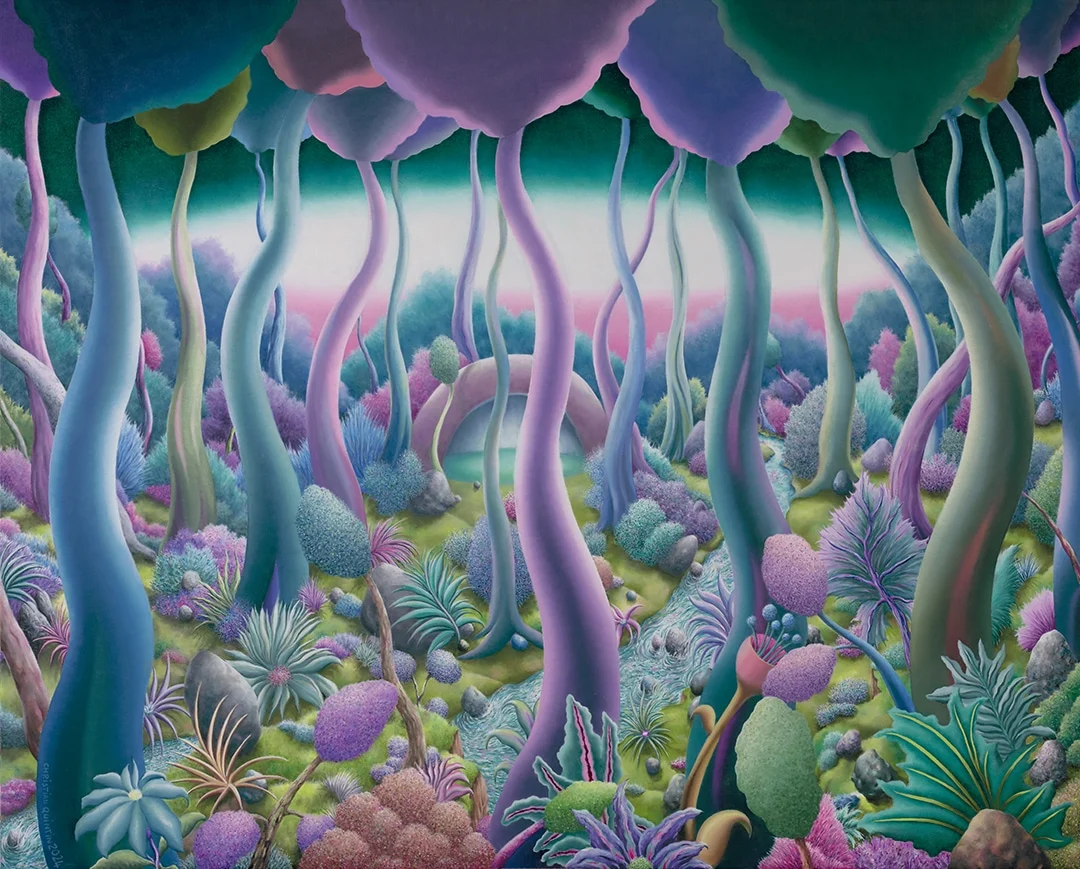
SONOMA COUNTY, CA — In an era of contemporary art often dominated by rapid-fire digital aesthetics, conceptual irony, and political didacticism, the work of Christian Quintin stands as a quiet, meticulous rebellion. A French-born artist who has spent over four decades rooted in the landscapes of Northern California, Quintin has carved out a singular space in the international art world. His work—a fusion of rigorous classical discipline and expansive surrealist imagination—does not merely depict scenes; it constructs what critics have termed "mental landscapes."
Quintin’s career, which has recently transitioned from a respected regional presence to an international phenomenon, offers a profound meditation on the intersection of human consciousness and the natural environment. By blending the moody, mythic atmospheres of his native Brittany with the vibrant, sacred ecology of the American West, Quintin has developed a symbolic language that speaks to the "deja vu" of the soul.
Main Facts: The Unified Vision of Christian Quintin
At the core of Christian Quintin’s practice is a rejection of the binary between the "inner" world of the psyche and the "outer" world of nature. For Quintin, these are not separate entities but a single, breathing continuum. His work is characterized by several defining pillars:

- Technique as Devotion: Quintin utilizes a diverse range of media, including pen and ink, oil, graphite, and pastel. His process is famously labor-intensive; major works often require six to seven months of daily, disciplined application to complete.
- The "Kaleidoscopic Consciousness": Many of his surrealist pieces feature "portraits" that are actually ecosystems. In works like The Aviary, human features dissolve into tree canopies and crystalline structures, suggesting that the self is an environmental construct.
- Beauty as a Philosophical Stance: Quintin explicitly avoids slogans or manifestos. Instead, he advocates for beauty and intuition as primary modes of engagement. He views the act of creating something beautiful not as an escape from reality, but as a "wondrous sanctuary" for the human spirit.
- International Resurgence: After decades of steady work in the United States, Quintin’s representation by the Lorin Gallery in the 2020s has propelled his work into major global markets, including Seoul, Hong Kong, Paris, and Los Angeles.
Chronology: From the Storm-Lashed Coast to the Golden State
To understand Quintin’s visual vocabulary, one must trace his journey across two continents and several distinct artistic eras.
1957–1974: The Brittany Foundation
Quintin was born in 1957 in Saint Brieuc, a port town on the northern coast of Brittany, France. This region, known for its dramatic cliffs, ruined castles, and ancient Celtic myths, provided his first aesthetic education. The L’île de la Comtesse, an island near his birthplace, became a recurring motif in his work—a symbol of solitude, mystery, and the "storybook aura" that would later define his romantic style.
1975–1980: The Parisian Discipline
In 1975, Quintin moved to Paris to study at the prestigious Beaux Arts Academy. It was here that he mastered the classical techniques of draftsmanship and form. While he was deeply influenced by the legacy of French Surrealism (Dali, Magritte) and the Symbolists, he avoided the movement’s tendency toward shock. Instead, he focused on "revelation"—using precise control of materials to uncover the hidden layers of the subconscious.

1981–1998: The California Integration
The pivotal moment in Quintin’s life occurred in 1981 when he relocated to Northern California. Settling in the vineyards and rugged valleys of Sonoma County, he found a landscape that mirrored the intensity of Brittany but offered a new, luminous palette. During this period, he began to fuse European surrealist sensibilities with the "sacred ecology" of the American West. He became a staple of the California art scene, winning the Grumbacher Award in 1987 and an Award of Excellence from the California State Fair in 1990.
1999–Present: Global Recognition
In 1999, Quintin began an association with the Vorpal Gallery, the institution famous for introducing M.C. Escher to the American public. This connection solidified his status as a master of "mind-bending" technique. By the 2020s, his career entered a new "fire" phase. Under the representation of Lorin Gallery, his work appeared at KIAF (Seoul) and Art Central (Hong Kong), signaling that the global art market had finally "caught up" to his slow-burning, meticulous vision.
Supporting Data: The Anatomy of a Masterpiece
The depth of Quintin’s work is perhaps best understood through the metrics of his labor and the specific symbolism of his major compositions. Unlike the "automatic drawing" of early surrealists, Quintin’s work is built with architectural intent.

The Six-Month Cycle
One of Quintin’s most celebrated works, The Aviary, serves as a case study in his technical endurance. The piece took six months to complete. In it, Quintin’s own face emerges from a crystal; his neck transforms into a sturdy tree trunk, and his hair expands into a vast, leafy canopy teeming with life. This is not merely a portrait; it is a visual argument for the "kaleidoscopic consciousness," where the boundaries of the individual are entirely porous.
The Rumi Influence
Another landmark work, La Porte Ouverte, was inspired by the 13th-century Persian poet Rumi. Specifically, the line: "Why stay in prison when the door is wide open?" Quintin spent seven months translating this poetic inquiry into a visual mystery. The resulting piece uses dense cross-hatching and symbolic figures to blur the line between logic and dream, inviting the viewer to "wander into the imagery" rather than decode it.
Medium as Metaphor
Quintin selects his medium with the precision of a composer choosing an instrument:

- Pen and Ink: Used for his most complex, "kaleidoscopic" surrealist maps, where every line represents a thread of memory.
- Oil and Pastel: Reserved for his "emotional terrains"—landscapes like Leaves of Absence or Les Amants, where trees sway like dancers and the sky takes on hues of orange, violet, and emerald to reflect internal moods.
Official Responses and Critical Analysis: Beauty as Resistance
The critical reception of Quintin’s work has remained remarkably consistent over forty years, focusing on his refusal to succumb to the cynicism of the modern age.
Alhia Warren, a prominent art commentator, described his work as a "beautiful intimate mystery," noting that Quintin manages to make the impossible feel legible. Similarly, Dan Taylor of the Press Democrat highlighted the "emerging beauty" of his work during his California years, noting that Quintin’s landscapes seem to "hum with life."
A particularly poignant review from the Calabi Gallery in 2022 touched on the sociological importance of his work: "In an era largely devoid of it, his work is beautiful. We could all use more beauty in our lives." This sentiment reflects a growing trend in the art world where viewers are seeking "sanctuary" art—works that provide emotional and spiritual replenishment rather than purely intellectual or political provocation.

Critics have also noted that Quintin’s work fills a gap left by the "Visionary Art" movement of the 1960s. While that movement often embraced chaos and psychedelic color, Quintin offers a "classical visionary" alternative—one that is quieter, more disciplined, and rooted in a "sacred geometry of thought."
Implications: Quintin’s Legacy in the Visionary Continuum
The rise of Christian Quintin in the 2020s carries significant implications for the direction of contemporary surrealism. His success suggests a shift in the "Visionary Continuum"—a lineage that includes masters like Escher, Magritte, and Dali.
The Rejection of Irony
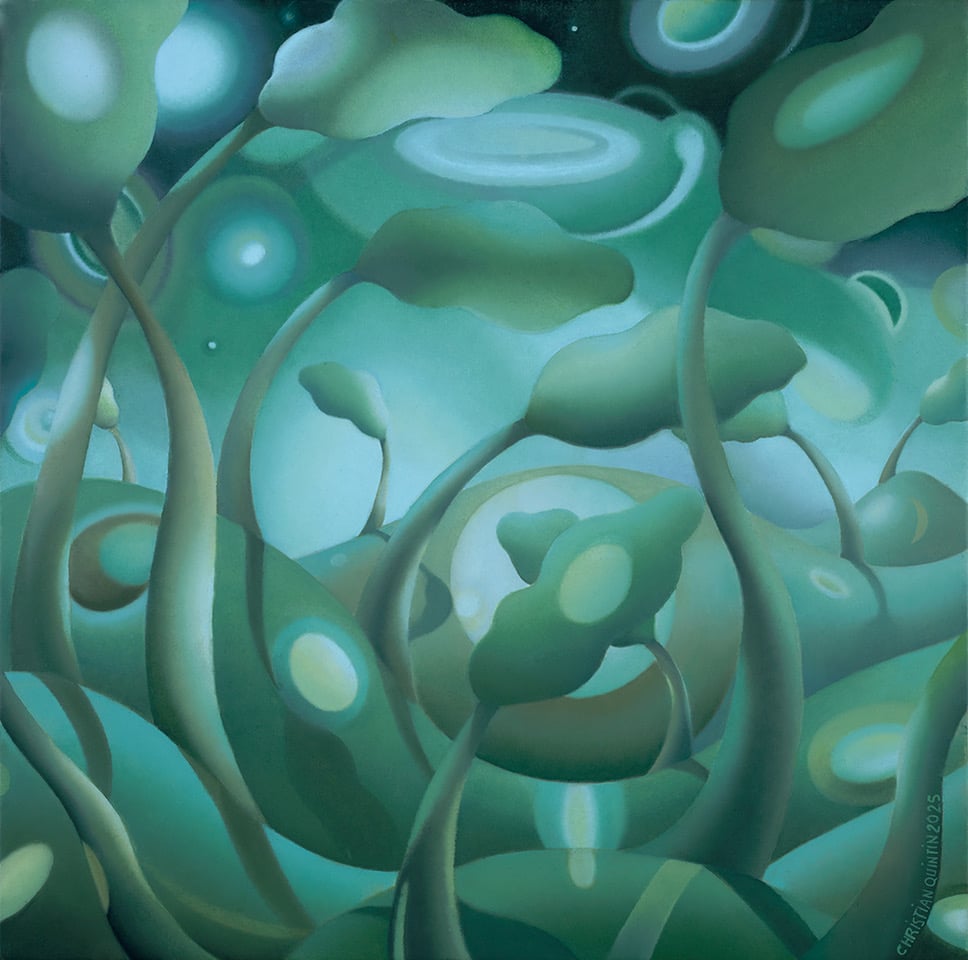
Quintin’s legacy is defined by his "rejection of irony." In a postmodern landscape where artists often distance themselves from their subjects through satire or critique, Quintin’s work is unabashedly sincere. By treating the "spirit of a tree" as equal to his own, he promotes an empathetic, rather than an exploitative, relationship with the natural world.
The Bridge Between Cultures
As an artist who bridges the gap between Europe and America, Quintin’s work serves as a synthesis of two distinct philosophies of nature. He combines the French "Symbolist" tradition—which views nature as a series of signs for the soul—with the American "Romantic" tradition, which views the wilderness as a sacred space for transformation.
Art as a Sanctuary for the Soul
Perhaps the most lasting implication of Quintin’s career is the reminder that art can serve as a form of resistance through slowness. In a culture of "speed and spectacle," Quintin’s six-month-long projects demand a corresponding slowness from the viewer. To see a Quintin painting is to enter a "wondrous sanctuary," a space where the noise of the world is replaced by the "pulse of surrealism" found in the bark of a tree or the curve of a cloud.
Conclusion: Looking Through the Imagery
Christian Quintin remains represented by the Lorin Gallery in Los Angeles and Paris, with a robust schedule of upcoming exhibitions, including a highly anticipated show at the Morrison Gallery in Connecticut. His work continues to invite viewers not to look at the canvas, but to look through it.
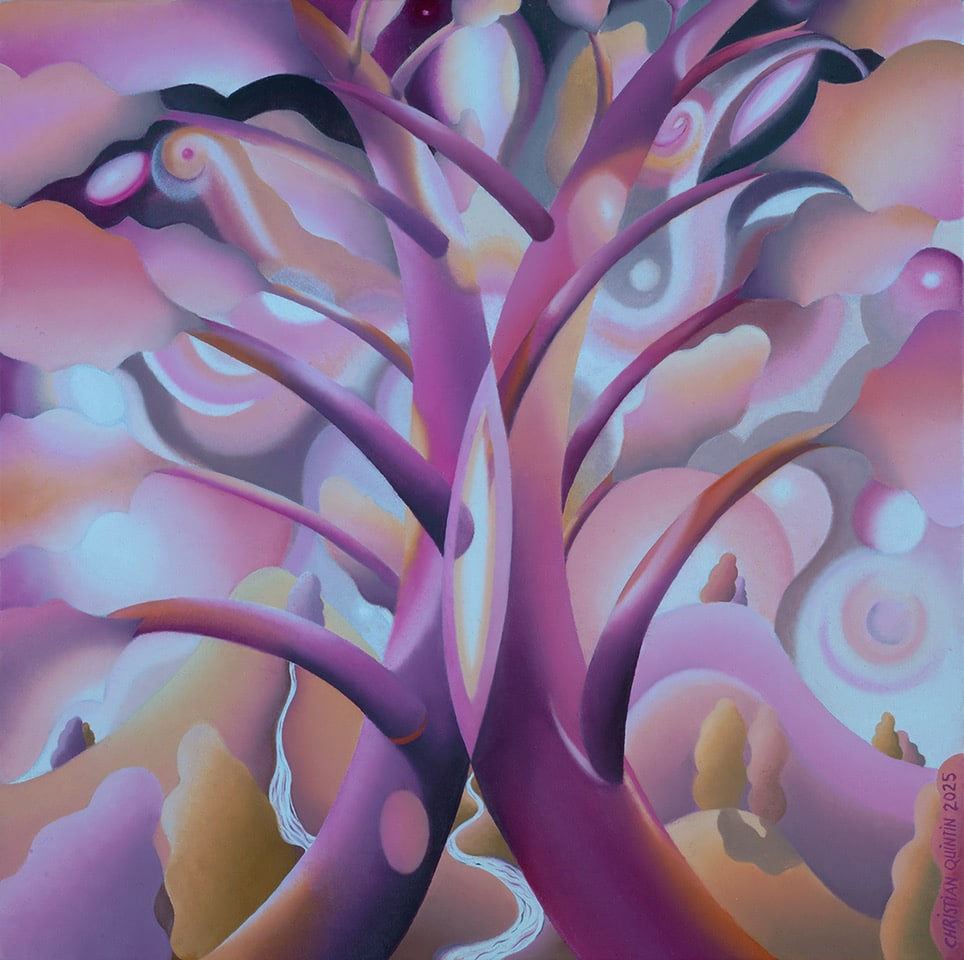
As Quintin himself suggests: "See the art as one would read poetry, hopeful that one would wander into its imagery." In doing so, he has created more than just a body of work; he has mapped the "hidden dimensions" of reality—the places we feel before we have the words to describe them. His art stands as a testament to the fact that when technique and intuition are perfectly tuned, the result is not just a painting, but a breathing philosophy of life.
For further exploration of Christian Quintin’s work, visit christianquintin.com.