From Code to Compassion: How Game Design Bridged the Gap in Pandemic Understanding
Six years after the initial shock of the COVID-19 pandemic, the global community remains locked in a complex debate over the efficacy of lockdowns, the long-term impacts of the virus, and the lessons learned for future public health crises. However, a significant chapter of this history lies not in the halls of government, but in the intersection of game design and epidemiological modeling.
Renowned game designer Raph Koster, known for his work on Ultima Online and Star Wars Galaxies, recently reflected on a pivotal moment in early 2020 when a simple "design sketch" posted to social media catalyzed the development of educational simulations that reached tens of thousands of people. These games, born from a frustration with the public’s inability to grasp exponential growth, offer a unique case study in how interactive media can translate complex statistical data into visceral, human experiences.
Main Facts: Translating the Mathematics of Mortality
The core challenge identified by Koster in early 2020 was a widespread "mathematical illiteracy" regarding viral spread. While epidemiologists were sounding alarms based on R-values (the basic reproduction number) and Infection Fatality Rates (IFR), the general public struggled to visualize how a low-percentage death rate could translate into millions of casualties.
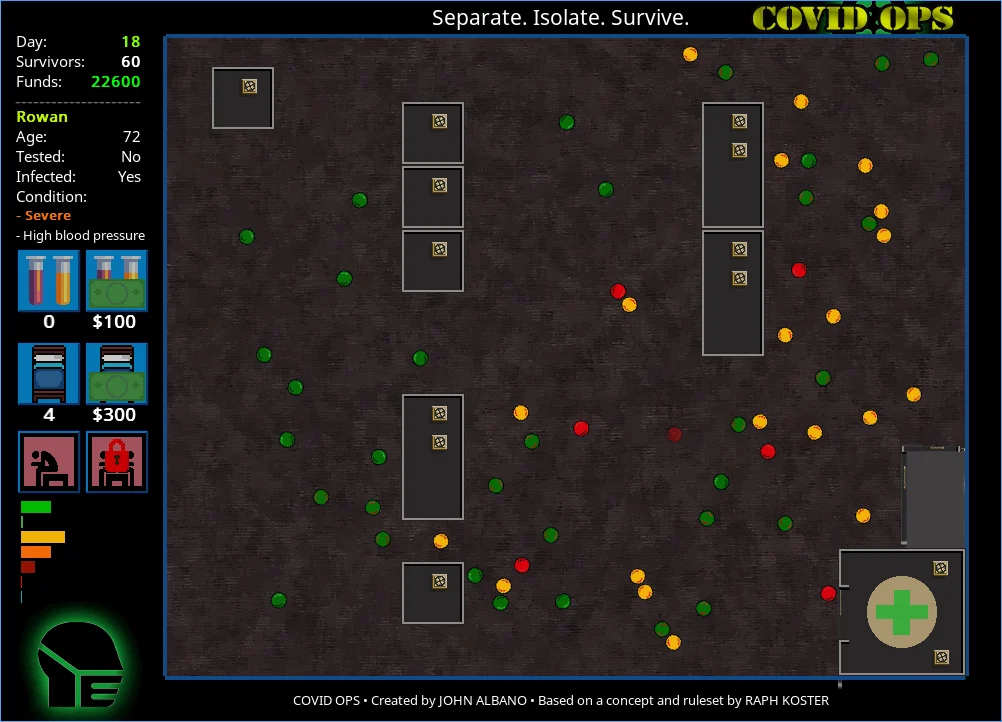
Koster’s intervention was a "design sketch" for a simulation game. The premise was deceptively simple: circles bouncing in a confined field. Yet, the underlying mechanics were rooted in rigorous statistical reality. The design proposed:
- Humanizing the Data: Each "circle" (individual) was assigned a name from a baby book, an age, and a statistically accurate chance of having comorbidities such as hypertension or diabetes.
- Modeling the Invisible: The game rendered asymptomatic individuals as "healthy" to the player, simulating the "stealth spread" that made COVID-19 so difficult to contain.
- The Cost of Inaction: Players were given limited buttons—Testing, Social Distancing, and Lockdown—each with economic costs, forcing them to balance fiscal health against human lives.
This framework was not intended as entertainment but as a pedagogical tool to help people "feel the challenges in their bones."
Chronology: From Facebook Post to Global Viral Success
The development of these simulations followed a rapid timeline, mirroring the acceleration of the pandemic itself:
- Late 2019 – January 2020: Koster, tracking early reports from China, begins posting warnings on social media. His early calculations, based on a 0.4% IFR and a 60% herd immunity threshold, predicted millions of deaths—a figure widely mocked at the time.
- March 24, 2020: Koster publishes his design sketch on Facebook. He argues that game designers, along with Wall Street quants and statisticians, are uniquely equipped to understand exponential curves.
- March 30, 2020: Only six days after the post, developer John Albano releases Covid Ops on Itch.io. The game stays faithful to the sketch, incorporating detailed comorbidity data and real-world resource links.
- April – June 2020: A larger team led by Khail Santia in Cebu City, Philippines, begins work on In the Time of Pandemia (ITOP) during the "Jamdemic 2020" game jam. The team eventually grows to 48 contributors, including medical professionals and mathematical biologists.
- July 2020: In the Time of Pandemia launches on Newgrounds. It quickly tops the charts and goes viral across the Pacific Rim, receiving extensive press coverage in the Philippines, Malaysia, and Singapore.
- 2021 – Present: These games become part of educational curricula in various universities, used to teach students about the challenges of health sector management and the importance of "flattening the curve."
Supporting Data: The Hidden Risk of Comorbidities
A significant portion of Koster’s original design and the resulting games focused on the prevalence of underlying conditions. At the time, public discourse often dismissed the risk by suggesting only a "small, vulnerable population" was at risk. The data integrated into these games told a different story.
The Scale of Vulnerability
Koster’s research, citing the American Heart Association (AHA) and the American Diabetes Association (ADA), highlighted that the "at-risk" population was actually a massive slice of the American public:
- Hypertension: Approximately 46% of U.S. adults have high blood pressure. Among those aged 45–54, this includes 44.1% of men and 42.2% of women. For those over 75, the rate climbs to nearly 80%.
- Diabetes: Over 34 million Americans (roughly 10.5% of the population) have diabetes, with another 88 million having prediabetes.
- Obesity: Studies in the Journal of the American Medical Association (JAMA) indicated that a high Body Mass Index (BMI) significantly increased the risk of severe COVID-19 outcomes, even in younger age groups.
Realized Mortality
Koster’s early "low-end" math predicted millions of deaths. Years later, the data largely vindicated these warnings. The estimated toll in the United States reached between 1.2 and 1.4 million lives. Worldwide, the estimated death toll ranges from 15 million to as high as 28.5 million when accounting for excess mortality.
The games aimed to show that because the disease spreads primarily within households, protecting these "at-risk" groups required total community cooperation—an insight many found difficult to accept without the visual aid of a simulation.
Official and Expert Responses: Validating the Simulation
The impact of In the Time of Pandemia (ITOP) was particularly notable because of its validation by the academic and medical communities. Unlike many commercial games, ITOP was treated as a "serious game"—a genre designed for a primary purpose other than pure entertainment.
Gregg Victor Gabison, Dean of the University of San Jose-Recoletos College of Information, Computer & Communications Technology, oversaw student play-testing of the game. He remarked, "This is the kind of game that mindful individuals would want to check out. It has substance and a storyline that connects with reality, especially during this time of pandemic."
Medical professionals also weighed in on the game’s accuracy. Dr. Mariane Faye Acma, a resident physician who consulted on the project, noted that the game effectively simulated the high-stakes decision-making required in the health sector. "You decide who are the high risks, who needs to be tested and isolated, where to focus, and how much funds to allocate," she stated. "The game will make players realize how challenging the work of the health sector is in this crisis."
This expert involvement ensured that the games were not merely "doom-scrolling" interactives but were grounded in "medical plausibility," making them valuable tools for public health advocacy.
Implications: The Future of "Serious Games" in Crisis Management
The success of these 2020 simulation games carries significant implications for how society communicates complex risks in the future. As Koster points out, the world is currently monitoring the first human cases of H5N1 (avian influenza), suggesting that the "next pandemic" is a matter of when, not if.
1. Games as Empathy Engines
The decision to give the "circles" names and ages was a critical design choice. In statistical reporting, a 1% mortality rate can feel abstract. In a game where "Rowan, age 72" dies because the player failed to trigger a lockdown in time, the loss becomes personal. This "visceral understanding" is something that traditional news reporting often fails to achieve.
2. Bridging the "Cognitive Gap"
Human brains are not evolutionarily wired to understand exponential growth. We think linearly. Game simulations provide a feedback loop that allows players to see the consequences of a single "bounce" (infection) multiplying into a field of red (illness) within seconds. This bridges the gap between scientific modeling and public perception.
3. The Role of Independent Developers
The fact that these games were developed in days or weeks by independent teams—often working for free—highlights a new frontier for public health communication. While government agencies often struggle with bureaucratic messaging, the "indie" game community can move with the speed of the internet to provide clarity during a crisis.
4. Psychological Respite
Interestingly, the developers themselves found the process of making these games to be a form of "respite from isolation." For Khail Santia and his team of 48, the project was a way to "transcend the chaos outside." This suggests that "making" can be as vital a tool for resilience as "playing."
Conclusion: A Legacy of Mindful Design
While some critics on platforms like Reddit have dismissed Koster’s inclusion of these games on his CV as "pathetic," the designer remains steadfast in his pride for the project. The games reached tens of thousands, were used in classrooms, and provided a framework for understanding at a time when the world felt incomprehensible.
As the discourse shifts toward the economic and educational "hits" taken during the pandemic, Koster’s retrospective serves as a reminder that the health response was often "too soft" and "too lenient" because the public did not fully grasp the stakes. By turning spreadsheets into interactive worlds, these designers did more than just create a game; they provided a mirror for a society in crisis, hoping that next time, we might see the curves coming before they become casualties.