Babylon 5’s Fifth Season: The Fraught Dawn of the Third Age and a Faltering Finale
Original Air Dates: January – November 1998
Executive Producers: Douglas Netter, J. Michael Straczynski
The fifth and final season of J. Michael Straczynski’s ambitious space opera, Babylon 5, marked a pivotal, if often controversial, conclusion to a narrative arc spanning five years. Airing from January to November 1998, this season aimed to resolve lingering plot threads and chart the future of the galaxy in the wake of the Shadow War and the Earth Civil War. While lauded for its overarching vision and groundbreaking serialized storytelling, the fifth season, produced under unexpected circumstances, faced critical scrutiny for its pacing, character development, and perceived narrative struggles.
This final chapter ushered in the "dawn of the third age," a period of immense change and precarious peace for the newly formed Interstellar Alliance. With EarthForce Captain Elizabeth Lochley taking command of Babylon 5 and President John Sheridan at the helm of the nascent IA, the stage was set for new conflicts, personal struggles, and ultimately, the poignant farewells of beloved characters. However, the season’s journey was fraught, marked by a contentious telepath rebellion, the tragic fall of Centauri Prime, and the challenging personal arcs of its main cast, leading to a complex legacy that continues to be debated by fans and critics alike.
Chronology: Navigating a New Galactic Order
The fifth season of Babylon 5 opens in a galaxy grappling with the aftermath of two devastating wars. The promise of a new era of cooperation under the Interstellar Alliance (IA) is immediately tested by internal dissent, ancient grievances, and a new, insidious threat.
The Interstellar Alliance Takes Root
Following his triumph in the Earth Civil War, John Sheridan is officially sworn in as the first President of the Interstellar Alliance. For its inaugural year, Babylon 5, the station that has been at the nexus of galactic events, serves as the temporary seat of the presidential office, awaiting the completion of the official headquarters in Tuzenor on Minbar. This period sees a significant shift in the station’s command structure, with the introduction of Captain Elizabeth Lochley of EarthForce. Lochley’s appointment is immediately contentious; a veteran who served on President Clark’s side during the civil war, and briefly married to Sheridan years prior, her presence adds a layer of political tension and personal history to the station’s new leadership. Despite initial mistrust, Lochley quickly establishes herself as a capable and by-the-book commander, often serving as a grounding force amidst the unfolding chaos.

The Telepath Rebellion and Byron’s Folly
One of the season’s central conflicts revolves around the plight of human telepaths and their oppressive overlords, Psi Corps. Sheridan, guided by principles of freedom, grants asylum on Babylon 5 to a group of unregistered telepaths, led by the enigmatic and charismatic Byron. This decision immediately puts the nascent IA at odds with Earth’s powerful Psi Corps, particularly its formidable agent, Alfred Bester.
Lyta Alexander, a powerful telepath herself, becomes deeply entangled with the rogue telepaths, forming a romantic relationship with Byron. Through Lyta, Byron learns a shocking truth: human telepaths were not a natural evolution but were engineered by the ancient Vorlons. This revelation fuels Byron’s demands for reparations from the Interstellar Alliance, seeking a homeworld for his people—a request that raises questions about why the IA should be held accountable for Vorlon actions.
The confrontation escalates when Bester arrives with Psi Cops to arrest Byron and his followers. The IA charter, which grants signatory worlds autonomy over internal affairs, means Psi Corps is technically within its rights. However, the telepaths resist, leading to a tragic standoff that ends with Byron’s death and the deaths of many of his followers. Byron’s sacrifice, however, is not in vain; his resistance ignites a widespread movement against Psi Corps, characterized by terrorist attacks on Psi Corps facilities and the defiant graffiti, "REMEMBER BYRON." Lyta Alexander, deeply affected by Byron’s death, continues to champion the telepath cause, providing them with resources and even striking a deal with Garibaldi to create a secret slush fund in exchange for removing Bester’s mental block on him. She eventually departs with G’Kar, seeking a telepath homeworld in exchange for telepath DNA.
Garibaldi’s Descent and Redemption
Michael Garibaldi, the former head of security, is appointed head of covert intelligence for the Interstellar Alliance. This new role, however, proves to be another chapter in his long history of personal struggles. His relationship with Lochley is marked by frequent clashes, indicative of their differing approaches to authority and protocol. The lingering effects of his previous capture and mental conditioning by Psi Corps, specifically Bester’s subtle manipulations, resurface. Upon discovering that Bester has engineered his mind to prevent him from ever harming the Psi Cop, Garibaldi experiences a profound relapse into alcoholism. His drunkenness severely impairs his judgment, exacerbating already dire situations, particularly during the escalating conflict with the Centauri.
His struggles do not go unnoticed. It is Captain Lochley, a recovering addict herself, who provides unexpected support and guidance, demonstrating a deeper understanding and empathy than many expected. Garibaldi eventually resigns his post, taking steps towards sobriety with the help of Lise, whom he marries. He finds a new, more fitting path, taking over Edgars Industries, a role where his "unethical and extralegal" tendencies ironically serve him well as a corporate CEO. His former position is filled by Tessa Halloran, also known as Number One of the Mars Resistance, a move that also bolsters Mars’s standing in its quest for independence from Earth.

The Drakh Conspiracy and the Fall of Centauri Prime
A new and shadowy threat emerges early in the season: IA cargo ships are attacked and destroyed by unknown aggressors, leaving no survivors or black-box data. Simultaneously, an attempt is made on Londo Mollari’s life. G’Kar, ever the loyal friend despite their species’ history, volunteers to be Mollari’s bodyguard during official business on Centauri Prime. There, another assassination attempt is thwarted by a mysterious alien, later revealed to be a Drakh.
The Drakh are eventually unmasked as the masterminds behind the cargo ship attacks, a calculated strategy to frame the Centauri Republic and ignite a war with the Interstellar Alliance. They are also responsible for the "Keeper" bonded to the Centauri Regent, controlling him from the shadows. This new war goes disastrously for the Centauri, not helped by Garibaldi’s compromised state. Against Sheridan’s wishes, a joint Drazi-Narn task force bombards Centauri Prime, leaving the once-proud homeworld in ruins and effectively outside the IA.
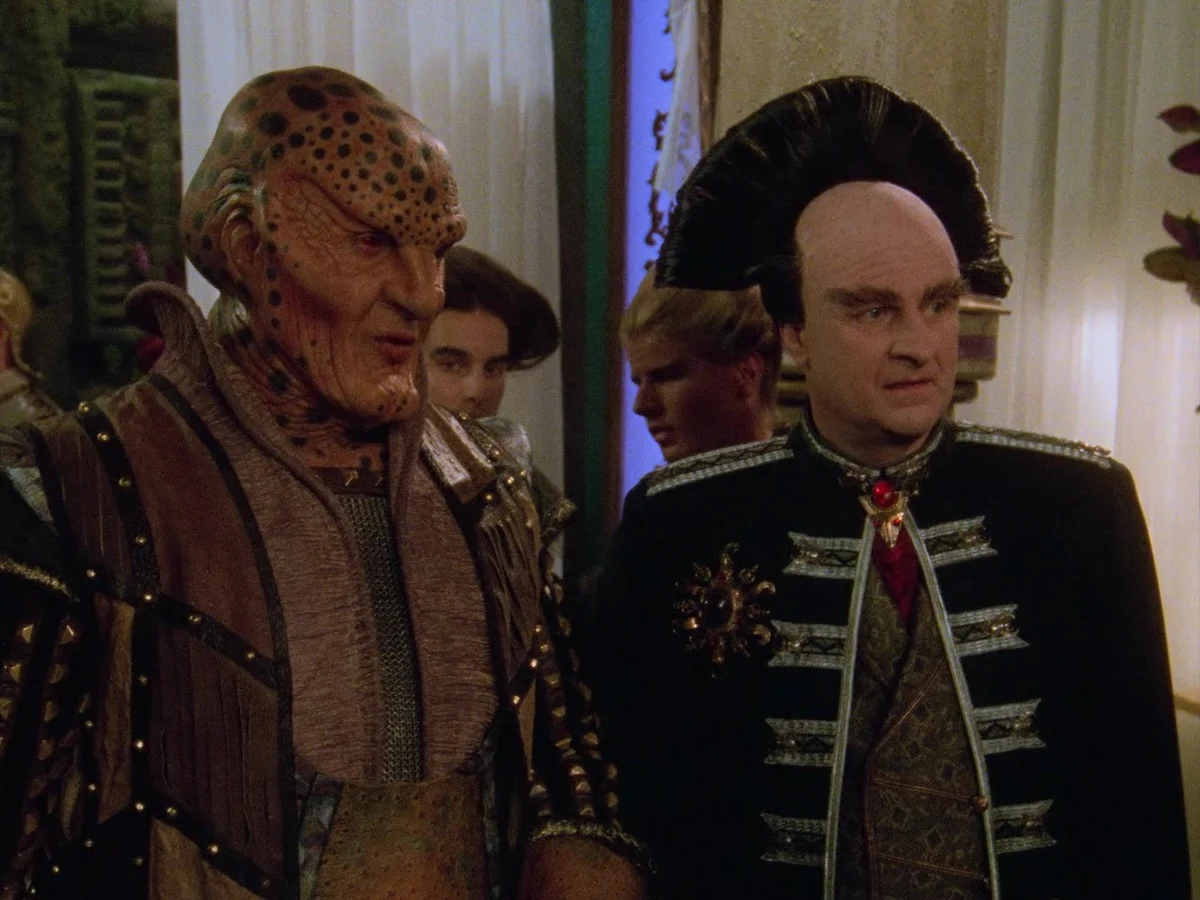
In the wake of the devastation and the Regent’s death at the hands of the Drakh, Mollari is forced to assume the emperorship. However, his ascension comes at a terrible price: he, too, is bonded with a Drakh Keeper, ensuring Centauri Prime’s subservience and preventing further destruction. Vir Cotto, Mollari’s loyal aide, takes over as Centauri ambassador to Babylon 5, carrying the heavy burden of his people’s shattered future. This storyline is widely considered the strongest and most compelling arc of the fifth season, lauded for its tragic depth and stellar performances.
Shifting Loyalties and Final Departures
The season also sees significant shifts in the lives of other key characters. G’Kar, whose philosophical writings, "The Book of G’Kar," have become a massive hit, finds himself an unwilling celebrity, plagued by "groupies." Rejecting both the fame and calls to lead the Narn government, he ultimately decides to leave Babylon 5, naming Ta’Lon as his successor and seeking a new path alongside Lyta Alexander.
Lennier, Delenn’s devoted aide, struggles with his unrequited love for her, which tragically consumes his personality. He joins the Rangers, hoping to find purpose and distance, but his inner turmoil leads to a shocking betrayal. During a critical mission to protect Sheridan and Delenn en route to Minbar, Lennier deliberately fails to act to save Sheridan’s life, an act born of jealousy and despair. Overwhelmed by shame, he flees, becoming a man-baby whose adolescent crush on Delenn has ruined his character arc.

The Final Goodbyes: "Sleeping in Light"
The season, and indeed the series, culminates with "Sleeping in Light," an episode originally filmed as the fourth-season finale when the show faced potential cancellation. Set two decades in the future, it depicts an older, more established Interstellar Alliance, with Delenn as its President and Sheridan as Ranger One. Sheridan’s life force, extended by Lorien, is finally waning. He gathers his closest surviving friends—Delenn, Ivanova, Franklin, Garibaldi, and Vir—for a final dinner, a bittersweet reunion before his impending departure.
Sheridan then makes one last visit to Babylon 5, the station that defined his life and shaped the galaxy’s future, before it is decommissioned and mysteriously destroyed. He fades away, joining Lorien beyond the veil of existence. The episode concludes with Ivanova being appointed Ranger One, and a sense of enduring peace, albeit tinged with the melancholy of endings.
Supporting Data: Echoes of Conversations and Behind-the-Scenes Insights
The fifth season, while facing its share of challenges, still delivered powerful moments and performances. The Centauri storyline, in particular, stood out, with Peter Jurasik (Mollari), Stephen Furst (Vir), and Andreas Katsulas (G’Kar) delivering consistently superb acting, supported by a strong ensemble including Ian Oglivy, Neil Hunt, Francis X. McCarthy, and the spectacular Damian London as the Regent.
Memorable Moments & Quotes:
- "Favorite Get the hell out of our galaxy!" From "The Very Long Night of Londo Mollari," Sheridan appears in Mollari’s dream in various iconic uniforms, symbolizing his journey and influence, before glowing and disappearing like the evolved human in "The Deconstruction of Falling Stars."
- "Favorite Ivanova is God." From "Sleeping in Light," Ivanova, describing her general’s life as an "old war horse," eagerly accepts the mantle of Ranger One, a fitting conclusion for her character.
- "Favorite Never work with your ex." From "Strange Relations," Lochley’s adherence to rules and rational behavior often positioned her as "the only grownup in the story."
- "Favorite The household god of frustration." From "Objects in Motion," Garibaldi’s unexpected aptitude for corporate leadership at Edgars Industries, where "being unethical and extralegal and cutting corners is far more beneficial," offered a humorous yet insightful turn for his character.
- "Favorite If you value your lives, be somewhere else." From "The Fall of Centauri Prime," Mollari’s desperate plea to the Drakh to save Delenn underscored his deep affection and respect for her.
- "Favorite In the glorious days of the Centauri Republic…" From "A Tragedy of Telepaths," Mollari’s parable of the forgotten garden guard illustrates the intractable nature of bureaucratic orders and his inability to simply free Na’Toth.
- "Favorite Though it take a thousand years, we will be free." From "In the Kingdom of the Blind," G’Kar’s refusal to take revenge on his former torturer, instead highlighting the Centauri noble Vole’s barbarity, was a powerful display of Narn dignity and moral superiority.
- "Favorite The Corps is mother, the Corps is father." From "Phoenix Rising," the revelation of Byron as a former Psi Cop and Bester’s profound, almost tragic, self-delusion regarding his intentions towards telepaths offered a deeper look into the complexities of Psi Corps.
- "Favorite The Shadowy Vorlons." From "Day of the Dead," Kosh’s final cryptic message, "When the long night comes, return to the end of the beginning," echoed the show’s cyclical themes.
- "Favorite Looking ahead." "The Fall of Centauri Prime" solidified the tragic future of Centauri Prime, foreshadowing the Drakh plague seen in A Call to Arms and Crusade.
- "Favorite No sex, please, we’re EarthForce." From "Secrets of the Soul," the intense telepathic sex between Byron and Lyta Alexander visually demonstrated the mind-melding nature of their bond and revealed the Vorlons’ manipulation of human telepath evolution.
- "Favorite The echoes of all of our conversations." Mollari’s rant to Allan in "The Very Long Night of Londo Mollari": "Do you know what this is? No, I can see you do not. You have that vacant look in your eyes that says, ‘Hold my head to your ear, you will hear the sea’."
Recurring and Guest Characters: The season saw the final appearances of many beloved recurring characters, including Jennifer Balgobin (Hobbs), Joshua Cox (Corwin), Maggie Egan (Jane the ISN anchor), Denise Gentile (Lise), Walter Koenig (Bester), Damian London (the Regent), Marie Marshall (Dodger), Marjorie Monahan (Halloran), Kim Strauss (Drazi ambassador), Marshall Teague (Ta’Lon), Fabia Udenio (Adira), and Ed Wasser (Morden). New, but equally impactful, characters included Robin Atkin Downes as Byron, Thomas MacGreevy as Cholini, Robin Sachs as Na’Tok, and Wayne Alexander, who not only portrayed the Drakh but also brought back Lorien at season’s end. A notable return was Julie Caitlin Brown as Na’Toth, filling a void left since Season 2. The comedic highlight was the appearance of real-life duo Penn & Teller as the fictional Rebo & Zooty, with Harlan Ellison voicing Zooty’s vocoder, in the episode "Day of the Dead."

Official Responses and Production Implications
The very existence of Babylon 5‘s fifth season was a testament to its dedicated fanbase and the complex world of television production. Originally, J. Michael Straczynski (JMS), the show’s creator, had been informed that the series would conclude after its fourth season. This led him to condense his meticulously planned five-year arc into four, famously resulting in the high-stakes, rapid-fire narrative of Season 4, which saw the Shadow War and Earth Civil War resolved with unprecedented speed. The episode "Sleeping in Light," intended as the series finale, was filmed during Season 4.
However, an unexpected last-minute pickup by TNT for a fifth season presented both an opportunity and a challenge. With the major galactic conflicts already concluded, JMS found himself needing to craft an entirely new narrative for the final 22 episodes. This abrupt change significantly impacted the season’s structure and reception.
JMS himself acknowledged the difficulties of this situation, often explaining that the core storyline was complete, and Season 5 had to explore the aftermath rather than build to a climactic event. This context is crucial for understanding the season’s perceived pacing issues; many critics and viewers felt there wasn’t enough compelling narrative to sustain 21 new episodes (excluding "Sleeping in Light"). This led to plotlines, such as the telepath rebellion, being stretched thin and feeling less impactful than earlier arcs.
The casting of certain new characters also drew criticism. Robin Atkin Downes as Byron was often cited for a "somnolent presence" that flattened the telepath storyline, while Tracy Scoggins as Captain Lochley faced an uphill battle replacing Claudia Christian’s beloved Ivanova. While Scoggins’ performance improved, the initial stiffness and the shadow of her predecessor proved difficult to overcome for many viewers. These factors, largely a consequence of the unexpected renewal and the need to quickly fill out a season with a largely concluded story, represent the "official response" of production challenges impacting the final product.
Implications: A Mixed Legacy for the Final Frontier
The fifth season of Babylon 5 holds a complex and often debated position in the show’s enduring legacy. While it successfully brought many character arcs to a definitive close and laid the groundwork for future spin-offs and movies, it also struggled to maintain the consistent narrative momentum and critical acclaim of its preceding seasons.

Impact on the Babylon 5 Universe: Despite its narrative struggles, Season 5 was vital in establishing the post-Shadow War galaxy. The Drakh conspiracy, particularly their bonding of Mollari with a Keeper and their desire to operate on Centauri Prime without IA interference, directly set up the plot for the subsequent television movies A Call to Arms and the spin-off series Crusade, which dealt with the Drakh plague unleashed on Earth. Thus, even its less-loved elements were integral to expanding the Babylon 5 mythos.
The "Bell Curve" of Quality: Many critics and fans often describe the Babylon 5 series as following a "bell curve" of quality, with the middle seasons (2-4) being the strongest, and the first and fifth seasons being comparatively weaker. The fifth season, in particular, is frequently cited as the lowest point. The stretched pacing, the perceived weakness of the telepath plotline, and certain controversial character developments contributed to this assessment. While the Centauri storyline remained a highlight, it wasn’t enough to elevate the entire season.
Controversial Character Arcs: The season left three main characters with particularly contentious developments:
- Sheridan’s Competence: His first year as IA president was portrayed as remarkably inept, marked by misjudgments (granting Byron asylum, mishandling cargo ship attacks, losing control during the Centauri war). While potentially foreshadowed as a deliberate portrayal of a leader learning on the job, it made for difficult viewing and retrospectively diminished the impact of his long, successful career as later depicted in "Sleeping in Light."
- Garibaldi’s Regression: His susceptibility to Bester’s influence and subsequent relapse into alcoholism, which actively worsened galactic conflicts, raised serious questions about his fitness for any position of authority. His character arc, though ending in personal redemption and a new career, left a lingering impression of vulnerability and compromise.
- Lennier’s Betrayal: Perhaps the most shocking and widely criticized development was Lennier’s transformation into a "toxic man-baby." His unrequited love for Delenn, previously a source of quiet nobility, warped into jealousy, leading to his deliberate inaction to save Sheridan’s life. This act, perceived by many as a character assassination, profoundly betrayed years of consistent character development and left a sour note for a once-beloved figure.
In conclusion, Babylon 5‘s fifth season, "The Wheel of Fire," ultimately served as a bittersweet, if somewhat uneven, coda to one of television’s most ambitious science fiction sagas. Forced into existence by unexpected circumstances, it struggled to match the narrative intensity of its predecessors. Yet, it delivered crucial resolutions, particularly for the tragic Centauri, and provided a final, poignant farewell to its iconic characters in "Sleeping in Light." While not without its significant flaws, Season 5 remains an essential, if imperfect, part of the complete Babylon 5 experience, ensuring that the saga of the station and its inhabitants reached its intended end.
(This article is part of a rewatch series. The next installment will cover the movie In the Beginning.)