Exodite Dragon Masters Ride into Warhammer 40,000: A Deep Dive into Aeldari’s New Cavalry
The ancient pathways of the Aeldari realm are set to tremor once more as the long-awaited Exodite Dragon Masters gallop onto the battlefields of Warhammer 40,000. Ahead of the anticipated release of the Kill Team: Exodite set this weekend, Games Workshop has unveiled the full rules and crucial points costs for these iconic units within the Warhammer 40,000 app, signaling a significant expansion for Aeldari armies in the 41st Millennium.
This digital release, providing immediate access to datasheets and strategic implications, allows players to integrate these dinosaur-riding warriors into their forces without delay. The Exodites, known for their unique blend of primal ferocity and sophisticated Aeldari psychic might, represent a cultural cornerstone of the Eldar race, choosing to live on Maiden Worlds, shunning the decadent paths that led to the Fall. Their arrival in Warhammer 40,000 marks the culmination of decades of anticipation from lore enthusiasts and tabletop generals alike, promising fresh tactical possibilities and a visually distinct aesthetic to the already diverse Aeldari collection.
Main Facts: The Exodites Emerge
The core announcement revolves around the immediate availability of datasheets for the new Exodite units within the official Warhammer 40,000 app. This includes the Dragon Knights, the Clanblade (a character leader), the Stonesinger (a support character), and the Leystalker (a lone operative). Each unit brings a unique set of skills and profiles, all centered around their iconic mounted status atop fierce reptilian steeds.
Crucially, these units are fully integrated into the existing Aeldari faction, benefiting from the foundational rules such as Battle Focus and possessing the Asuryani keyword. This ensures seamless compatibility with existing Stratagems, Enhancements, and Detachments, opening a myriad of strategic synergies that Aeldari players are eager to explore. The initial assessment suggests a balanced yet potent addition, designed to enrich the faction’s tactical depth rather than overtly disrupt the meta.
Chronology: From Lore to Lifelike Miniatures
The journey of the Exodites from the fringes of Aeldari lore to fully realized tabletop units has been a long and winding one. For decades, Exodites have existed as a romanticized concept within the Warhammer 40,000 background – nomadic Aeldari who escaped the clutches of Slaanesh by settling on primitive "Maiden Worlds," forging symbiotic bonds with the native megafauna. While glimpses of their aesthetic and a few rudimentary rules appeared in older editions of the game, a dedicated and comprehensive release for Warhammer 40,000 remained an elusive dream for many.
The modern era saw a renewed interest, with Games Workshop gradually introducing more niche factions and expanding existing ones. The first concrete step towards the Exodites’ full integration came with the announcement of the Kill Team: Exodite set. This specialist skirmish game offered the perfect platform to introduce new, highly detailed models for a smaller, focused force. Initial model reveals showcased breathtaking sculpts of Aeldari warriors astride powerful dragons and other reptilian beasts, igniting a fervent excitement within the community.
The Kill Team release served as the direct precursor, establishing the visual identity and core thematic elements. Following this, the community eagerly awaited how these models would translate to the larger scale battles of Warhammer 40,000. Games Workshop opted for a modern, agile release strategy: bypassing a traditional codex update for now, and instead pushing the full 40K rules directly to the official app. This digital deployment ensures that players can immediately incorporate their newly acquired Kill Team models into their main armies, offering instant gratification and demonstrating a responsive approach to content delivery. Review copies, such as those provided to Tabletop Battles, further facilitated early community engagement and strategic analysis.
Supporting Data: Unpacking the Exodite Datasheets
The newly released datasheets reveal a consistent design philosophy for the Exodites, emphasizing speed, durability, and multi-phase threat.
General Exodite Attributes
All Exodite units, whether characters or regular squads, share a foundational profile that defines their role on the battlefield. They are characterized by their Mounted keyword and a formidable Movement characteristic of 10 inches, making them highly mobile threats capable of rapidly traversing the battlefield. Defensively, they boast a respectable Toughness of 5 (T5) and 4 Wounds (4W) per model, which positions them as significantly more resilient than typical Aeldari infantry. However, this robustness is tempered by a standard 4+ Save with no invulnerable save, making them vulnerable to sustained high-AP fire. Each model contributes Objective Control 2 (OC2), making them effective at seizing and holding critical objectives. Their leadership is generally 7+, with the noble leader, the Clanblade, stepping up to 6+.
![[40K] Aeldari Exodites: The Tabletop Battles Hot Take](https://assets.tabletopbattles.com/wp-content/uploads/2023/10/Aeldari_Banner2-768x432.png)
A crucial offensive attribute shared across the board is the Extra Attacks melee profile from their steeds. This profile, typically 3 Attacks at Weapon Skill 3+, Strength 5, and AP-1, provides a reliable baseline of damage against lighter infantry and serves to augment their primary attacks, ensuring they are never truly harmless in close combat.
Beyond their raw stats, all Exodites benefit from the core Aeldari army rule, Battle Focus, allowing them crucial mobility tricks like shooting and then moving, or advancing after a normal move. Critically, they also possess the Asuryani faction keyword. This keyword is a linchpin for their integration, making them fully compatible with numerous Aeldari Stratagems and Enhancements. This is particularly relevant for Detachments like the Warhost and Windrider Host, and allows units like the Stonesinger to activate Seer Council Stratagems, while also ensuring full functionality within Ynnari armies.
Dragon Knights: The Core Cavalry
The backbone of any Exodite force, Dragon Knights, are available in units of three models for 90 points or six models for 180 points. These units exemplify the Exodite fighting style.
Weaponry: Dragon Knights are famed for their laser lances. In melee, each model wields a devastating 3 Attacks at WS3+, Strength 6, AP-2, and Damage 3, with the Lance ability, which further enhances their efficacy on the charge. They also carry a close-range shooting attack with a S6 AP-2 D3 profile. For sustained ranged engagements, they are equipped with solar carbines, offering 18" range, 2 Attacks at BS3+, S4, AP0, D1, with Rapid Fire 2, providing a respectable volume of fire against lightly armored targets.
Abilities: Their unit abilities underscore their agility and combat prowess. They can Fall Back, Shoot, and Charge freely, making them incredibly difficult to pin down and allowing them to dictate engagement ranges. Agile Reach 3" allows models within 3 inches of an enemy to fight, rather than the standard 2 inches, greatly enhancing their combat footprint and effectiveness, especially with their larger bases.
Furthermore, for every three models in the squad, they gain two Drakolithe tokens. These tokens can be spent when an enemy ends a move within 8 inches of an unengaged unit or engaged with them, to deal a Mortal Wound on a 3+. This seemingly minor ability can be surprisingly impactful, particularly when an opponent charges and then piles in, potentially triggering multiple tokens in quick succession.
Strategic Analysis: At 90 points for three models, Dragon Knights present a highly efficient package. While the absence of an invulnerable save is a notable vulnerability, their T5 and 4W profile makes them significantly more durable than many other Aeldari units in their points bracket. Their S6 lances also give them a distinct edge against ‘Gravis-style’ infantry or light vehicles.
Their synergy with various Aeldari Detachments is compelling:
- Warhost Detachment: As a "Recon" unit, 90 points for a fast, damaging unit is appealing. Lightning Fast Reactions can bolster their durability, and boosted Battle Focus further enhances their repositioning capabilities.
- Ynnari (Devoted of Ynnead): The Macabre Resilience Stratagem, providing an unconditional -1 to Wound rolls, is exceptionally powerful on T5 units, rendering them incredibly resilient against common S4/S5 attacks. Their fast OC6 also makes them excellent for objective play.
- Windrider Host Detachment: This Detachment arguably offers the strongest synergy. The rules within Windrider Host typically care about the MOUNTED keyword, not specifically MOUNTED FLY. This means Dragon Knights gain access to all the potent abilities, including the crucial 4+ Invulnerable Save against shooting attacks, the ability to leap into reserves, move after killing an enemy, and Advance and Charge. They compete directly with Shining Spears, but their S6 lances often make them a better choice against tougher infantry, and their larger round bases, combined with Agile Reach, make positioning a full six-model unit easier.
Clanblade: The Melee Multiplier
The Clanblade is a character leader designed to augment Dragon Knight units, priced at 70 points.
![[40K] Aeldari Exodites: The Tabletop Battles Hot Take](https://assets.tabletopbattles.com/wp-content/uploads/2026/07/IMG_8053-scaled.jpg)
Leader Abilities: Leading a unit, the Clanblade grants Sustained Hits 1 in melee, significantly increasing the damage output of the Dragon Knights’ already potent lances. Their Cornered Prey rule forces any unit falling back from them to use Desperate Escape, which can be devastating, especially as it applies to enemy Monsters and Vehicles, allowing the Clanblade to pin down key threats.
Weaponry: The Clanblade swings with moonblades, delivering 5 Attacks at WS2+, S4, AP-2, D2, with both Lethal Hits and Twin-Linked. While this profile leans towards anti-infantry, the Lethal Hits ensure some utility against tougher targets, and the Twin-Linked provides crucial reliability.
Enhancements: As a character, the Clanblade can take Enhancements, unlocking further strategic depth:
- Windrider Host: Firstdrawn Blade provides a valuable Scouts 9" move, enhancing pre-game positioning. Mirage Field offers a permanent -1 to Hit for the unit, making them exceptionally durable against shooting.
- Warhost Detachment: Gift of Foresight provides a free Command Re-roll each Battle Round, a valuable asset for Aeldari armies that often suffer from a lack of re-rolls.
Strategic Analysis: At 160 points for a Clanblade and three Dragon Knights, the unit becomes a potent counter-charge threat. However, some analysts, like Sky Serpent from Tabletop Battles, suggest that for a similar points investment, adding more Dragon Knights might be more impactful unless aiming for a truly dominant "Dinosaur Deathstar" unit. In Windrider Host, the Clanblade’s abilities and enhancement options make them a clear contender.
Stonesinger: The Psychic Support
The Stonesinger, priced at 60 points, offers a different flavor of character support, focusing on ranged attacks and psychic utility. They cannot be taken alone and can be added alongside a Clanblade.
Weaponry: The Stonesinger supplements the unit’s solar carbines with versatile ranged attacks. Their psychic attack offers 3 shots at BS3+, S4, AP-2, D3, with Anti-Monster/Vehicle 3+, providing dedicated damage against heavy targets. Their acid-spit torrent attack features 3 shots with Blast at S3, AP-2, D2, with Anti-Non Monster/Vehicle 3+, making it excellent for clearing elite infantry screens and a strong option for Overwatch. In melee, their staff offers 3 Attacks at AP-1, D1, with Anti-Non Monster/Vehicle 2+, making them less potent in close combat than their counterparts.
Psychic Ability: At the end of the Fight Phase, if the unit isn’t Battle-shocked, the Stonesinger can attempt to Ensnare a visible enemy Monster/Vehicle (non-Titanic) on a 2+, inflicting a -2" move penalty until your next turn. This ability, while powerful for slowing key threats, carries a risk: rolling a 1 results in the Stonesinger’s unit becoming Battle-shocked.
Strategic Analysis: The Stonesinger diversifies the unit’s threat profile, allowing for meaningful damage from range without immediate melee engagement. While generally less appealing than the Clanblade outside specific contexts, their cheaper cost makes them an attractive option for carrying enhancements.
Their primary niche, however, lies within the Seer Council Detachment. Here, the Stonesinger can be an excellent choice for the Torc of Morai-Heg (for psychic re-rolls), and can effectively trigger powerful Stratagems like Isha’s Fury (healing) or Presentiment of Dread (FNP). For matchups against psychic-heavy armies like Thousand Sons, the Runes of Warding enhancement can also be a strong pick. A unit with both a Clanblade and Stonesinger could offer a robust, multi-faceted counter-charge piece with significant psychic utility.
![[40K] Aeldari Exodites: The Tabletop Battles Hot Take](https://assets.tabletopbattles.com/wp-content/uploads/2026/07/IMG_4886-scaled.jpeg)
Leystalker: The Lone Operative Vanguard
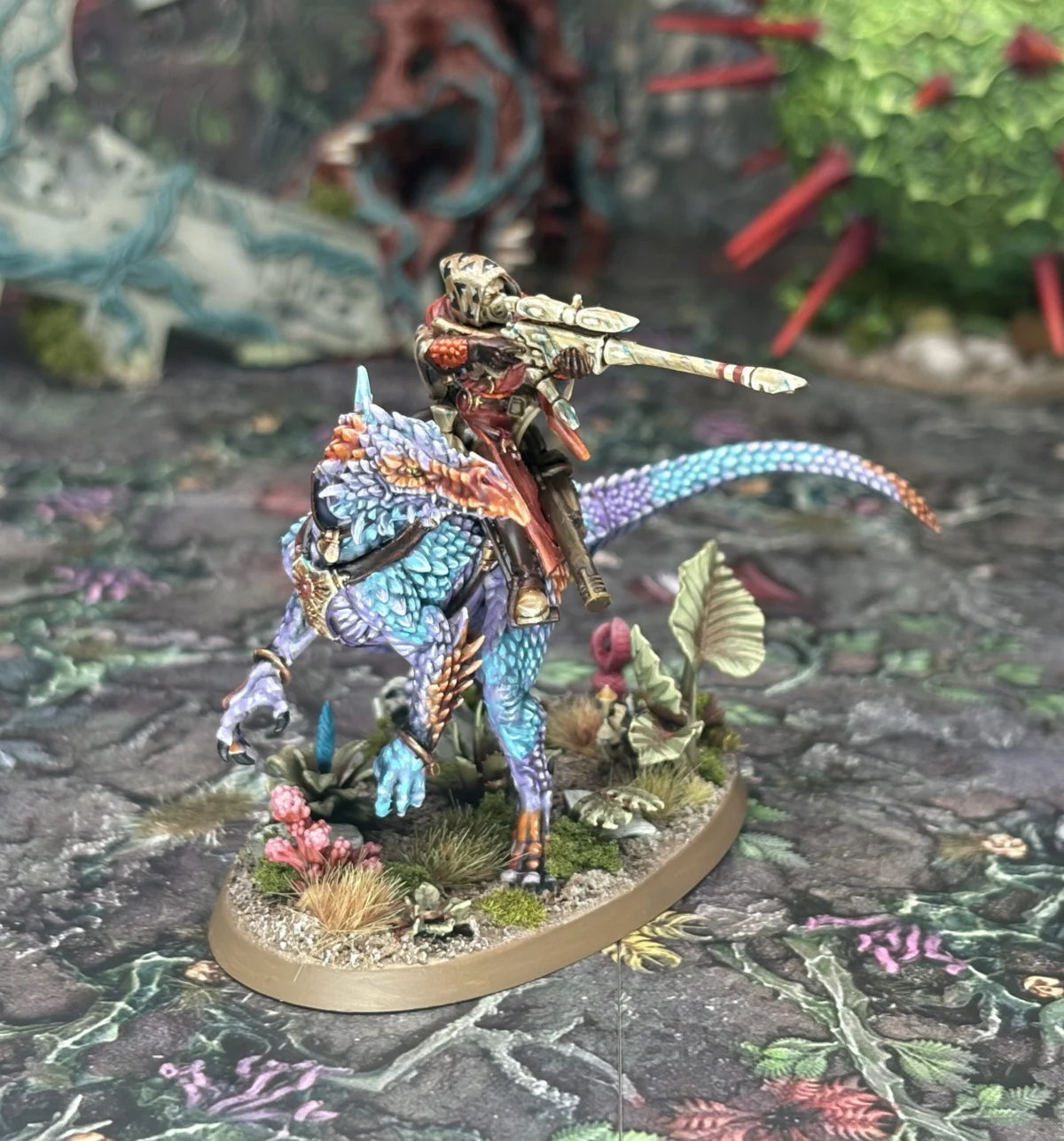
Last but certainly not least, the Leystalker stands out as a unique and potentially ubiquitous addition to Aeldari rosters. Priced at 80 points, the Leystalker possesses the invaluable Lone Operative ability, making them incredibly difficult to target from more than 12 inches away.
Abilities: Complementing Lone Operative is Scout 9", allowing them excellent pre-game positioning for objective grabbing, screening, or deploying in advantageous firing lanes. They also carry a couple of Drakolithe tokens, providing a minor deterrent against charges.
Weaponry: The Leystalker excels at precision ranged attacks. Their primary weapon fires 2 shots at 36" range, BS2+, S6, AP-2, D3, with Precision and Devastating Wounds against non-Vehicle/Monster targets. Any non-Vehicle/Monster hit by this attack must also take a Battle-shock test at -1. This makes them a potent character assassin or elite infantry sniper. Their melee profile is comparatively weaker, reflecting their ranged focus.
Strategic Analysis: The Leystalker’s 80-point cost makes them highly competitive, slightly pricier than a Death Jester but offering distinct advantages. Their large base makes them excellent for screening vital areas, and their OC2 on a Lone Operative is a rare and powerful combination, allowing them to reliably flip objectives against single enemy models. As the first Asuryani Lone Operative, they open up several compelling enhancement options:
- Warhost Detachment: Gift of Foresight provides a consistent free re-roll. The Phoenix Gem offers crucial durability, allowing them to potentially survive a devastating attack once per game.
- Guardian Battlehost Detachment: Craftworld’s Champion boosts their Objective Control to an impressive OC5, making a single Leystalker an immovable force on a key objective.
The Leystalker is poised to become a staple in almost any Aeldari list. Their ability to pull into reserves in a Windrider Host further amplifies their strategic utility, making them an incredibly flexible and durable piece for board control and crucial objective plays.
Official Responses: Games Workshop’s Design Philosophy
While Games Workshop does not typically issue detailed "official responses" to community analysis of new rules, their actions speak volumes. The provision of review copies to outlets like Tabletop Battles indicates a clear strategy of engaging with the community and fostering early discussion and excitement around new releases.
The design choices evident in the Exodite datasheets suggest a careful balancing act. Games Workshop appears committed to fulfilling long-standing community desires for unique sub-factions while integrating them into the existing game framework without causing immediate meta-disruption. The points costs, described as "fairly priced" and not "busted," reflect an intent to introduce viable new options that encourage diverse list building rather than creating an overpowering "must-take" unit.
Furthermore, the decision to release the 40K rules via the app ahead of the physical Kill Team set’s launch highlights Games Workshop’s evolving approach to content delivery. This digital-first strategy for rules allows for rapid deployment, responsiveness, and a direct pipeline to the player base, ensuring that new models can be used in the main game immediately upon acquisition. This mirrors a broader trend within the industry to leverage digital platforms for rule updates and supplementary content.
Implications: A New Dawn for Aeldari Armies
The arrival of the Exodite Dragon Masters heralds a new and exciting era for Aeldari players and the broader Warhammer 40,000 community.
![[40K] Aeldari Exodites: The Tabletop Battles Hot Take](https://assets.tabletopbattles.com/wp-content/uploads/2026/07/IMG_8044-scaled.jpg)
For Aeldari Players
This release fills a significant gap in the Aeldari roster. While the faction boasts incredible speed and potent firepower, it has sometimes lacked truly durable, fast melee units outside of specialized options like Shining Spears. Exodites, with their T5, 4W profiles, and the formidable potential of a 4+ invulnerable save in Windrider Host, offer a resilient, hard-hitting cavalry option that can contest objectives and engage in melee with greater confidence. Their unique aesthetic, combining the elegance of the Aeldari with the primal majesty of reptilian steeds, offers hobbyists a fresh avenue for army building and painting projects. This could easily lead to many new players starting Aeldari armies solely to field these stunning models, as noted by Sky Serpent.
The strong synergy with existing Detachments, particularly Windrider Host and Ynnari, provides immediate competitive viability. The Leystalker, in particular, is poised to become an almost ubiquitous inclusion due to its Lone Operative status, Scout move, and high Objective Control, offering unparalleled strategic flexibility for objectives and board control.
For the Hobby Community
The visually striking nature of the Exodite models is a major draw. The concept of Aeldari riding dinosaurs has captivated fans for decades, and the new sculpts deliver on this promise with exquisite detail. This will undoubtedly inspire countless hobbyists to collect, build, and paint these models, leading to a surge of creative projects and army showcases across social media and gaming tables. The unique blend of technology and nature offers rich opportunities for distinctive paint schemes and conversions.
Competitive Landscape
In the competitive arena, Exodites are likely to add significant depth to Aeldari list construction. They offer reliable counter-charge threats, excellent objective play, and versatile character support. While they don’t scream "broken," their balanced pricing and strong abilities mean they will be carefully considered in top-tier lists. The ability to field a resilient, fast unit that can fall back, shoot, and charge, or become exceptionally tough against shooting, provides tactical flexibility that Aeldari armies will greatly benefit from. The Leystalker’s ability to act as a nearly unkillable objective holder or character sniper will force opponents to adapt their strategies.
The current lack of a dedicated Exodite Detachment, as highlighted by Sky Serpent, suggests potential future expansions. A bespoke Detachment centered around Exodite themes could further unleash their potential, perhaps emphasizing synergistic abilities with their reptilian steeds or unique psychic powers linked to their Maiden Worlds. This prospect keeps the future exciting for Aeldari players, hinting at further lore and rule development.
Future of Warhammer 40,000
The Exodite release serves as a precedent for how Games Workshop might integrate units from specialist games like Kill Team into the main 40K system. It demonstrates a willingness to revisit beloved lore elements, update them with stunning new models, and provide immediate rules support. This approach could pave the way for other long-requested factions or units from the deep lore of Warhammer 40,000 to eventually make their way to the tabletop, enriching the game’s narrative and tactical diversity for years to come. The continued reliance on the Warhammer 40,000 app for rapid rule dissemination also underscores the increasing importance of digital platforms in the hobby.
In conclusion, the Exodite Dragon Masters are more than just new units; they represent a significant cultural and strategic injection into the Aeldari faction. Their balanced rules, dynamic abilities, and compelling aesthetic promise to invigorate Aeldari armies, offer exciting new hobby opportunities, and leave players eagerly anticipating what other ancient wonders Games Workshop might unearth from the vast lore of the 41st Millennium.