Dashiell Hammett’s Pulp Resurgence: How a Visionary Editor Forged the Hardboiled Era’s Cornerstone
Pittsburgh, PA – The world of pulp fiction, a vibrant yet often dismissed literary realm, found its enduring voice in Dashiell Hammett, particularly through his groundbreaking work in Black Mask magazine. His journey from disillusioned writer to the undisputed master of hardboiled detective fiction, culminating in the serialization of Red Harvest, is a testament to both his singular talent and the prescient vision of editor Joseph ‘Cap’ Shaw. This pivotal period, marked by Hammett’s return to the pulps after a brief but significant hiatus, not only defined his career but irrevocably shaped the landscape of modern mystery writing.
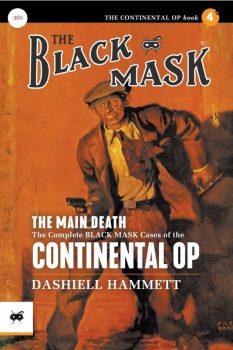
The recent annual Pulp Fest in Pittsburgh, a gathering celebrating the rich history of pulp magazines, once again highlighted this crucial chapter. Steeger Books, a prominent publisher in the field, showcased its summer line, including a new collection of Hammett’s Continental Op stories. This fourth consecutive volume, featuring a fresh introduction by acclaimed author and pulp historian Bob Byrne, underscores the timeless appeal and continued scholarly interest in Hammett’s foundational contributions, particularly his first great hardboiled novel, Red Harvest.
The Wilderness Years: Hammett’s Departure from Black Mask
By early 1926, Dashiell Hammett, despite having penned acclaimed stories like “The Girl with the Silver Eyes” and “The House in Turk Street,” found himself at a crossroads. Disenchanted with the editorial direction and financial constraints imposed by then-Black Mask editor Phil Cody, Hammett quit writing for the magazine, and indeed the pulps entirely. His final story before this self-imposed exile, “The Creeping Siamese,” appeared in the March 1926 issue, marking the end of what is now considered Volume Three of his collected works.
Struggles and Disillusionment
Hammett’s departure was not merely a creative decision; it was born out of profound personal and professional struggles. Unable to sustain a living solely from his fiction, he took a full-time position as advertising manager for Albert S. Samuels Co. Jewelers in March 1926. This period was fraught with immense pressure: he maintained a demanding job, battled alcoholism, sought a second apartment to serve as a writing studio, and embarked on an affair with his office secretary, all while his second child was being born. The cumulative stress took a severe toll on his war-damaged lungs, leading to a collapse marked by coughing up blood. Forced to abandon full-time employment, he resorted to freelance advertising, vowing to leave fiction behind. The vibrant, gritty world of the Continental Op, it seemed, was destined to fade into obscurity.
Joseph ‘Cap’ Shaw: The Visionary Editor’s Arrival
However, fate intervened in the form of Joseph ‘Cap’ Shaw. Phil Cody, burdened with multiple responsibilities for Pro-Distributors Publishing, made a surprising choice by hiring Shaw to helm Black Mask. Shaw, nicknamed ‘Cap’ due to his World War I service, was an unconventional selection. He had no prior experience writing for the pulps, nor had he ever edited a magazine. Yet, this seemingly strange decision by Cody proved remarkably prescient.
Reshaping the Pulp Landscape
Shaw, a man of profound literary taste and an unwavering commitment to quality, embarked on a mission to redefine Black Mask. The magazine, while already home to burgeoning talents like Carroll John Daly, Erle Stanley Gardner, and Raoul Whitfield, was still a heterogeneous mix of genres, including Westerns and adventure tales. Shaw was determined to carve out a distinct identity, one that would champion a new, uncompromising style of detective fiction. His vision prominently featured emerging talents such as Frederick Nebel and Horace McCoy, but he recognized that the true foundation for this new direction lay with the estranged Hammett.
After immersing himself in back issues, Shaw identified Hammett as the cornerstone upon which to build his revitalized Black Mask. He reached out with a compelling offer: a princely sum of four cents a word – a substantial increase for the era – and an explicit encouragement for Hammett to write longer, more ambitious stories. Crucially, Shaw also paid Hammett the $300 that the writer insisted Cody owed him, a gesture that spoke volumes about his respect for authors. Shaw proved to be more than just an editor; he was a manager, a facilitator, and a shrewd negotiator. His efforts bore fruit: Dashiell Hammett was writing for Black Mask once again.
The Prodigal Son Returns: Hammett’s Resurgence
The period between 1927 and 1930 marked Hammett’s definitive establishment as the preeminent pulpster of his time. This prolific era saw the creation of two Continental Op novels, a host of high-quality short stories, and the initial development of iconic works such as The Glass Key, Sam Spade, and The Maltese Falcon. Shaw wasted no time in trumpeting the return of his star detective, announcing the Op’s “return from retirement” in the January 1927 issue. The following month, February, featured “The Big Knockover,” a story that immediately signaled Hammett’s triumphant resurgence.
The Big Knockover: A Symphony of Violence
“The Big Knockover” was a tour de force, pushing the boundaries of the detective story. Hammett elevated the “military-like organization” he had previously showcased in “The Gutting of Couffignal” to an unprecedented level within the heart of San Francisco. The story’s relentless trail of violence and death, from its explosive beginning to its brutal conclusion, drew comparisons to modern crime epics like the film Heat. Unlike the gratuitous mayhem often depicted by contemporaries like Race Williams, the Op in this story primarily employed his intellect. He masterfully manipulated situations, infiltrating the inner circles of the criminal underworld. Yet, he was no pacifist; the narrative demanded both brains and brawn, showing the Op willing to resort to physical force or even sacrifice an ally to achieve his objectives.
Hammett’s prose was rich with authentic gangland color, dropping underworld names like the Dis-and-Dat Kid, L.A. Slim (from Denver), and Toby the Lugs with an effortless realism that imbued the narrative with depth and vibrancy. The intricate layering of details and the compelling cast of characters set a new standard for realism in pulp fiction. While the inclusion of a deus ex machina (a plot device where an insoluble problem is suddenly and abruptly resolved by an unexpected and unlikely intervention) in the penultimate chapter initially felt jarring, Hammett, ever the master, skillfully integrated it, delivering a satisfying, if slightly less impactful, resolution. He might have referred to his pulp stories as “Black Mask junk” in a letter to his wife Josie, but “The Big Knockover” was anything but. It crackled with an energy and urgency that had been absent during his earlier struggles with Cody, marking Hammett working at an unparalleled level of craftsmanship.
$106,000 Blood Money: Intricacy and Imperfection
Just three months later, in the May issue, Black Mask presented a sequel: “$106,000 Blood Money.” Shaw, ever the astute promoter, included a note inviting readers who had missed the first installment to send a dime (the cover price) for a copy. The story picked up four weeks after the conclusion of “The Big Knockover,” with the Continental Detective Agency pursuing individuals connected to the previous caper. Hammett wove a complex tapestry of intrigue, with the Op orchestrating events like a puppet master, often without the reader realizing his machinations until later. The plot was dense, requiring careful attention to keep track of the myriad characters and their shifting allegiances. Hammett also introduced a new level of gruesome torture, within the confines of 1930s pulp conventions, demonstrating his willingness to explore darker facets of the criminal underworld.
However, “$106,000 Blood Money” suffered from a common flaw in mystery fiction: “The Big Explanation.” Unlike “The Big Reveal,” where a detective brilliantly unmasks a culprit, often in a dramatic confrontation (as perfected by authors like Rex Stout with Nero Wolfe), Hammett’s story concluded with a lengthy monologue. In the final chapter, the Op, having lunch with his boss, delivers an exhaustive summary of how and why everything transpired. This narrative “info dump,” while providing closure, inevitably slows the story’s momentum, acting as a brake just as the narrative should be accelerating towards its conclusion. While reading the two stories consecutively as a novella might mitigate this effect, as a standalone short story, it somewhat diminished the impact of an otherwise intricate plot.

Despite this narrative hiccup, these two stories showcased the Op’s evolving moral compass. While steadfastly loyal to the Agency and incorruptible by bribes, he demonstrated a willingness to undertake ethically ambiguous actions – moving into the “gray, and even black, on the black/white scale” – to achieve his objectives and protect the Agency’s reputation. This moral toll was evident in scenes with the “Old Man,” the Agency’s soft-spoken, yet quietly ruthless, leader. Both men emerged weary from the ordeal of “$106,000 Blood Money,” with the Op declaring himself “washed out” and in need of a break, bearing the internal burden of the dirty work required to maintain order. The combined novella, Blood Money, was later issued as a book in 1943, though its length of approximately 38,000 words firmly places it in the novella category rather than a full novel.
Throughout this period, Shaw continued to refine Black Mask. The word “The” was officially dropped from the magazine’s title after the April issue, signifying a conscious shift. While covers still featured Westerns and Eastern Adventures, Shaw was undeniably steering Black Mask towards the hardboiled identity it would soon embody.
Hammett’s output continued with the short story “The Main Death” in the June 1927 issue. Despite its shorter length compared to his previous two, it earned high praise, with Erle Stanley Gardner calling it “not only the best story ever in Black Mask, it was the best story he had ever read, period.” While perhaps an exaggeration, it underscored the quality of Hammett’s writing. This story marked a return to a more procedural PI narrative, devoid of grand heroics. The Op’s task was simple: recover $20,000 and investigate a murder. His disdain for the client, an unlikable rare items merchant, fueled his approach, leading him to uncover the missing money but leaving the client and the police in the dark about certain details. The Op, an independent operator, chose not to fully serve what he perceived as a morally bankrupt client, showcasing his personal code of justice.
Red Harvest: Birth of a Hardboiled Masterpiece
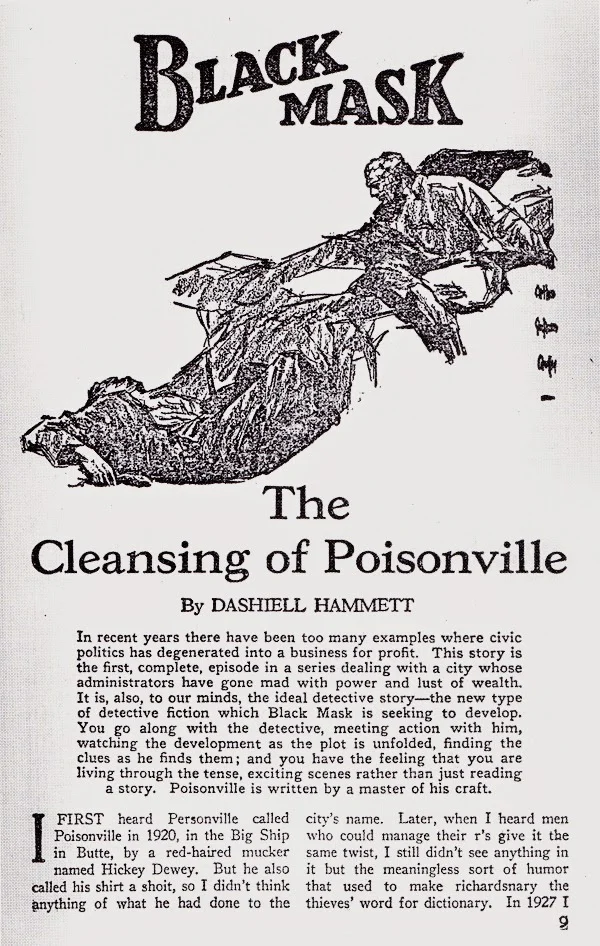
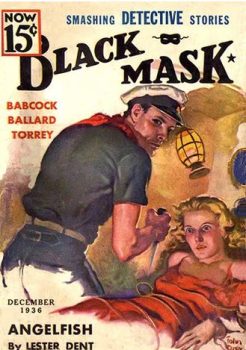
The true apotheosis of Hammett’s return arrived with Red Harvest. The November 1927 issue of Black Mask carried the first installment of “The Cleansing of Poisonville,” a serial that would redefine mystery fiction and set an indelible benchmark for hardboiled literature. Published in four parts, it would later be renamed Red Harvest in its book form.
Shaw’s Bold Proclamation
Cap Shaw, recognizing the monumental significance of the work he was publishing, declared at the end of the second installment: “…these stories are remarkable if only for the fact that their manner of telling points the way to a new type of detective fiction, which in BLACK MASK is coming to take the place of the old, worn-out formula sort of gruesome-murder-and-clever-solution detective story.” This was not merely promotional hype; it was a public declaration of Shaw’s vision, intentionally built upon Hammett’s genius. By the end of 1927, the qualitative chasm between Hammett and his contemporaries, even popular writers like Carroll John Daly, was undeniable. While Daly’s Race Williams delivered "loud violence," Hammett’s nuanced approach elevated the genre, making every word resonate with profound impact.
The Continental Op Unleashed in Poisonville
The first installment of “The Cleansing of Poisonville” functioned as a standalone story, with the Op completing his initial assignment. However, his client’s attempt to dismiss him and send him back to San Francisco met with the Op’s defiant declaration: “I’ve got ten thousand dollars of your money to work with and I’m going to use it to open Personville up from Adam’s apple to ankles… Now I’m going to have my fun.” This echoes his earlier sentiment from “The Golden Horseshoe”: “One way of finding what’s at the bottom of either a cup of coffee or a situation is to keep stirring it up until whatever is on the bottom comes to the surface.”
And stir he did. In Poisonville, a mining town dominated by a ruthless baron and four warring mob bosses, the Op deliberately instigated chaos. He played four (or five, including his own) factions against each other, creating a maelstrom of violence. As he ominously states at the end of installment two, “Poisonville was beginning to boil out under the lid.” The bodies piled up, a grim testament to his ruthless methods.
Hammett, drawing from his own experience as a Pinkerton operative, depicted the Op operating far beyond the conventional rules of the Continental Detective Agency. He acknowledged that while the Agency had its regulations, on the job, one did what was necessary. "Anybody that brings any ethics to Poisonville is going to get ‘em rusty," he mused, adding that "a report is no place for the dirty details." This candid portrayal highlighted the moral compromises inherent in cleaning up a town rotten to its core, a task he accomplished by "painting it with blood."
A crucial moment arrived when the Old Man, the Agency boss, sent a letter demanding a full explanation and daily reports. The Op, pocketing the letter, understood that compliance would be tantamount to resignation. He was now operating entirely on his own terms. In the fourth installment, after a necessary recap (an inherent serial flaw), Hammett delved deep into the Op’s psyche. Drinking gin mixed with laudanum, the Op bared his soul to the female lead, confessing his enjoyment of the "game" and the grim satisfaction derived from the violence he orchestrated. This unprecedented introspection revealed the Op’s inner world in a way that short stories simply couldn’t, offering a profound glimpse into the psychological toll of his profession. The action remained relentlessly violent, culminating in an O. Henry-esque twist. Red Harvest is widely considered one of the Top Five Novels of the Hardboiled Era, a testament to Hammett’s unhindered genius under Shaw’s supportive leadership.
From Pulp Serial to Literary Novel
In February 1928, Hammett submitted the serialized novel to Alfred A. Knopf. After revisions and a title change (Blanche Knopf discarded "Poisonville," and Hammett suggested eight alternatives, favoring Red Harvest), it was published as a hardback novel. The book toned down some of the serial’s raw violence but retained its revolutionary spirit.
Hammett, now firmly established as a hardboiled novelist, immediately began work on The Dain Curse. He articulated his ambition in a March letter to Blanche Knopf: “I’m one of the few people… moderately literate who take the detective tale seriously… I mean, the detective story as a form… Some day, somebody’s going to make ‘literature’ of it.” While Raymond Chandler is often credited with elevating the genre to literature and frequently praised Hammett, it was Hammett who first forged this path, distinguishing himself from his peers and raising the expectations for what a detective story could achieve.
Legacy and Lasting Impact
The impact of Joseph ‘Cap’ Shaw’s decision to bring Dashiell Hammett back to Black Mask is immeasurable. One can scarcely imagine a pulp world where Hammett’s writing career ended with “The Creeping Siamese.” The loss would have been catastrophic, depriving American literature of seminal works and the hardboiled genre of its most potent foundational influence. Shaw’s managerial acumen and editorial vision provided Hammett with the creative freedom and financial stability necessary to produce his masterpieces.
Red Harvest stands as a hardboiled treasure, a brutal yet intellectually sophisticated narrative that forever changed detective fiction. It demonstrated that pulp stories could possess literary merit, psychological depth, and incisive social commentary. Hammett’s unflinching realism, morally ambiguous protagonists, and lean, evocative prose laid the groundwork for countless authors who followed, cementing his status as a titan of American letters and a defining voice of the 20th century. The ongoing publication of his collected works by Steeger Books, accompanied by insightful introductions, ensures that new generations continue to discover and appreciate the enduring power of Dashiell Hammett’s legacy.
Bob Byrne’s ‘A (Black) Gat in the Hand’ made its Black Gate debut in 2018 and has returned every Summer since. His ‘The Public Life of Sherlock Holmes’ column ran every Monday morning at Black Gate from March, 2014 through March, 2017. He irregularly posts on Rex Stout’s gargantuan detective in ‘Nero Wolfe’s Brownstone.’ He is a member of the Praed Street Irregulars, and founded www.SolarPons.com (the only website dedicated to the ‘Sherlock Holmes of Praed Street’). He organized Black Gate’s award-nominated ‘Discovering Robert E. Howard’ series, as well as the award-winning ‘Hither Came Conan’ series. Which is now part of THE Definitive guide to Conan. He also organized 2023’s ‘Talking Tolkien.’ He has contributed stories to The MX Book of New Sherlock Holmes Stories – Parts III, IV, V, VI, XXI, and XXXIII. He has written introductions for Steeger Books, and appeared in several magazines, including Black Mask, Sherlock Holmes Mystery Magazine, The Strand Magazine, and Sherlock Magazine. You can definitely ‘experience the Bobness’ at Jason Waltz’s ‘24? in 42’ podcast.