The survival-horror landscape of the virtual Amazon rainforest has just become significantly more vibrant. Incuvo, the developer behind the acclaimed VR adaptation of Creepy Jar’s survival hit Green Hell, has officially released its latest major content expansion: the "Modular Building & Painting Update." Now live for Meta Quest and PlayStation VR2 (PS VR2) users, this update marks a pivotal moment in the game’s post-launch roadmap, transitioning the experience from pure survival to a more robust, creative sandbox.
Announced and showcased during the recent VR Games Showcase, the update introduces a suite of creative tools and architectural assets designed to allow players to personalize their jungle sanctuaries. Beyond the creative additions, the update serves as a celebration of a massive commercial milestone, as Green Hell VR officially surpasses one million players on the Meta Quest platform alone.
Main Facts: A New Canvas for Survival
The "Modular Building & Painting Update" is a multi-faceted expansion that addresses one of the most requested features from the Green Hell VR community: deeper aesthetic customization. While the game has always been lauded for its punishingly realistic survival mechanics—including leech removal, wound cauterization, and complex nutrient management—the latest update shifts the focus toward the "home-making" aspect of the long-term survival experience.
The Painting System
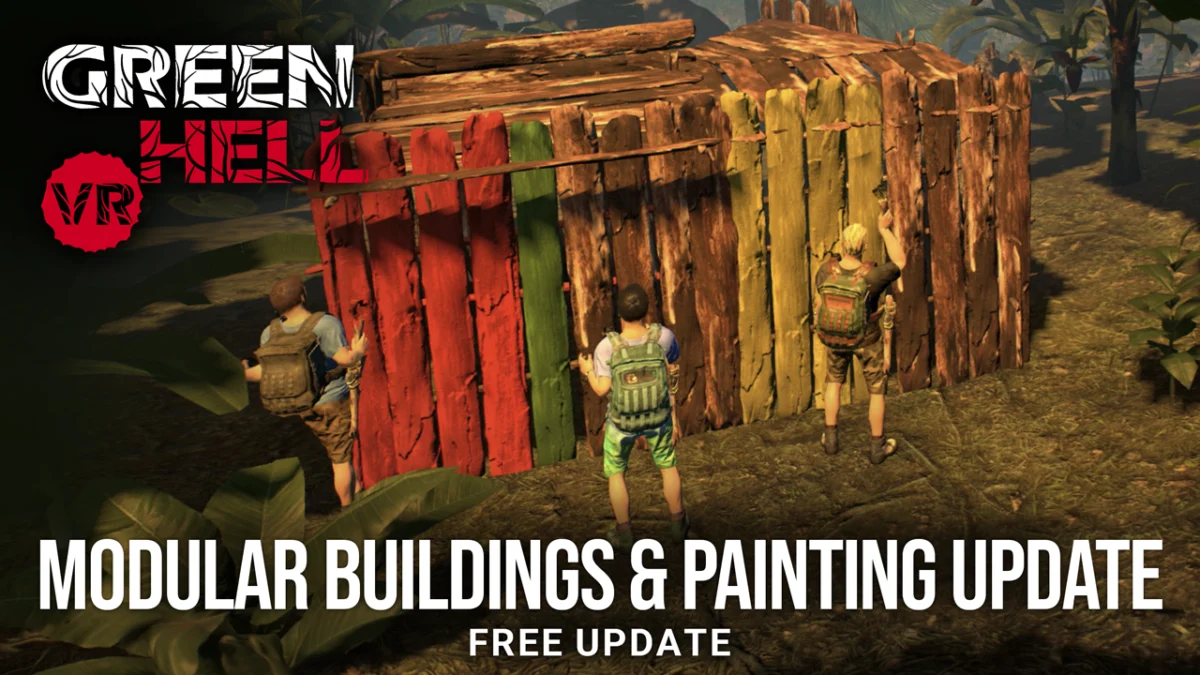
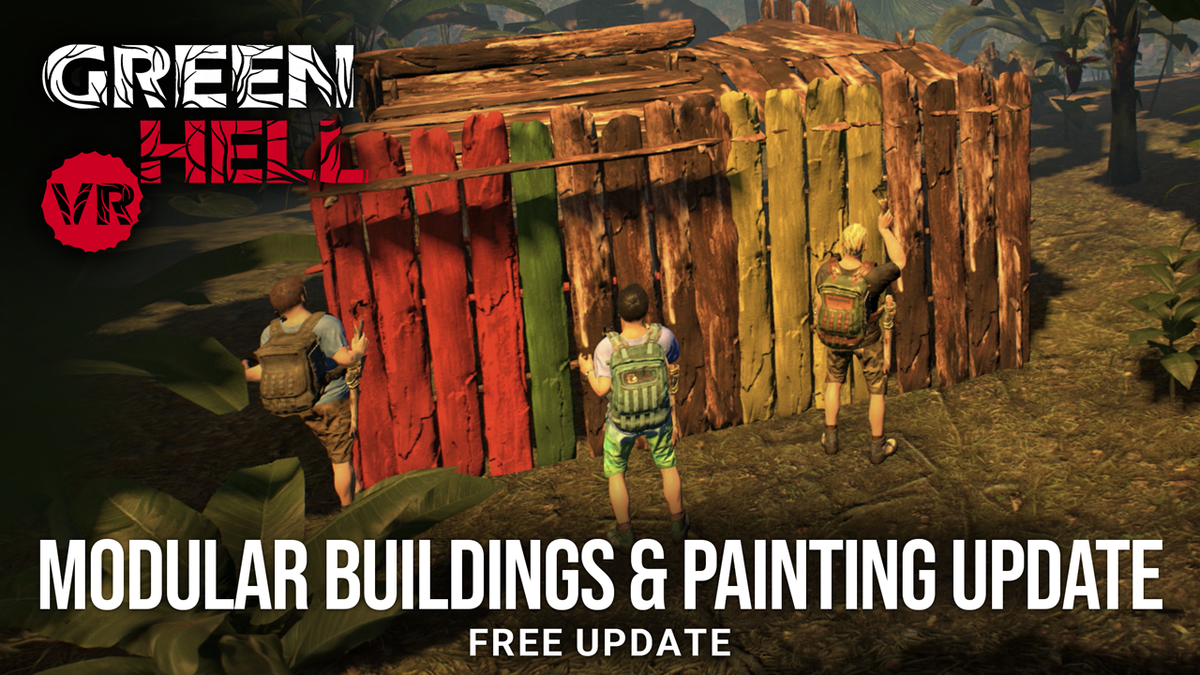
The headline feature of the update is the introduction of a functional painting system. Unlike many games that utilize a simple menu-based color picker, Green Hell VR maintains its commitment to diegetic, immersive mechanics. To begin decorating their base, players must engage with the game’s crafting systems:
Craftable Tools: Players must now find the recipes for and craft a handmade painting brush and a mixing bowl.
Tactile Interaction: Using the VR controllers, players physically dip their brushes into bowls and apply color to their structures, mimicking the real-world motions of a painter.
Aesthetic Variety: This allows for the color-coding of different wings of a base (e.g., a red-tinted storage area versus a blue-tinted sleeping quarter) or simply adding a touch of humanity to the oppressive green of the Amazon.
Architectural Enhancements
In addition to the painting mechanics, Incuvo has expanded the "Modular Building" system that was introduced in a previous major update. The new update adds:
Triangle Frames: These allow for more complex geometric designs, enabling players to create hexagonal rooms or more intricate roof structures that were previously impossible with strictly rectangular assets.
Plank Structures: A new material type that provides a more "finished" look to camps compared to the rough-hewn logs and mud walls of the early game.
Monetization and Milestones
To coincide with the update, Incuvo has introduced two new paid cosmetic packs:
The Art Instructor Pack ($2.99): Provides premium aesthetic options for the more discerning jungle artist.
The Painter Pack ($1.99): A budget-friendly entry point for basic decorative needs.
Furthermore, to commemorate the milestone of reaching one million players on Meta Quest, all players can claim a free "Anniversary Shirt" for their in-game avatar, a nod to the community that has sustained the game since its 2022 launch.
Chronology: The Evolution of the Virtual Amazon
The journey of Green Hell VR has been one of constant iteration and platform-specific divergence. Understanding the current update requires looking back at the game’s developmental trajectory.
April 2022:Green Hell VR launches on Meta Quest. It is immediately recognized as a technical feat, bringing a complex PC survival game to mobile VR hardware, albeit with a more streamlined world and a slightly more linear campaign compared to the original PC version.
June 2022: The game arrives on SteamVR. Interestingly, the SteamVR version was closer to the original flat-screen PC game in terms of map size and complexity but lacked some of the VR-specific optimizations found in the Quest version.
Early 2023: The "Modular Building Update" arrives on Quest and PS VR2, fundamentally changing the endgame by allowing players to build multi-story bases rather than just pre-fabricated huts.
August 2024: The "Modular Building & Painting Update" is showcased at the VR Games Showcase, bringing the painting mechanics and new structural frames to the forefront.
Present Day: While Quest and PS VR2 users enjoy the latest features, the SteamVR community remains in a state of transition as Incuvo works to align the various versions of the game.
Supporting Data: The "One Million" Milestone
The announcement that Green Hell VR has reached one million players on Meta Quest is a significant data point for the VR industry. In an ecosystem where software sales are often opaque, this figure places Green Hell VR in the upper echelon of Quest titles, alongside hits like Beat Saber, Blade & Sorcery: Nomad, and Into the Radius.
This success is attributed to several factors:
Brand Recognition: The original Green Hell had already sold millions of copies on PC and consoles, providing a built-in audience.
Physicality:Green Hell VR is often cited as a "gold standard" for VR interaction. Every action, from starting a fire with a bow drill to checking a watch for biological stats, requires physical movement, which resonates with the Quest’s "untethered" audience.
Post-Launch Support: Incuvo has maintained a steady cadence of free updates, preventing the player base from stagnating.
Official Responses: The PCVR Port and Roadmap Shifts
While the mood is celebratory for Quest and PS VR2 owners, the SteamVR community has expressed concerns regarding the delay of these features on PC. Earlier this year, Incuvo announced an ambitious plan to port the PlayStation VR2 version of the game—which features the more linear, VR-optimized campaign—back to PC VR.
Initially scheduled for a Summer 2024 release, Incuvo recently issued an update to their roadmap, officially pushing the PC VR update to Fall 2024.
In an official statement posted to the Steam Community hub, Incuvo explained:
"Our plan to bring the enhanced PS VR2 version to PC VR has shifted to the fall. This decision was made to ensure we have adequate time for rigorous testing and optimization. We want to ensure that the transition between the original PC VR version and this new, content-rich version is seamless for our existing players."
Incuvo has clarified that existing Steam owners will receive the new version for free. Crucially, the developer intends to keep the original PC VR version available as a separate branch, acknowledging that some purists prefer the original, larger map over the more optimized, feature-heavy version being brought over from consoles.
Implications: The Future of Cross-Platform VR Development
The "Modular Building & Painting Update" and the surrounding news regarding the PC VR port highlight a broader trend in the VR industry: the move toward feature parity through optimization.
1. The "Quest-First" Reality
The fact that the painting and modular building updates are debuting on Quest and PS VR2 before PC VR underscores the market dominance of standalone and console VR. Developers are increasingly prioritizing platforms with the largest active user bases, using them as the "lead" version for new content.
2. The Creative Survival Pivot
By adding painting and intricate building tools, Incuvo is leaning into the "lifestyle" aspect of survival games. This shift suggests that Green Hell VR is moving away from being a "one-and-done" campaign experience and toward a "forever game" where players spend dozens of hours perfecting their virtual homesteads. This model is essential for sustaining long-term engagement and justifying the sale of cosmetic DLC.
3. Technical Fragmentation
The existence of two different versions of Green Hell VR on Steam (the original sandbox and the upcoming PS VR2 port) represents a unique solution to the problem of "VR fragmentation." Rather than forcing players into a version they might not like, Incuvo is offering a choice. This could set a precedent for other developers who find themselves needing to "re-tool" their games for better performance or more frequent updates.
4. Expansion of the VR Market
Reaching one million players on a single VR platform is a "proof of concept" for high-fidelity, complex survival games in the virtual space. It signals to other developers that there is a massive appetite for "hardcore" mechanics in VR, provided they are implemented with the level of physical immersion seen in Green Hell.
In conclusion, the "Modular Building & Painting Update" is more than just a palette of colors for a jungle hut; it is a testament to the longevity of Green Hell VR. As Incuvo prepares for the final push to bring all platforms into alignment this fall, the Amazon remains as beautiful, and as deadly, as ever—only now, players can choose exactly what shade of green their survival story will be.
The intersection of physical fitness and immersive technology has reached a new milestone with the release of TaoLu, a specialized martial arts simulator developed by The Game Forger. Released in late
The landscape of virtual reality gaming has reached a significant turning point with the official release of Roboquest VR on the Meta Quest 3 and 3S platforms. Developed by Flat2VR Studios in collabor
Snap Inc., the parent company of the popular social media platform Snapchat, has officially announced a high-profile event dedicated to the unveiling and demonstration of its next-generation augmented