Unpacking the "Lie": A Deeper Look at Character Arc and the Nature of Belief
The foundational concept of a character’s "Lie the Character Believes" is a cornerstone of narrative craft, but a nuanced examination reveals it’s far more than a simple falsehood. It represents a complex interplay of ingrained perspective, ego identity, and the deeply human journey toward self-awareness and alignment.
For years, the concept of the "Lie the Character Believes" has been a guiding principle for understanding character development in storytelling. Presented in works like K.M. Weiland’s "Creating Character Arcs," this framework posits that a character’s arc is fundamentally driven by their struggle against a limited perspective—a belief system that hinders their growth and prevents them from embracing the story’s central thematic truth. In positive change arcs, characters shed this "lie" to adopt a more expansive worldview. Conversely, negative change arcs see characters devolve further into their constricted beliefs.

While this terminology offers immediate clarity and accessibility, a deeper exploration, particularly within the realm of transformational fiction, suggests that the "Lie" is not always a straightforward untruth. Instead, it often represents a perspective that, while perhaps no longer serving the character, was once their perceived reality, a truth that enabled them to navigate their world up to the point where the story’s events necessitate a re-evaluation.
The Lie as a Continuum: From Truth to Limitation
At its core, the "Lie the Character Believes" refers to a state of being or a perception that characters must transcend to positively alter their circumstances. However, the author argues that this "lie" is rarely an absolute falsehood. Instead, it functions as a comparatively limited belief existing on a continuum with a comparatively expansive Truth.

Consider the character of Feyre from the "A Court of Thorns and Roses" series. In the initial stages of her journey, her intense focus on survival skills, a "truth" that allowed her to support her family for years, becomes a limiting factor when she enters the complex world of the Fae. Her initial perspective on herself and her capabilities, honed by necessity, must evolve and expand to adapt. This evolution illustrates how a belief, once functional, can become a "lie" when circumstances change and demand a broader understanding.
This concept extends beyond individual story arcs. In life, we are constantly navigating this continuum. Yesterday’s hard-won truth can become tomorrow’s limiting belief as our horizons expand. Feyre’s journey further exemplifies this: by the end of the first book, she understands that love is worth sacrifice. Yet, subsequent installments reveal the limitations of this perspective, forcing her to expand her understanding to recognize that authentic love should not demand the perpetual sacrifice of one’s identity.

Beyond Deception: The Lie as Clarity and Alignment
Further reflection suggests that many significant personal revelations and moments of growth don’t feel like a dramatic shift from falsehood to truth. Instead, they often manifest as clarity, a sense of coming into alignment with something that, on a deeper level, always felt true but was previously obscured.
This leads to a more profound understanding: the "Lie" a character overcomes isn’t always a "wrong" belief to be corrected. It can be a fissure in consciousness, a space where the conscious self is ensnared by an ego identity that creates a disconnect between surface-level understanding and a deeper, more fundamental truth of being.

Three Models of the "Lie the Character Believes"
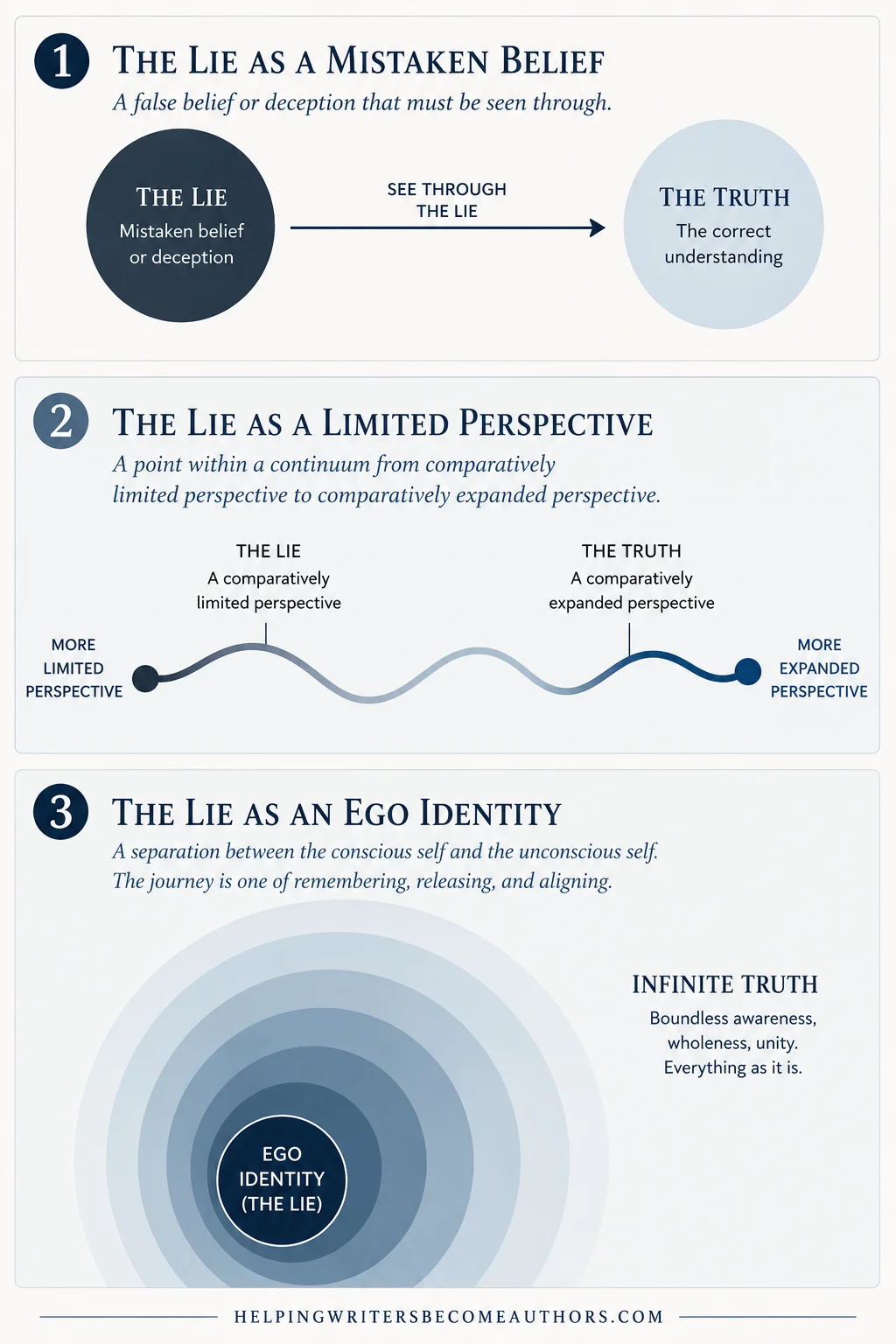
To better grasp this nuanced concept, three models of increasing complexity can be identified:
1. The Mistaken Belief
The most straightforward interpretation views the "Lie" as an outright mistaken belief or even a deliberate deception that the character must see through. This is the foundational understanding, often serving as the initial hook for a character’s journey.

2. A Limited Perspective on a Continuum
This model refines the concept, positioning the "Lie" as a point on a spectrum between a comparatively limited perspective and a comparatively expanded one. Neither the "lie" nor the "truth" are absolute; they are reference points that define the character’s position in their journey of growth. This acknowledges that even the "truth" a character discovers is often a stepping stone toward further understanding.
3. An Ego Identity or Limited Consciousness
The most complex and arguably most profound understanding views the "Lie" as an ego identity or a comparatively limited consciousness. This is fundamentally a separation between the conscious and unconscious self. The journey of character arc, viewed from this perspective, is a process of expanding consciousness by releasing the limitations imposed by ego identities, allowing for a deeper alignment with life’s inherent truths.

The Ego and the "Lie" of Separation
Identifying with the ego means defining oneself through limited parameters: name, job, gender, trauma, roles. This egoic lens reflects the world back in similarly restricted terms, leading to polarized perceptions of good and bad, success or failure. However, these identities are often transient constructs. A writer is not solely defined by their profession, nor is one’s inherent worth tied to external validation.
When the ego latches onto these definitions as core identity, it creates a separation from a broader consciousness, fostering a limited perspective. This identity then becomes something to defend, often unconsciously, leading to a resistance to growth and change.

The Ghost in the Backstory: Origin of the "Lie"
The roots of this limiting ego identification often lie in the Ghost in the character’s backstory. This formative experience, often a wound, shapes the ego identity or creates a defensive need to cling to it. In the context of expanded consciousness, these Ghosts are frequently recognizable as childhood coping mechanisms—strategies developed to meet early needs and maintain a sense of wholeness, however fractured.
As neuroscientist Loretta Graziano Breuning discusses in "Habits of a Happy Brain," early experiences, particularly those influencing neurotransmitter release, wire our perception of the world. These experiences shape our personalities, influencing the narratives we construct about ourselves and others, which in turn solidify into identities. The "Lie," therefore, can be understood as a deeply ingrained coping mechanism. It’s a strategy that only becomes a "lie" when it ceases to be effective, or actively begins to create more problems than it solves. This is precisely the point at which a story typically begins, initiating the character’s slow journey toward recognizing their potential beyond these limiting mechanisms.

The Painful Path to Alignment: Transformation vs. Alignment
While the concept of character arc as "transformation" is compelling, a deeper examination suggests it might be more accurately framed as coming into alignment. It’s less about fundamentally changing who a character is and more about removing the false self—the egoic layers that obscure their true nature. It’s not about adding a new perspective, but about stripping away what is not true to allow for clearer perception.
In soul-driven arcs, characters exhibit less resistance to this process. Even when faced with difficult changes, they embrace the understanding that movement toward truth is inevitable and beneficial. This willingness to embrace suffering as a catalyst for growth is key, even for characters deeply entrenched in egoic "lies." They learn to become non-reactive to the confusion created by their outdated beliefs, allowing the truth to "enthuse and fire their mind with inspiration."

Jungian scholar Marie-Louise von Franz emphasizes that this "creative active aspect of the psychic nucleus" emerges when the ego relinquies its rigid aims and embraces a deeper form of existence, listening to the inner urge toward growth without ulterior motives.
The "Lie" as Social Reality and the Tyranny of the Status Quo
The concept of the "Lie the Character Believes" also extends beyond individual psychology to encompass social reality. Collective beliefs and societal norms can act as powerful ego identities, shaping our understanding of ourselves and the world. Sociologists Peter L. Berger and Thomas Luckmann argued that reality itself is a social construction, built upon agreed-upon customs, traditions, and language.

While we contribute to and influence society, it profoundly shapes our own ego identities. Many of these inherited beliefs function as "uniforms" that enable us to navigate social roles. They maintain order and ward off chaos. However, this adherence to the status quo can also be stifling, what Joseph Campbell termed the "tyrant-ogre Holdfast, Keeper of the Status Quo." This symbolic antagonist is central to the Hero’s Journey and other archetypal character arcs.
While there’s a time and place for integrating the status quo, a Positive Change Arc fundamentally represents a movement away from the confines of social reality toward the initiation of individuation. Individuation, as described by Carl Jung, is the process by which the smaller egoic consciousness enters into a relationship with the larger Self, the totality of the psyche.

The ego’s role is to help realize this totality, to bring unconscious contents into conscious awareness. Without egoic recognition, even innate talents may remain unrealized. The process of individuation requires conscious awareness and a connection to this inner urge for growth.
The transformation at the heart of character arc, therefore, is an awakening to consciousness and a departure from the ego’s identification with social reality. This movement fosters greater alignment with self-responsibility and accountability. The pervasive "lie" beneath many smaller lies is the notion that circumstances dictate our lives, absolving us of responsibility. With awareness comes accountability, which, while potentially painful, ultimately leads to freedom and profound health.

The Union of Consciousness and the Unconscious
Ultimately, the most compelling stories tap into the fundamental human drive for growth and evolution. The hidden structure of character arc mirrors this journey, reflecting a thematic movement toward truth. The quest for the union of conscious awareness and the unconscious self is archetypally at the core of compelling narratives.
As Joseph L. Henderson noted, a sense of completeness is achieved through this union. By resonating with this primal shape of the psyche’s journey, writers can tap into universal archetypes, creating stories that deeply connect with audiences. Every Positive Change Arc serves as a reminder that true growth involves discovering who we are beneath the layers of fear, defense mechanisms, and accumulated identities. The "Lie the Character Believes" is not merely a plot device; it is a profound exploration of the human condition, the limitations we impose upon ourselves, and the liberating potential of embracing a more expansive truth.