A Journey into the Universal Heart of Folklore: The Treasury Series Culminates in a Grand Compendium
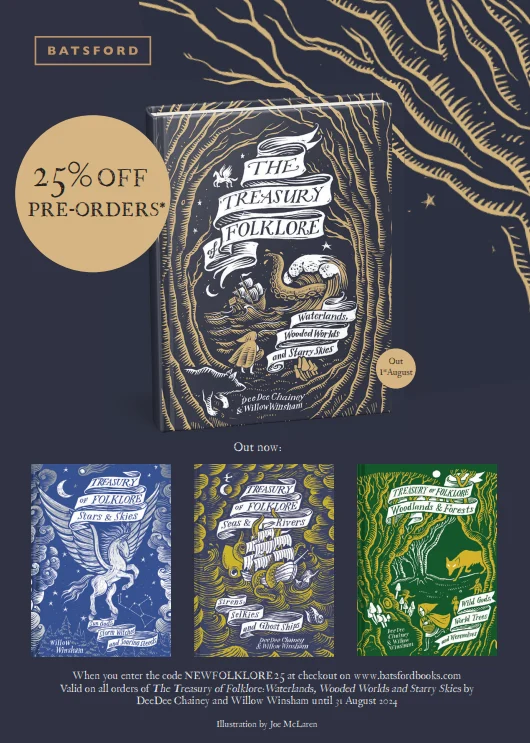
London, UK – July 25, 2024 – Nearly a decade after its initial conception, the ambitious vision behind the acclaimed Treasury of Folklore book series is set to reach its triumphant culmination. Authors Dee Dee Chainey and Willow Winsham are poised to release "The Treasury of Folklore: Waterlands, Wooded Worlds and Starry Skies," a magnificent new compendium that brings together the most beloved and essential tales from their three original, bestselling volumes. This beautifully bound edition, featuring the evocative original illustrations by Joe McLaren, is available for pre-order now and will officially be released on August 1, 2024.
This special volume represents a significant milestone for the series, fulfilling the authors’ initial dream of creating a single, comprehensive exploration of global folklore. While the material initially proved too vast for one book, leading to the highly successful individual releases of Seas and Rivers, Trees and Woodlands, and Stars and Skies, this new compilation distills the essence of their journey, presenting a curated selection designed to captivate both loyal readers and new enthusiasts.
Chronology: From Initial Vision to a Hefty Tome
The Genesis of a Global Exploration
The genesis of the Treasury of Folklore series began nearly a decade ago, born from a profound desire to understand the intricate tapestry of human belief. The initial spark ignited amidst the vibrant online community fostered by the #FolkloreThursday hashtag, a testament to the enduring human fascination with myths and legends. Dee Dee Chainey and Willow Winsham, inspired by the overwhelming outpouring of shared narratives, recognized the urgent need to create something tangible, meaningful, and lasting that would reflect the unifying universality of folklore across the globe.
Their initial ambition was grand: a single, expansive tome that would traverse the myriad physical landscapes inhabited by humanity, from the deepest oceans to the highest peaks. However, as their research deepened and the wealth of material they uncovered grew exponentially, it became clear that such an undertaking could not be contained within a solitary volume. This realization led to the strategic decision to divide the project into three distinct, yet interconnected, books, each dedicated to a specific natural realm: Seas and Rivers, Trees and Woodlands, and Stars and Skies. This approach allowed for a richer, more detailed exploration of each thematic area, much to the delight of readers.
The Unifying Thread: Shared Human Experience
At its heart, the Treasury of Folklore series embarked on a quest for understanding. The authors sought to explore the fundamental question of how humans across the globe create customs, beliefs, and tales around the very places they call home. What they unearthed, beneath the vibrant surface of cultural diversity, was a profound and resonant truth: in countless fundamental ways, humanity is inherently the same.
Through their meticulous collection of myths and legends, Chainey and Winsham discovered that, irrespective of geographical location, cultural attire, or the specific names assigned to mythical monsters, humans share primal fears and dreams. Whether gazing across a boundless ocean into a vast horizon, longing for treasures and pleasures the wide world offers, or huddled around a campfire in the darkness of a nighttime forest, dreading the unknown, the core human experience remains constant. We all stand in awe of the eternity of time under the glimmer of ancient stars, contemplating the unwritten future of our own fleeting lives. This shared emotional and spiritual landscape forms the bedrock of the series, demonstrating that folklore is not merely a collection of quaint stories, but a profound mirror reflecting our collective consciousness.
Crafting the Compendium: A Return to the Original Dream
The suggestion to bring forth a compendium of the Treasury of Folklore books was met with immediate enthusiasm from the authors. It represented a rare and cherished opportunity to finally realize their original vision: to bring the rich tapestry of folklore together in a single, cohesive volume. This was not a task taken lightly; it involved a significant undertaking behind the scenes.
The authors embarked on a meticulous process of re-reading words they already knew intimately, approaching them with fresh eyes. The challenge lay in carefully curating what to include and what to leave out, ensuring that the final selection would best represent the series’ spirit and flow seamlessly within a singular narrative. The goal was to create a volume that not only spanned shared landscapes but also resonated across time and place. The dedication to this task has yielded remarkable results. Both Dee Dee Chainey and Willow Winsham have expressed being "blown away" by the end product, describing themselves as "utterly thrilled" to share this "beautifully bound volume." They particularly commend its substantial size, the evocative cover that cleverly combines the themes, and the luxurious feel of the cream paper, declaring it unequivocally a "hefty tome."

It is important to note for existing fans that this compilation does not contain new material. Instead, it features text taken directly from the existing three books of the series, presented in a refreshed and unified format. This approach ensures that the compendium serves as a magnificent consolidation of beloved content, making it an ideal addition to any bookshelf or coffee table. Beyond its aesthetic appeal, it is designed to be a conversation starter, a tangible way to connect with the timeless stories that bind us. The Treasury is thoughtfully divided into three sections, each featuring extracts from the original books and showcasing the wonderful, distinctive illustrations of Joe McLaren.
Supporting Data: The Enduring Power of Myth and Legend
The Impact of the Original Series
The individual books in the Treasury of Folklore series – Seas and Rivers, Trees and Woodlands, and Stars and Skies – garnered a level of popularity that was both "surprising and heartwarming" for the authors. Their success underscored a widespread public appetite for well-researched, engagingly written folklore presented within a thematic framework. The series has played a significant role in making these ancient narratives accessible to a broader audience, fostering a deeper appreciation for cultural heritage and the universal human experience. The authors extend their heartfelt gratitude to "each and every person who has bought and read these books," acknowledging the vital role their readership has played in the series’ journey.
A Decorative and Conversational Centrepiece
Beyond its rich content, the new compendium has been consciously crafted to be a significant physical object. Its substantial size, high-quality binding, and beautiful cream paper elevate it beyond a mere collection of texts. It is envisioned as a "beautiful addition to any book case or coffee table," designed not just for reading but for display. More than that, it is intended to be a "conversation starter," a catalyst for discussions about culture, history, and the shared human imagination. In an increasingly digital world, the tangibility of such a "hefty tome" offers a unique way to connect with stories and with one another. The visual appeal is further enhanced by Joe McLaren’s "wonderful original illustrations," which are integral to the aesthetic and narrative experience of the book.
Delving into the Lore: Extracts from the Compendium
To provide a tantalizing glimpse into the riches contained within this new volume, the authors have shared a selection of extracts that exemplify the breadth and depth of the series.
The Perilous Water Horses: Majestic and Malevolent Creatures from the Depths
The folklore of water horses taps into a deep-seated human fear of the unknown lurking beneath the surface of seemingly serene waters. These creatures, often depicted with deceptive beauty, represent the treacherous nature of untamed elements. The stories serve both as cautionary tales and as reflections of humanity’s respect and fear for powerful natural forces.
One of the most renowned water horses is the Scottish Kelpie. While the terms are often used interchangeably, Scottish folklore distinguishes the kelpie (found in rivers) from other water horses like the each-uisge (which frequent lakes and lochs). The kelpie is a notoriously malevolent entity, luring unwary travelers onto its back before dragging them down to a watery demise. Tales describe fleeting ways to cheat or even seemingly tame a kelpie, such as through a bridle marked with a cross, but this control is always illusory. The creature would eventually revert to its wild nature, often taking its rider with it. A rare, definitive victory against a kelpie, as one story recounts, involved the use of red-hot iron, a classic bane for many folkloric creatures. The enduring grip of the kelpie on the Scottish imagination is dramatically visible in the colossal 30-meter-tall sculptures near Falkirk, erected in 2013, and its continued presence in modern literature, including works by Lari Don and J.K. Rowling’s Fantastic Beasts and Where to Find Them. Interestingly, this particular variant of water horse is conspicuously absent from English folklore, suggesting a localized specificity of belief.
This deficit is, however, redressed in Wales, home to tales of the Ceffyl Dwr. Remaining a staple of Welsh folkloric belief well into the 19th century, the Ceffyl Dwr displayed remarkable variability in its appearance and purpose. In the north of the country, this spirit was a shapeshifter, capable of assuming various forms and prone to violence. In the south, it consistently presented as a small, enchanting horse, designed to lure people onto its back. Common to all accounts is its incredible speed, said to cover vast distances in impossibly short times before vanishing, leaving its hapless rider to drown. A curious exception to this rule, reflecting a denominational equality, was observed for clergymen. Ministers of any creed were said to be able to ride the Ceffyl Dwr without harm, a privilege not afforded to accompanying clerks or deacons, who were frequently abandoned or thrown into the water.
Across Scandinavia, the water horse manifests as the bäckahäst, or ‘brook horse’. Often appearing in foggy conditions, the bäckahäst is described as a majestic and luminous being, its beauty masking its deadly intent. It beguiles riders into mounting, only to plunge back into the water, trapping its victim who is unable to dismount. Many tales feature children as its victims, perhaps to heighten the sense of peril and tragedy. One popular story tells of boys playing near a frozen river who climb onto a beautiful horse. The last child, in awe, exclaims a colloquial phrase that rhymes with "Jesus Christ" – which he mispronounces as such. The horse immediately vanishes, leaving the boys saved but with sore behinds, due to the bäckahäst‘s aversion to the name of Christ. Despite the terrifying premise, many bäckahäst stories, much like some kelpie tales, end with the riders surviving, sometimes by tricking the creature into performing labor.

Lords of the Wild: Guardians and Tricksters of the Forest
Leaving the watery depths, the compendium ventures into the verdant embrace of the forest, a realm teeming with powerful spirits and creatures. These "Lords of the Wild" reflect humanity’s complex relationship with untamed nature: some are benevolent protectors, while others are malevolent forces capable of wreaking havoc. These figures, often hidden by leaves and shadows, reveal the true faces of the wilderness in human imagination.
Tapio, the Finnish king of the forest realm, is a commanding figure also known as Metsähine or Hiisi. He is depicted as tall and slender, his body cloaked in ermine fur or moss, and his head crowned with a hat. Like the ancient Green Man or foliate heads of Europe, his face is often obscured by bushy eyebrows of moss and lichen, and a great beard, sometimes described as straggling black hair. Akin to the hulder and other female spirits of Scandinavia, Tapio is said to appear fully human from the front, but with the gnarled back of a tree. He is both the personification and the protector of the forest, and historically, hunters would seek his blessing before a chase, pledging respect for the woods, its creatures, and its delicate balance. Tapio was believed to be the lord of all forest creatures, capable of ensuring a plentiful haul or cursing a hunter to return empty-handed. His family includes Mielikki, his wife (who can also be Kuurikki when malevolent); Nyrikki, their son, who guides hunters with trail marks; and Tulikki, their daughter, who directs prey. The Estonian equivalent of this forest god shares many traits but, like the Norse god Odin, possesses only one eye.
The Leshy (or leshii, lyeshy) is a prominent Slavic tutelary spirit of the woods, acting as a protector of trees and animals. In Ukraine, he is particularly associated with wolves, while others claim bears are his favorite. Like bears, the leshy hibernates in winter. Known by numerous regional names, these creatures are consistently linked to the forests and are often said to be ruled either by the woodsman or the Devil. Visually, they are frequently likened to Greek satyrs, appearing human from the waist up but sporting horns, claws, and a bushy beard—sometimes forest green, sometimes entirely covered in moss. They are master shapeshifters, able to grow taller than a tree or shrink to the size of a blade of grass, and can disguise themselves as any familiar human, animal, or plant. When in human form, a leshy can be identified by the absence of eyelashes or brows, shoes worn on the wrong feet, or clothing wrapped opposite to local fashion (e.g., in Yaroslavl Province). Some possess only one eye, but all are covered in wild hair and have the cloven feet reminiscent of fauns or the Devil. In certain regions, they are described with wings and a black-furred tail, while others depict them in white attire with swollen eyes.
The leshy’s presence is often heralded by great winds whipped up by their bellowing as they patrol their territory, causing all creatures to flee. Intruders who ignore their shrieking laughter, clapping, or howling risk being confused, lured off path, and lost to the wilds by morning, never to be seen again. As trickster figures, leshies can alter their voices to mimic others, enticing victims closer, sometimes even to tickle them to death. Their voices can also sound like creaking branches or rustling leaves. Crossing a leshy can lead to illness, and they are known to abduct women for marriage—or other purposes—and snatch children found wandering or those cursed by their parents. Their wrath could extend to entire farms, sucking milk from herds, leading farmers in areas like the Olonetsky District of Russia to make annual cow sacrifices for protection. Those who offer prayers or leave gifts of bread and tobacco before entering the forest are generally safe.
Leshies are believed to live alone or with their wives, the lesovikha, and children, often in a woodland hut. They are not above battling their own kind, wielding clubs and tearing up trees during skirmishes. One leshy from Vologda District was even said to frequent local taverns, driving his wolf pack, and downing entire buckets of vodka before returning to the night. Notorious gamblers, they often bargain with squirrels instead of money and enjoy playing cards—though only with decks missing clubs, which too closely resemble the Christian cross. Safeguarding against leshies involves turning clothes inside out and putting shoes on the wrong feet, which is said to make them laugh, returning the victim to their rightful path. Some areas advise stripping naked and redressing backwards. Swearing remorselessly is also believed to banish them instantly, while making the sign of the cross offers a less jovial method. For those daring enough to summon a leshy, the method is simple: cut young birch trees, arrange them in a circle with tops touching, stand in the center devoid of Christian symbols, and call out to the "grandfather of the forest."
The Enduring Image of the Hare in the Moon
Finally, the compendium invites readers to gaze skyward, to the greatest celestial body after the sun: the moon. Across time and place, humankind has perceived faces and images upon its surface, giving rise to myriad tales and ideas about their origins. A particularly common and widespread motif is that of a rabbit or hare living on the moon, with the Sea of Tranquillity often seen as its head, and the seas of Fertility and Nectar forming its ears.
This universal image is perhaps best exemplified by tales of a self-sacrificing hare. In the Buddhist Sasa-Jātaka, a hare and his three friends—an otter, a jackal, and a monkey—pledged to give alms on a fast day. The deity Sakka, ruler of Trāyastriṃśa heaven and protector of Buddhism, descended to earth disguised as an old man to test them. While the otter, jackal, and monkey readily offered their gathered food, the hare, having only grass, realized it was unsuitable. In an act of profound selflessness, he offered himself to a fire for Sakka to eat. Moved by this devotion, Sakka did not allow the hare to perish but plucked him from the flames and placed him in the moon for all eternity. Some versions claim Sakka squeezed a mountain to extract its essence and draw the hare’s image on the moon. Similar narratives exist in other cultures, sometimes with different animal companions.
A tale from Sri Lanka recounts a lost Buddha in a wood. When the hare offered to guide him, Buddha confessed hunger and poverty, unable to pay. The hare immediately offered himself as sustenance. As Buddha prepared a fire, the hare leaped in, but Buddha, using his divine powers, saved the selfless creature and sent him to reside on the moon. Similarly, in Japan, where the rabbit is known as Tsuki no Usagi, the Man in the Moon descends disguised as a beggar. Other animals provide food, but the rabbit, having only grass, sacrifices itself on the fire. The beggar then reveals his true form and takes the rabbit to live with him on the moon, recognizing its profound selflessness. This popular Japanese tale is frequently told to children in September, coinciding with the Harvest Moon and the Mid-Autumn Festival, reinforcing themes of sacrifice and compassion.

In a starkly contrasting vein, a tale from South Africa attributes a darker fate to the hare. Here, the hare is responsible for humanity’s mortality. The Moon dispatched Hare to deliver a message to people: just as she, the moon, "dies" and returns each month, so too would humankind. However, the flighty hare botched the message, telling people only that they would die, without the promise of return. Enraged upon discovering Hare’s error, Moon attacked him with a hatchet, intending to cleave him in two. She only succeeded in splitting his lip. In retaliation, an angered Hare lashed out with his claws, scarring the Moon’s face—scars that are still visible today in the dark shapes we see. This narrative offers a powerful explanation for human mortality and the visible features of the moon, revealing the diverse ways cultures weave meaning into their cosmic observations.
Official Responses: A Shared Triumph
The creation of "The Treasury of Folklore: Waterlands, Wooded Worlds and Starry Skies" has been a deeply rewarding experience for authors Dee Dee Chainey and Willow Winsham. Their shared vision and collaborative spirit have been instrumental in bringing this project to fruition. They have repeatedly expressed their immense pride in the final product and their heartfelt gratitude to Joe McLaren, whose original illustrations have been a defining feature of the series from its inception. These images not only complement the text but also add a layer of depth and atmosphere that is crucial to the immersive experience of exploring folklore. Their appreciation for their readers remains paramount, as it is the continued support and enthusiasm that has allowed this ambitious project to grow and now culminate in such a magnificent volume.
Implications: The Lasting Legacy of Folklore
The Power of Universal Storytelling
The release of "The Treasury of Folklore: Waterlands, Wooded Worlds and Starry Skies" carries significant implications for the appreciation and preservation of global folklore. By bringing together these diverse narratives into a single, accessible volume, the compendium powerfully reiterates the series’ core message: that folklore is a profound revelation of our shared humanity. It illuminates our universal fears, our enduring hopes, and our intrinsic connection to the natural world. In a world often fragmented by differences, these stories serve as potent reminders of our commonalities, transcending geographical and cultural boundaries. This compilation stands as a testament to the enduring power of storytelling to connect us to our past, to each other, and to the fundamental questions of existence.
Fostering Connection in a Modern World
In an age dominated by fleeting digital interactions, the Treasury of Folklore compendium offers a tangible anchor to ancient wisdom and human connection. Positioned as a "conversation starter," it encourages readers to step away from screens and engage in dialogue, sharing tales and discovering shared fascinations. The act of holding and perusing such a beautifully crafted book itself becomes an experience, inviting contemplation and discussion. By preserving and presenting these ancient narratives in a captivating format, the authors contribute to fostering a deeper understanding and appreciation for cultural heritage, encouraging a renewed interest in the stories that have shaped human societies for millennia.
A Collector’s Edition for Future Generations
The description of the compendium as a "hefty tome" speaks to its intended longevity and significance. This is not merely a book to be read and discarded; it is designed to be a cherished, enduring object, a collector’s edition meant to be passed down through generations. For long-time fans, it offers the convenience and aesthetic pleasure of having their favorite stories from the series consolidated in one beautiful volume. For new readers, it provides an unparalleled entry point into the rich and diverse world of folklore, curated by experts and presented with meticulous care. The accompanying promotional offer of 25% off when ordered directly from Batsford Books with the code NEWFOLKLORE25 further incentivizes its acquisition, making this treasure trove of human imagination accessible to a wider audience. The release of this compendium is not just a book launch; it is a celebration of stories, a reinforcement of shared heritage, and a beautiful invitation to explore the timeless truths embedded in folklore.