The Architect of Interior Landscapes: The Meticulous Vision of Christian Quintin
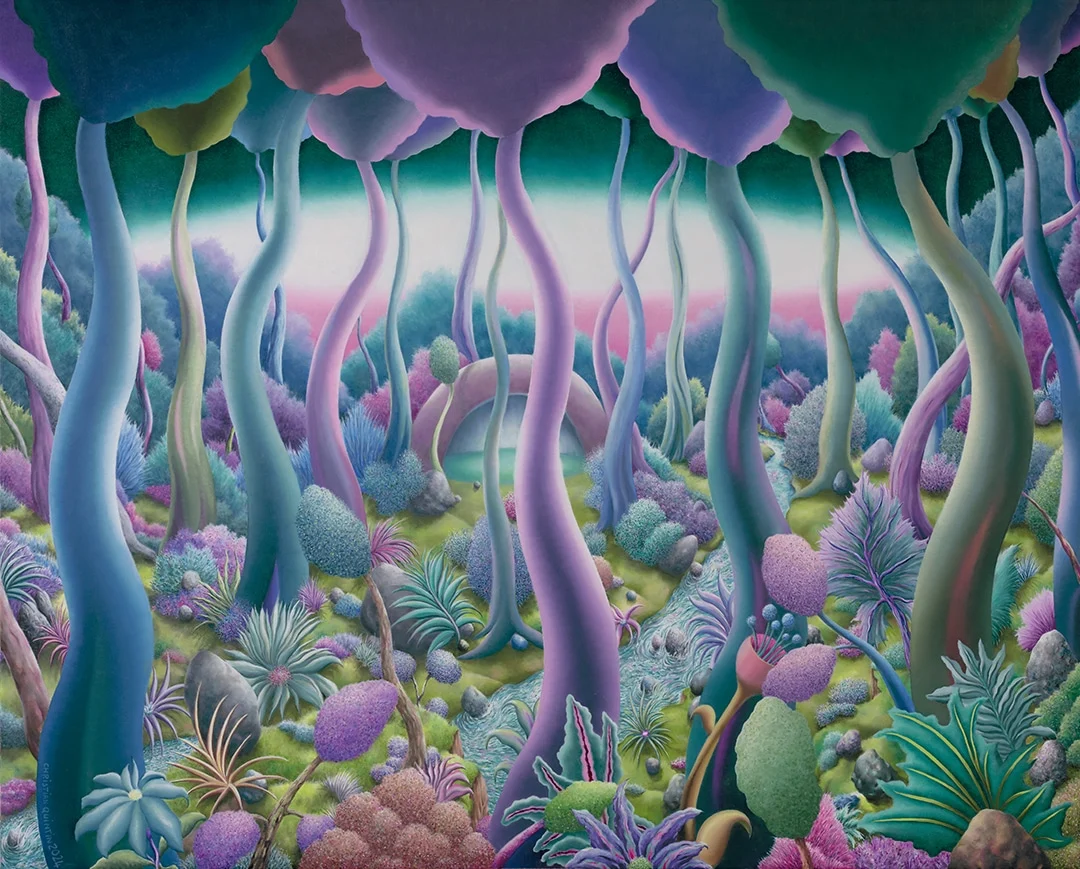
In an era of contemporary art often dominated by rapid-fire digital execution and heavy conceptual irony, the work of Christian Quintin stands as a quiet, defiant monument to patience, beauty, and the subconscious. A French-born painter and draftsman who has spent over four decades in the light of Northern California, Quintin has cultivated a visual language that bridges the gap between classical European Surrealism and the expansive, spiritual ecology of the American West.
Quintin’s oeuvre is not merely a collection of images; it is a unified visual philosophy. His work explores what he terms "kaleidoscopic consciousness," a state where the boundaries between the human psyche and the natural world dissolve into a singular, breathing entity. From the storm-lashed cliffs of his youth in Brittany to the sun-drenched vineyards of Sonoma County, Quintin’s career represents a lifelong pilgrimage toward an art that functions as a "sanctuary for the soul."
Main Facts: The Duality of Presence and Memory
Christian Quintin’s artistic practice is characterized by a rare duality. He operates simultaneously as a master of meticulous, surrealist pen-and-ink compositions and as a romantic landscape painter in oils and pastels. While these may seem like disparate paths, Quintin views them as two eyes seeing the same truth: the internal world of memory is just as vast and structured as the external world of nature.

His technical approach is famously labor-intensive. Some of his most complex works, such as The Aviary or La Porte Ouverte, require six to seven months of daily, disciplined execution. Utilizing cross-hatching, fine-line ink work, and layered glazes, he builds images that demand a "slow looking" from the viewer. This commitment to craft has earned him a place in the lineage of visionary artists like M.C. Escher and Salvador Dalí, though Quintin’s work lacks the aggressive shock value of the early 20th-century Surrealists. Instead, he offers an invitation to wander, treating his canvases like poetry rather than manifestos.
Chronology: From the Armorican Coast to the Golden State
The Breton Foundation (1957–1975)
Born in 1957 in Saint Brieuc, a port town on the northern coast of Brittany, Quintin’s earliest influences were the "moody" landscapes of the French Atlantic. This region, known for its ruined castles, ancient myths, and storm-lashed cliffs, instilled in him a sense of "melancholy grandeur." A specific geographical landmark, L’Île de la Comtesse, became a recurring motif in his mind—a symbol of solitude and architectural mystery that would resurface in his paintings decades later.
The Paris Years and Classical Discipline (1975–1981)
In 1975, Quintin moved to Paris to study at the prestigious Beaux Arts Academy. It was here that his raw romantic instincts were refined by rigorous classical training. He mastered the draftsmanship and control of form that define his current work. While Paris provided him with the history of French Surrealism and Symbolism, it also gave him the technical tools to move beyond mere imitation. He absorbed the lessons of the masters not to replicate the past, but to develop a precision that could make the invisible world of the mind visible.

The California Transformation (1981–Present)
The most significant shift in Quintin’s life and art occurred in 1981 when he moved to Northern California. Settling in Sonoma County, he found a landscape that resonated with his internal state but offered a different palette. The oak-studded hills and redwood forests became his "second vocabulary." This period marked the unification of his style; the old-world myths of Brittany began to merge with the sacred ecology of the West. He began to see the "spirit in a tree" as an extension of himself, leading to his current philosophy where drawing nature is an act of drawing the self.
Supporting Data: Technical Mastery and Symbolic Language
The depth of Quintin’s work is supported by his staggering attention to detail and his refusal to rely on "accidents" or automatism. Unlike the Surrealists who sought "psychic automatism" (unconscious drawing), Quintin’s work is built with extreme intent.
The "Kaleidoscopic Consciousness"
In his surrealist ink works, Quintin explores the "interior constellation" of the mind.

- Case Study: The Aviary: This piece serves as a masterclass in his methodology. Over six months, Quintin constructed a self-portrait where his face emerges from a crystal, his neck transforms into a tree trunk, and his hair becomes a canopy. It is an ecosystem of the self, suggesting that the human identity is not a closed loop but a part of a larger biological and spiritual network.
- Case Study: La Porte Ouverte: Inspired by the Sufi poet Rumi—specifically the line, "Why stay in prison when the door is wide open?"—this work utilized seven months of meticulous cross-hatching. It transforms a philosophical question into a visual meditation, using symbols that blur the lines between logic and dream.
The Emotive Landscape
Parallel to his ink drawings are his works in oil and pastel, which he describes as "emotional terrains."
- Color as Feeling: In works like A Lake Color of Emeralds, Quintin departs from literal representation. He uses brown-orange skies and bright emerald waters to convey a specific mood.
- The Animism of Form: In Leaves of Absence and Les Amants, trees are not static objects; they sway like dancers or embrace like human lovers. This personification of nature is a hallmark of his romantic sensibility.
Official Responses: Critical Reception and Market Evolution
For much of his career, Quintin was a celebrated but primarily regional figure in the California art scene. However, critical reception has consistently pointed toward the "timelessness" and "beauty" of his work—qualities that were often out of fashion in the late 20th-century art market but have seen a massive resurgence in the 21st.
Critical Acclaim
Critics have frequently highlighted the "mental" quality of his landscapes. Suzanne Munich famously titled her review of his work "Mental Landscapes," noting that his paintings are as much about the viewer’s interior state as they are about the scenery. Dan Taylor of the Press Democrat described his work as "Emerging Beauty," a sentiment echoed by a 2022 Calabi Gallery review which stated: "In an era largely devoid of it, his work is beautiful. We could all use more beauty in our lives." This diagnosis suggests that Quintin’s work fills a psychological gap left by the cynicism of modern conceptualism.

The Vorpal Connection and Global Expansion
A major institutional validation came in 1999 when the Vorpal Gallery—the gallery responsible for introducing M.C. Escher to the United States—began representing Quintin. This placed him firmly within the "Visionary Continuum," a lineage of artists who use high-level technique to explore "mind-bending" ideas.
In the 2020s, Quintin’s market reach expanded internationally. Represented by Lorin Gallery (Los Angeles/Paris), his work has been featured at:
- KIAF (Seoul)
- Art Central (Hong Kong)
- Morrison Gallery (Connecticut)
This global trajectory indicates that the "art world has caught up" to Quintin, rather than the artist changing his style to fit contemporary trends.

Implications: Beauty as a Form of Resistance
The resurgence of interest in Christian Quintin’s work carries significant implications for the direction of contemporary art. His career suggests a "Visionary Turn"—a movement away from irony and toward "wonder."
1. The Rejection of Irony
In a cultural landscape often defined by speed and spectacle, Quintin’s six-month-long projects are an act of defiance. He proves that there is still a profound hunger for "slowness" and "care." By offering beauty without a hidden "gotcha" or political slogan, he provides what curators call a "sanctuary."
2. The Ecological Connection
Quintin’s work anticipates the growing cultural need to reconnect with the natural world. His philosophy—that the "inner psyche" and "outer terrain" are a seamless language—aligns with modern ecological thought that views humanity as part of, not separate from, the environment.

3. The Bridge Between Cultures
Quintin remains a vital link between the European tradition of meticulous craftsmanship and the American spirit of exploration. He is a "bridge" artist: between the tree and the dream, between the precision of the hand and the intuition of the soul.
Conclusion: A Wondrous Sanctuary
Christian Quintin does not paint what he sees; he paints what we remember feeling before we had the words to describe it. His legacy is one of "reentry"—using art as a way to step back into the hidden dimensions of reality that are often obscured by the noise of modern life.
As he continues to exhibit in major art capitals from Paris to Seoul, Quintin remains anchored in the quiet valleys of Northern California, following his own advice: "Intuition first. Technique follows." For those who encounter his work, the experience is less like visiting a gallery and more like entering a "wondrous sanctuary for the soul," where every line of ink and every stroke of pastel is a reminder that beauty is not an escape from reality—it is the very heart of it.