"Fascinating Folklore": A Groundbreaking Compendium Weaves Ancient Myths into Modern Artistry
FOR IMMEDIATE RELEASE
LONDON, UK – A new benchmark in the exploration of global mythology has been set with the release of "Fascinating Folklore," a meticulously crafted compendium that marries scholarly insight with breathtaking graphic storytelling. Penned by acclaimed comic world luminaries John Reppion and PJ Holden, this ambitious project transcends traditional boundaries, offering an unparalleled journey into the heart of ancient tales and cultural narratives.
Main Facts: A New Era for Folklore Enthusiasts
"Fascinating Folklore," published by Liminal 11, emerges as a vital contribution to both the study of mythology and the art of graphic narration. This unique volume is the brainchild of writer John Reppion, known for his work in supernatural and historical fiction, and artist PJ Holden, celebrated for his dynamic and atmospheric illustrations across various comic titles. Together, they have forged a creative alliance that brings a fresh, contemporary lens to humanity’s oldest stories.
The compendium distinguishes itself by presenting "rich and informative essays" alongside "breathtaking comics," creating a multi-sensory experience designed to captivate a broad audience. Unlike conventional anthologies, "Fascinating Folklore" does not merely recount tales; it immerses the reader in them, offering both intellectual depth and visual splendor. Its primary goal is to make the vast and intricate world of folklore accessible, engaging, and relevant to modern readers, from seasoned folklorists to curious newcomers.
The book delves into a diverse array of myths, legends, and cultural beliefs from across the globe. Featured narratives include the epic sagas of historical figures like Boudicca and Beowulf, the mystical insights of plantlore (exploring the secrets of Mandrake, Willow, and the elusive Yedua), and chilling encounters with spectral entities such as Okiku of Japan and the ancestral Wandjing spirits of Western Australia. Furthermore, it shines a light on lesser-known deities, exemplified by Anteros, the resolute Greek guardian of slighted love, providing a nuanced perspective on divine complexities.
This innovative approach promises to leave readers "spellbound," bridging the gap between academic discourse and popular appeal. The blend of meticulously researched text and evocative artwork positions "Fascinating Folklore" not just as a book, but as an experience, an invitation to rediscover the magic inherent in the human imagination.
Chronology: From Hashtag to Historical Masterpiece
The genesis of "Fascinating Folklore" can be traced back to a seemingly simple yet profoundly influential online phenomenon: the #FolkloreThursday hashtag. This popular social media movement, which encourages the sharing and discussion of folklore every Thursday, served as the initial spark for Reppion and Holden’s collaborative endeavor. What began as a "creative pact" fueled by shared enthusiasm for myth and legend, swiftly blossomed into a comprehensive and extraordinary compendium.
H3: The Genesis: A Digital Spark Ignites a Creative Pact
FolkloreThursday, a vibrant online community, has, for years, provided a platform for scholars, enthusiasts, and storytellers to share snippets of global folklore. It fosters a collective appreciation for the diverse tapestry of human storytelling. It was within this digital crucible of shared knowledge and passion that John Reppion and PJ Holden found their initial inspiration. Both established figures in the comic book industry, Reppion with his critically acclaimed writing often touching on the arcane and historical, and Holden with his distinctive, atmospheric art, recognized the immense potential in translating this collective fascination into a tangible, immersive format. Their shared vision was to create a work that would not only document folklore but also celebrate its narrative power through their respective crafts.
H3: The Development: A Harmonious Blend of Text and Art
The development of "Fascinating Folklore" involved a rigorous and symbiotic creative process. Reppion, with his deep well of knowledge in mythology and occult history, undertook the meticulous research and essay writing. His aim was not just to present facts but to weave compelling narratives that contextualize each piece of folklore within its cultural and historical framework. This required delving into ancient texts, ethnographic studies, and historical accounts to ensure accuracy and depth.
Concurrently, Holden translated Reppion’s rich narratives into dynamic visual sequences. His task was to capture the essence of each myth, whether it be the terror of a sea monster, the pathos of a vengeful spirit, or the ethereal beauty of a woodland deity, through his unique artistic style. The synergy between writer and artist was crucial; the essays needed to flow seamlessly into the comics, and vice-versa, to create a cohesive and engaging reading experience. This collaborative dance, where words inform images and images deepen understanding of words, is what gives "Fascinating Folklore" its distinctive character. The decision to integrate essays and comics was not merely stylistic; it was a pedagogical choice, recognizing that different forms of media can illuminate complex subjects in complementary ways.
H3: Publication and Release
The arduous journey of research, writing, and illustration culminated in the publication of "Fascinating Folklore" by Liminal 11. Although a specific release date isn’t explicitly mentioned, the digital timestamp of the provided content suggests a late 2023 release, positioning it as a significant new offering for the holiday season and beyond. Liminal 11, known for its focus on esoteric, spiritual, and mythological subjects, is an ideal publisher for a work that seeks to explore the deeper currents of human belief and imagination. Their commitment to visually stunning and intellectually stimulating publications aligns perfectly with the ethos of Reppion and Holden’s compendium.
Supporting Data: A Deep Dive into Featured Lore
"Fascinating Folklore" promises a rich tapestry of myths, each brought to life with scholarly detail and compelling artwork. The excerpts provided offer a tantalizing glimpse into the breadth and depth of the compendium’s content.
H3: Island: The Deceptive Depths of the Aspidochelone and Zaratan
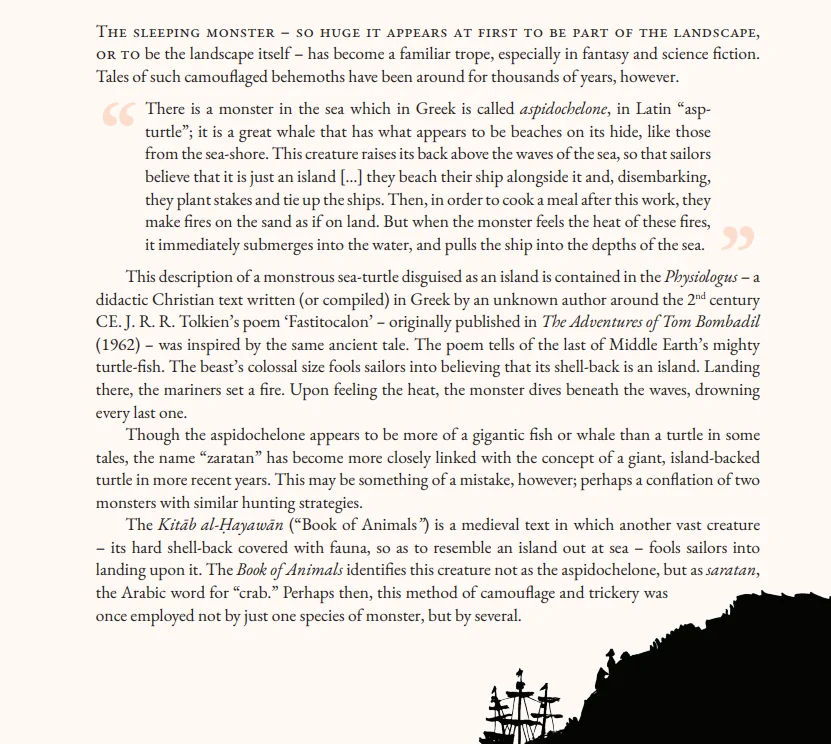
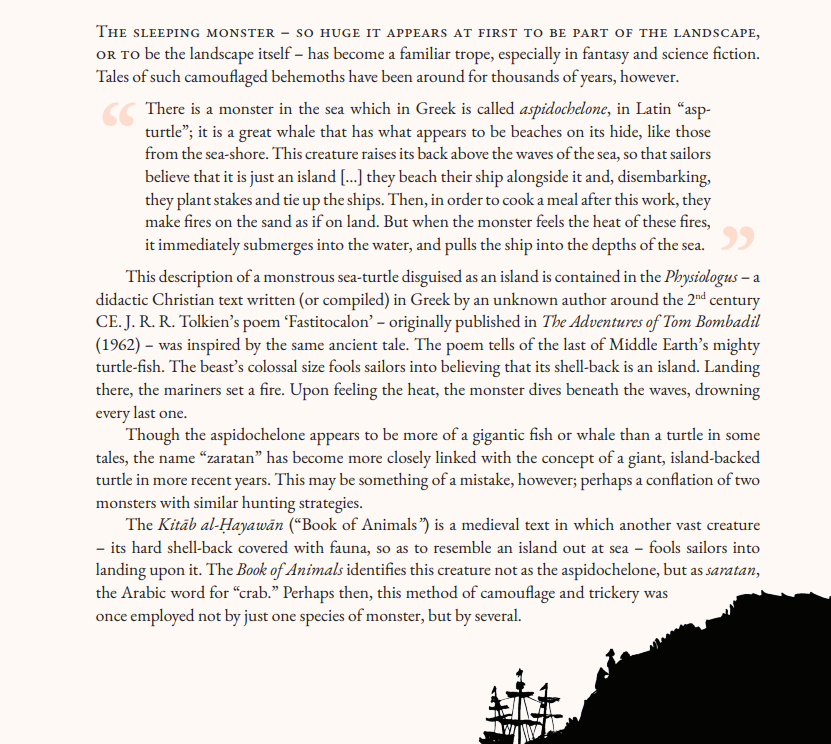
One of the most captivating tales featured is that of the "Island" monster, a colossal sea creature so immense that its back appears as land, luring unsuspecting sailors to their doom. The excerpt vividly describes the aspidochelone, a Greek term for "asp-turtle," a "great whale that has what appears to be beaches on its hide." Sailors, mistaking it for an island, land their ships, make fires, and only then does the monster submerge, dragging vessels and crew into the abyss.
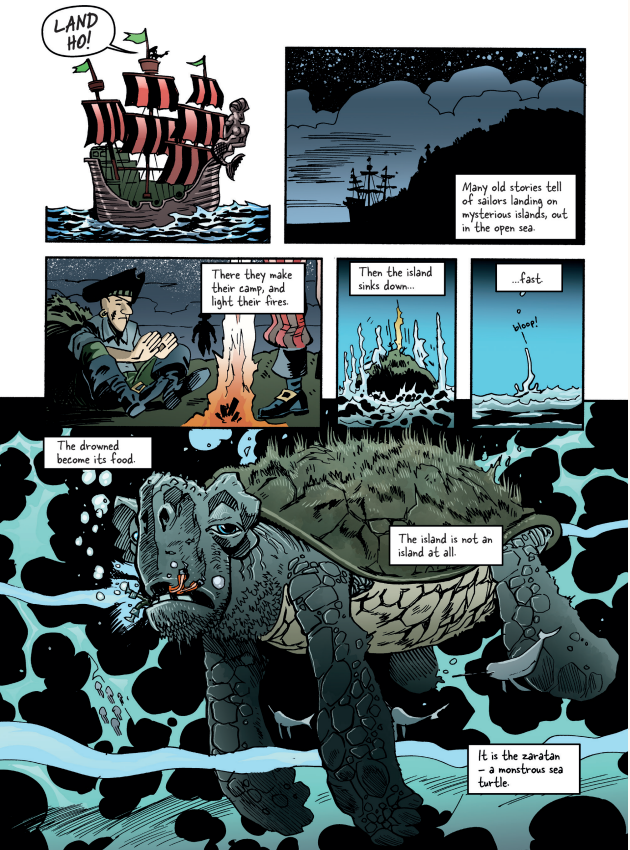
This ancient trope, the sleeping behemoth camouflaged as landscape, has permeated fantasy and science fiction for millennia. Its origins can be traced to the Physiologus, a didactic Christian text compiled by an unknown Greek author around the 2nd century CE. This early bestiary used allegorical animal descriptions to teach moral and theological lessons, and the aspidochelone served as a potent symbol of deceptive appearances and the perils of worldly temptations.
The myth’s enduring appeal is evident in its modern reinterpretations. J.R.R. Tolkien, a master of myth-making, drew inspiration from this very tale for his poem "Fastitocalon," published in The Adventures of Tom Bombadil (1962). Tolkien’s poem recounts the fate of the last of Middle-earth’s mighty "turtle-fish," whose colossal shell-back is mistaken for an island, leading mariners to their watery graves after lighting a fire on its back.
The excerpt also highlights an interesting linguistic and mythological conflation. While "aspidochelone" suggests a whale or large fish, the name "zaratan" has become popularly associated with the island-backed turtle in recent years. This connection might stem from a misunderstanding or a merging of similar legends. The Kitāb al-Ḥayawān ("Book of Animals"), a medieval Arabic text, describes a vast creature with a hard, fauna-covered shell resembling an island. Crucially, this text identifies the creature not as an aspidochelone, but as saratan, the Arabic word for "crab." This suggests that the motif of a camouflaged, island-like monster was not exclusive to one species but perhaps a shared predatory strategy across several mythical sea creatures, from giant whales and turtles to colossal crabs. This exploration into etymology and cross-cultural variations enriches the understanding of how myths evolve and intertwine.
H3: Anteros: The Unsung God of Reciprocated Love
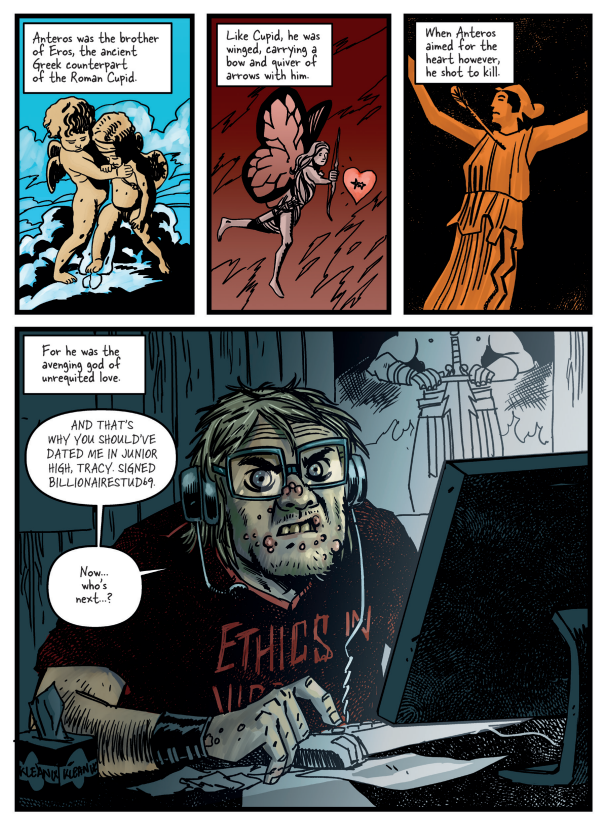
While Eros, the winged god of desire, has been popularized as the cherubic Cupid, his lesser-known brother, Anteros, holds a profoundly significant, albeit darker, role in the Greek pantheon. The excerpt introduces Anteros, whose name translates to "love returned," as the deity "charged with the task of punishing those who did not return the affections of another."
Anteros’s lineage traces back to Aphrodite, the goddess of love and beauty, and Ares, the god of war. He is one of the Erotes, a group of winged gods who assisted Aphrodite in her earthly duties. While Eros embodied love and sexual desire, his brothers had more specific domains: Hedylogos (sweet talk), Pothos (longing), Hymenaeus (weddings), and Hermaphroditus (fertility). Anteros, however, represented the necessary balance to Eros – the consequence of unrequited love.
Historical texts, such as Thomas Swinburne Carr’s A Manual of Classical Mythology (1846), further illuminate Anteros’s role as "Deus ultor" or "avenger." He was often depicted in conflict with Eros, symbolizing the struggle between two lovers or the punitive aspect of love. Interestingly, Carr notes a fable where Cupid’s strength and wings enlarge only when Anteros is near, suggesting that true love (Eros) can only fully flourish in the presence of reciprocation (Anteros), or the threat of its absence. Anteros was typically armed with lead arrows, signifying the weight and pain of unrequited affection, or a club of solid gold, representing the valuable but often elusive nature of true reciprocity.
A fascinating modern-day example of Anteros’s overlooked significance is the iconic statue atop the Shaftesbury Memorial Fountain in Piccadilly Circus, London. Widely, and mistakenly, known as "Eros" for decades, the sculpture, cast in aluminum in 1892, actually represents Anteros. It was chosen to symbolize "love given blindly, or without expectation of return," reflecting the philanthropy of Lord Shaftesbury, to whom the fountain is dedicated. This poignant detail underscores how profoundly Anteros’s story has been misunderstood or overshadowed, despite his critical role in the complex tapestry of human emotions.

H3: Okiku: The Enduring Wail of the Vengeful Spirit
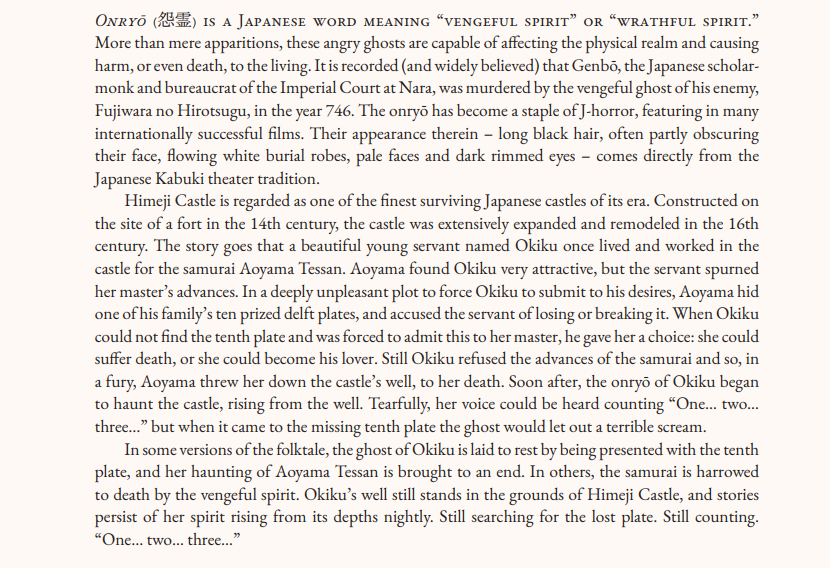
The chilling tale of Okiku, a Japanese onryō, offers a stark look into the consequences of injustice and the enduring power of vengeful spirits. The excerpt recounts the legend of a beautiful young servant named Okiku, who worked for the samurai Aoyama Tessan at Himeji Castle. When Okiku spurned Aoyama’s advances, he enacted a cruel plot: hiding one of his family’s ten prized delft plates and accusing her of its loss. Faced with a choice between death or becoming his lover, Okiku steadfastly refused, leading Aoyama to throw her down the castle well to her death.
Soon after, the onryō of Okiku began to haunt the castle, rising from the well with a mournful count: "One… two… three…" Her voice would trail off into a "terrible scream" when she reached the missing tenth plate.
Onryō (怨霊), meaning "vengeful spirit" or "wrathful spirit," are a central figure in Japanese folklore and horror. Unlike mere ghosts, onryō are capable of affecting the physical realm, causing harm, illness, or even death to the living. Their appearance – long black hair often obscuring their face, flowing white burial robes, pale skin, and dark-rimmed eyes – has become iconic, directly influencing the imagery of J-horror cinema, as seen in internationally successful films like Ringu (The Ring) and Ju-on (The Grudge). The belief in onryō is ancient, with documented cases such as the belief that Genbō, a Japanese scholar-monk, was murdered by the vengeful ghost of Fujiwara no Hirotsugu in 746 CE.
The legend of Okiku is deeply rooted in specific locations, most famously Himeji Castle, one of Japan’s most magnificent surviving feudal castles. Her well, known as Okiku’s Well, still stands on the castle grounds, a potent reminder of the tragic legend. Variations of the tale exist; in some, the ghost is finally appeased by the return of the tenth plate, bringing her haunting to an end. In others, Aoyama Tessan is relentlessly tormented to death by her spirit. The legend persists, with stories of her spirit rising nightly, perpetually searching for the lost plate, forever counting.
H3: Glimpses of Other Lore: From Warriors to Whispering Flora
"Fascinating Folklore" extends its reach to a multitude of other captivating narratives:
- Boudicca: The fierce Celtic warrior queen who led a major uprising against the Roman Empire in ancient Britain. Her story is one of defiance, courage, and a desperate fight for freedom against overwhelming odds, embodying the spirit of resistance in the face of tyranny.
- Beowulf: The legendary hero of the Old English epic poem, renowned for his superhuman strength and his battles against monstrous adversaries like Grendel, Grendel’s mother, and a fearsome dragon. Beowulf’s saga is a cornerstone of Anglo-Saxon literature, exploring themes of heroism, fate, and the struggle between good and evil.
- Plantlore: The compendium delves into the mystical world of plants, exploring their symbolic meanings, magical properties, and traditional uses.
- Mandrake: Known for its human-like root and its association with powerful magic, fertility, and even a deadly scream upon being uprooted.
- Willow: Often linked to melancholy, flexibility, healing, and water, with connections to witchcraft and lunar cycles in various traditions.
- Yedua: While less commonly known, its inclusion suggests an exploration of more obscure or localized plant myths, further diversifying the book’s scope.
- Wandjing Spirits: From the rich Aboriginal mythology of Western Australia, these ancestral spirits represent a deep connection to the land, its history, and the spiritual dimensions of the Dreamtime. Their inclusion highlights the book’s commitment to showcasing indigenous folklore and its profound cultural significance.
Official Responses: A Publisher’s Vision and Anticipated Acclaim
Liminal 11, the publisher of "Fascinating Folklore," specializes in titles that explore the mystical, the magical, and the mythological. Their editorial philosophy aligns perfectly with Reppion and Holden’s vision, emphasizing both intellectual rigor and aesthetic beauty. While official reviews may still be emerging given the book’s recent release, the very nature of Liminal 11’s catalogue suggests a strong belief in the project’s potential.
The publisher’s implicit "response" is their investment in a work that meticulously blends academic essay with comic art – a testament to their confidence in the project’s ability to resonate with a diverse readership. Such a hybrid format is often lauded for its accessibility, making complex subjects digestible and engaging for those who might find purely academic texts intimidating. Early indications from the authors’ previous works and the buzz generated around #FolkloreThursday suggest that "Fascinating Folklore" is poised to receive critical acclaim for its innovative approach, its depth of research, and the captivating quality of its artwork. It is anticipated to be celebrated as a significant work that not only entertains but also educates and inspires a renewed appreciation for the world’s diverse folkloric heritage.
Implications: Revitalizing Ancient Narratives for a Modern World
"Fascinating Folklore" carries significant implications for how ancient stories are consumed, understood, and preserved in the 21st century.
H3: Revitalizing Folklore for a Modern Audience
In an increasingly digital and globalized world, there’s a constant challenge to keep traditional narratives alive and relevant. "Fascinating Folklore" offers a powerful solution by presenting these stories in a dynamic, contemporary format. By combining scholarly essays with vibrant graphic narratives, Reppion and Holden ensure that the depth and cultural context of each myth are preserved, while the visual storytelling makes them immediately engaging to a generation accustomed to visual media. This approach helps to prevent folklore from becoming relegated solely to academic archives, instead placing it firmly in the cultural mainstream. It demonstrates that these ancient tales are not relics of the past but living narratives that continue to resonate with universal human experiences.
H3: Educational and Cultural Value
The compendium possesses immense educational value. Its structure—informative essays paired with illustrative comics—makes it an ideal resource for both casual learners and more formal educational settings. Students of literature, history, anthropology, and art could find "Fascinating Folklore" to be an invaluable tool for understanding cross-cultural narratives, artistic interpretation of myth, and the evolution of storytelling. It fosters cultural literacy by exposing readers to a wide array of global traditions, encouraging empathy and understanding across different societies. By highlighting figures like Boudicca and Beowulf alongside Okiku and the Wandjing spirits, the book champions a truly global perspective on human mythology.
H3: Bridging the Gap Between Academia and Popular Culture
One of the most profound implications of "Fascinating Folklore" is its success in bridging the often-wide gap between academic scholarship and popular culture. Traditional folklore studies, while rich in detail, can sometimes be inaccessible to the general public. Comic books and graphic novels, on the other hand, boast a massive and diverse readership. By utilizing this popular medium, Reppion and Holden democratize access to complex folkloric themes, inviting a broader audience to engage with material they might otherwise overlook. This crossover appeal can invigorate both fields, bringing new readers to folklore studies and adding intellectual depth to the graphic novel genre.
H3: The Enduring Power of Narrative
Ultimately, "Fascinating Folklore" serves as a powerful testament to the enduring power of narrative. These ancient myths, whether they concern monstrous sea creatures, avenging deities, or spectral women, reflect fundamental human fears, hopes, values, and the eternal quest for meaning. They speak to our collective unconscious, providing frameworks for understanding the world and our place within it. By presenting these stories with such care and creativity, Reppion and Holden remind us that myths are not just fantastical tales but crucial cultural artifacts that continue to shape our perceptions and inspire our imaginations. The success of this project could well inspire further interdisciplinary works, fostering a new golden age for collaborative storytelling that draws from the deepest wells of human history.
"Fascinating Folklore" is more than just a book; it’s an invitation to embark on an epic intellectual and visual adventure, promising to leave readers enriched, enlightened, and utterly spellbound. It is available for order now at liminal11.com/product/fascinating-folklore/.