
The Cartography of Consciousness: The Visionary Surrealism of Christian Quintin
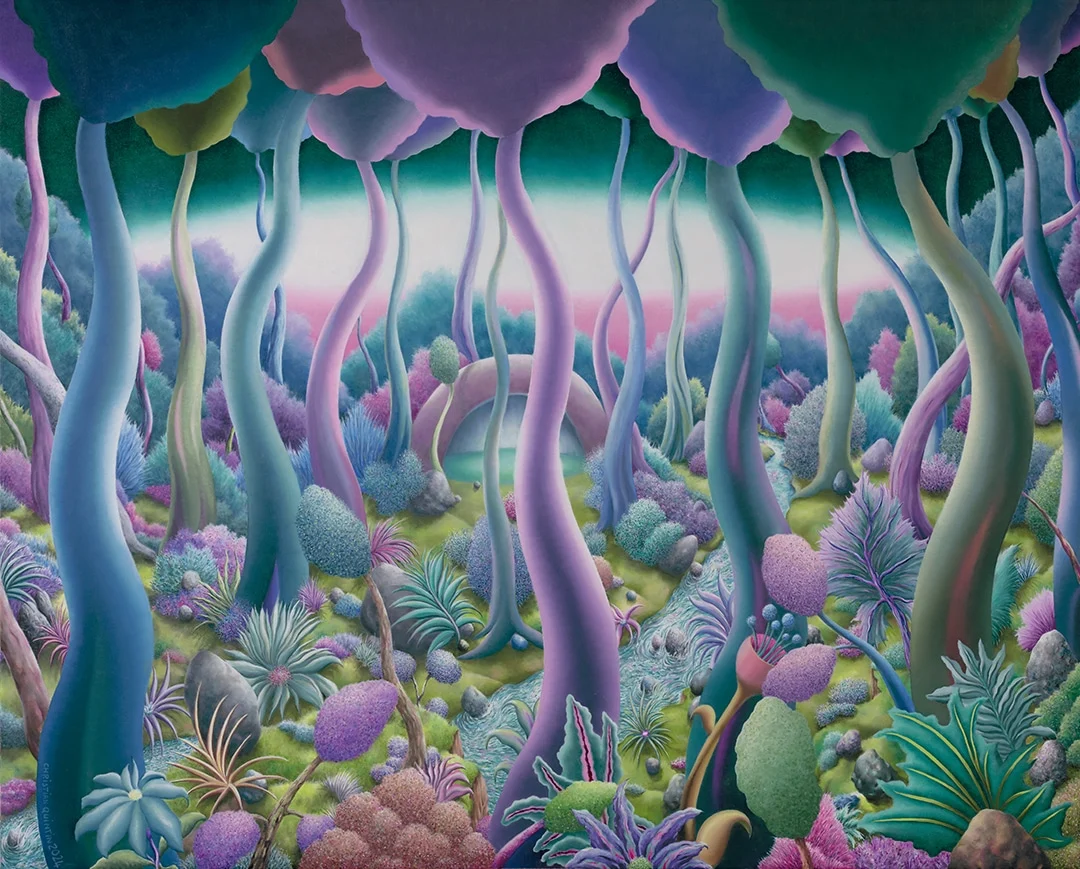
For over four decades, Christian Quintin has operated as a silent architect of the subconscious, constructing bridges between the rugged coastlines of Brittany and the rolling vineyards of Northern California. A painter whose work defies the transient trends of the contemporary art world, Quintin has carved out a unique space where classical draftsmanship meets a deeply felt, romantic surrealism. His images do not merely document the world as it appears; they map the "kaleidoscopic consciousness" of the human experience, translating memory, emotion, and intuition into a seamless symbolic language.
Main Facts: A Unified Vision of Inner and Outer Worlds
Christian Quintin is a French-born artist whose practice spans ink, oil, graphite, and pastel. While often categorized under the umbrella of surrealism, Quintin’s work avoids the clinical detachment of the Freudian school or the shock-value of the avant-garde. Instead, he pursues what he terms "emotional terrains"—landscapes and portraits that breathe with a life of their own.

His technical approach is characterized by an almost monastic patience. Major works, such as The Aviary or La Porte Ouverte, often take six to seven months to complete, involving intricate cross-hatching and layered glazing that suggest a lineage back to the Old Masters. Despite this technical rigor, Quintin maintains that his process is fundamentally intuitive. He invites the viewer to "read the art as one would read poetry," suggesting that the meaning of a piece lies not in a predetermined message, but in the viewer’s willingness to wander into its imagery.
Represented internationally by Lorin Gallery (Los Angeles and Paris), Quintin’s work has seen a significant resurgence in the 2020s, appearing at major global art fairs like KIAF in Seoul and Art Central in Hong Kong. This global recognition marks the culmination of a career built on the steady, uncompromising pursuit of beauty as a form of philosophical inquiry.

Chronology: From the Atlantic Coast to the Pacific Rim
1957–1975: The Breton Roots
Christian Quintin was born in 1957 in Saint Brieuc, a port town on the northern coast of Brittany. This formative environment—defined by moody skies, storm-lashed cliffs, and ruined medieval architecture—provided the foundational "alphabet" of his visual language. In particular, the island of L’Île de la Comtesse became a recurring motif in his work, representing a mythic point of return. The solitude and storybook aura of the Breton coast instilled in him an early sensitivity to the "melancholy of nature," a theme that persists in his work today.
1975–1981: The Parisian Discipline
In 1975, Quintin moved to Paris to study at the prestigious École des Beaux-Arts. This period was essential for grounding his romantic instincts in classical discipline. In the ateliers of Paris, he mastered the precise draftsmanship and control of materials that allow his surrealist visions to feel physically tangible. He absorbed the legacies of French Surrealism and the Symbolists, learning that the power of an image often lies in what it reveals rather than what it obscures.

1981–1999: The California Resonance
The most significant shift in Quintin’s life occurred in 1981 when he relocated to Northern California. Settling in the vineyards of Sonoma County, he found a landscape that mirrored the spirit of his Breton home while offering a new, vibrant vocabulary. The sacred ecology of the American West—the giant redwoods, the golden hills, and the Pacific fog—blended with his European sensibilities. During this period, he established himself as a prominent figure in the California art scene, winning the Grumbacher Award in 1987 and an Award of Excellence from the California State Fair in 1990.
1999–Present: Global Recognition
In 1999, Quintin began an association with the Vorpal Gallery, the institution famously responsible for introducing M.C. Escher to the American public. This partnership placed Quintin within a specific lineage of visionary artists who combine high technical mastery with mind-bending conceptual depth. In the 2020s, under the representation of Lorin Gallery, his career transitioned from a regional success to an international phenomenon, with exhibitions spanning Los Angeles, Paris, Seoul, and Connecticut.

Supporting Data: Artistic Style and Methodological Analysis
The Kaleidoscopic Consciousness
Quintin’s surrealism is best understood through his concept of "kaleidoscopic consciousness." In works like The Aviary, the boundaries between the self and the environment are porous. The artist’s face emerges from a crystal, his neck transforms into a tree trunk, and his hair becomes a leafy canopy. This is not a depiction of a dream, but a map of "presence"—an attempt to show how the human mind is an ecosystem of memories and natural forces.
The Psychology of Landscape
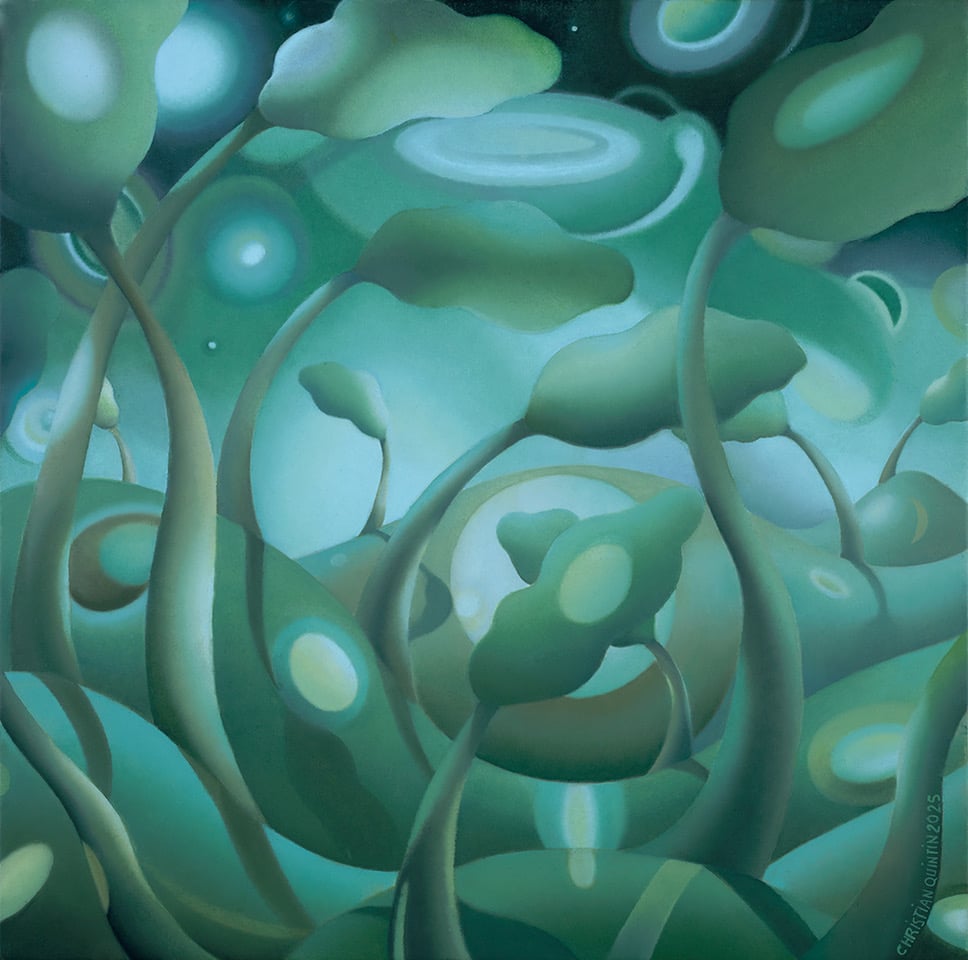
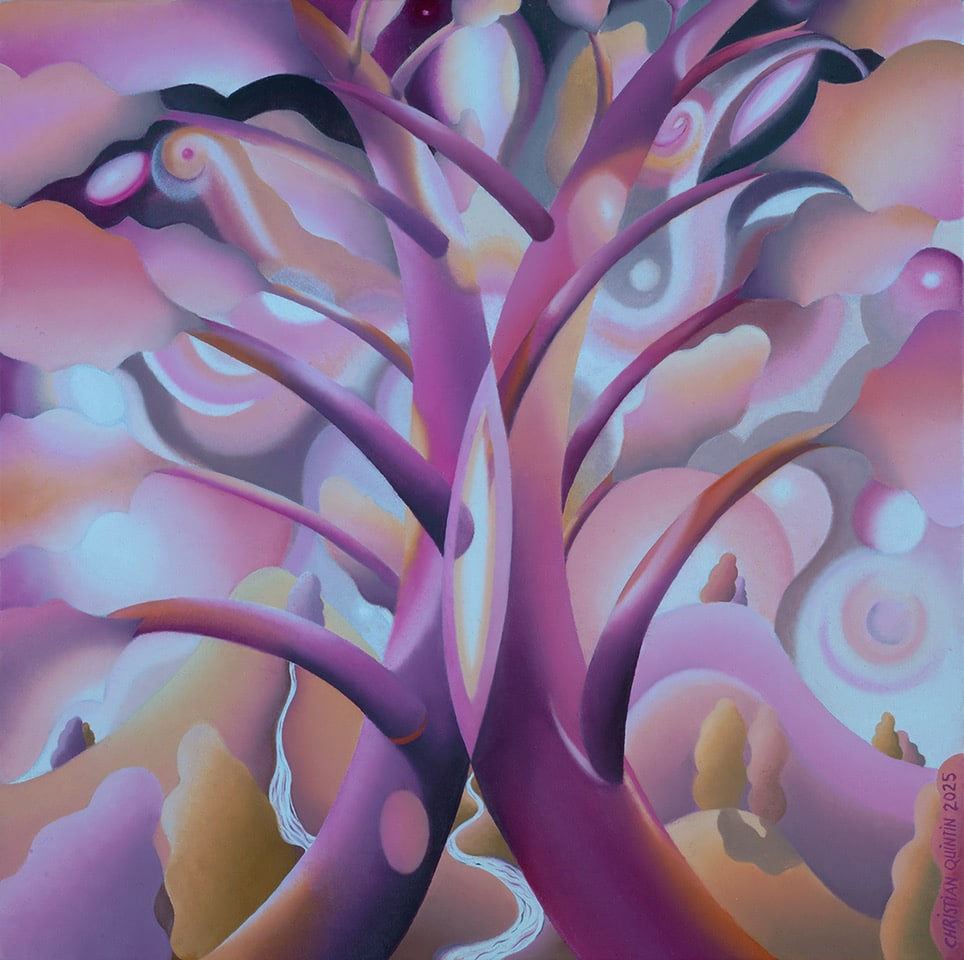
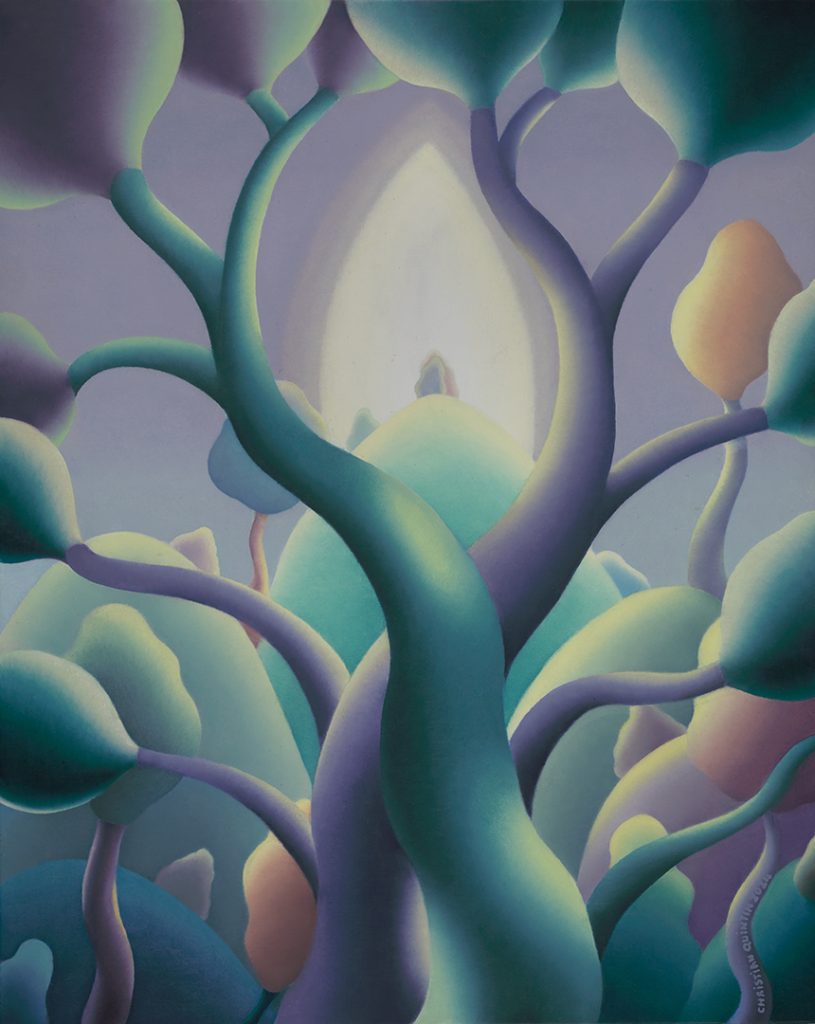
In his "emotive sceneries," Quintin uses color and form to represent internal moods rather than literal geography. In A Lake Color of Emeralds, he utilizes a palette of brown-orange, violet, and olive green to evoke a specific emotional resonance. His landscapes "breathe" because they are treated as living entities. In Leaves of Absence and Les Amants, trees are given human agency, swaying like dancers or embracing like lovers. This anthropomorphism serves to bridge the gap between human consciousness and the "spirit of the tree," a connection Quintin has frequently cited as a core inspiration.

Technical Precision as Meditation
The meticulous nature of Quintin’s work—particularly his pen-and-ink compositions—functions as a form of visual philosophy. The seven-month process behind La Porte Ouverte (inspired by the poetry of Rumi) involves thousands of individual strokes. This slow accumulation of detail mirrors the slow unfolding of an idea. For Quintin, technique is the servant of intuition; by mastering the "how," he frees himself to explore the "why" without the interference of logic.
Official Responses: Critical Reception and Curatorial Perspectives
Over the decades, critics have consistently noted that Quintin’s work fills a specific void in the modern art landscape—a void left by the prevalence of irony and cynicism.

- The Press Democrat: Critic Dan Taylor described Quintin’s work as "Emerging Beauty," highlighting the artist’s ability to pull graceful forms out of complex, layered compositions.
- Suzanne Munich: In her review titled "Mental Landscapes," Munich focused on the psychological depth of the work, noting that Quintin’s paintings act as mirrors for the viewer’s own internal state.
- Calabi Gallery (2022): A recent retrospective review emphasized the radical nature of Quintin’s pursuit of the aesthetic: "In an era largely devoid of it, his work is beautiful. We could all use more beauty in our lives." This sentiment echoes a growing sentiment among curators that Quintin’s work serves as a "wondrous sanctuary for the soul."
- Alhia Warren: The critic characterized his portfolio as a "beautiful intimate mystery," suggesting that the power of the work lies in its invitation to the viewer to participate in the completion of its meaning.
The association with the Vorpal Gallery remains a critical benchmark. By being exhibited alongside artists like Escher, Quintin was codified as a "Visionary Artist"—a title that acknowledges his ability to make the impossible feel structurally sound and legible.
Implications: Legacy and the Visionary Continuum
The Return to Beauty as Defiance
In the context of the 21st-century art market, which often prioritizes "the message" or "the critique" over the object itself, Christian Quintin’s practice is a form of quiet defiance. By focusing on beauty, craft, and intuition, he rejects the didactic nature of much contemporary art. The implication of his success is that there remains a profound, global hunger for art that speaks to the "sacred geometry" of thought and feeling rather than political or social commentary.
Bridging the Visionary Movements
Quintin represents a bridge between two major traditions: European Surrealism (the lineage of Dalí and Magritte) and the Northern California Visionary Art movement. While the latter often leans toward the psychedelic and chaotic, Quintin brings a European restraint and classical elegance to the visionary experience. This synthesis has allowed his work to resonate in diverse cultural contexts, from the high-paced art markets of East Asia to the traditional salons of Paris.
The Slow Art Movement
As the art world increasingly grapples with the impact of AI and digital reproduction, Quintin’s "slow art"—the six-month ink drawing, the hand-layered oil glaze—stands as a testament to the irreplaceable value of the human hand and the human timeline. His legacy is likely to be defined by this commitment to "slowness," reminding both artists and collectors that the most profound insights are often those that take the longest to emerge.
Conclusion: A Sanctuary for the Soul
Christian Quintin’s body of work is more than a collection of paintings; it is a reentry into a hidden dimension of reality. Whether through the depiction of a "dancer" tree in Sonoma or a "room-filled" face inspired by a Rumi poem, he offers a sanctuary from the speed and spectacle of modern life. In his unified vision, the tree and the dream are one, the inner psyche and the outer terrain are a single landscape, and beauty is not an escape from the world—but a way to truly see it.
For those seeking to explore this "kaleidoscopic consciousness," Quintin’s work can be found in the permanent collections of California institutions and through his representative galleries, Lorin and Morrison. As his international footprint continues to grow, he remains anchored by his original invitation: to see the art as poetry and to wander, without a map, into the imagery of the self.
Where to See His Work:
- Lorin Gallery: Los Angeles / Paris
- Morrison Gallery: Kent, Connecticut
- Online Portfolio: christianquintin.com


Leave a Comment