The Haunting Echo: Unpacking North America’s Obsession with the "Indian Burial Ground" Trope

In North America, the chilling claim that a haunted house or cursed land sits atop an "Indian burial ground" has transcended mere urban legend to become a deeply ingrained, yet profoundly problematic, fixture of popular culture. This pervasive trope, used repeatedly as a literary device in horror, has journeyed from terrifying cliché to comedic meme, revealing a complex tapestry of historical anxieties, cultural misunderstandings, and unresolved colonial guilt. Far from being an innocuous plot device, the "Indigenous burial ground" narrative often distorts history, disrespects Indigenous cultures, and ultimately, blames the wronged for the very injustices they suffered.
This article delves into the origins and evolution of this ubiquitous trope, examining its problematic implications and the crucial need for a more critical and respectful understanding of Indigenous histories and spiritualities.
A Troubled History: Tracing the Trope’s Genesis and Evolution
The idea of land being cursed by disturbed Indigenous graves is not a recent invention. Its roots stretch back into earlier periods of North American history, reflecting colonist fears and anxieties long before it solidified into a mainstream pop culture phenomenon.
Early American Apprehensions: Indigenous Ghosts Before the Mainstream
Before the trope found its most prominent mainstream expressions, faint echoes of Indigenous-related hauntings appeared in regional folklore and local news. Renee L. Berland, in her work The National Uncanny: Indian Ghosts and American Subjects, notes that many early American writers were preoccupied with Indigenous ghosts. This obsession often mirrored a broader colonial dread, as seen in the late 19th century. For instance, newspapers in 1890 reflected settler fear as the Ghost Dance movement gained momentum across North America. This ceremonial dance, intended to raise the spirits of recently deceased tribe members for protection against settler injustices, tragically culminated in the Wounded Knee Massacre. The U.S. Army killed 150-300 Lakota people, mostly women, children, and Elders, demonstrating a profound fear of resurrected Indigenous spirits that paradoxically fueled the creation of new ones.
Closer to home for the author, early 20th-century Canadian reports also hinted at this developing narrative. In 1924, the Victoria Daily Times reported that seven road builders in British Columbia were haunted for four nights after setting up camp. They described "whishing" sounds and rapping noises between 8 PM and 2 AM. Despite searching with lanterns and looking for animal prints, they found nothing concrete, ultimately concluding their camp was built on the grave of a "Red Indian" and relocating.
Further examples illustrate the burgeoning idea:
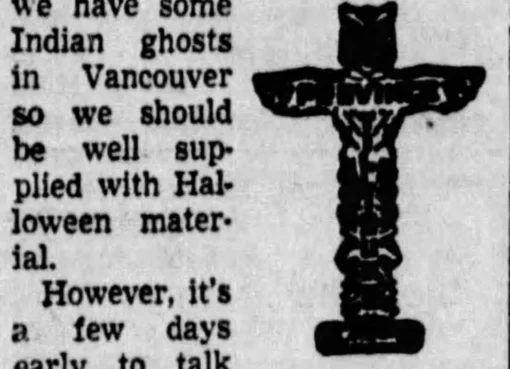
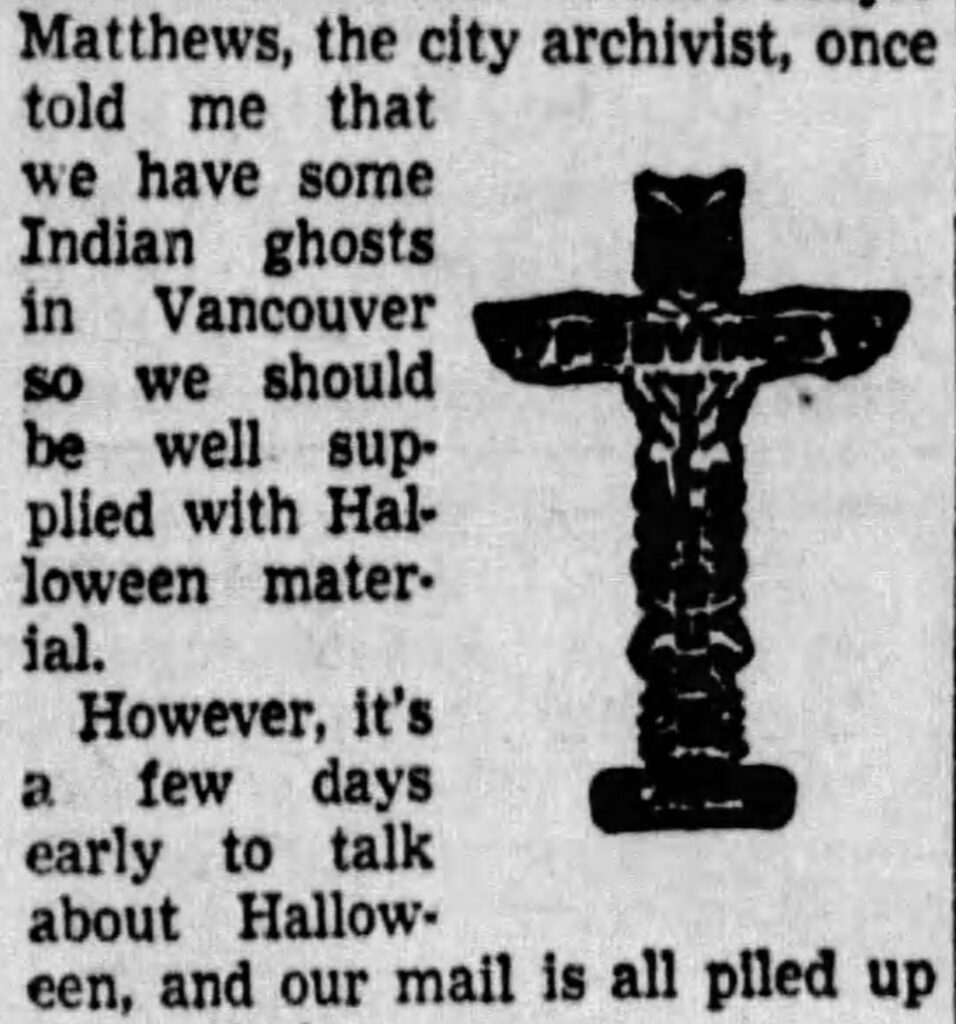
- In 1940, City Archivist Major Mathews cryptically informed a Province reporter that Vancouver harbored "Indian ghosts," an isolated mention within an article otherwise dedicated to Halloween festivities for youth. The brevity and lack of elaboration suggest it was a notion understood, if not fully detailed.
- A 1946 Vancouver Sun article from Ontario recounted sightings of a headless woman’s ghost, seen near the rumored secret burial site of Tecumseh, the famed Shawnee chief who sought to unite Indigenous groups against American expansion. The ghost of an unnamed woman, rather than Tecumseh himself, being tied to his grave, highlights an evolving narrative where Indigenous burial sites, even rumored ones, became loci for spectral activity.
- Pulp writer Bjarne Kirchhoff, in his 1950 Vancouver Sun story "The Ghost of Graveyard Flats," featured an Indigenous burial ground haunted by a wendigo, a chilling 33 years before Stephen King would famously appropriate the Algonquian legend.
These early instances, though varied, collectively laid groundwork for the more explosive popularization of the trope that was to come.
The Amityville Catalyst: From Tainted Land to Vengeful Spirits
The "Indigenous burial ground" trope found its most potent mainstream catalyst in the infamous Amityville Horror narrative. Jay Anson’s 1977 book, The Amityville Horror: A True Story, became a runaway bestseller, captivating audiences with its tale of a haunted Long Island home. Anson initially claimed the Amityville house was built not on a burial ground, but on an old Shinnecock "enclosure for the sick, mad, and dying," a place where people were "penned up" until they died of exposure. He specified that no burials occurred there, as the Shinnecock allegedly believed the land was infested with demons. This original account introduced the concept of "tainted Indigenous land" as a source of malevolence.
However, the narrative took a significant and problematic turn later that year. Celebrity TV ghost hunter Hans Holzer, accompanied by medium Ethan Johnson Meyers and others, investigated the Amityville house. Holzer’s subsequent claims dramatically reshaped the story: according to him, the ghost of an Indigenous chief contacted Meyers, asserting responsibility for the murders of Ronald DeFeo Jr.’s family—including his four younger siblings—by possessing DeFeo. Until this point, the victims themselves had been implicated in the haunting, but now, an Indigenous ghost was recast as the true culprit. The highly anticipated 1979 Amityville Horror movie adapted Holzer’s sensational, unfounded claims, cementing the "Indigenous ghost as vengeful perpetrator" into the popular imagination. This dramatic shift not only sensationalized the story but also effectively blamed an Indigenous spirit for a brutal crime committed by a non-Indigenous person, diverting culpability and reinforcing harmful stereotypes.
Mass Popularization: Disney’s Role in Spreading the Narrative
Concurrent with the Amityville phenomenon, Disney theme parks unwittingly became a powerful vector for the "Indigenous burial ground" trope. Their iconic Big Thunder Mountain Railroad rides, launched in California in 1979 and Florida in 1980, quickly exposed hundreds of thousands to the narrative. While the ride’s story has evolved over the years, its core premise remains: a runaway train traversing a haunted mine and ghost town purportedly built on Indigenous burial grounds. A 2020 Disney blogger recounted an employee claiming Indigenous spirits could be heard chanting during the ride, though the blogger herself only detected drums. This mass-market exposure in a family-friendly environment normalized the trope, embedding it deeply into the collective consciousness of generations of theme park visitors, often without any critical reflection on its origins or implications. The casual acceptance of such a narrative within a global entertainment empire demonstrated its widespread, unchallenged presence.
Stephen King and the Mainstream Embrace of the Trope
The 1980s saw the trope fully embraced by mainstream horror, largely propelled by the immense influence of Stephen King. While Stanley Kubrick’s 1980 adaptation of King’s The Shining mentioned a burial ground, it explicitly stated it was not the cause of the haunting. Similarly, the 1982 film Poltergeist famously featured a haunting linked to a developer moving headstones but not the bodies from a cemetery, suggesting the land itself was disturbed, but again, it was explicitly not an Indigenous burial ground. These instances show the trope was already in the cultural lexicon, even if to be dismissed or reframed.
However, it was King’s 1983 novel, Pet Sematary, that truly cemented the Indigenous burial ground as a chilling and potent literary device. In the book, a malevolent force animates the titular pet cemetery, which is revealed to be built on an ancient Mi’kmaq burial ground. King also appropriated a version of the Algonquian wendigo story, further intertwining Indigenous spiritual concepts with his horror narrative. The book’s runaway success and subsequent film adaptation solidified this specific iteration of the trope as a benchmark for supernatural terror. As Renee L. Berland observed, while Indigenous ghosts fascinated early American writers, King’s Pet Sematary became "one of the most popular novels that has ever been published," thus amplifying the trope’s reach exponentially.
From Horror to Humor: The Trope’s Ubiquity in Pop Culture
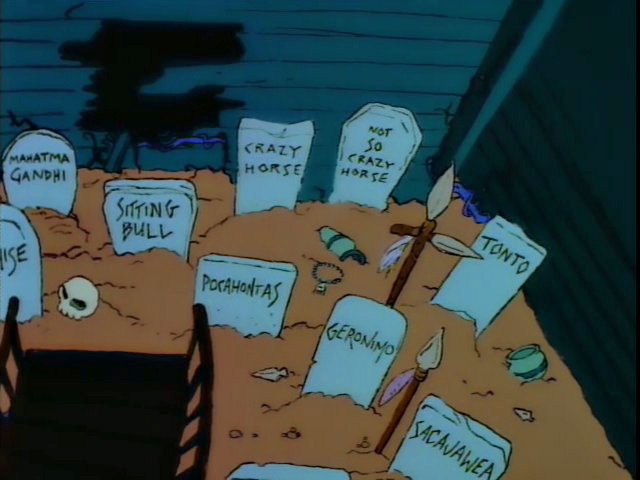
Following its mainstream entrenchment, the "Indigenous burial ground" trope infiltrated virtually every corner of popular culture, becoming so recognizable that it could be invoked for both scares and laughs. It appeared in television series like Buffy the Vampire Slayer and The Real Ghost Busters cartoon, as well as countless other books, games, and shows. Its ubiquity eventually led to its transformation into a comedic cliché, satirized by some of the most popular comedy series of all time, including The Simpsons, Friends, South Park, Family Guy, and Parks and Recreation. Seth Grahame-Smith’s satirical guide, How to Survive a Horror Movie, even suggested a definitive way to confirm a house’s haunting: "Are Native Americans constantly showing up to ask, ‘What happened to our cemetery?’" This ironic question underscores just how deeply embedded and parodied the trope had become.
Yet, while comedy poked fun, serious ghost-hunting TV shows simultaneously exploited the trope. Programs like Ghost Adventures frequently employ Indigenous burial grounds as an explanation for "demonic" entities, often following a formula that leads them to conclude Indigenous ghosts are responsible. This "shift-the-blame-to-nonwhite-ghosts" strategy, reminiscent of Holzer’s Amityville intervention, became a mainstream and uncritical approach to paranormal investigation, further normalizing the harmful narrative for a broad audience.
The Digital Age: Memes, Satire, and Growing Awareness
The digital era has seen the trope further evolve, solidifying its place in internet culture while also sparking increased critical awareness. In 2011, the satirical news source The Onion released a prescient video titled "Report: Economy Failing Because U.S. Built on Ancient Indian Burial Grounds." This brilliant piece of comedy depicted panelists gravely discussing a congressional report attributing America’s economic woes to disturbed burial grounds, with one panelist suggesting Republicans were painting President Obama as "soft on poltergeists" by demanding a "blood offering." A voice-of-reason character humorously argued it was merely "the settling of America’s foundations," while others insisted "Indian ghosts" were to blame for everything, including the existence of poverty. This satire brilliantly highlighted the absurdity and underlying anxieties the trope represents.
Since then, thousands of posts on Twitter and threads on Reddit, often featuring photo memes and videos, have echoed similar sentiments, showcasing the trope’s pervasive presence in online discourse. While memes can perpetuate, they can also raise awareness. In recent years, several non-academic articles, with Atlas Obscura potentially being one of the first in 2008, have begun to critically examine the trope. However, the original stories and memes that fueled its spread have rarely received the same rigorous critical attention, leaving many of the problematic underpinnings unexamined by the wider public.
Unearthing the Truth: Supporting Data and Cultural Disconnects
The enduring popularity of the "Indigenous burial ground" trope stands in stark contrast to the historical and archaeological realities. Its widespread acceptance is often built upon a foundation of misinformation, cultural appropriation, and a profound misunderstanding of Indigenous histories and spiritual beliefs.
Debunking the Myths: Archaeological and Historical Inaccuracies
One of the most significant issues with the trope is its consistent lack of factual basis. The Amityville Horror narrative provides a prime example: numerous statements from the Shinnecock Nation confirm they never lived in the Amityville area, which was outside their traditional territory, and there was never a burial ground at the site. No archaeological evidence or oral history has ever supported these claims. Holzer and Meyers effectively capitalized on a lesser-known but prevalent "Indigenous burial ground" story to lend credibility to their own paranormal claims, piggybacking on Anson’s initial "tainted Indigenous land" narrative.
Further personal accounts highlight this disconnect. In Victoria, British Columbia, the author notes how the city’s burgeoning ghost tourism industry, fueled by local ghost hunters, attributes its "very haunted" status to being built on an Indigenous burial ground. Yet, historical and archaeological evidence refutes this. While burial mounds in Beacon Hill Park and around Cadboro Bay are often cited, the park’s 23 mounds were never built upon, and Cadboro Bay is in a neighboring city. Crucially, local First Nations historically used cairns, not mounds, in ancient times, and for the past 1,500 years, bodies were placed in trees, on raised platforms, or in shoreline caves. Early settlers, in fact, often collected Indigenous bones as souvenirs. While Indigenous remains are occasionally found, the idea that Victoria sits on a "mega burial ground" is unsubstantiated and dismisses the actual practices of local First Nations.
Even more egregious are claims found in texts like Robin Skelton and Jean Kozacari’s 1989 Gathering of Ghosts. In their chapter "The Indian Inheritance," they attribute a cult’s actions near Nanaimo to "tainted land." Incorrectly identifying it as Kwakiutl territory and a "slave-body dump site," the authors assert, "It seems not unlikely that the long history of Indian raids, feasts, and ritual killings accounted in part for the way in which Brother Twelve’s initially peaceful and gentle community became disturbed… The problem was the land and its history. It was crying out for blood. The evil was in the earth itself." These "facts" were untrue, yet they painted Indigenous people, or their "evil soil made sentient," as the true culprits. The hateful depiction—of "body dumps," "ritual killings," and "evil feasts"—is made even more disturbing by Skelton’s standing as a respected university professor and public figure, demonstrating how deeply ingrained and normalized these racist narratives were, even among intellectual elites.
The Psychology of "Settler Guilt" and Projected Fears
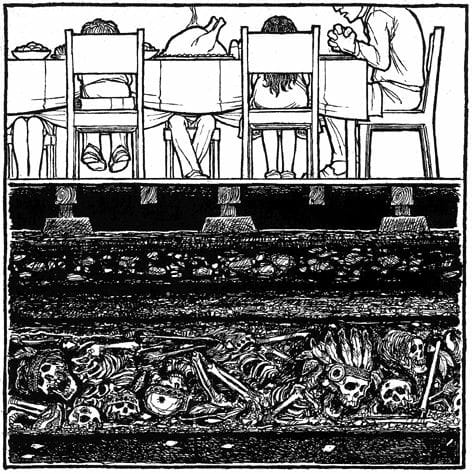
The persistent appeal of the "Indigenous burial ground" trope cannot be fully understood without examining its folkloric origins, which often intersect with what is termed "Settler Guilt." A popular theory about ghosts is that they are the spirits of individuals wronged in life, sometimes even murdered. If colonial ancestors committed horrific acts against Indigenous peoples, then perhaps, on some level, contemporary society is haunted by the repercussions, continuing to reap benefits from stolen resources, food, and trade. Ron Cobb’s powerful 1968 illustration, "Thanksgiving in America," for The Los Angeles Free Press, visually captures this sentiment, depicting a seemingly idyllic Thanksgiving dinner table resting directly atop Indigenous skeletal remains. This image poignantly suggests that many might believe they are haunted by the sins of their forefathers and foremothers.
However, this "inferior-earthbound ghosts" perspective, while seemingly acknowledging historical injustice, is deeply flawed. Instead of genuinely grappling with the complex legacy of colonialism, settler stories often project traditional Christian fears onto "uncivilized" people. Concepts like consecrated ground, the power of Christ’s name to dispel paranormal activity, and Heaven as a place reserved for denominational believers influence these narratives. The trope thus becomes a convenient, albeit distorted, mechanism for expressing a form of guilt without truly engaging with the humanity or sovereignty of Indigenous peoples. It externalizes the blame onto a vengeful, often caricatured, Indigenous spirit, rather than confronting the systemic issues and historical trauma caused by settler actions.
The Real Harm: Delegitimizing Graves and Perpetuating Stereotypes
The "Indigenous burial ground" trope, despite its seemingly benign or even sympathetic intent (in the case of "Settler Guilt"), inflicts significant harm. By broadly claiming that "all places are Indigenous burial grounds," it inadvertently delegitimizes actual, sacred Indigenous burial sites. It minimizes real crimes and injustices, from individual acts of violence like the DeFeo murders to monumental sites of genocide, such as the unmarked graves at former residential schools. These real sites of trauma, where countless Indigenous children were buried without dignity, demand genuine respect, acknowledgement, and action, not reduction to a horror cliché.
Furthermore, the trope perpetuates hateful and dehumanizing depictions of Indigenous people. The idea that their spirits are inherently vengeful, demonic, or capable of tainting the very earth itself, as seen in Skelton’s "evil soil" claims, reinforces racist stereotypes. It strips Indigenous cultures of their spiritual complexity and diversity, reducing them to a monolithic, malevolent force. This dehumanization, disguised as a supernatural threat, sidesteps the actual historical context of dispossession, violence, and cultural erasure that Indigenous communities have endured.
Responding to the Narrative: Indigenous Voices and Official Silence
The pervasive nature of the "Indigenous burial ground" trope highlights a critical imbalance in cultural representation and a general lack of accountability from mainstream institutions. While the trope proliferates, Indigenous communities consistently work to protect their heritage, correct misinformation, and assert their cultural sovereignty.
Indigenous Communities Speak Out: Denials and Cultural Preservation
Indigenous communities have frequently responded to the misrepresentation and appropriation embedded in the "burial ground" trope. The Shinnecock Nation’s clear statements regarding the Amityville claims are a direct rebuttal to historical falsehoods. These denials serve as a crucial "official response" to specific instances of cultural appropriation and historical distortion, asserting factual accuracy against sensationalized narratives.
Beyond direct refutations, Indigenous communities actively engage in cultural preservation and the assertion of their right to self-determination in storytelling. This involves establishing clear protocols for recording and sharing oral histories, often designating specific storytellers and knowledge keepers to share with outsiders, as many traditional stories are intentionally private. The Alutiiq Museum’s chart, referenced by the author during field school, exemplifies a structured, respectful approach to engaging with Indigenous narratives.
The legal protection of Indigenous heritage also reflects this assertion of sovereignty. Courts have ruled that even petroglyphs are copyright protected, recognizing the inherent cultural and intellectual property rights of Indigenous peoples. These efforts stand in stark contrast to the often careless and disrespectful appropriation seen in mainstream media. They underscore the fact that "traditional belief" is not merely "myth" or "legend" but a living, evolving cultural reality. The very terminology used, such as the preference for "Indigenous" over outdated and offensive labels, is part of an ongoing process of decolonization and respectful engagement.
Traditional Indigenous beliefs regarding death and the deceased also offer a profound counterpoint to the trope. Many Indigenous cultures hold the belief that merely speaking about a deceased person can cause a haunting, underscoring a deep respect for the dead and the spiritual realm. This contrasts sharply with the settler-centric, often Christian-influenced beliefs taught in abusive residential schools, which propagated the notion that Jesus was the only cure for evil, dismissing complex Indigenous spiritual frameworks.
The Absence of Accountability: Mainstream Institutions and the Trope
Despite the clear harm and historical inaccuracies, there has been a notable absence of formal "official responses" in the form of apologies or retractions from many mainstream institutions that have perpetuated the "Indigenous burial ground" trope. Hollywood studios, theme park operators, and television networks have largely continued to profit from and disseminate these narratives without critical re-evaluation or public acknowledgment of their problematic nature.
The continued normalization of these harmful stories, even in comedic contexts, demonstrates a systemic failure to understand and respect Indigenous cultures. This silence from powerful cultural producers reinforces the idea that Indigenous histories and spiritualities are fair game for fictional exploitation, rather than deserving of accuracy, respect, and self-determination. The lack of accountability perpetuates a cycle of misinformation and cultural insensitivity, leaving Indigenous communities to bear the burden of constant correction and advocacy.
Beyond the Trope: Implications for Reconciliation and Cultural Understanding
The ubiquitous "Indigenous burial ground" trope is more than just a storytelling device; it is a cultural symptom. Its popularity and resilience demand a critical examination of what it reveals about North American society, particularly concerning its relationship with Indigenous peoples and its own colonial past.
Challenging the Mainstream Explanation for Evil
The core implication of the trope is that it serves as a mainstream explanation for perceived "evil" hauntings in North America. This explanation, however, invariably points the finger at the ghosts of the very people whose lands were stolen, whose cultures were suppressed, and whose lives were often violently taken by settler ancestors. This narrative not only misrepresents Indigenous people as inherently "evil" or "demonic" but also absolves the descendants of colonizers from confronting the true historical violence and injustice that forms the bedrock of their societies. It is a convenient, albeit deeply racist, way to acknowledge a "wrong" without actually taking responsibility for it.
To move forward, it is essential to dismantle these racist undertones. Indigenous people are not inherently evil or demonic. Their traditional spiritual beliefs, often characterized by profound respect for the land, ancestors, and the interconnectedness of all life, are far more nuanced and often less judgmental than many settler beliefs. Blaming Indigenous spirits for hauntings is a simplistic and harmful reduction of rich, complex spiritual traditions to a vengeful caricature.
Towards Respectful Engagement and Decolonized Narratives
The path forward requires a conscious effort toward respectful engagement and the cultivation of decolonized narratives. This means actively listening to Indigenous voices, learning from Indigenous knowledge keepers, and acknowledging the true histories of the land and its original peoples. The popularity of the "Indigenous burial ground" trope underscores a deep-seated cultural need to reckon with the past, but this reckoning must be approached with authenticity and respect.
Genuine reconciliation demands moving beyond simplistic tropes and embracing the complexity, beauty, and resilience of Indigenous cultures. It calls for an ethical approach to storytelling, one that prioritizes accuracy, avoids appropriation, and respects intellectual and cultural property rights. As the author learned at the University of Fairbanks in Alaska, observing the Alutiiq Museum’s chart for recording oral stories, being "as respectful as possible is the only way forward." This includes understanding that the terms and protocols for discussing Indigenous cultures are dynamic and differ across communities and generations.
The continued prevalence of the "Indigenous burial ground" trope serves as a powerful reminder of the ongoing work of decolonization and reconciliation. It challenges us to critically examine the stories we tell, the histories we perpetuate, and the ways in which we engage with the profound and often painful legacy of colonialism. Only by confronting these narratives with honesty, humility, and a genuine commitment to justice can we hope to foster a future where Indigenous cultures are truly honored and respected, not merely exploited for a cheap thrill.
Conclusion
From the whispered fears of early colonists to the blockbuster movies and viral memes of today, the "Indigenous burial ground" trope has carved an indelible, yet deeply problematic, niche in North American popular culture. Its journey from a terrifying literary device to a comedic cliché reflects a profound cultural fascination intertwined with historical anxieties and unresolved colonial guilt. However, beneath the surface of entertainment lies a narrative built on historical inaccuracies, cultural appropriation, and the perpetuation of harmful stereotypes.
The analysis of its evolution, from Amityville Horror‘s sensationalism to Disney’s mass popularization and Stephen King’s literary influence, reveals how easily misinformation can become entrenched. Debunking these myths through archaeological evidence and Indigenous testimony highlights the urgent need for factual accuracy. The trope’s connection to "Settler Guilt" underscores a complex psychological dynamic where historical injustices are acknowledged, yet often distorted to blame the wronged. Ultimately, this pervasive narrative delegitimizes actual sacred sites, minimizes profound historical traumas like residential school graveyards, and dehumanizes Indigenous peoples by portraying their spirits as malevolent.
As Indigenous communities actively work to preserve their heritage and assert their right to self-determination in storytelling, the silence and continued exploitation from many mainstream institutions remain a stark reminder of the work ahead. Moving forward demands a critical re-evaluation of the stories we consume and create. By challenging these harmful narratives and embracing authentic Indigenous voices and perspectives, North American