Speculative Fiction Unleashed: A Bumper Harvest of New Releases Hits Shelves This September
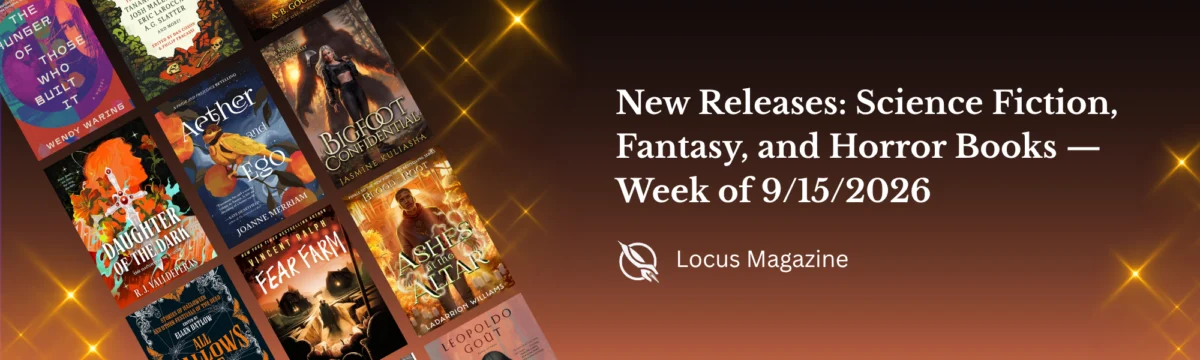
September 15, 2026 – The literary worlds of science fiction, fantasy, and horror are set to experience an unprecedented surge of new narratives this month, with a robust lineup of titles scheduled for release between September 15th and 26th, 2026. This period promises an exciting journey for readers, encompassing everything from dark fantasy and atmospheric horror to sprawling science fiction epics, poignant young adult tales, and captivating "romantasy" entries. Featuring works by celebrated authors such as Leigh Bardugo and China Miéville, alongside an impressive array of debut novelists and meticulously curated anthologies, this release window is a testament to the enduring creativity and commercial vitality of speculative fiction.
Readers are encouraged to explore these new worlds and support the literary ecosystem by visiting our dedicated Bookshop.org page. Purchases made through this platform directly benefit local independent bookstores, crucial hubs for fostering literary communities, and contribute to our ongoing efforts to provide comprehensive coverage of the speculative fiction field.

A Deep Dive into the Week’s Most Anticipated Titles
This September brings a diverse collection that promises to thrill, chill, and transport readers to new realities. The sheer volume and thematic breadth underscore a vibrant genre continually pushing its boundaries.
Dark Fantasy and Unsettling Horror Dominate the Landscape
The horror and dark fantasy genres are particularly well-represented, offering a spectrum of chilling narratives:

-
Leigh Bardugo’s Dead Beat (Macmillan/Flatiron) marks the highly anticipated third installment in the acclaimed Ninth House series. Following her arduous journey from hell, protagonist Alex Stern, still navigating the demanding academic world of Yale, finds herself and her companions embroiled in a relentless hunt for the demonic entities that have pursued her back. This dark fantasy/horror blend continues to explore the hidden, sinister underbelly of elite academia, promising further twists and visceral encounters.
-
Laura Creedle’s The Girl in Green (HarperCollins) plunges readers into a young-adult horror mystery. When Jess relocates to a new school nestled in the eerie West Virginian mountains, she is immediately drawn into the chilling enigma surrounding a missing student, suggesting a sinister secret lurking beneath the tranquil facade of her new home.

-
A notable debut in YA horror, Peace Mbengei’s We Run the Night (Soho Teen) introduces Shani, who returns to her isolated boarding school after her father’s death, only to find students developing peculiar skin conditions and a popular classmate vanishing without a trace. Mbengei’s inaugural novel promises a tense, atmospheric exploration of grief and unexplained phenomena.
-
Leopoldo Goût’s Rooted (Tor/Nightfire) presents a disorienting horror narrative. Aurora, an art major, returns to Mexico City to celebrate a significant achievement, only for her reality to unravel, distorting the very fabric of her existence in a deeply unsettling manner.

-
Hailey Piper’s This Movie Doesn’t End the Way We Want (Titan Books UK) is a horror novel that rewinds to 1994, where Val and her companions watch an obscure horror film. Val, however, is the only one who emerges from the experience, leading to a decades-long struggle with a haunting mystery and survivor’s guilt.
-
Another compelling debut, Saratoga Schaefer’s A Thousand Monstrous Forms (The Quick Brown Fox/Crooked Lane) offers a contemporary Bluebeard retelling. Impulsive artist Poppy Reed marries the wealthy art dealer Celia Marie Fox, only to find herself irresistibly drawn to a forbidden, locked basement—a classic horror setup promising dark secrets.

-
Emily Zinnikas’s I Am the Monster Under the Bed (St. Martin’s) is a debut horror novel exploring memory and trauma. Reclusive painter Willa is unexpectedly outed as the sole survivor of a high school massacre, forcing her to confront not only the horrific night but also the lingering presence of a benevolent creature beneath her bed.
-
Vincent Ralph delivers two young-adult horror installments in the Bleak Haven series: Corpse Creek and Fear Farm (St. Martin’s/Wednesday Books). In Corpse Creek, teen Ethan returns to the cursed waters where his brother perished years ago, encountering a spectral figure demanding a sacrifice. Fear Farm sees Tori go undercover at Bleak Haven’s annual "Fright-Fest," a suspicious event plagued by peculiar accidents, hinting at a deeper, malevolent force at play.

-
For anthology enthusiasts, Ellen Datlow’s All Hallows Eve (Titan Books UK) compiles 19 original horror stories that offer fresh, global perspectives on Halloween, featuring an introduction by Datlow herself and a foreword by Lisa Morton, with contributions from Linda D. Addison, Chikodili Emelumadu, and many more. Similarly, Dan Coxon & Philip Fracassi’s Unearthed (Titan Books UK) presents another original horror anthology with 19 new stories from a stellar lineup including Tananarive Due, Christopher Golden, Josh Malerman, Tim Lebbon, Eric LaRocca, A.M. Shine, Jonathan Maberry, Hildur Knútsdóttir, Ai Jiang, and A. G. Slatter. These collections promise diverse voices and innovative takes on horror.
Epic Fantasies and Mythic Reinterpretations
The fantasy genre this month spans mythic retellings, intricate world-building, and high-stakes adventures:

-
Nikita Gill’s Styx: The River (Little, Brown) is a young-adult fantasy novel told through poetry and vignettes, the second in the Goddesses of the Underworld series. It reimagines Greek myth, focusing on Styx, the firstborn Titan, who, overshadowed by her siblings, finds solace and power in mastering magic and creation.
-
Auden Patrick’s Thoughts Be Bloody (Astra House/DAW) offers a fantasy retelling of Shakespeare’s Hamlet. Set in a magical college, the story begins as Horatio discovers Carson Hamlett cradling his father’s lifeless body in the library, setting off a chain of magical and political intrigue.

-
Louisa Morgan’s The Faerie Handmaid (Orbit US/Redhook) is a fantasy novel where Braithe becomes the handmaid to the powerful priestess Morgana. Their journey to the white city to investigate a cursed king promises a blend of political machinations and ancient magic.
-
Hannah Mathewson’s The Age of Blood and Magic (HarperCollins/Morrow) presents a world where magic, once exclusive to witches, fae, and vampires, was stolen a century ago by Martin Maddock, who built a trillion-dollar empire selling bottled magic. This fantasy novel explores the consequences of commodified magic and its impact on society.

-
R.J. Valldeperas’s Daughter of the Dark (Tor/Bramble) marks a debut in dark fantasy, the first in the Daughters of Auquis series. In the land of Supay, where the cursed are resurrected as muki, Solana is offered the prestigious and dangerous position of Royal Demon Hunter.
-
L.K. Steven’s Turncloak (Penguin Random House/Del Rey) is the second book in the Silvercloak Saga, a fantasy romance. The new kingpin of the Bloodmoon Gang uncovers Saffron’s identity as a Silvercloak, leading to a tense chase as a detective pursues them both while Saffron endeavors to rectify her past missteps.

-
Marie O’Regan & Paul Kane’s The Hopeless Romantic’s Guide to Enchantment (Titan Books UK) is an anthology of 12 fantasy and romance stories, featuring a lineup including Kelley Armstrong, Rebecca Thorne, Alexis Hall, L. R. Lam, and A.Y. Chao, promising a blend of magic and heartfelt connections.
-
Kalynn Bayron’s Tell the Ghosts I’m Gone (Bloomsbury USA) is a young-adult fantasy where Moll and her friends each possess supernatural powers. Moll’s ability to manipulate emotions is ready for real-world application, but the consequences may prove far greater than she anticipates.

-
LaDarrion Williams’s Ashes at the Altar (Penguin Random House/Labyrinth Road) is the third installment in the Blood at the Root trilogy, a young-adult fantasy novel. Malik continues his studies at the secret magical HBCU Caiman Academy, battling the demonic entity Marinette and contending with the formidable Bonclairs, his father’s family.
Ventures into the Sci-Fi Unknown
Science fiction offerings this month span satirical space operas, classic retellings, and urgent ecological narratives:

-
A.B. Goodman’s House of Atreus: Trial & Consequences (Planetary Books) continues a compelling SF series where ancient Greek gods are revealed to be corrupted artificial intelligences. This fourth book sees Orestes on trial for his mother’s murder, with Athena convening twelve mortals to render judgment.
-
Paul McGrath’s A Hard Left (Stoney Creek) is the third satirical SF novel in the Terran Incognita series. The FBI investigates a bizarre case of body swapping while two alien Xylodonian Guardians strive to maintain cosmic order amidst human chaos.

-
Joanne Merriam’s Aether and Ego (Inanna) is a debut SF novel, a reimagining of Pride & Prejudice set on a generation ship journeying to Alpha Centauri. Elizabeth Bennett, a second-generation voyager, must reluctantly collaborate with the insufferable Mr. Darcy to salvage her family’s reputation after her younger sister Lydia elopes.
-
Wendy Waring’s The Hunger of Those Who Built It (Stelliform Press) is a debut solarpunk novel set in a Paris devastated by ecological collapse in 2049. Amidst the ruins, people fight to preserve precious seeds and reaffirm their bonds, painting a hopeful yet stark vision of humanity’s resilience.

-
Ava Reid’s Winterveil (HarperCollins) is a young-adult SF novel where criminal students are trained in war simulations at the titular Winterveil. Four students are unexpectedly drawn into a perilous conspiracy, testing their loyalties and skills.
-
Nina Schuyler’s Open the Floodgates (Chin Music Press/Reverberations) is an environmental fable set in a California town where a river is granted personhood. It must argue for its very existence in court against powerful adversaries determined to pollute it with toxic waste, offering a poignant commentary on ecological justice.

Romance with a Speculative Twist
The growing "romantasy" and genre-blending romance categories offer thrilling love stories entwined with the fantastical and horrific:
-
T.C. Kraven’s Blood & Bedlam (Diversion Books) is a vampire romance novel. Vlad Dracul, the original vampyr, seeks to rekindle his centuries-old love with Reine, a bartender with an ancient soul, even if it precipitates a supernatural war.

-
Jasmine Kuliasha’s Bigfoot Confidential (Orbit Works) introduces Jericho James, a fantasy novel protagonist investigating Bigfoot sightings. Her professional pursuit takes a personal turn as she senses she is being watched, hinting at a connection to the very creatures she seeks.
-
Laura Piper Lee’s Doomsdate (Penguin Random House/Dell) delivers a unique zombie apocalypse romance. As a lockdown looms, Maisie Bennett’s sole objective is to "get laid." However, her first date with the melancholic Dr. Everett Greer takes a gruesome turn when flesh-eating zombies emerge, forcing a fight for survival amidst blossoming romance.

Dark Academia and Literary Explorations
Beyond specific genre classifications, some titles offer unique blends and literary explorations:
-
Freya Marske’s Bodies of Magic (Tor) is a dark academia fantasy novel. A cohort of mages, gifted with healing magic, are on the cusp of their final examination when they stumble upon a dead body, unearthing a mystery that threatens to unravel their magical institution.

-
China Miéville’s The Rouse (Penguin Random House/Del Rey) is an expansive, uncanny novel with horror elements. Maur’s life has been defined by loss, and the answers she seeks appear to be intertwined with the dark past of a soldier who shares her deepest interests and motivations, promising a labyrinthine psychological journey across its substantial 1260 pages.
-
Sheree Renée Thomas’s The Tongue I Dream In (PM Press), part of the Outspoken Authors series, is a collection of poems, stories, essays, and an interview. Thomas delves into the intricate intersections of poetry, science fiction, and myth, exploring their resonance across Black and white cultures.

Essential Reference: Stephen King’s Legacy
- Guy Astic & Frank Lafond’s The Art and Craft of Stephen King (Hachette/Black Dog & Leventhal) stands out as a crucial non-fiction reference guide. This comprehensive volume meticulously examines every novel, novella, and short story by the iconic author, offering insights into King’s life and works, and featuring over 300 photographs. It is an indispensable resource for fans and scholars alike.
Industry Insights: Trends and Market Dynamics
The concentrated release of such a diverse array of speculative fiction titles in late September 2026 is a strong indicator of the genre’s robust health and expanding appeal within the publishing industry. Major imprints—including Macmillan/Flatiron, HarperCollins, Tor, and Penguin Random House—are demonstrably investing heavily, showcasing a strategic blend of established, high-profile authors like Leigh Bardugo and China Miéville, whose works consistently generate significant buzz, and a vibrant cohort of debut novelists. This commitment to both seasoned masters and fresh voices highlights a dynamic ecosystem designed to cater to a broad spectrum of reader tastes while also nurturing the next generation of genre-defining talent.
The prevalence of "romantasy" and YA-focused horror and fantasy titles reflects a keen awareness of surging market segments, driven by engaged online communities and a demand for emotionally rich, character-driven narratives within fantastical settings. Similarly, the frequent reinterpretation of classic myths and literature, seen in titles like Styx: The River and Aether and Ego, suggests a continuous effort to engage new audiences with timeless stories reframed through a speculative lens. The inclusion of anthologies curated by respected editors like Ellen Datlow also points to a healthy appetite for short fiction, offering diverse thematic explorations and introducing readers to a wider range of authors.

Looking Ahead: Implications for Readers and the Genre
For enthusiasts of speculative fiction, this period represents an embarrassment of riches. The sheer volume and variety of releases offer unparalleled opportunities to explore new worlds, confront new horrors, and fall in love with new characters and concepts. The continued strength of multi-book series alongside standalone works and curated anthologies provides both long-term narrative engagement and opportunities for quick, immersive reads.
For the publishing industry, these releases underscore the enduring appeal and commercial viability of science fiction, fantasy, and horror. These genres consistently push creative boundaries, experiment with narrative forms, and attract highly dedicated fanbases. The thematic breadth, ranging from ancient myths to urgent environmental narratives, demonstrates the genre’s profound capacity to engage with complex contemporary issues while still delivering compelling entertainment. Moreover, the strong presence of debut authors signals a healthy pipeline of new talent, ensuring the continued evolution and reinvention of these beloved literary realms.

The initial call to support local bookstores through platforms like Bookshop.org is a crucial reminder of the broader ecosystem that brings these stories to life. Every purchase contributes not just to an author’s career but to the vitality of independent retailers and the thriving literary community as a whole. As readers immerse themselves in these new worlds, they also contribute to the ongoing success and diversification of speculative fiction, ensuring its continued growth and innovation for years to come.
While you are here, please take a moment to support Locus with a one-time or recurring donation. We rely on reader donations to keep the magazine and site going, and would like to keep the site paywall free, but WE NEED YOUR FINANCIAL SUPPORT to continue quality coverage of the science fiction and fantasy field. We publish hundreds of reviews and news stories each year, but we can’t do it without your help.