The Treasury of Folklore: A Grand Compendium Unveils Humanity’s Shared Myths
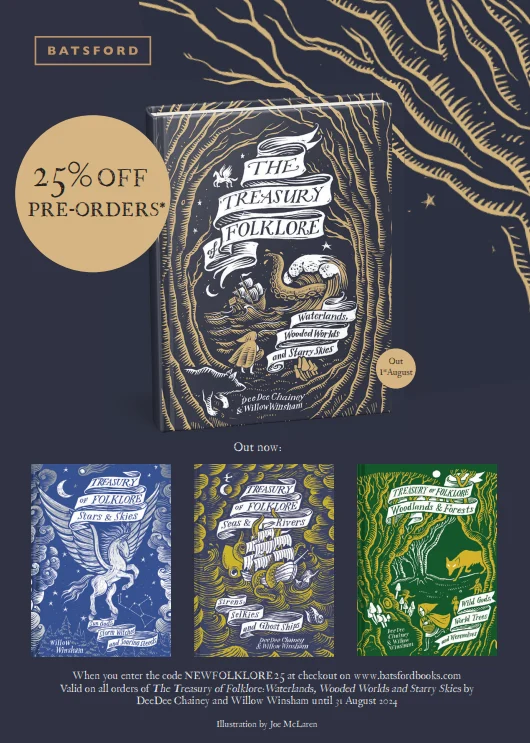
LONDON, UK – Nearly a decade after embarking on a journey to chronicle the world’s diverse folkloric traditions, the creators of the acclaimed Treasury of Folklore series are set to release a monumental single-volume compilation. The Treasury of Folklore: Waterlands, Wooded Worlds and Starry Skies gathers the most captivating tales and beliefs from across their three original, best-selling books – Seas and Rivers, Trees and Woodlands, and Stars and Skies – into a magnificent "hefty tome" designed to be both an academic resource and a cherished coffee table centrepiece. Scheduled for release on August 1st, 2024, this special edition promises to be a powerful testament to the enduring universality of human storytelling.
Main Facts
This eagerly anticipated compilation, The Treasury of Folklore: Waterlands, Wooded Worlds and Starry Skies, represents the original vision of its authors: a single volume encompassing the rich tapestry of global folklore connected to humanity’s physical landscapes. Far from merely a re-packaging, this edition is a carefully curated selection from the three highly popular preceding books in the series. While containing no new material, it offers readers a beautifully bound and presented collection of tales that reveal the shared fears, dreams, and wonders that unite people across continents and cultures. Adorned with the exquisite original illustrations by Joe McLaren, the book is available for pre-order now, promising a tangible connection to the ancient wisdom and imagination of humankind.
The Grand Vision Realized
When the concept for the Treasury of Folklore series first took shape, the ambition was immense: to create a singular, comprehensive volume that explored the myriad ways humans interact with and interpret the diverse physical environments of our world. However, the sheer volume and richness of the material uncovered by authors Dee Dee Chainey and Willow Winsham quickly surpassed the confines of a single book. This led to the creation of the acclaimed trilogy, each volume delving into specific realms: the aquatic mysteries of Seas and Rivers, the arboreal secrets of Trees and Woodlands, and the cosmic wonders of Stars and Skies. Now, the compilation seamlessly brings these disparate elements together, fulfilling that initial, expansive vision. It underscores the authors’ core belief that, despite geographical and cultural distances, humans share fundamental experiences and emotions, which are eloquently expressed through their folklore.
A Physical Masterpiece
Beyond its intellectual content, The Treasury of Folklore: Waterlands, Wooded Worlds and Starry Skies is crafted to be an aesthetic and tactile delight. The authors have expressed their profound satisfaction with the final product, describing it as a "hefty tome" – a testament to its substantial content and robust construction. The physical attributes, including its generous size, the thoughtfully designed cover that harmoniously blends the themes of water, wood, and sky, and the choice of beautiful cream paper, all contribute to an immersive reading experience. Every page is brought to life by the distinctive original illustrations of Joe McLaren, whose artwork has become synonymous with the series. This compilation is not just a book; it is an artifact, intended to be a cherished addition to any bookshelf or coffee table, serving as a constant invitation to explore and discuss the world’s shared heritage of myths and legends.
Chronology
The journey to this compilation began almost a decade ago, rooted in a burgeoning online movement and a deep-seated desire to understand the human condition through its oldest stories.
A Decade of Discovery
The genesis of the Treasury of Folklore series can be traced back to the vibrant online community fostered by the #FolkloreThursday hashtag. This digital phenomenon, which saw an "overwhelming outpouring of folklore" from enthusiasts worldwide, ignited in the authors a powerful inspiration. They recognised the profound hunger for meaningful, lasting content that could encapsulate the "unifying universality of folklore across the globe." This inspiration blossomed into the first book, Seas and Rivers, which explored the watery realms and their associated myths. Its subsequent success paved the way for Trees and Woodlands, delving into the mystical significance of forests, and finally, Stars and Skies, which gazed upwards to the celestial bodies that have captivated humanity for millennia. The popularity of these three individual volumes, described by the authors as both "surprising and heartwarming," validated their initial premise and demonstrated a widespread appetite for engaging with these ancient narratives. Their gratitude extends to "each and every person who has bought and read these books," acknowledging the crucial role of their readership in the series’ success.
From Series to Compendium
The idea of consolidating the rich material from the three individual volumes into a single compendium emerged from the publisher, Batsford Books, a proposition that immediately resonated with the authors’ original, overarching vision. This transition from a successful series to a unified compilation was not a trivial undertaking. "Much work went on behind the scenes," the authors recall, involving a meticulous re-evaluation of content they already knew intimately. They approached the existing texts "with fresh eyes," a process of careful selection and omission to ensure that the consolidated volume maintained narrative flow, thematic coherence, and the highest quality. The objective was to create a single, cohesive narrative that elegantly spanned "our shared landscapes across time and place." The authors’ enthusiastic response to the final product – "To say we have been blown away by the end result is an understatement, and we are utterly thrilled" – speaks volumes about the dedication and passion invested in bringing this grand project to fruition.
Supporting Data
The core strength of The Treasury of Folklore series, and now its compilation, lies in its ability to illuminate universal human experiences through diverse cultural lenses. The included extracts serve as powerful examples of this thematic richness.
Unearthing Universal Truths
The driving force behind the Treasury of Folklore series has always been a quest for understanding: how do humans, regardless of their geographical location or historical era, forge customs, beliefs, and narratives around the environments they inhabit? The authors’ extensive research has consistently revealed a profound truth: despite the intricate variations in local beliefs and practices, humanity is "inherently the same" in many fundamental aspects. We share "primal fears and dreams," a universal human condition that transcends differences in dress, language, or the specific names we assign to mythical creatures. Whether "gazing across the ocean into the vast horizon" with a longing for discovery or "gathering around our campfires in the darkness of the nighttime forest" dreading the unknown, these fundamental sentiments resonate across all cultures. Similarly, the "awe of the eternity of time under the glimmer of ancient stars, wondering about the unwritten future of our own short lives," speaks to a collective human contemplation of existence, mortality, and destiny. The compilation offers a direct portal into these shared psychological and emotional landscapes.

Echoes from the Deep: Water Horse Legends
The compilation opens with a plunge into the mysterious and often perilous world of water horses, creatures that embody both awe and dread, lurking beneath the surfaces of lakes and rivers worldwide. These tales, whether real experiences or cautionary fables, speak to humanity’s ancient fear of the unknown depths and the power of nature.
The Kelpie’s Allure and Danger
Perhaps the most famous of these is the Scottish Kelpie. While often used interchangeably, the authors clarify the distinction between the river-dwelling Kelpie and the loch-frequenting Each-uisge. The Kelpie’s modus operandi is chillingly consistent: luring an "unwary traveller" onto its back before dragging them "down beneath the water to their death." This narrative serves as a potent cautionary tale, particularly in a land rich with treacherous waterways, warning against recklessness and disrespect for nature’s hidden dangers. Yet, folklore also offers glimpses of hope or defiance. Some tales suggest the Kelpie could be "seemingly tamed," even compelled to work through a bridle marked with a cross, though this control was always "illusory and fleeting." The ultimate triumph over such a creature, as demonstrated in one story, involved "red-hot iron," a common folkloric weakness for supernatural beings, underscoring the ancient belief in the protective power of fire and metal.
The enduring power of the Kelpie legend in the Scottish imagination is dramatically evident in the monumental 30-metre-tall sculptures near Falkirk, a modern testament to an ancient myth, integrated into the contemporary landscape since 2013. Its continued presence in popular culture, from Lari Don’s children’s literature to J.K. Rowling’s Fantastic Beasts and Where to Find Them, highlights its sustained cultural relevance. Intriguingly, the authors note the Kelpie’s absence in English folklore, suggesting a unique regional specificity to these aquatic equine terrors.
The Elusive Ceffyl Dwr of Wales
This folkloric deficit in England is more than compensated for in Wales by the tales of the Ceffyl Dwr, a creature that remained a staple of Welsh belief well into the 19th century. The Ceffyl Dwr exhibits regional variations in its appearance and behaviour. In northern Wales, it was a shapeshifting spirit, prone to violence. In the south, it consistently appeared as a "small horse, enchanting in appearance," designed to lure riders. Speed is a defining characteristic, with tales describing its ability to cover "huge distances in an impossibly short space of time" before vanishing, leaving its hapless rider to drown. A curious exception, highlighting "denominational equality," granted clergymen immunity from this fate, allowing them to reach their destinations unscathed, while their accompanying clerks or deacons often met a watery end – a subtle commentary on spiritual authority in the face of supernatural peril.
Scandinavian Bäcka-häst: Luminous Betrayal
Crossing the North Sea, Scandinavia offers its own variant: the bäcka-häst, or "brook horse." Most frequently sighted in foggy conditions, this creature is described as "majestic and luminous," a deceptive beauty. Like its Celtic cousins, it beguiles riders into mounting, only to plunge back into the water, drowning its victims who are unable to dismount. A recurring motif in these tales involves children as victims, perhaps amplifying the sense of tragedy or suggesting their greater susceptibility to such enchanting dangers. One popular story recounts a group of boys saved from the bäcka-häst when the last child, mispronouncing a colloquial phrase, inadvertently invokes "Jesus Christ." The horse’s "hatred of the name of Christ" causes it to disappear, leaving the boys bruised but alive. This narrative often provides a surprising twist, with many tales ending in the riders’ survival, and some even suggesting the bäcka-häst could be tricked and put to work, much like the Kelpie. The common thread in these water horse legends is the inherent danger of beauty, the deceptive nature of the unknown, and the ancient human impulse to personify the perils of the natural world.
Guardians of the Green: Lords of the Wild
Leaving the treacherous waters, the compilation guides readers into the "verdant greenery of the forest," the domain of powerful spirits and creatures known as the Lords of the Wild. These figures range from malevolent forces of destruction to benevolent protectors of nature, embodying humanity’s complex relationship with the untamed wilderness.
Tapio: The Revered Finnish Forest King
Finland’s mythology introduces Tapio, also known as Metsähine or Hiisi, the majestic king of the forest realm. His appearance is deeply intertwined with his domain: tall and thin, cloaked in ermine fur or moss, with a hat and bushy eyebrows of moss and lichen. He often sports a great beard, sometimes of straggling black hair, and, like the European Green Man, seems to emerge directly from the flora. His back is said to resemble a gnarled tree, highlighting his profound connection to the forest. Tapio is both the personification and the protector of the woods, embodying its wild essence. Historically, hunters would seek his blessing before their chase, pledging respect for the forest’s ways, quiet hunting, and minimal disruption. It was believed that Tapio controlled all forest creatures, capable of granting a plentiful haul or cursing a hunter to return "empty-handed." His family – his wife Mielikki (benevolent) or Kuurikki (malevolent), his son Nyrikki who guides hunters, and his daughter Tulikki who directs prey – further illustrates the intricate pantheon of Finnish nature spirits. The Estonian equivalent, sharing many traits but notably possessing only one eye, points to a broader regional belief system.
The Enigmatic Leshy of Slavic Lands
Slavic folklore presents the Leshy (or leshii, lyeshy), a complex and captivating tutelary spirit of the woods. Often seen as a protector of trees and animals, particularly wolves in Ukraine or serving the bear in other regions, the Leshy hibernates in winter, mirroring the natural cycle of the forest. Known by numerous names, all pointing to his dominion over the woods, he is sometimes linked to the Devil or depicted as a woodsman. Resembling Greek satyrs, he is human above the waist but may possess horns, claws, and a bushy beard often described as forest green or moss-covered.
The Leshy is a master shapeshifter, capable of altering his size from taller than a tree to as small as a blade of grass, or appearing huge from a distance but tiny up close. He can disguise himself as any familiar human, animal, or plant, making him a formidable trickster. In human form, his disguise is never perfect; tell-tale signs include a lack of eyelashes or brows, shoes worn on the wrong feet, or clothing wrapped opposite to local fashion. Some accounts even describe him with only one eye, wild hair, cloven feet, or in certain regions, wings and a tail with black fur, or white attire with swollen eyes.

His presence is often heralded by powerful natural phenomena: his bellowing whips up great winds, causing creatures to flee in terror. For humans who intrude uninvited, his warnings come as "shrieking laughter, clapping or howling." Those who ignore these signals risk being "lost to the wilds by morning," confused and led astray from their path, never to be seen again. The Leshy is a trickster par excellence, able to mimic voices to lure victims, sometimes "tickling their victims to death." His voice can also sound like creaking branches or rustling leaves, blurring the line between natural and supernatural. Crossing a Leshy can bring illness, and he is known to abduct women for marriage and children, especially those found wandering or cursed by their parents. Farmers in the Olonetsky District of Russia once sacrificed a cow annually to appease him and protect their cattle from his wrath, which included "sucking the milk from the herd." Conversely, prayers and offerings of bread or tobacco could ensure safety.
Leshies are said to live alone or with their wives, the lesovikha, and children, often in forest huts. They are not above battling their own kind with clubs, "ripping up trees as they go." One Leshy from Vologda District was even reported to frequent taverns, driving his wolf pack and consuming "a whole bucket of vodka." Notorious gamblers, they prefer playing cards without clubs (due to their resemblance to the Christian cross) and bargain with squirrels instead of money.
Protection against Leshies, much like other fae folk, involves specific rituals: turning one’s shirt inside out and shoes on the wrong feet is said to provoke laughter, instantly returning the lost to their rightful path. More drastically, one method involves stripping naked and then redressing backwards. Swearing "remorselessly" is also believed to banish them, while the sign of the cross offers a less jovial alternative. For those daring enough to summon a Leshy, the method is deceptively simple: cut young birch trees, arrange them in a circle with tops touching, stand in the centre devoid of Christian symbols, and call out to the "grandfather of the forest." These intricate details paint a vivid picture of a spirit deeply embedded in the daily lives and fears of Slavic communities.
Celestial Tales: The Hare in the Moon
Finally, the compilation lifts our gaze skyward to the Moon, that eternal celestial body upon whose surface humankind has projected countless faces and images, generating a rich tapestry of origin myths. A particularly widespread motif is that of a rabbit or hare residing on the Moon, with specific lunar features like the Sea of Tranquillity often identified as its head, and the seas of Fertility and Nectar forming its ears.
The Buddhist Sacrifice (Sasa-Jātaka)
One of the most profound narratives comes from the Buddhist Sasa-Jātaka, a tale of selflessness and divine recognition. The hare, along with its friends – an otter, jackal, and monkey – resolves to offer alms on a forthcoming fast day. To test their resolve, the deity Sakka, ruler of Trāyastriṃśa heaven and protector of Buddhism, descends to Earth disguised as an old man, requesting food. While the otter, jackal, and monkey readily provide what they have, the hare, possessing only grass, deems it insufficient. In an ultimate act of generosity, the hare offers its own body as sustenance, throwing itself onto a fire. Sakka, moved by such faithfulness, intervenes, preventing the hare from perishing and immortalizing its image on the Moon. In some versions, Sakka squeezes a mountain to extract its essence, using it to paint the faithful hare’s image for all to behold, ensuring its eternal presence as a symbol of sacrifice. This powerful story, with similar variations across different cultures, highlights the virtue of selfless giving.
Variations Across Asia
The theme of the self-sacrificing hare resonates deeply in other Asian traditions. A Sri Lankan tale recounts Buddha, lost and hungry in a wood, being offered the hare’s life. As Buddha makes a fire, the hare leaps in, but is saved by Buddha’s powers and sent to the Moon. In Japan, the rabbit, known as Tsuki no Usagi, encounters the Man in the Moon disguised as a beggar. When other animals offer food, the rabbit, having only grass, sacrifices itself on the fire. The beggar then reveals his true form and takes the rabbit to live with him on the Moon, a recognition of its profound selflessness. This particular Japanese tale is popular and frequently recounted to children during September, coinciding with the Harvest Moon and the Mid-Autumn Festival, linking the celestial body to themes of harvest, gratitude, and sacrifice.
The South African Counter-Narrative
In a strikingly different vein, a tale from South Africa assigns the hare a more somber role, blaming it for humanity’s mortality. According to this story, the Moon dispatches the Hare to deliver a crucial message to humankind: just as the Moon itself "dies" and is reborn each month, so too would humanity experience death and subsequent return. However, the "flighty creature" misdelivers the message, conveying only that humans would die, omitting the promise of rebirth. Enraged by this error, the Moon attacks the Hare with a hatchet, intending to cleave it in two, but only succeeds in splitting its lip. The Hare, in retaliation, lashes out with its claws, scarring the Moon’s face – scars that are still visible today in the dark shapes on its surface. This narrative offers a primal explanation for both human mortality and the Moon’s familiar markings, showcasing folklore’s capacity to address existential questions and natural phenomena.
Official Responses
The release of The Treasury of Folklore: Waterlands, Wooded Worlds and Starry Skies is met with considerable excitement and pride from its creators and publisher, reflecting the culmination of years of dedicated work and a passion for cultural heritage.
Authors’ Reflections
Dee Dee Chainey and Willow Winsham, the creative force behind the series, convey a deep sense of accomplishment and gratitude. They acknowledge the profound impact that the #FolkloreThursday movement had on their initial inspiration, driving them to create something "meaningful, lasting, that reflected the unifying universality of folklore across the globe." The journey of nearly a decade has been a revelation, far exceeding their initial dreams. The "popularity of the three books… has been both surprising and heartwarming," they state, expressing heartfelt thanks to their dedicated readership. Their excitement for the compilation is palpable, particularly regarding its physical presentation. "We are utterly thrilled to be able to share this beautifully bound volume with you. We love the size and the cover combining everything and the beautiful cream paper: it is a ‘hefty tome’ indeed," they affirm, highlighting their satisfaction with the book’s aesthetic and tactile qualities. Their commitment to sharing these stories remains unwavering, reinforced by this definitive collection.

Publisher’s Perspective
While specific quotes from Batsford Books are not provided, the very existence of this compilation, following the success of the individual volumes, speaks volumes about the publisher’s confidence in the series and its market appeal. The decision to invest in such a high-quality, substantial compendium underscores a recognition of the lasting value and broad interest in global folklore. Batsford Books likely views The Treasury of Folklore: Waterlands, Wooded Worlds and Starry Skies as a flagship publication, celebrating not only the authors’ meticulous research and engaging storytelling but also the artistic contribution of Joe McLaren, whose illustrations are integral to the series’ identity. This release solidifies the series’ position as a significant contribution to the popularisation and academic appreciation of folklore, making these ancient tales accessible to a wider audience in an elegant and enduring format.
Implications
The launch of this compilation carries significant implications, extending beyond mere literary interest to cultural preservation, global understanding, and the continued relevance of traditional narratives in the modern world.
The Enduring Power of Folklore
The Treasury of Folklore: Waterlands, Wooded Worlds and Starry Skies serves as a powerful reminder of the enduring power and relevance of folklore. In an increasingly globalised yet often fragmented world, these stories highlight the deep-seated human need to make sense of our environment, confront our fears, and articulate our hopes. By presenting tales from diverse cultures side-by-side, the compilation implicitly argues for the interconnectedness of human experience, demonstrating how similar archetypes, fears, and aspirations manifest in different cultural contexts. It is a vital contribution to cultural heritage, preserving narratives that might otherwise fade and ensuring their transmission to new generations.
A Gateway to Global Understanding
More than just a collection of stories, this "hefty tome" is designed to be "a conversation starter, a way to connect." Its structure, drawing parallels between geographically disparate myths, encourages readers to look beyond superficial differences and recognise profound commonalities. This can foster greater empathy and cross-cultural understanding, challenging preconceived notions and opening minds to the rich diversity of human thought and imagination. As a beautifully presented object, it invites exploration and prompts discussion, becoming a physical nexus for dialogue about shared human heritage.
Investment in Cultural Heritage
For readers, acquiring The Treasury of Folklore: Waterlands, Wooded Worlds and Starry Skies is not merely purchasing a book; it is an investment in cultural heritage. It supports the ongoing work of folklorists and authors dedicated to documenting and interpreting these invaluable narratives. The high-quality production ensures that these stories are presented with the respect and gravitas they deserve, making them accessible and engaging for both casual readers and serious scholars. This compilation solidifies the legacy of the Treasury of Folklore series, ensuring its continued impact on how we perceive and appreciate the world’s myths.
Availability and Call to Action
The Treasury of Folklore: Waterlands, Wooded Worlds and Starry Skies is now available for pre-order and will be officially released on August 1st, 2024. Readers can secure their copy through Amazon.co.uk: https://www.amazon.co.uk/Treasury-Folklore-Waterlands-Wooded-Worlds/dp/1849949212. Additionally, a special 25% discount is available when ordering directly from Batsford Books at https://www.batsfordbooks.com/book/the-treasury-of-folklore/ using the code NEWFOLKLORE25. Don’t miss the opportunity to own this magnificent collection, a timeless tribute to the shared stories of humanity.