Unearthing Universal Truths: "The Treasury of Folklore" Unites Global Narratives in a Landmark Compilation
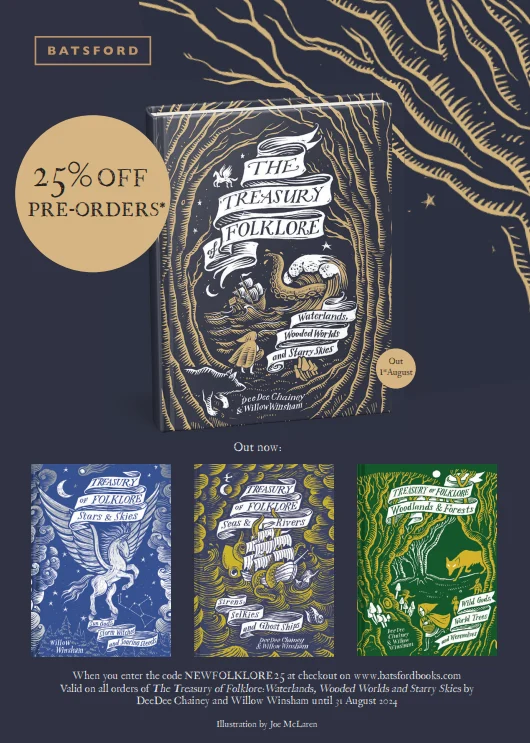
London, UK – July 25, 2024 – Nearly a decade after its inception, the acclaimed Treasury of Folklore series culminates its journey of exploration and discovery with the release of a definitive single-volume compilation. Titled The Treasury of Folklore: Waterlands, Wooded Worlds and Starry Skies, this ambitious new edition brings together the most captivating tales, beliefs, and customs from the three original bestselling books, offering readers an unprecedented panorama of humanity’s shared imaginative landscape.
Published by Batsford Books and authored by renowned folklorists Dee Dee Chainey and Willow Winsham, with stunning original illustrations by Joe McLaren, the compilation is more than just a collection; it is a meticulously curated testament to the profound similarities that bind cultures across continents and through time. Scheduled for release on August 1, 2024, the volume is currently available for pre-order, promising a rich, immersive experience for both long-time enthusiasts and newcomers to the world of folklore.
The Genesis of a Grand Vision: From Scattered Tales to a Unified Tapestry
The journey of The Treasury of Folklore began with a singular, expansive vision: to encapsulate the vast tapestry of human folklore, spanning every physical landscape inhabited by humankind, within a single, comprehensive volume. However, the sheer volume and richness of the material quickly revealed the impossibility of this initial goal. The world’s stories, myths, and beliefs were simply too abundant, too intricate, to be contained in one book. This realization led to the birth of a successful series, which ultimately comprised three distinct, yet interconnected, volumes: Seas and Rivers, Trees and Woodlands, and Stars and Skies.
The inspiration for this ambitious project emerged nearly a decade ago, significantly fueled by the vibrant, global exchange of folklore fostered by the #FolkloreThursday hashtag on social media. This digital phenomenon highlighted a burgeoning public appetite for traditional narratives and demonstrated the profound connective power of shared stories. Witnessing this overwhelming outpouring of cultural heritage, Chainey and Winsham embarked on a mission to create something tangible, meaningful, and enduring that would reflect the universal threads woven through global folklore.
The authors’ primary objective was not merely to document, but to understand: to explore how diverse human communities worldwide construct customs, beliefs, and tales around the specific environments they inhabit. From the treacherous depths of the ocean to the silent majesty of ancient forests and the boundless expanse of the night sky, they sought to uncover the underlying human experiences that give rise to such narratives. The popularity of the three original books underscored the universal resonance of this quest, garnering a heartwarming response from readers eager to delve into the mysteries and marvels of their shared heritage.
A Decade of Discovery: A Chronological Journey
Early Conceptualization (Pre-2010s): The initial, grand idea of a single, all-encompassing folklore volume for physical landscapes. This early vision laid the groundwork for the thematic approach.

The #FolkloreThursday Catalyst (Early 2010s): The emergence and widespread adoption of the #FolkloreThursday hashtag on social media platforms provided a powerful impetus. It demonstrated a widespread, international interest in folklore and the potential for a global conversation around shared human experiences, solidifying the authors’ resolve to create a lasting contribution.
The Birth of the Series (Mid-2010s): Recognizing the depth of material, the single-volume concept evolved into a multi-book series. The first of the three original volumes, Seas and Rivers, was published, delving into the aquatic myths and legends that shape human interaction with water bodies. This was followed by Trees and Woodlands, exploring the arboreal folklore of forests and groves, and Stars and Skies, which ascended to the celestial narratives woven around the heavens. Each book, though focused on a specific landscape, consistently aimed to highlight cross-cultural commonalities.
The Call for a Compendium (Recent Years): Following the sustained success and critical acclaim of the individual volumes, the idea was put forth to fulfill the original vision: to consolidate the beloved content into a single, comprehensive book. This decision was met with immediate enthusiasm by the authors, who saw it as an opportunity to present their findings in the initially intended, unified format.
The Curation and Production Process (Past Year): Much diligent work transpired behind the scenes. The authors revisited their own words, reading through familiar passages with fresh eyes, carefully selecting which tales and analyses to include and which to omit. The goal was to distill the essence of the series into a coherent, compelling narrative that seamlessly spanned shared landscapes across time and place. This meticulous curation ensured that the final product would not merely be a rehash but a thoughtfully structured compendium.
Release (August 1, 2024): The culmination of this decade-long endeavor, The Treasury of Folklore: Waterlands, Wooded Worlds and Starry Skies is poised for release, offering a beautifully bound "hefty tome" that embodies the rich journey of its creation.
Supporting Data: The Unifying Threads of Human Imagination
The core discovery of Chainey and Winsham’s extensive research is the profound truth that, despite surface-level variations in belief and custom, humanity is fundamentally interconnected. Across oceans and continents, we share primal fears and dreams, whether gazing at the vast horizon or huddling around a campfire in the darkness. We stand in awe of the eternal cosmos, pondering the brevity of our own lives. This shared human experience forms the bedrock of folklore, manifested in tales that, while geographically distinct, often echo similar archetypes and concerns.

The new compilation is divided into three thematic sections, mirroring the original series and each enriched by Joe McLaren’s distinctive illustrations. While no new textual material has been added, the recontextualization within a single volume provides a fresh perspective on the interconnectedness of these global narratives.
Water Horses: Majestic and Malevolent Guardians of the Deep
The extracts from Seas and Rivers offer a chilling introduction to the pervasive myth of water horses – creatures of deceptive beauty and deadly intent. These entities, found lurking beneath lakes and waterways, serve as powerful cautionary tales, embodying the dangers and mysteries of aquatic environments.
- The Scottish Kelpie and Each-Uisge: Scotland provides perhaps the most famous examples. The kelpie, typically found in rivers, lures victims to a watery grave, though some tales speak of temporary taming through a cross-marked bridle. The each-uisge, inhabiting lochs, is even more malevolent, sometimes consuming its victims entirely. These narratives underscore the historical perils of navigating Scottish waters and the deep respect (or fear) accorded to nature’s untamed forces. The enduring power of these myths is dramatically evidenced by ‘The Kelpies’ sculptures near Falkirk, standing at a staggering 30 meters tall since 2013. These monumental artworks bridge ancient folklore with modern art, drawing tourists and reminding locals of the legends that shaped their landscape. Furthermore, the kelpie’s appearance in contemporary literature, such as J.K. Rowling’s Fantastic Beasts and Where to Find Them, highlights its continued relevance in popular culture. Interestingly, English folklore is noted for its surprising lack of such water horses, suggesting a divergence in cultural anxieties or storytelling traditions regarding inland waters.
- The Welsh Ceffyl Dŵr: Wales, however, remedies this deficit with tales of the Ceffyl Dŵr, a staple of Welsh belief into the 19th century. This shapeshifting spirit, often appearing as an enchanting small horse, similarly entices riders to their doom. Its incredible speed, covering vast distances in impossibly short times, before vanishing and leaving its rider to drown, emphasizes the sudden and inescapable nature of aquatic dangers. A fascinating detail is the reported immunity of clergymen of any creed, who could ride the Ceffyl Dŵr unscathed, while their companions faced the usual perilous fate – perhaps a reflection of societal respect for religious figures or a symbolic protective power attributed to faith.
- The Scandinavian Bäckahäst: Across the North Sea, the bäckahäst, or "brook horse," mirrors its Celtic counterparts. Often sighted in foggy conditions, this majestic, luminous creature beguiles riders before plunging back into the water, trapping its victims. Tales frequently feature children as riders, amplifying the sense of tragedy and peril. A famous variant describes children saved when one mispronounces a rhyme, invoking the name of Christ, which the bäckahäst despises. This detail, like the cross-marked bridle of the kelpie, points to a common folkloric theme: the power of sacred symbols or specific verbal utterances to ward off malevolent spirits. Despite their terrible predictions, many bäckahäst tales end with the riders surviving, often due to trickery, suggesting a glimmer of hope or human ingenuity against supernatural forces.
Lords of the Wild: Guardians and Ghouls of the Forest
The extracts from Trees and Woodlands introduce readers to the ‘Lords of the Wild’ – powerful spirits and creatures that embody humanity’s complex relationship with forests and jungles. These figures can be benevolent protectors, fierce guardians, or malevolent tricksters, reflecting the diverse emotions evoked by the wilderness: awe, reverence, fear, and respect.
- Tapio, the Finnish Forest God: Tapio, also known as Metsähine or Hiisi, is the revered king of the Finnish forest realm. His appearance – tall, thin, cloaked in ermine or moss, with a gnarled tree-like back – personifies the forest itself. Like the ‘Green Man’ figures found across Europe, he peers out with bushy, mossy eyebrows and a great beard, a potent symbol of nature’s ancient wisdom and wildness. As both personification and protector, Tapio held immense significance for ancient Finnish hunters. They sought his blessing before a chase, pledging respect for the land and its creatures, understanding that Tapio alone could ensure a plentiful haul or curse them to return empty-handed. His family – the benevolent Mielikki, the formidable Kuurikki, and their children Nyrikki and Tulikki, who aid hunters – further illustrates the intricate spiritual ecosystem of the Finnish forest, where every aspect of nature has its divine representation. The Estonian equivalent, notable for having only one eye, draws a fascinating parallel to the Norse god Odin, suggesting shared mythic archetypes across Fennoscandian cultures.
- The Slavic Leshy: The leshy, leshii, or lyeshy is a fascinating Slavic tutelary spirit of the woods, a protector of trees and animals, particularly wolves or bears. Like the animals they guard, leshies hibernate in winter, further linking them to the natural cycles of the forest. Known by many names, all signifying their connection to the woodlands, leshies are shapeshifters, capable of altering their size and form at will, appearing as tall as a tree or as small as a blade of grass. When disguised as humans, they possess tell-tale signs: no eyelashes or brows, shoes worn on the wrong feet, clothing wrapped opposite to local fashion, or even a single eye. All are covered in wild hair, often with the cloven feet reminiscent of fauns or even the Devil. Their bellowing can whip up great winds, causing all creatures to flee in terror. To humans, leshies are trickster figures, capable of confusing travelers, luring them off paths, mimicking voices, and even tickling victims to death. They abduct women and children, curse farms, and demand appeasement. Farmers in the Olonetsky District of Russia, for example, would annually sacrifice a cow to protect their cattle. However, offerings of bread and tobacco, or a simple prayer, can ensure safe passage. Methods for protection against leshies often involve turning clothes inside out or shoes on the wrong feet – actions believed to provoke their laughter, thus breaking their spell. Swearing remorselessly or making the sign of the cross are also said to banish them. For the daring, a specific ritual involving young birch trees arranged in a circle, and the absence of Christian symbols, can summon the "grandfather of the forest." These detailed descriptions of their appearance, powers, and interactions with humans reveal the intricate relationship between Slavic communities and their formidable forests, reflecting both respect for nature’s power and strategies for navigating its inherent dangers. The charming detail of them being notorious gamblers, using squirrels instead of money, and refusing card decks with clubs (due to their resemblance to the Christian cross), adds a layer of cultural nuance and personality to these powerful entities.
The Hare in the Moon: A Celestial Symbol of Sacrifice and Mortality
The extracts from Stars and Skies explore the universal motif of the hare or rabbit on the moon, an image seen by countless cultures in the lunar surface’s markings, with the Sea of Tranquility often interpreted as the rabbit’s head. This widespread belief serves as a powerful testament to humanity’s innate desire to find meaning and narrative in the celestial sphere.
- The Buddhist Sasa-Jātaka: In this foundational Buddhist tale, the hare, renowned for its piety, instructs its friends (an otter, jackal, and monkey) on the virtues of giving alms. On a fast day, when the deity Sakka (ruler of Trāyastriṃśa heaven and a protector of Buddhism) descends disguised as an old man, the hare, having only grass, offers itself as food by throwing itself onto a fire. Moved by this ultimate act of self-sacrifice, Sakka saves the hare and places its image on the moon for all eternity, sometimes by squeezing a mountain’s essence to draw its form. This narrative powerfully conveys the Buddhist principle of selfless compassion and the reward for virtuous action.
- Sri Lankan and Japanese Variations: Similar tales of self-sacrificing hares appear in other cultures. In Sri Lanka, the Buddha himself is the recipient of the hare’s generosity, saving the creature from the flames and sending it to the moon. In Japan, the rabbit, known as Tsuki no Usagi, encounters the Man in the Moon disguised as a beggar. Again, with no other offering, the rabbit sacrifices itself, only to be saved and taken to live on the moon. This Japanese tale is particularly popular and often recounted to children during the September Harvest Moon and Mid-Autumn Festival, linking celestial observation with cultural celebration and moral instruction. These cross-cultural parallels highlight a universal appreciation for altruism and the idea of a spiritual reward for selflessness, etched into the very fabric of the cosmos.
- The South African Counter-Narrative: A strikingly different, darker tale from South Africa offers a compelling contrast. Here, the hare is responsible for humankind’s mortality. Sent by the Moon to deliver a message that humans, like the moon, would "die" (wane) but return, the flighty hare misdelivers, stating only that humans would die permanently. Enraged, the Moon attacks the hare with a hatchet, only succeeding in splitting its lip. In retaliation, the hare lashes out, scarring the Moon’s face, whose dark shapes are still visible today. This narrative provides a mythic explanation for both human mortality and the lunar markings, offering a poignant counterpoint to the tales of sacrifice, emphasizing instead the consequences of folly and the origins of cosmic imperfections.
Official Responses and Endorsements
The authors, Dee Dee Chainey and Willow Winsham, expressed immense pride and satisfaction with the new compilation. "To say we have been blown away by the end result is an understatement," they remarked, "and we are utterly thrilled to be able to share this beautifully bound volume with you. We love the size and the cover combining everything and the beautiful cream paper: it is a ‘hefty tome’ indeed." This sentiment underscores the profound personal connection the authors have with their work and their excitement about seeing their initial vision finally realized in such a tangible and aesthetically pleasing form.
The decision by Batsford Books to produce this compendium speaks volumes about the enduring appeal and commercial success of The Treasury of Folklore series. It reflects a publisher’s confidence in the material’s ability to captivate a broad audience and its recognition of the growing demand for well-researched and beautifully presented folklore. The exquisite original illustrations by Joe McLaren, a hallmark of the series, are once again featured prominently, ensuring that the visual experience matches the richness of the narratives. McLaren’s distinctive style perfectly captures the enigmatic and often ethereal nature of these ancient tales, adding another layer of depth to the reading experience.

Implications: The Enduring Power of Shared Stories
The release of The Treasury of Folklore: Waterlands, Wooded Worlds and Starry Skies carries several significant implications for cultural understanding and the future of folklore publishing.
Firstly, it reaffirms the enduring appeal of folklore in a rapidly modernizing world. In an era dominated by digital information and globalized culture, there is a clear and growing hunger for stories that connect us to our roots, to the natural world, and to the fundamental questions of human existence. Folklore offers a unique lens through which to understand our collective past, providing insights into the fears, hopes, and values that have shaped human societies for millennia.
Secondly, this compilation highlights the universal threads of human experience that transcend geographical and cultural boundaries. By presenting diverse narratives side-by-side, the book eloquently demonstrates how similar anxieties about nature, death, and the unknown manifest in different cultural contexts. It serves as a powerful reminder that beneath the surface differences, humanity shares a common imaginative core.
Thirdly, the "hefty tome" itself is designed to be more than just a book; it is intended as a conversation starter and a way to connect. Its beautiful binding and curated content make it an ideal addition to any bookshelf or coffee table, inviting readers to delve into its pages, discuss its tales, and perhaps even share their own family folklore. In a world increasingly fragmented, such artifacts can serve as bridges, fostering dialogue and mutual understanding.
Finally, the success of The Treasury of Folklore series, from its origins in a social media hashtag to its culmination in a definitive compilation, underscores the vital role of both digital platforms and traditional publishing in cultural preservation. While #FolkloreThursday provided the initial spark and a dynamic forum for exchange, the meticulously researched and beautifully presented books ensure that these precious narratives are preserved, celebrated, and made accessible to new generations of readers. It represents a significant contribution to the ongoing documentation and popularization of global folklore, cementing its place not just as historical curiosity, but as a living, breathing testament to the power of human imagination.
The Treasury of Folklore: Waterlands, Wooded Worlds and Starry Skies is available for pre-order now and will be released on August 1, 2024. For those wishing to secure a copy directly from the publisher, Batsford Books is offering a 25% discount when ordering at batsfordbooks.com/book/the-treasury-of-folklore/ using the code NEWFOLKLORE25.