Speculative Fiction’s “Magazine of Record” Chronicles a Season of Change: Inside Locus Issue #789
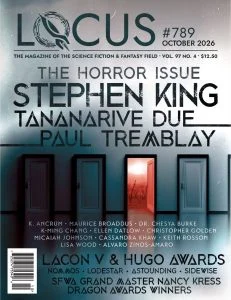
OAKLAND, CA — Locus magazine, the long-standing “Magazine of Record” for the science fiction, fantasy, and horror genres, has released its October 2026 edition (Issue #789), marking a pivotal moment in the 59th year of its publication. As the industry grapples with shifting editorial landscapes, geopolitical tensions within fandom, and a resurgence of the horror genre, this 30-time Hugo Award-winning publication provides an exhaustive look at the state of speculative fiction today.
The October issue is anchored by high-profile interviews with titans of the field—Stephen King, Tananarive Due, and Paul Tremblay—while providing definitive coverage of the 2026 Worldcon (LAcon V) and the prestigious Hugo Awards. With a sprawling reviews section and a specialized spotlight on the mechanics of fear, Issue #789 serves as both a historical document and a critical compass for the genre’s future.
Main Facts: A Convergence of Horror Royalty and Grand Masters
The centerpiece of Issue #789 is a trio of interviews that bridge the gap between classic horror and the modern “literary horror” movement. Stephen King, in a feature titled "Idea of Echoes," discusses the cyclical nature of storytelling and the persistent resonance of the uncanny in his latest work. This is complemented by a deep dive with Tananarive Due, whose "Doorway to the Supernatural" explores the intersection of historical trauma and the paranormal—a theme that has earned her widespread acclaim in recent years. Paul Tremblay, a leader in the psychological horror space, rounds out the interviews with "Rupture Point," discussing the fragility of reality in contemporary fiction.
Beyond the interviews, the magazine reports on two of the highest honors in the field. Nancy Kress has been officially named a Science Fiction and Fantasy Writers Association (SFWA) Grand Master. Kress, known for her rigorous "hard" science fiction and her explorations of genetic engineering, joins the ranks of legends like Robert A. Heinlein and Ursula K. Le Guin.
The issue also serves as the official record for the 2026 Hugo Award winners, the most prestigious fan-voted honors in the genre. This year’s winners represent a diverse cross-section of the global SFF community, reflecting a year of significant literary achievement despite the administrative controversies that have plagued the World Science Fiction Society (WSFS) in recent cycles.

Chronology: The 2026 Convention Season and the Path to Brisbane
The October issue provides a comprehensive timeline and reportage of the 2026 convention circuit, which has been one of the most active in recent memory.
LAcon V: The 84th Worldcon
The magazine features an extensive report on LAcon V, the 2026 World Science Fiction Convention held in Los Angeles. This coverage includes:
- The Hugo Breakdown: A statistical analysis of the voting patterns, providing transparency into how this year’s winners were selected.
- The WSFS Business Meeting: Detailed reporting on the administrative decisions that govern the future of Worldcon, including constitutional amendments and procedural changes aimed at preventing the eligibility scandals of years past.
- The Social Fabric: Extensive photo galleries documenting the "Brooklyn Books & Booze" event, the "KGB Reading" series, and "Hexagon XVIII," capturing the community aspect of the genre.
Future Horizons
Looking forward, Locus confirms the site selection for Worldcon 2028, which will take place in Brisbane, Australia. This marks a significant return to the Southern Hemisphere. Additionally, the issue notes that Montréal 2027 has bolstered its guest list, adding celebrated authors Katherine Addison and Cory Doctorow as Guests of Honor.
Dragon Con and Regional Awards
The chronology extends to Dragon Con 2026 in Atlanta, where the Dragon Awards—often seen as a more populist counterpart to the Hugos—announced their winners. The issue also tracks the Sidewise Awards for alternate history and the shortlist for the Nommo Awards, which recognize the best in African speculative fiction.
Supporting Data: The Critical Landscape and the Horror Spotlight
Locus remains the industry leader in critical analysis, and Issue #789 features an unprecedented volume of reviews, covering nearly 50 new titles and dozens of short fiction entries.

The Horror Spotlight: "Monsters are Hot"
A significant portion of the issue is dedicated to a specialized feature on horror, a genre currently experiencing a commercial and critical "golden age."
- Cassandra Khaw contributes a commentary titled "Monsters are Hot," examining the cultural appetite for the monstrous.
- Maurice Broaddus & Dr. Chesya Burke provide a vital historical perspective with "Black Horror: Why Canonical Voices From Then to Now," tracing the evolution of the Black experience within the genre.
- Lisa Wood (writing as L.M. Wood) offers insights into the Horror Writers Association (HWA) and the "Common Thread" that binds practitioners of the dark fantastic.
- Additional spotlights feature K. Ancrum, K-Ming Chang, Ellen Datlow, Christopher Golden, Micaiah Johnson, and Keith Rosson.
The Review Matrix
The magazine’s review staff, including veterans like Gary K. Wolfe and Ian Mond, provide critiques of major new releases. Notable books reviewed this month include:
- A Wall Is Also a Road by Annalee Newitz
- D: Heavy Water by Neal Stephenson
- The Scarlet Ball by Nghi Vo
- As You Wake, Break the Shell by Becky Chambers
- Mazywood by Tananarive Due
- Find Me Where It Ends by Cassandra Khaw
The short fiction section, helmed by Maria Haskins and A.C. Wise, reviews the latest issues of Analog, Clarkesworld, Lightspeed, Strange Horizons, and Fiyah, ensuring that the magazine covers the pulse of the genre’s most experimental formats.
Official Responses: Upheaval and Institutional Shifts
Issue #789 does not shy away from the more contentious aspects of the industry. The "Data File" and "Main Stories" sections report on several institutional disruptions that have sparked debate within the community.
The Chengdu Aftermath
In a significant move by the WSFS, several officials involved in the Chengdu Worldcon (2023) have been officially banned from future participation. This follows a multi-year investigation into the "Hugo-gate" eligibility scandals. The official response from the WSFS, as recorded in the business meeting report, signals a hardline stance on maintaining the integrity of the Hugo Awards.

Editorial and Board Changes
The issue reports on a "Board Upheaval" at the Horror Writers Association (HWA), suggesting internal friction within the organization’s leadership. Simultaneously, the magazine notes major editorial changes at Nightmare and Lightspeed, two of the most influential digital venues for short fiction. These shifts indicate a period of transition as the industry adapts to new economic and cultural pressures.
Personal Milestones and Transitions
On a more somber note, the industry reflects on the news that long-time Asimov’s Science Fiction editor Sheila Williams will be entering an assisted living facility. Williams has been a cornerstone of the magazine for decades, and the announcement has prompted a wave of tributes from writers and readers alike. The issue also includes an obituary for David Kopaska-Merkel, a respected poet and editor whose work in the small-press scene left a lasting mark.
Implications: The Future of Speculative Fiction
The content of Locus Issue #789 suggests three major trends that will define the next decade of the genre:
- The Institutionalization of Horror: Once relegated to the fringes of "pulp," horror has now achieved a level of academic and critical parity with science fiction. The inclusion of heavyweights like King and Due alongside deep-dive historical essays suggests that horror is now the primary lens through which the industry is exploring contemporary social anxieties.
- Global Accountability: The banning of Chengdu officials and the rigorous reporting on WSFS business meetings reflect a "pro-transparency" movement within fandom. As the genre becomes more global (evidenced by the Brisbane 2028 selection and the Nommo Awards), the demand for standardized, fair, and transparent governance of awards and conventions is reaching a fever pitch.
- The Persistence of the Physical and Critical: In an era of AI-generated content and declining media literacy, the sheer volume of human-authored reviews in Locus serves as a bulwark for quality. The "People & Publishing" section, which tracks hundreds of book sales and milestones for authors like Nnedi Okorafor and Ai Jiang, proves that the traditional publishing engine remains robust despite digital disruptions.
As Locus approaches its 60th year of publication, Issue #789 reinforces the magazine’s role not just as a news outlet, but as the essential archive of the speculative imagination. For creators, publishers, and fans, the October 2026 issue provides the data and the narrative necessary to navigate an increasingly complex literary landscape.
Locus Issue #789 (October 2026) is available now in digital and print formats. For more information or to support the magazine’s mission of genre preservation, visit Locusmag.com.