Ape Intelligence: The Satirical Rise of "Did a Monkey Write This?" in the Age of Automated Creativity

LONDON — As the creative industries grapple with the encroaching shadow of automation, a new title in the indie gaming sector is turning the discourse on its head with a blend of biting satire and addictive incremental mechanics. Did a Monkey Write This?, a recently announced title from developer Sophia Wawak, offers a whimsical yet pointed critique of the "AI revolution" by literalizing the concept of "Ape Intelligence."
Set in the near-future landscape of 2026, the game explores the plight of the modern creative: an author overwhelmed by a saturated market, drowning in a sea of daily digital releases, and ultimately turning to a troop of primates to maintain their career. By replacing "Artificial Intelligence" with "Ape Intelligence," the game provides a playground for players to explore the ethics of outsourcing creativity while managing the literal hunger of their simian ghostwriters.
Main Facts: A New Paradigm in Idle Gaming
Did a Monkey Write This? is positioned as an incremental "idle" game, a genre characterized by progression through automated resource generation and strategic upgrades. However, unlike many of its peers that focus on abstract numbers or industrial complexes, this title centers its narrative on the publishing industry.
The player assumes the role of a young author suffering from a paralyzing case of writer’s block. In a world where Amazon and other digital storefronts are flooded with thousands of new titles every twenty-four hours, the protagonist finds the traditional path to success impossible. The solution? A pet ape that possesses a surprising knack for prose. This primate soon recruits its "cousins," creating a literalized AI (Ape Intelligence) workforce.
The core gameplay loop involves managing these monkeys, ensuring they are fed and motivated, and then navigating the chaotic world of 2026 publishing. The game is currently available for wishlisting on Steam, with a playable demo hosted on itch.io, allowing players to experience the early stages of their simian-led literary empire.
Chronology of the Author’s Journey: From Block to Billionaire
The progression of Did a Monkey Write This? follows a distinct chronological path that mirrors the rise of a tech-era entrepreneur, albeit one fueled by fruit rather than venture capital.
The Initial Struggle
The game begins in a modest setting where the player’s primary obstacle is the sheer volume of the competition. The narrative setup establishes that the protagonist is not necessarily a bad writer, but a "frozen" one. The sheer scale of the 2026 publishing world has rendered human effort seemingly futile. The introduction of the first pet ape serves as the catalyst for the game’s transition from a narrative setup to an active simulation.
The "Bruised Banana" Phase
In the early game, resources are scarce. The player’s first monkey is a modest worker with low stamina. To keep the gears of "Ape Intelligence" turning, the player must provide food. Initially, the only affordable sustenance is "bruised bananas." These provide minimal energy and require constant clicking and management. This phase represents the "grind" of the indie author, where every cent earned from a short story or a pamphlet is immediately reinvested into basic survival.

Scaling the Empire
As the player earns "loot" from published works, they unlock a comprehensive skill tree. This tree allows for the diversification of the monkeys’ diet, introducing higher-quality fruits that keep the workers fed for longer periods. Simultaneously, the player can hire more monkeys, expanding their "AI" department. The chronology shifts from manual management to a more automated, "idle" experience as the monkeys begin to produce longer, more complex manuscripts that command higher market prices.
The Final Evolution
The endgame of the current demo and planned full release involves upgrading the author’s environment. Players move from cramped apartments to sprawling estates, all while their primate workforce grows in size and efficiency. The books become "epic" in length, requiring significant time and caloric investment but yielding millions in profit.
Supporting Data: The Mechanics of Simian Success
To understand the appeal of Did a Monkey Write This?, one must look at the data-driven mechanics that underpin its silly premise. The game balances three primary systems: Resource Management, Mini-Game Multipliers, and the "Publishing Engine."
The Fruit Economy
The monkeys do not demand a salary, but their productivity is directly tied to a "Hunger Meter."
- Bruised Bananas: Low cost, low satiety.
- Premium Fruit (Unlocked via Skill Tree): Higher cost, significantly higher satiety and duration.
If the hunger meter hits zero, production halts entirely. This creates a high-stakes "failure state": if a player spends all their money on upgrades and runs out of cash for fruit while their monkeys are idle, they face a bankruptcy loop.
The Tomato and the Professor
A unique mechanic in the early publishing phase involves a mini-game where the player throws tomatoes at their professor’s face. The data suggests that accuracy in this mini-game acts as a profit multiplier. It serves as a cathartic representation of the "student vs. academic" struggle, where the author rejects traditional literary criticism in favor of raw, monkey-generated profit.
The Slot Machine Engine
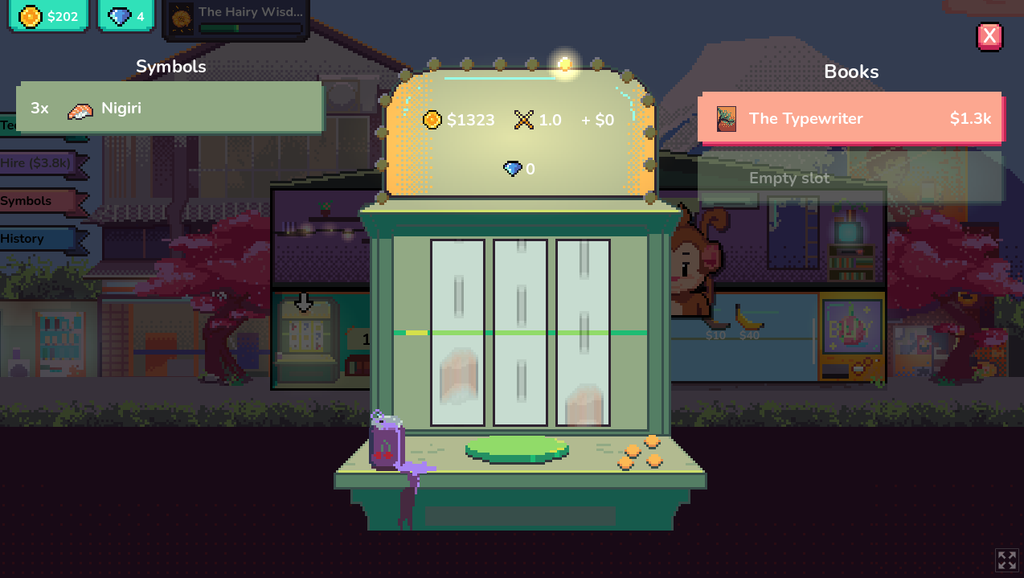
As the game progresses, the publishing process evolves into a sophisticated slot machine mechanic. Players don’t just "hit publish"; they "spin" for bonuses.
- Icon Customization: Players can purchase new icons for the slot machine via the skill tree.
- Ability Synergy: Different icons have varying abilities—some increase the base profit of a book, while others provide "crit-like" multipliers.
- Scaling Difficulty: Reports from early playtests indicate that it can take a dozen books before a player successfully builds a "deck" of icons strong enough to hit consistent high-value bonuses, adding a layer of strategic depth to what is ostensibly a simple idle game.
Official Responses: Developer Intent and Satirical Edge
While Sophia Wawak has maintained a playful tone regarding the game’s development, the "tongue-in-cheek" nature of the project is its primary selling point. In various development logs and the game’s announcement trailer, the message is clear: the game is a parody of the current obsession with automation.
The developer’s choice to use the acronym "AI" for "Ape Intelligence" is a deliberate commentary on the dehumanization of the creative process. By showing that a "monkey with a typewriter" can achieve the same commercial success as a human author in a broken market, the game asks uncomfortable questions about what we value in art.
Early reviews of the demo on itch.io have praised the pacing. Players have noted that the game avoids the common "idle game trap" of becoming too slow too quickly. Instead, the constant feedback loop of feeding monkeys and upgrading the slot machine keeps the engagement high. "It feels like a fever dream of the 2026 gig economy," noted one player in the game’s community forum.
Implications: Art, Automation, and the Infinite Monkey Theorem
The release of Did a Monkey Write This? comes at a pivotal moment in the real-world conversation about generative models. The implications of the game’s narrative extend far beyond its "silly concept."
The Devaluation of Prose
The game posits a world where the volume of content is so high that the quality of the prose—whether written by a human, a machine, or a monkey—is irrelevant. The only metrics that matter are "Profit" and "Loot." This mirrors real-world concerns among authors that "AI-slop" is making it impossible for human-centric stories to find an audience.
The "Infinite Monkey" Reality
The "Infinite Monkey Theorem" suggests that a monkey hitting keys at random on a typewriter for an infinite amount of time will almost surely type a given text, such as the complete works of William Shakespeare. Did a Monkey Write This? gamifies this theorem but adds a modern twist: the monkeys aren’t trying to write Shakespeare; they are trying to write "content" for a marketplace that doesn’t know the difference.
The Irony of the Idle Genre
There is a profound irony in using an idle game—a genre defined by "playing itself"—to critique the automation of art. By making the player the "manager" of the automation, the game highlights the shift from creator to curator. In the world of 2026, the author’s job is no longer to write, but to keep the "Ape Intelligence" fed and the machines running.
Conclusion: A Playable Critique
Did a Monkey Write This? is more than just a humorous distraction. It is a sharp, mechanical critique of a creative industry at a crossroads. By blending the addictive nature of incremental games with a satirical take on the future of publishing, Sophia Wawak has created a title that is as thought-provoking as it is absurd.
As players continue to wishlist the title on Steam and experiment with the demo on itch.io, the industry watches closely. In a world increasingly dominated by algorithms, perhaps the only way to process the absurdity of the current moment is to lean into it—one bruised banana at a time. Whether the books produced by these digital monkeys are "any good" remains to be seen, but in the economy of 2026, the only thing that matters is that the monkeys are fed and the "Publish" button is pressed.