The Cartography of Consciousness: The Luminous Surrealism of Christian Quintin
By [Your Publication Name] Arts Desk
In an era where contemporary art is frequently defined by its capacity to shock, deconstruct, or provide social commentary, the work of Christian Quintin stands as a deliberate and luminous anomaly. A painter who refuses the constraints of slogans or manifestos, Quintin has spent over four decades crafting a visual language that bridges the rugged, mythic coastlines of his native Brittany with the sun-drenched, "sacred ecology" of Northern California.
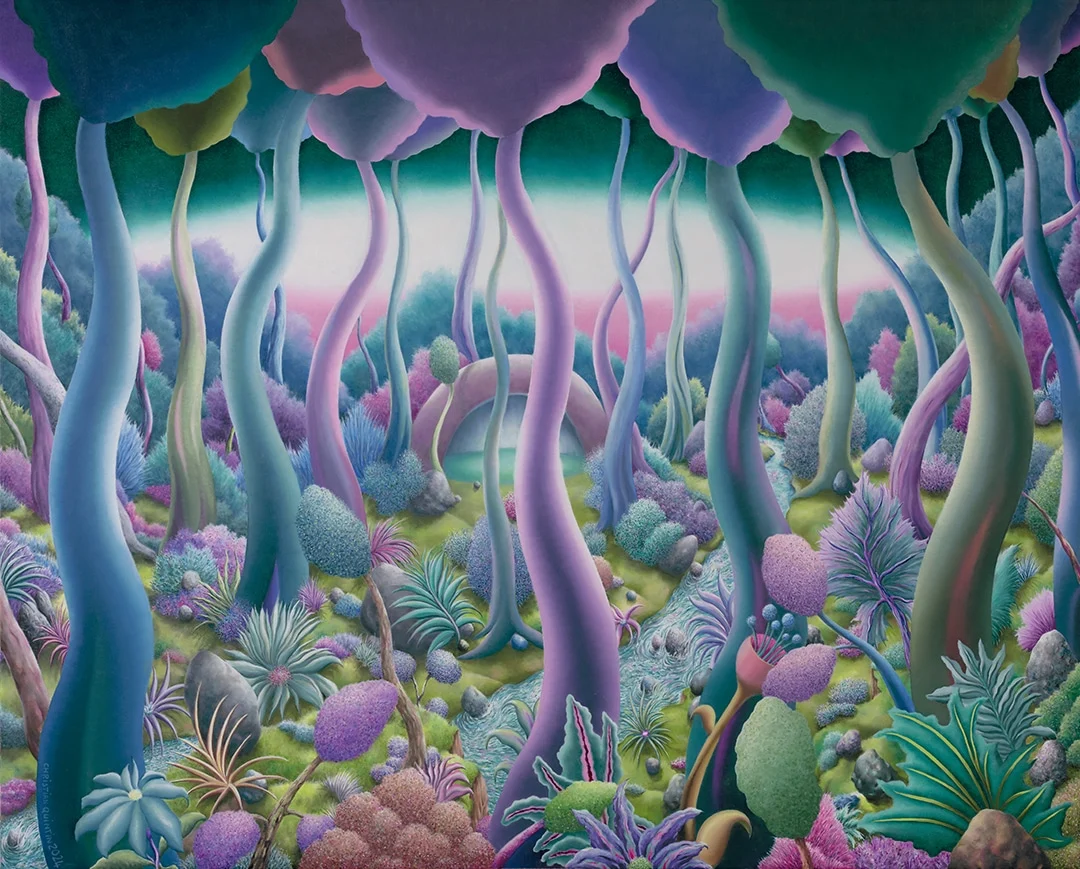
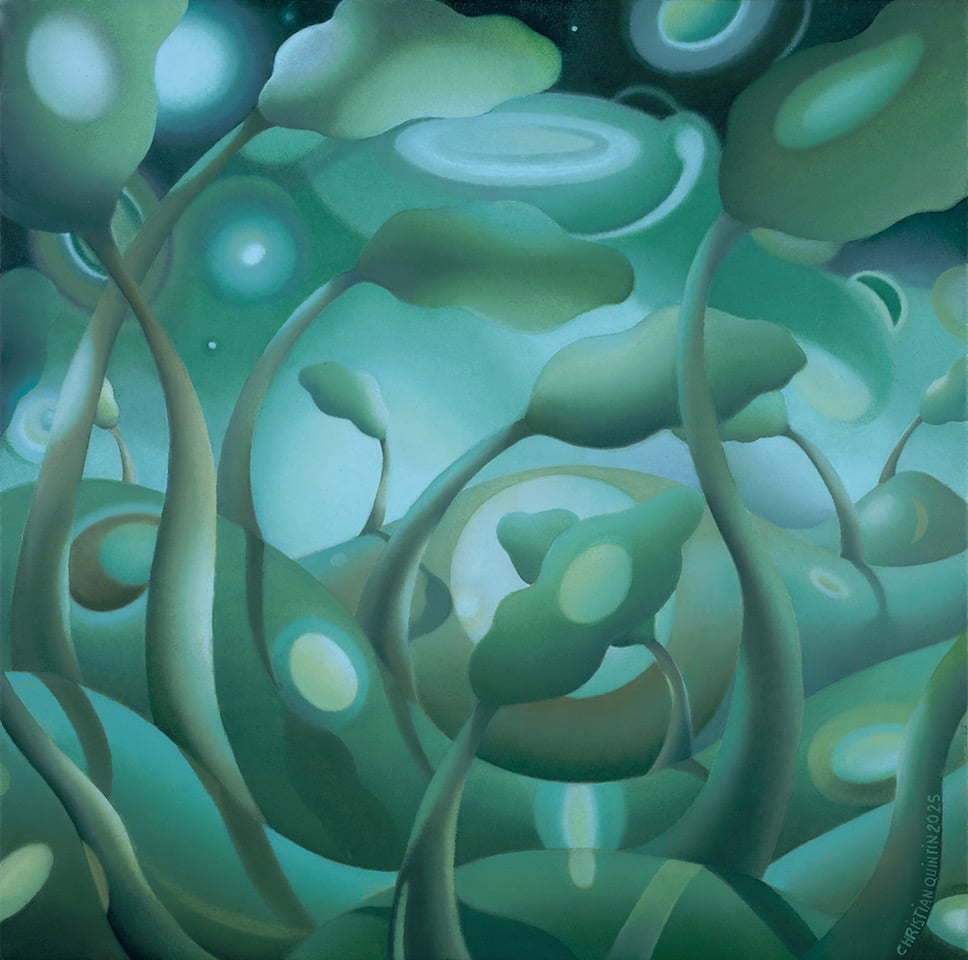
His work does not merely depict landscapes or faces; it maps the "kaleidoscopic consciousness" of the human experience. Through a meticulous application of ink, oil, graphite, and pastel, Quintin creates what critics have termed "mental landscapes"—spaces where the boundary between the observer and the observed dissolves into a seamless, symbolic poetry.

Main Facts: A Unified Vision of Inner and Outer Worlds
Christian Quintin’s practice is defined by a rare synthesis of classical discipline and surrealist intuition. Born in 1957, his career has been a slow-burning ascent from regional acclaim in California to recent international recognition in major art hubs like Seoul, Hong Kong, and Paris.
The core of Quintin’s appeal lies in his technical mastery. He is known for spending months—sometimes upwards of half a year—on a single composition. His surrealist works are not "accidents" of the subconscious in the Freudian sense; they are architectural constructions of memory and emotion. Whether he is rendering the "breathing" trees of Sonoma County or a face that unfurls into an entire ecosystem, Quintin’s work serves as a "wondrous sanctuary for the soul," a phrase often cited by curators to describe the meditative quality of his portfolio.
Currently represented by the Lorin Gallery (Los Angeles/Paris) and appearing in upcoming exhibitions at the Morrison Gallery in Connecticut, Quintin represents a "Visionary Continuum." He acts as a bridge between the European masters of the impossible—such as Magritte and Escher—and the emotive, nature-centric traditions of the American West.

Chronology: From the Storms of Brittany to the Valleys of Sonoma
1957–1975: The Formative Coastline
Quintin’s artistic DNA was forged in Saint Brieuc, a port town on the northern coast of Brittany, France. This region, characterized by ruined castles, storm-lashed cliffs, and a palpable sense of ancient history, instilled in him an early sensitivity to nature’s grandeur and melancholy. A recurring motif in his later work, L’île de la Comtesse, originates from this period—a mythic island that represents the solitude and storybook aura he continues to explore.
1975–1981: The Parisian Discipline
In 1975, Quintin moved to Paris to study at the prestigious Beaux Arts Academy. It was here that his romantic instincts were tempered by classical rigor. He mastered the precise draftsmanship and control of form that allow his current surrealist works to feel grounded and "legible" despite their impossible subject matter. During this time, he absorbed the legacies of French Surrealism and Symbolism, though he gravitated away from the movement’s more aggressive tendencies, seeking instead to "reveal" rather than to "shock."
1981–1999: The California Resonance
The most significant pivot in Quintin’s life occurred in 1981 when he relocated to Northern California. Settling in the vineyards and valleys of Sonoma County, he discovered a second vocabulary in the American landscape. The "sacred ecology" of the West—its towering redwoods and rolling golden hills—found a mirror in the old myths of Brittany.

Throughout the late 1980s and 90s, Quintin established himself as a master technician, winning the Grumbacher Award in 1987 and an Award of Excellence from the California State Fair in 1990. His work during this period transitioned from strictly regional interest to a more profound exploration of the "spirit" shared between the artist and the natural world.
1999–Present: International Recognition
A watershed moment arrived in 1999 when the Vorpal Gallery—the institution famous for introducing M.C. Escher to the American public—began representing his work. This association solidified his place in the lineage of artists who combine meticulous technique with mind-bending philosophical inquiry. By the 2020s, his representation by Lorin Gallery propelled him onto the global stage, with major showings at KIAF in Seoul and Art Central in Hong Kong.
Supporting Data: The Architecture of the Work
The technical demands of Quintin’s work provide a quantitative look at his dedication to "slow art." His process is a negotiation between intuition and the hand, often requiring hundreds of hours of labor.

- The Aviary: A seminal work that serves as an "ecosystem of self." It took Quintin six months to complete. In this piece, a face emerges from a crystal, a neck transforms into a tree trunk, and hair becomes a leafy canopy.
- La Porte Ouverte: Inspired by the poetry of Rumi ("Why stay in prison when the door is wide open?"), this work required seven months of intricate cross-hatching and symbolic layering.
- Medium Diversity: Quintin does not adhere to a single medium, instead choosing based on the "emotional temperature" of the piece. His landscapes often utilize the luminosity of oil or the softness of pastel to create "emotional terrains," while his more cerebral surrealist works often employ pen, ink, and graphite for maximum precision.
His landscapes, such as Leaves of Absence and Les Amants, demonstrate his ability to anthropomorphize nature. In these works, trees are not static objects but "dancers" or "lovers," swaying with a pulse that Quintin describes as a "communion" with the spirit of the land.
Official Responses: What the Critics See
Critics have consistently pointed to Quintin’s work as a necessary antidote to the cynicism of the modern art world. The reception of his 2022 exhibition at the Calabi Gallery serves as a primary example of this sentiment.
The review noted: "In an era largely devoid of it, his work is beautiful. We could all use more beauty in our lives." This was not merely a compliment on aesthetics but a diagnostic observation of a cultural void that Quintin’s work fills.

Alhia Warren, a prominent voice in art criticism, described his pieces as a "beautiful intimate mystery," while Suzanne Munich famously titled her review "Mental Landscapes," acknowledging that Quintin’s subjects are internal states projected onto the canvas. Dan Taylor, writing for the Press Democrat, highlighted the "emerging beauty" of his career, noting how the artist has remained steadfast in his vision regardless of passing trends.
The consensus among curators is that Quintin’s rejection of irony and didacticism is what makes him radical. By refusing to tell the viewer what to think, he provides the space for the viewer to feel—a rare commodity in contemporary galleries.
Implications: Beauty as a Form of Defiance
The career of Christian Quintin suggests a significant shift in the "Visionary Art" movement. While the movement was once associated primarily with the psychedelic and chaotic aesthetics of the 1960s, Quintin offers a "classical" visionary alternative.

The Bridge Between Cultures
Quintin’s work serves as a vital link between European Surrealism and American Romanticism. He takes the intellectual curiosity of the French tradition and infuses it with the expansive, spiritual reverence for nature found in the American West. This synthesis suggests that the "inner" world of the psyche and the "outer" world of the terrain are not separate entities but a unified field of consciousness.
The Return to "Slow Art"
In a digital culture characterized by speed, spectacle, and AI-generated imagery, Quintin’s six-to-seven-month production cycle for a single drawing is an act of defiance. His work implies that true depth requires time, care, and a manual "negotiation" with the medium. This dedication to craftsmanship has allowed his work to age with a timelessness that ephemeral, concept-heavy art often lacks.
Art as Sanctuary
Perhaps the most profound implication of Quintin’s legacy is the re-establishment of art as a "sanctuary." His philosophy—"Intuition first. Technique follows"—prioritizes the emotional well-being of the viewer. As the art world moves into the mid-2020s, Quintin’s success at international fairs indicates a growing global appetite for work that honors the "hidden dimension" of reality—the feelings we have before we have the words to describe them.
Conclusion: A Legacy of Wonder
Christian Quintin’s journey from the rugged coast of Brittany to the international galleries of Paris and Seoul is a testament to the power of a singular, uncompromised vision. He has shown that beauty is not an escape from reality, but a more profound reentry into it.
By mapping the "kaleidoscopic consciousness" of the human soul, Quintin does more than paint; he reminds us of the capacity for wonder that exists within the mundane. As his work continues to gain traction on the world stage, it stands as a reminder that the most revolutionary thing an artist can do is to remain silent enough to hear the trees speak—and then have the discipline to spend half a year capturing their voice.
Where to See His Work:
- Lorin Gallery: Los Angeles and Paris.
- Morrison Gallery: Kent, Connecticut (Upcoming).
- Online: christianquintin.com