Redefining Digital Space Tourism: Solara One Brings the Majesty of Mars to Meta Quest
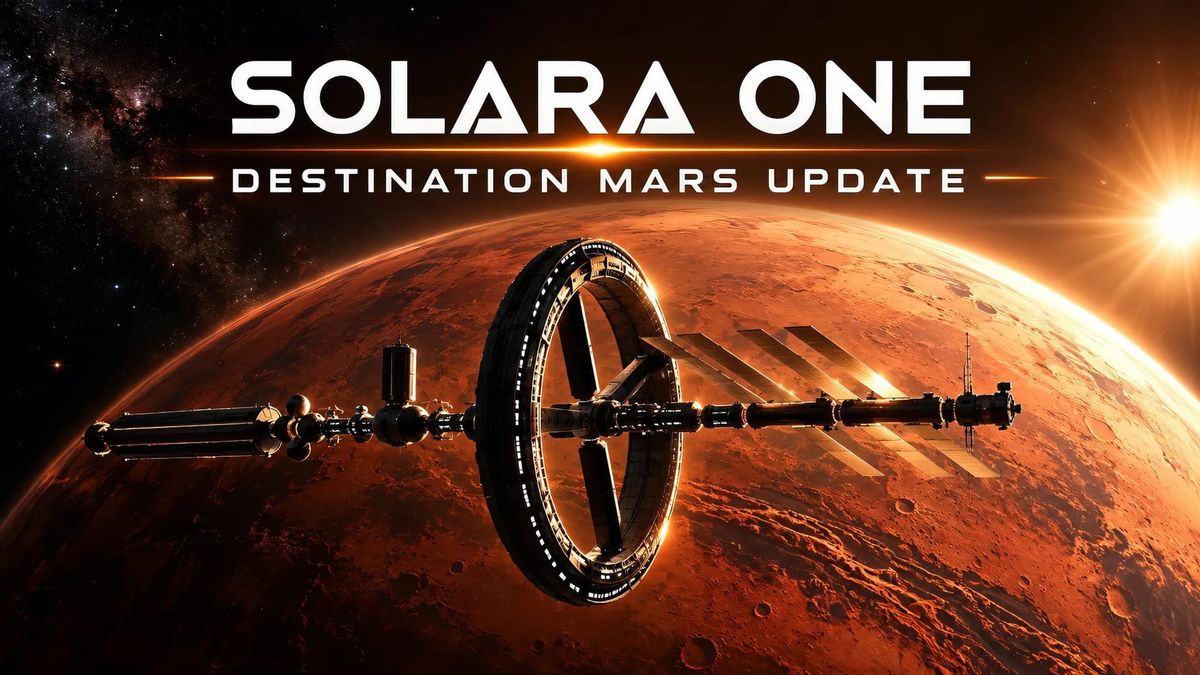
The dream of interplanetary travel has long been a cornerstone of human ambition, yet the physical reality of standing on or orbiting the Red Planet remains decades away for even the most elite astronauts. However, for users of the Meta Quest ecosystem, that distant future has arrived in a strikingly vivid digital form. Solara One, the premier "space sci-fi and chill" application, has officially launched its highly anticipated Mars expansion, offering an unprecedented look at Earth’s neighbor through the lens of high-fidelity virtual reality.
Launched on November 19, the Mars update represents a significant leap forward for standalone VR experiences. Developed by Aaron Cryderman of AC Reality Studios, Solara One has transitioned from a niche relaxation app into a powerful tool for digital exploration, blending scientific data with immersive gameplay mechanics. By utilizing cutting-edge texture techniques and taking full advantage of the Meta Quest 3’s hardware capabilities, the update provides a window into a world that, until now, was only accessible through grainy rover photos and Hollywood dramatizations.
Chronology of Development: From the Arboretum to the Red Planet
The journey of Solara One has been one of steady, iterative growth. To understand the significance of the Mars update, one must look back at the development roadmap established by AC Reality Studios over the past year.
In September, the app received the "Arboretum" update, which introduced a lush, green sanctuary within the confines of the space station. This update was designed to provide a contrast to the cold, sterile environment of deep space, offering users a "holodeck-like" experience where they could relax amidst terrestrial flora while orbiting the Earth. The Arboretum was a proof of concept for the developer’s ability to render complex, high-detail environments on standalone hardware.
Following the success of the Arboretum, Cryderman shifted his focus toward the next frontier: Mars. The development of the Mars expansion required a complete overhaul of the app’s environmental rendering pipeline. Unlike the Earth-based orbits previously available, Mars presented a unique challenge in terms of lighting, atmospheric representation, and geographical accuracy. After months of refinement, the update went live on November 19, allowing users to transition from the familiar blue marble of Earth to the rust-colored expanses of the fourth planet from the sun.
Technical Specifications and Supporting Data: The Power of 32K Textures
The most striking feature of the Mars update is the visual fidelity of the planet itself. Achieving a realistic planetary scale in virtual reality is a notorious hardware tax, particularly on standalone headsets like the Meta Quest, which lack the raw processing power of high-end PCs.
To overcome these limitations, Cryderman employed a sophisticated approach to asset creation:
- 32K Texture Mapping: The model for Mars utilizes a massive 32K texture. This level of detail allows for crisp visuals even when the user is "floating" close to the surface or viewing the planet through the station’s observation windows.
- AI-Assisted Upscaling: Because raw satellite data can often be inconsistent or low-resolution in certain quadrants, the developer used AI-assisted upscaling to fill in the gaps. This process enhances the sharp edges of craters and the deep shadows of canyons, ensuring that the planet looks like a physical object rather than a flat image.
- Hardware Optimization: The timing of the update coincides with the increased adoption of the Meta Quest 3. The Quest 3’s pancake lenses are critical to the experience, as they eliminate the "god rays" and peripheral blurring found in older Fresnel lenses. This clarity allows the 32K textures to shine, providing a sense of "presence" that is vital for the "chill" genre of VR.
Beyond the visuals, the update introduces functional gameplay features that enhance the sense of scale. The "Jet Thrusters" mode remains a fan favorite, utilizing a physics-based movement system. By applying a short burst of thrust, users can drift through the vacuum of space, allowing Newton’s first law of motion to dictate their path around the station. This creates a meditative, low-stress environment that distinguishes Solara One from more frantic space combat simulators.
Geographic Landmark Labels: Navigating the Martian Surface
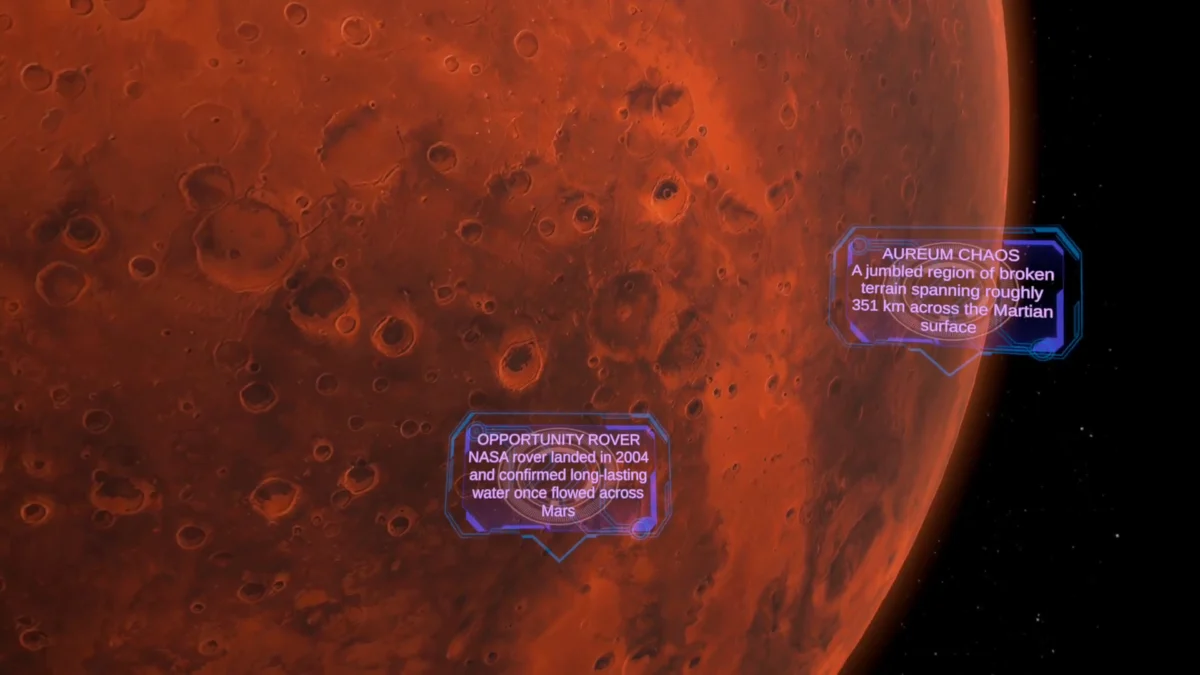
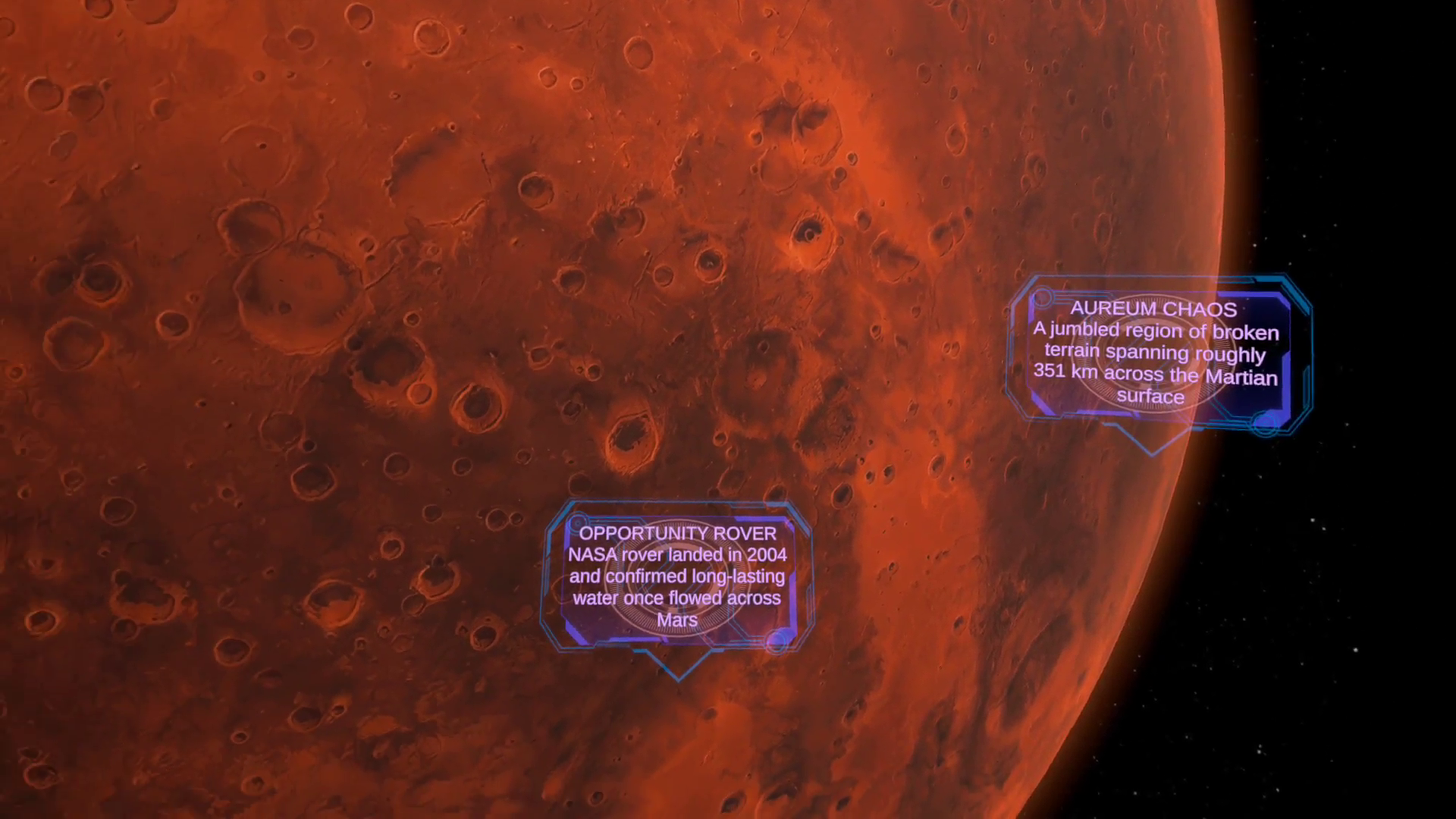
A key addition in this update is the geographic landmark "labels" feature. By toggling the Y button on the Quest controller, users can instantly see floating markers identifying points of interest on the planet below. This transforms the app from a simple visual experience into an educational tool.
Key landmarks featured in the update include:
- Schiaparelli Crater: Known to many as the primary landing site for the Ares 4 mission in Andy Weir’s The Martian, this crater is rendered with stunning accuracy.
- Valles Marineris: Often called the "Grand Canyon of Mars," this system of canyons spans over 2,500 miles (4,000 km) and reaches depths of up to 4 miles. Seeing the scale of this geological feature from orbit provides a perspective that is impossible to grasp through 2D photographs.
- NASA Rover Landing Sites: The update includes markers for historical landing sites, including those of the Curiosity and Perseverance rovers, allowing users to see the exact terrain where human-made machines are currently conducting research.
Official Responses: The Vision of AC Reality Studios
In an era where many VR developers focus on high-octane action or social metaverses, Aaron Cryderman’s vision for Solara One is decidedly more contemplative. When asked about the motivation behind adding Mars to the platform, Cryderman emphasized the role of VR as a surrogate for experiences that are currently out of reach for humanity.
"This is the way that people can kind of experience what it’s like to be in orbit around Mars," Cryderman stated. "It’s as close visually as we are going to get probably in our lifetimes. And that’s why I’m doing it."
This philosophy reflects a growing trend in the VR industry known as "Digital Space Tourism." For many users, the primary appeal of virtual reality is not to play a game, but to "be" somewhere else. Cryderman’s focus on the "Overview Effect"—a cognitive shift reported by astronauts when seeing the Earth or other planets from space—is central to the design of Solara One. By providing a high-resolution, scientifically grounded representation of Mars, the app aims to trigger a similar sense of awe and perspective in the average consumer.
Implications: The Future of Standalone VR and Education
The success of the Solara One Mars update has broader implications for the VR industry and the field of education.
1. Pushing the Limits of Standalone Hardware
Solara One serves as a benchmark for what is possible on mobile chipsets (like the Snapdragon XR2 Gen 2 found in the Quest 3). It proves that developers do not necessarily need a tethered PC to deliver high-fidelity, "prosumer" level visuals if they use clever optimization techniques like AI upscaling and efficient texture streaming. This could encourage other developers to move away from the "low-poly" aesthetic that has dominated standalone VR for years.
2. VR as a Pedagogical Tool
The inclusion of landmark labels and scientifically accurate topography positions Solara One as a valuable resource for classrooms. While students can read about Valles Marineris in a textbook, "floating" above it in a 1:1 scale simulation offers a visceral understanding of planetary geology. As VR hardware becomes more affordable, apps like Solara One could become standard components of astronomy and science curricula.
3. The "Slow VR" Movement
Solara One is a leading example of the "Slow VR" or "Zen VR" movement. In a world of constant notifications and fast-paced digital consumption, there is a clear demand for software that encourages stillness. The "Mars and Chill" concept caters to a demographic of users who use VR for mental health, meditation, and stress relief. The ability to simply drift in orbit, watching the sun rise over the Martian horizon, offers a form of escapism that is both profound and accessible.
Conclusion
Solara One’s Mars update is more than just a content patch; it is a testament to the power of virtual reality to bridge the gap between scientific data and human experience. By combining 32K textures, AI-enhanced visuals, and a deep respect for Martian geography, Aaron Cryderman has created a portal to another world.
As the Meta Quest platform continues to evolve, Solara One stands as a reminder that some of the most powerful experiences in VR are not those where we are fighting for our lives, but those where we are simply allowed to look out the window and wonder. The Mars update is currently available for all Solara One owners, inviting a new generation of "digital astronauts" to take their first steps—or rather, their first drifts—into the orbit of the Red Planet.