The Architect of Interior Landscapes: The Aesthetic Evolution of Christian Quintin
By [Your Name/Journalist Name]
In the contemporary art world—a landscape often dominated by rapid-fire digital spectacles, ironic detachment, and conceptual provocation—the work of Christian Quintin stands as a quiet, defiant sanctuary. For over four decades, the French-born, California-based artist has meticulously crafted a visual language that bridges the gap between the external natural world and the internal topography of the human psyche.
Quintin does not merely paint what he sees; he paints the resonance of memory and the pre-linguistic feelings of existence. His body of work, which oscillates between luminous romantic landscapes and intricate surrealist compositions, offers a profound meditation on the connectivity of all living things. As his career transitions from regional acclaim in Northern California to a presence on the international stage in Paris, Seoul, and Hong Kong, Quintin remains an artist committed to the "slow burn" of technical mastery and the radical pursuit of beauty.

I. Main Facts: The Unified Vision of a Transatlantic Master
Christian Quintin’s art is characterized by an almost obsessive level of detail and a philosophical depth that defies easy categorization. Working primarily in ink, oil, graphite, and pastel, Quintin has developed a "kaleidoscopic consciousness" in his work, where boundaries between the self and the environment dissolve.
Key pillars of his practice include:
- Dual Heritage: A synthesis of the moody, mythic atmosphere of coastal Brittany and the vibrant, sacred ecology of Northern California.
- Technical Rigor: A commitment to classical draftsmanship, often spending six to seven months on a single pen-and-ink composition.
- Stylistic Fluidity: A "unified vision" that treats surrealism and landscape painting not as opposing genres, but as mirrors of one another.
- Global Trajectory: Recent representation by international galleries has propelled his work into major global art fairs, signaling a renewed critical interest in "Visionary Art" and technical excellence.
Quintin’s philosophy is deceptively simple: "See the art as one would read poetry, hopeful that one would wander into its imagery." He offers no slogans or political manifestos, opting instead to provide a "wondrous sanctuary for the soul."

II. Chronology: From the Storm-Lashed Cliffs of Brittany to the Valleys of Sonoma
The Formative Years in Saint Brieuc (1957–1974)
The roots of Quintin’s aesthetic were planted in 1957 in Saint Brieuc, a port town on the northern coast of Brittany. This region of France is defined by its rugged coastline, ruined castles, and a palpable sense of ancient history. The young Quintin was deeply influenced by the solitude of L’Île de la Comtesse, an island that would later become a recurring motif in his work—a symbol of the "storybook aura" and the mythic isolation that informs his surrealist pieces.
The Paris Ateliers and the Beaux Arts (1975–1980)
In 1975, Quintin moved to Paris to study at the prestigious Beaux Arts Academy. It was here that his romantic instincts were married to classical discipline. Under the tutelage of French masters, he learned the precision of line and the mastery of materials. While he absorbed the legacy of French Surrealism (Dalí, Magritte) and the Symbolist movement, he avoided the era’s trend toward shock value. Instead, he focused on the "revelatory" power of art—using technique to unveil the invisible.
The California Transition and the "Second Vocabulary" (1981–1998)
A pivotal shift occurred in 1981 when Quintin relocated to Northern California. Settling in the vineyards and rolling hills of Sonoma County, he found a landscape that resonated with the spirit of Brittany but offered a new, expansive light. This period saw the development of his "emotional terrains"—landscapes that were not documentations of place but expressions of mood. He famously remarked, "I feel the same spirit in a tree as in myself," a sentiment that became the cornerstone of his California works.

The Vorpal Era and Regional Recognition (1999–2019)
Quintin’s career reached a critical milestone in 1999 when he began exhibiting at the Vorpal Gallery. Known for introducing M.C. Escher to the American public, Vorpal provided the perfect context for Quintin’s mind-bending yet meticulously executed works. During these decades, he became a fixture in the California art scene, completing public commissions, winning the Grumbacher Award, and earning accolades from the California State Fair.
International Breakthrough (2020–Present)
The 2020s marked Quintin’s emergence as a global figure. Partnering with Lorin Gallery (Los Angeles/Paris), his work began appearing at international fairs such as KIAF in Seoul and Art Central in Hong Kong. This era represents a "catching up" of the art world to Quintin’s timeless style, as collectors and critics alike rediscovered the value of beauty and technical intricacy in a post-conceptual market.
III. Supporting Data: The Mechanics of "Kaleidoscopic Consciousness"
To understand the depth of Quintin’s work, one must examine the labor-intensive nature of his process. His surrealist ink drawings are not the result of "automatism" or accidental scribbling; they are architectural builds of the mind.

The Time-Intensive Process
Works such as The Aviary and La Porte Ouverte are benchmarks of his patience.
- The Aviary: A self-portrait where the artist’s face emerges from a crystal and his hair transforms into a forest canopy. This piece required six months of daily, meticulous work to achieve the necessary density of symbolism and texture.
- La Porte Ouverte: Inspired by the Sufi poet Rumi’s line, "Why stay in prison when the door is wide open?", this work took seven months of cross-hatched ink mystery to complete.
The Symbiosis of Medium and Message
Quintin selects his medium based on the "vibration" of the subject matter:
- Ink/Graphite: Used for his most complex surrealist maps, where precision is required to make the impossible look tangible.
- Oil: Reserved for his "luminous landscapes," where he explores the interplay of light and shadow in the natural world.
- Pastel: Utilized for emotive, soft-focus works that capture the "breathing" quality of the atmosphere.
The Landscape as Character
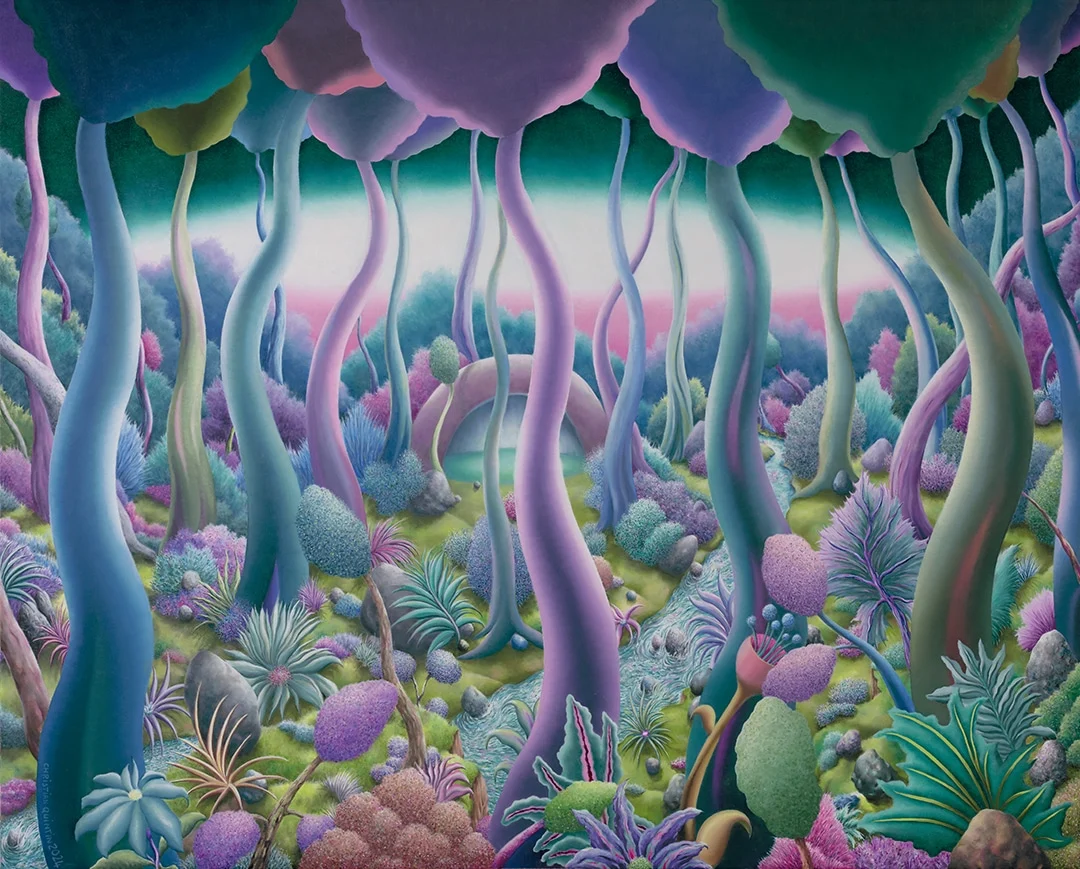
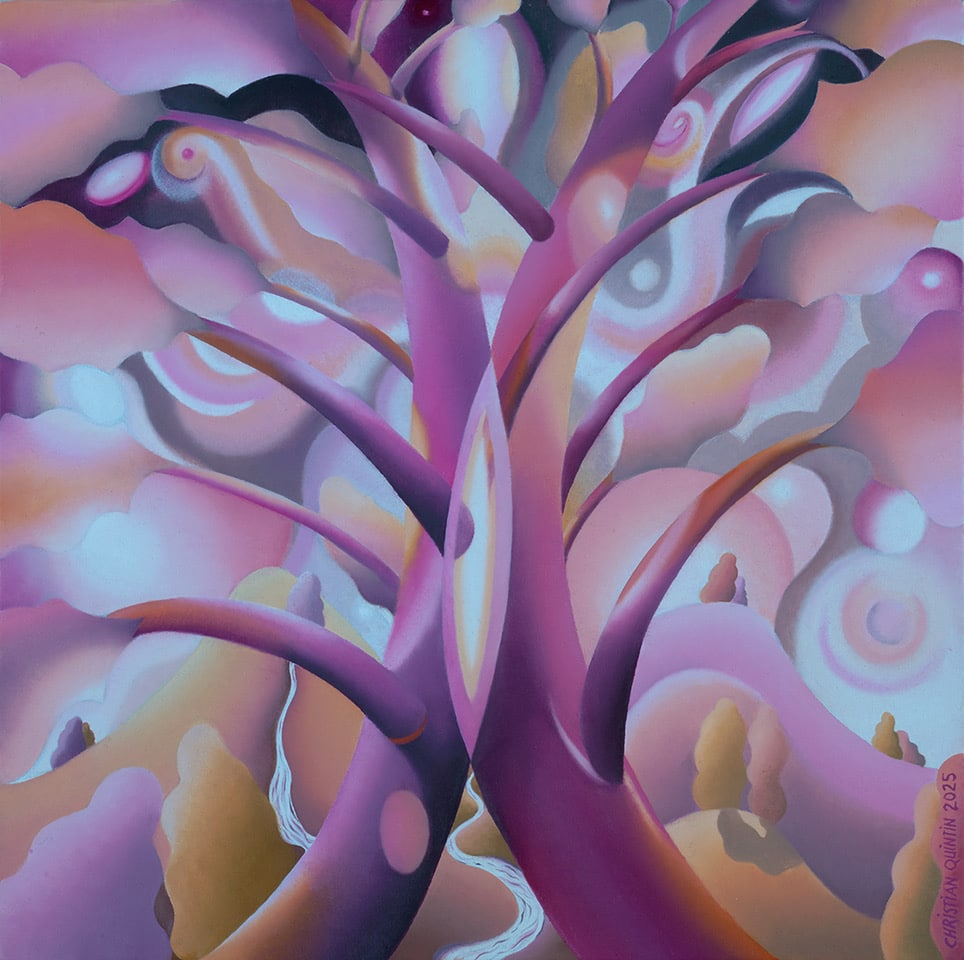
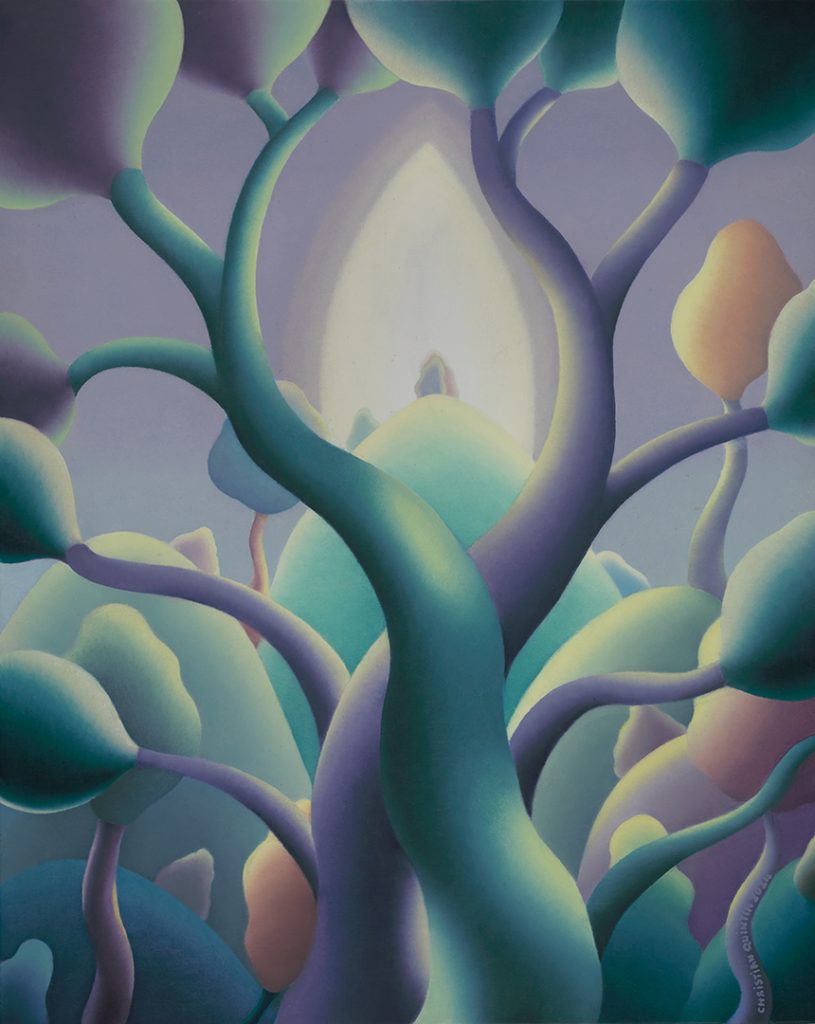
In Quintin’s visual vocabulary, nature is never static. In Leaves of Absence, trees are rendered as dancers; in Les Amants, they are lovers in an embrace. Data from his exhibition history shows a recurring focus on "emotional color." For instance, in A Lake Color of Emeralds, he abandons literal color for a palette of brown-orange skies and violet undertones—a choice backed by his philosophy that "color is feeling."

IV. Official Responses: Critical Acclaim and Curatorial Perspectives
The critical response to Quintin’s work over the last forty years has been remarkably consistent, focusing on his ability to fill a perceived "beauty gap" in modern art.
Alhia Warren, art critic, described his compositions as a "beautiful intimate mystery," noting that his work invites the viewer into a private conversation with the subconscious.
Suzanne Munich, in a widely cited review titled "Mental Landscapes," argued that Quintin’s strength lies in his ability to make the internal world appear as structured and "real" as the external one.

The Calabi Gallery, in a 2022 retrospective review, provided a poignant diagnosis of his relevance: "In an era largely devoid of it, his work is beautiful. We could all use more beauty in our lives." This sentiment echoes a broader shift in curatorial circles toward "Visionary Art"—a movement that values the spiritual and the aesthetic over the purely didactic.
The Vorpal Gallery’s legacy also looms large. By placing Quintin in the same lineage as Escher, curators officially recognized his work as part of the "Visionary Continuum"—a tradition of artists who use mathematical or technical perfection to explore the boundaries of logic and dream.
V. Implications: Beauty as an Act of Resistance
The rise of Christian Quintin’s profile in the 2020s suggests a significant shift in the contemporary art market’s priorities. For decades, the "fine art" world prioritized irony, social critique, and deconstruction. Quintin’s success with his "rejection of irony" points toward several broader implications:
1. The Return to "Slow Art"
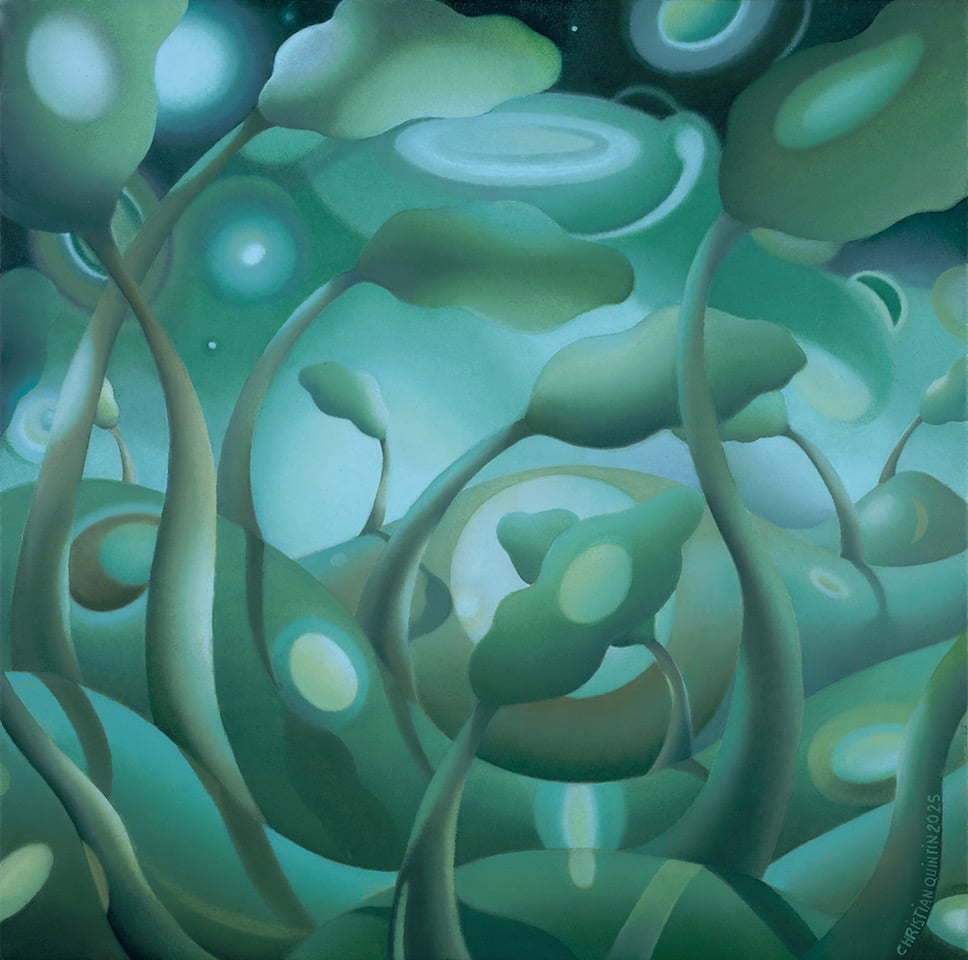
In a digital age characterized by "speed and spectacle," Quintin’s six-month-long ink drawings represent a form of "Slow Art." This movement emphasizes the value of the human hand and the time required for deep contemplation, both for the creator and the viewer.
2. Aesthetic Resilience
Quintin proves that beauty is not merely "escapism." In his view, creating a "sanctuary for the soul" is an act of resistance against a culture of cynicism. By focusing on the "sacred geometry of thought," he provides a counter-narrative to the often-bleak outlook of contemporary conceptualism.
3. The Bridge Between Traditions
Quintin serves as a vital bridge between the European Surrealist tradition and the American Visionary movement. He strips away the aggressive, often disturbing elements of early Surrealism (the "shock of the new") and replaces them with a sense of wonder and "sacred ecology." This makes his work uniquely accessible to a global audience, as evidenced by his recent success in Asian markets like Seoul and Hong Kong.
4. Environmental Consciousness
While not an "activist" in the traditional sense, Quintin’s landscapes—where faces emerge from clouds and trees pulse with human emotion—foster a deep sense of empathy for the natural world. His work implies that the "landscape" and the "psyche" are one and the same; to damage one is to damage the other.
Conclusion: The Enduring Echo
Christian Quintin’s legacy is one of attention, soul, and meticulous care. As he prepares for upcoming exhibitions at the Morrison Gallery in Connecticut and continues his representation with Lorin Gallery, the art world is finally recognizing what his Northern California collectors have known for decades: that Quintin is a master of the "hidden dimension."
His work reminds us that art does not need to shout to be heard; it only needs to resonate. In the "wondrous sanctuary" of his canvases, we find a reentry into the world we felt before we had words for it—a place where the tree, the dancer, and the dreamer are finally, inextricably, one.
For further information and to view the artist’s portfolio, visit christianquintin.com.