
Cultural Sovereignty vs. Curatorial Vision: The Growing Controversy Over Pedro Reyes’s ‘Tlali’ at LACMA
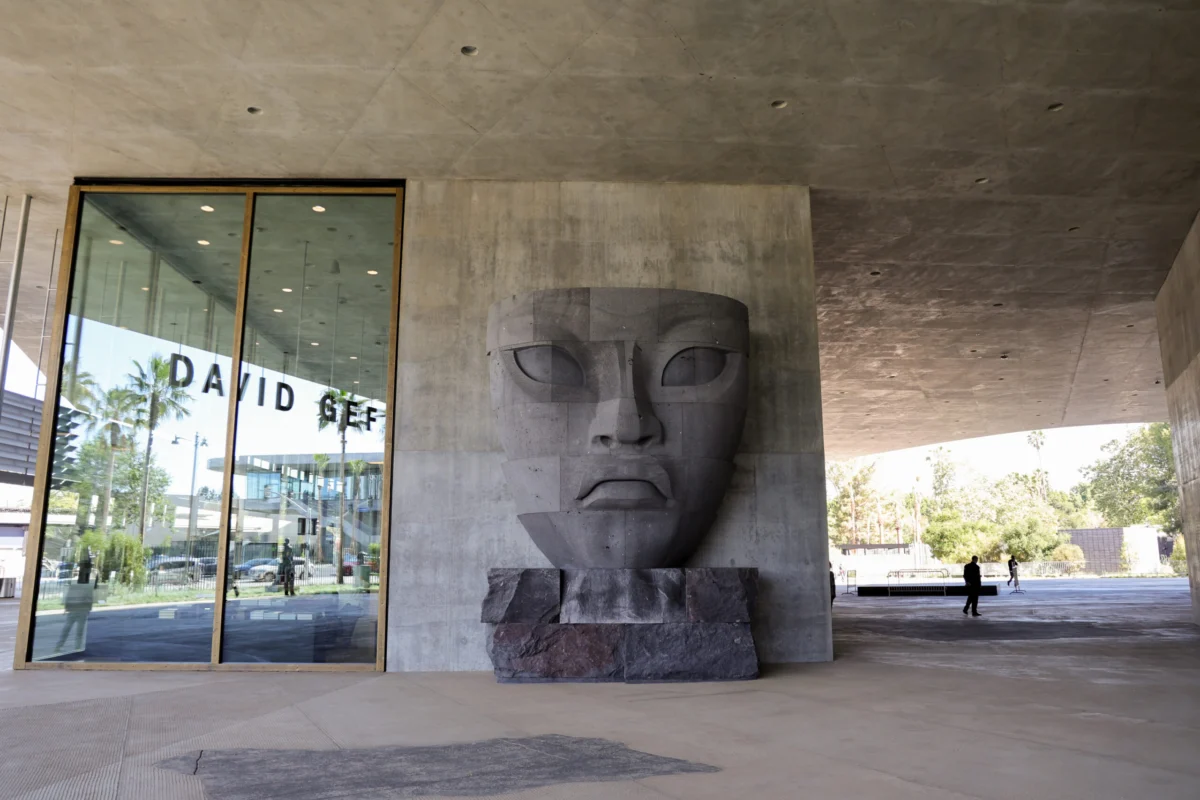
The grand unveiling of the Los Angeles County Museum of Art’s (LACMA) new $715 million David Geffen Galleries was intended to be a moment of architectural and cultural triumph. However, the celebration has been tempered by a burgeoning international controversy. Nearly eighty prominent Mexican cultural figures—including artists, curators, and intellectuals—have signed a scathing open letter decrying the installation of Tlali, a monolithic sculpture by renowned Mexican artist Pedro Reyes, in the museum’s central plaza.
The dispute centers on allegations of cultural appropriation, "neo-indigenism," and a perceived lack of sensitivity by LACMA’s leadership regarding a project that was previously rejected in Mexico City under similar pretenses. As the sculpture prepares to become a permanent fixture of the Los Angeles skyline, the debate highlights the increasingly complex intersection of public art, Indigenous representation, and the ethical responsibilities of global art institutions.
Chronology of a Controversy: From Paseo de la Reforma to Wilshire Boulevard
To understand the current friction at LACMA, one must look back to the social and political climate of Mexico City in 2021. In the wake of global movements to remove colonial monuments, the Mexican government decided to remove a 19th-century statue of Christopher Columbus from the Paseo de la Reforma, the city’s most prominent boulevard.
The 2021 ‘Tlalli’ Proposal
In September 2021, Mexico City authorities commissioned Pedro Reyes to create a replacement monument. The proposed work, titled Tlalli (the Nahuatl word for "Earth"), was envisioned as a massive head inspired by Olmec stone carvings, intended to honor Indigenous women. However, the announcement immediately sparked a firestorm of criticism.
Hundreds of cultural workers and activists signed a petition arguing that it was "inadmissible" for a male artist who does not identify as Indigenous to be chosen to represent "the Indigenous woman." Critics argued that the commission bypassed Indigenous female artists who were more than capable of representing their own heritage. Under intense pressure, the city government scuttled the plans, and the commission was eventually awarded to a different project: a replica of The Young Woman of Amajac, a pre-Hispanic sculpture discovered in Veracruz.
The 2026 ‘Tlali’ at LACMA
Fast-forward to 2026, and the controversial design has resurfaced in Los Angeles. The work, now titled Tlali (dropping one "l"), has been installed in the plaza of the Peter Zumthor-designed David Geffen Galleries at LACMA. While the context has shifted from a state-sponsored replacement of a colonial monument to a centerpiece for a private-public museum expansion, the visual and conceptual DNA of the work remains nearly identical to the rejected 2021 proposal.
Supporting Data: Aesthetic Criticism and the "Instagrammable" Monument
The backlash against Tlali is not merely political; it is also aesthetic and functional. Critics have pointed to the sculpture’s design as being symptomatic of a modern trend where scale and "shareability" take precedence over depth and historical nuance.
The "Social Media Bait" Critique
Writer and art critic William Poundstone has described the monolithic work as a "ready-made backdrop for social media posts." This critique suggests that the sculpture functions more as "Instagram bait" than as a serious engagement with Indigenous history. In an era where museums are under pressure to generate digital engagement, the scale of Tlali—a looming, stylized visage—is perfectly calibrated for the smartphone lens, a fact that detractors argue cheapens the gravity of the culture it purports to honor.

Linguistic Modernization or Cultural Erasure?
A significant point of contention in the 2026 installation is the subtle change in the work’s title. The original Nahuatl spelling, Tlalli, uses a double "l." The LACMA version, Tlali, uses a single "l."
Signatories of the open letter argue this change was made to "appeal to Anglophones," making the word easier to pronounce for English speakers while stripping it of its linguistic authenticity. LACMA officials have defended the change as a "modernization" in line with Spanish phonetics, where a double "l" creates a "y" sound. However, to the protesting cultural figures, this linguistic shift is emblematic of a broader "sanitization" of Indigenous identity for Western consumption.
The Problem of "Neo-Indigenism"
The open letter characterizes the work as a "vagueness typical of 19th-century national statuary." This refers to indigenismo, a movement in Latin American history where the state uses Indigenous imagery to build a national identity while simultaneously marginalizing actual Indigenous populations. Critics argue that by placing a stylized, "anonymous" Indigenous face on a pedestal, Reyes and LACMA are engaging in a decorative gesture that avoids the harder work of addressing contemporary Indigenous struggles or supporting living Indigenous artists.
Official Responses: LACMA Stands Its Ground
Despite the high profile of the signatories, LACMA has remained firm in its support of the commission. The museum’s leadership views the work not as a continuation of the failed Mexico City project, but as a distinct evolution.
The Museum’s Defense
A LACMA spokesperson, speaking to Hyperallergic, pushed back against the characterization of the work as culturally insensitive. The museum maintains that the 2026 sculpture is "entirely different in purpose and meaning" from the 2021 proposal. According to the museum, the context of a contemporary art museum in Los Angeles—a city with its own deep and complex ties to Mexico—provides a different framework for interpreting the work than a public square in Mexico City.
Curators have suggested that Reyes’s work should be viewed through the lens of modernism’s long-standing dialogue with "primitive" and ancient forms, rather than as a literal representation of an ethnic group. They argue that Reyes, as a Mexican artist, has a right to engage with the visual history of his own country, including Olmec influences.
Pedro Reyes’s Silence
As of mid-2026, Pedro Reyes has not issued a formal public statement regarding the latest round of criticism. Historically, Reyes has defended his work as an attempt to bring ancient Mexican aesthetics into a contemporary global dialogue. In past interviews, he has emphasized the importance of "reclaiming" pre-Hispanic forms from the realm of archaeology and bringing them back into the living world of contemporary art.
Implications: Global Museums and the Ethics of Representation
The Tlali controversy at LACMA is a microcosm of a much larger debate currently roiling the global art world. It raises fundamental questions about who has the right to represent whom, and how museums should navigate the "afterlife" of controversial projects.

The "Sensitivity Gap"
One of the most stinging criticisms in the open letter is the assertion that LACMA lacked the internal expertise or sensitivity to recognize the baggage associated with the Reyes commission. "We are deeply concerned about the fact that there was seemingly no one in the museum sensitive enough or well-informed about the controversy the sculpture generated in Mexico," the letter states.
This points to a "sensitivity gap" in major Western institutions. While LACMA has made strides in diversifying its board and its collections, the decision to proceed with a project that had already been denounced by hundreds of cultural workers in its country of origin suggests a breakdown in the due diligence process.
The Obsolescence of Nationalistic Proposals
Critic María Minera, a signatory of both the 2021 and 2026 protests, told The Art Newspaper that "nationalistic proposals are obsolete." This sentiment reflects a shift in how art is evaluated in the 21st century. The 20th-century model of "monumentalism"—where large-scale sculptures serve as symbols of national or ethnic pride—is increasingly seen as a tool of state control rather than artistic expression.
In the contemporary view, representation must be tied to agency. If a work purports to represent Indigenous identity, the process of its creation must involve Indigenous voices. Without that agency, the work risks being seen as "extractive"—taking the aesthetic beauty of a culture without honoring its political or social sovereignty.
Los Angeles as a Cultural Battleground
The location of the controversy is also significant. Los Angeles is home to one of the largest Mexican and Indigenous-diaspora populations in the world. For many, Tlali is not just an art object; it is a statement about how the city views its own heritage. By installing a work that was rejected in Mexico for being "colonial," LACMA risks alienating the very communities it aims to serve with its new, "accessible" campus.
Conclusion: The Future of ‘Tlali’
As the David Geffen Galleries open to the public, Tlali stands as a permanent fixture of the museum’s landscape. For some visitors, it will be an awe-inspiring tribute to Mexico’s ancient roots, a monumental achievement in stone that bridges the past and the present. For others, it will remain a symbol of curatorial tone-deafness—a "decorative gesture" that prioritizes architectural scale over cultural integrity.
The controversy ensures that Tlali will be one of the most discussed and debated works of public art in recent Los Angeles history. Whether the museum will engage in the "dialogue" that María Minera and her colleagues are calling for remains to be seen. What is certain, however, is that the era where a museum could install a monument without answering for its historical and political lineage has come to a definitive end.




Leave a Comment