The Uncanny Alchemy of Debra Broz: Redefining Kitsch Through Ceramic Collage
Main Facts: The Surgeon of Secondhand Ceramics
In the heart of Seattle’s vibrant arts community, Debra Broz is performing a unique kind of surgery. Her patients are not living beings, but rather the forgotten relics of suburban mantels: mass-produced porcelain birds, kitschy ceramic cats, and sentimental figurines found in the dusty corners of thrift stores. Through a process she calls "ceramic collage," Broz deconstructs these items, surgically altering their forms to create hybrid sculptures that are simultaneously familiar and deeply unsettling.
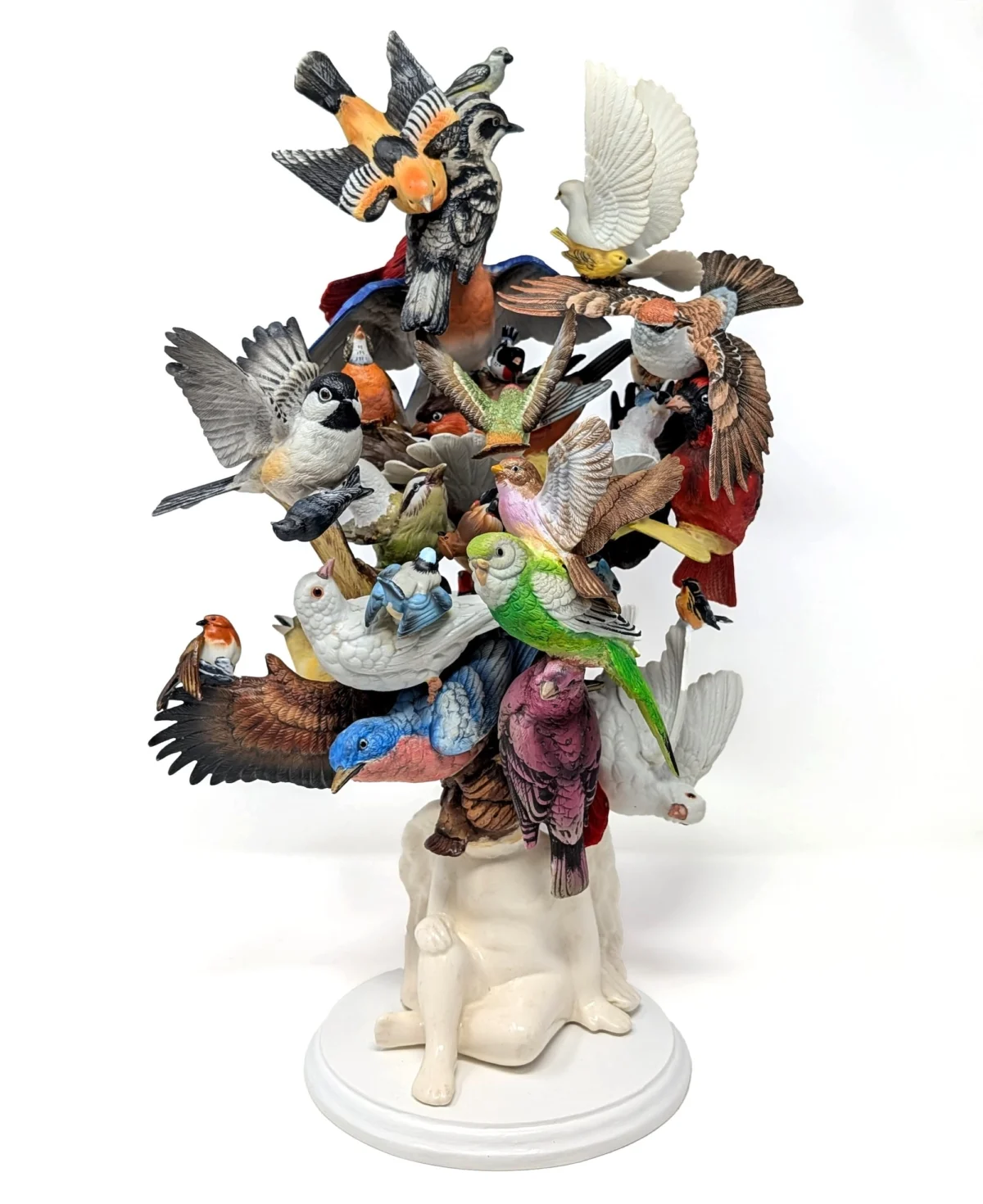
Broz’s work has garnered significant attention for its ability to navigate the "uncanny valley"—that psychological space where an object is close enough to reality to be recognizable, yet different enough to provoke a sense of unease. Her latest series, Superorganisms and Biblical Angels, pushes this concept to new heights. By seamlessly joining disparate parts, she creates "super-forms" where multiple animals appear to merge into a single, undulating mass of porcelain.
The art world is taking notice. This July, from the 23rd to the 26th, Broz’s work will be a focal point at the Seattle Art Fair, represented by the Antler Gallery. The exhibition will feature her "Biblical Angel" series, a trio of complex works that use avian forms to interpret ancient, often terrifying, theological descriptions of celestial beings. Broz’s practice is not merely about upcycling; it is a profound commentary on mass production, the lifecycle of consumer objects, and the fluid nature of biological identity.

Chronology: From Restoration to Reconfiguration
The evolution of Debra Broz’s artistic career is inextricably linked to her technical mastery of ceramics. Understanding the timeline of her development is essential to appreciating the precision of her current portfolio.
The Foundation in Restoration (2000s–Present)
Before Broz became known for her "mutant" figurines, she established herself as a master of invisible repair. Operating under the name Science of Restoration, Broz specializes in the conservation and repair of ceramics. This professional background provided her with the highly specialized skills required to cut, sand, join, and paint porcelain so seamlessly that the interventions are invisible to the naked eye. This "conservation-grade" precision is what separates her work from standard "found object" art; her sculptures do not look like they were glued together—they look as though they were manufactured in a factory to be exactly as they are.
The Emergence of the Hybrid (2010s)
Broz began experimenting with the subversion of kitsch by creating simple hybrids—a rabbit with two heads, or a bird with extra wings. These early works focused on the humor and strangeness of biological anomalies. During this period, she began refining her philosophy of the "second thought," aiming for a viewer experience where the initial recognition of a common figurine is immediately followed by the jarring realization that something is fundamentally "wrong" with the object’s anatomy.

The Superorganism and Biblical Series (2024–2026)
In recent years, Broz’s compositions have grown in scale and complexity. Moving beyond simple hybrids, she began creating "Superorganisms." These works, such as Superorganism (Cat) (2025) and Horse Tree (2025), involve the accumulation of dozens of similar figurines into a singular, swarming entity. This culminated in her 2026 series, Biblical Angels, which utilizes the aesthetics of secondhand birds to create multi-winged, multi-faceted structures that mimic the "wheels within wheels" and many-eyed descriptions found in Ezekiel and other ancient texts.
Supporting Data: The Mechanics of "Ceramic Collage"
Broz’s work is defined by its materiality and the technical rigor of its execution. To understand the impact of her sculptures, one must look at the data points of her process and the physical specifications of her recent output.
Materiality and Sourcing
Broz exclusively uses secondhand ceramics. This choice is deliberate, as the "pre-loved" nature of the objects carries a history of domesticity and sentimentality. By using mixed media alongside these found objects—including specialized epoxies, resins, and paints—she is able to bridge the gaps between different ceramic bodies that may have different firing temperatures or chemical compositions.

Dimensionality of Key Works
The scale of Broz’s work varies, reflecting the domestic origins of her materials while asserting a sculptural presence:
- Biblical Angel 1 (2026): 26 x 19 x 14 inches. This is one of her largest pieces, utilizing a vast array of bird figurines to create a towering, ethereal form.
- Superorganism (Cat) (2025): 16 x 20 x 16 inches. A dense accumulation of feline forms that challenges the viewer’s perception of individual vs. collective.
- Horse Tree (2025): 14.5 x 9 x 5 inches. A vertical composition of all-white horses, emphasizing the grace and repetition of mass-produced forms.
The Precision Factor
In her restoration practice, Broz often works with high-value antiques where the goal is 100% invisibility of the break. She brings this same metric to her art. The junctions in her Superorganisms are sanded and color-matched to the original glazes, ensuring that the "mutations" appear to be inherent to the object’s birth rather than an after-the-fact modification.
Official Responses: The Artist’s Perspective
In interviews with the Seattle Channel and through her own artist statements, Broz provides insight into the psychological and philosophical drivers behind her work. Her perspective offers a window into why these objects resonate so deeply with contemporary audiences.

On the Life of Objects
Broz views her materials through a lens of speculative biology. "A lot of times when I look at them, I think about if they were alive, how would they move and how would they operate?" she told the Seattle Channel. This curiosity transforms the static, often dismissed world of "kitsch" into a playground for evolutionary experimentation. She is not merely breaking toys; she is reimagining the physics of a porcelain world.
On the "Uncanny" Experience
The intentionality of the viewer’s reaction is central to Broz’s mission. She notes, "It’s really important to me that you look at it and your first thought is, ‘That’s a figurine I’ve seen before.’ And then your second thought is, ‘Wait, that’s something I’ve never seen before.’" This cognitive dissonance is what gives her work its power—it forces the viewer to re-examine their own memories of home and childhood decor.
Gallery Representation
The Antler Gallery, which will showcase Broz’s work at the Seattle Art Fair, has long championed artists who blend high-level craft with surrealist sensibilities. Their support underscores the transition of Broz’s work from a niche craft interest to a significant fixture in the contemporary fine art market.

Implications: Consumerism, Waste, and the Future of the Object
The work of Debra Broz carries implications that reach far beyond the walls of a gallery. Her practice touches on several critical themes in 21st-century culture.
The Reclamation of the "Discarded"
In an era of hyper-consumerism, thrift stores are overflowing with the remnants of past trends. Broz’s work serves as a form of cultural recycling. By taking objects that have lost their value—items often destined for landfills—and turning them into high-value art, she challenges our definitions of "preciousness." She suggests that value is not inherent in the material (cheap porcelain) but in the vision and labor applied to it.
Subverting the Domestic Sphere
Ceramic figurines have traditionally represented a sense of order, safety, and middle-class aesthetic aspiration. By distorting these symbols, Broz subverts the domestic sphere. Her "Superorganisms" suggest that beneath the surface of our tidy, curated lives, there is a chaotic, swarming biological reality that we cannot fully control.

The Intersection of Art and Science
Broz’s dual role as an artist and a restorer highlights a growing trend in the art world: the blurring of lines between conservation and creation. Her work suggests that to truly create something new, one must first deeply understand how things are broken and how they are put back together. This "forensic" approach to art-making provides a level of detail and authenticity that resonates in a world increasingly dominated by digital and ephemeral media.
Looking Ahead: The Seattle Art Fair
As the Seattle Art Fair approaches this July, Broz’s presence signifies a homecoming for the artist. Her work reflects the Pacific Northwest’s unique blend of reverence for nature (seen in her bird and animal forms) and its history of industrial and technical innovation. For attendees, the "Biblical Angel" series will likely be a highlight, offering a tactile, three-dimensional exploration of the divine and the distorted—all born from the humble shelves of a neighborhood Goodwill.