
The Human Firewall: Signal Strengthens Defenses Against Sophisticated Social Engineering Attacks
In an era where end-to-end encryption has become the gold standard for digital privacy, the frontline of cybersecurity has shifted. Hackers are increasingly moving away from attempting to break complex mathematical ciphers and are instead focusing on a much more vulnerable target: the human user. Recognizing this shift, Signal, the gold standard for private messaging, has announced a comprehensive suite of new in-app safety features designed to combat the rising tide of phishing and social engineering.
The updates, rolled out on May 11, 2026, represent a pivotal moment for the platform. While Signal has long been lauded for its technical architecture, these changes acknowledge that a secure "pipe" is only as safe as the person at either end of it. By introducing visual cues, friction-based confirmations, and proactive educational messaging, Signal aims to turn its user base into a more resilient "human firewall."
Main Facts: A Multi-Layered Approach to User Safety
The core of Signal’s new security update is a series of UI (User Interface) and UX (User Experience) modifications that target the specific tactics used by modern scammers. These features do not compromise the app’s famous end-to-end encryption but rather provide a layer of "contextual intelligence" to help users make safer decisions.
The "Name Not Verified" Disclosure
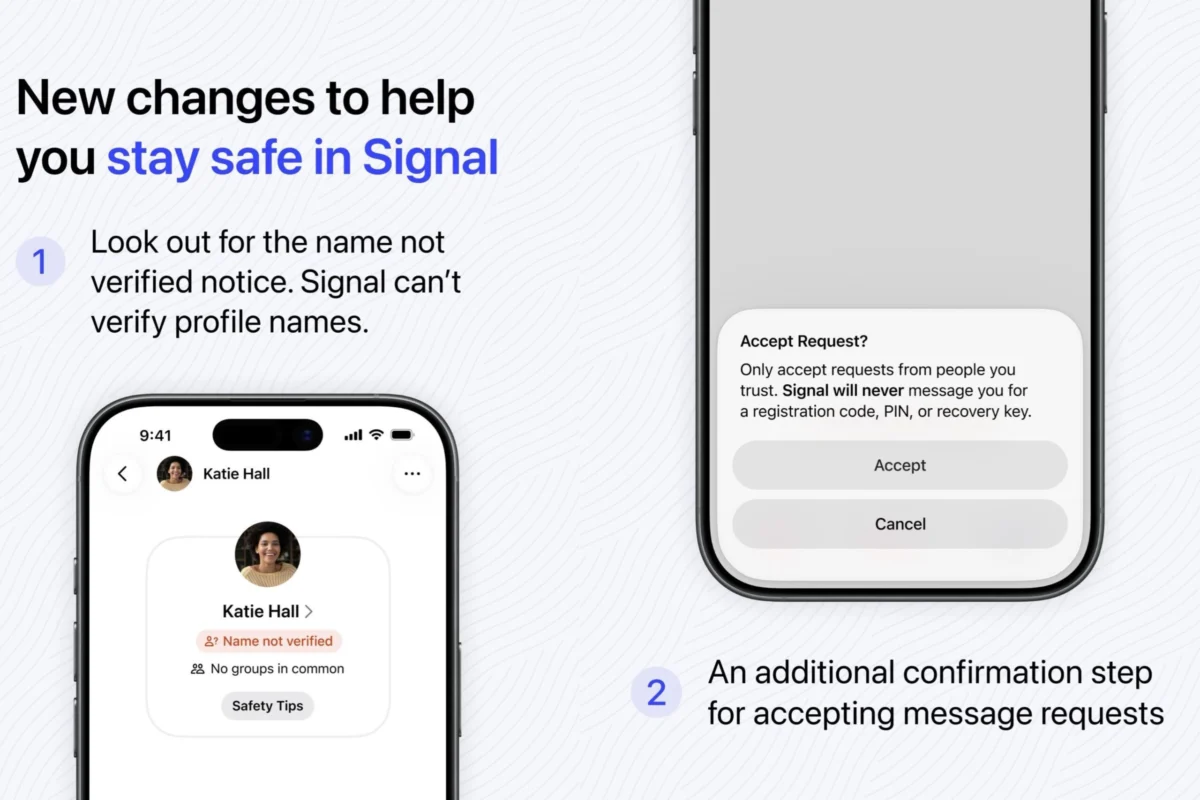
The most visible change is the introduction of a "name not verified" notice on user profiles. Unlike social media platforms that use "blue checks" to verify identity, Signal’s architecture is built on anonymity and phone-number-based discovery. This has historically allowed scammers to set their display names to "Signal Support" or "Security Alert" to trick users. The new notice explicitly reminds users that a profile name is self-selected and not a verified identity.

Enhanced Message Request Confirmations
Signal is introducing a more robust "interstitial" or "gatekeeper" screen when a user receives a message from someone not in their contact list. This feature forces a moment of pause, requiring the user to manually accept or block the request before any media is downloaded or links become active. This mirrors successful implementations in other Meta-owned apps like WhatsApp but adds Signal’s specific brand of privacy-first warnings.
Proactive Educational Banners
To combat the specific threat of account takeovers, Signal has integrated permanent safety reminders within the chat interface for unknown senders. These banners explicitly state that Signal staff will never ask for a user’s PIN, registration code, or recovery key. By placing this information directly in the line of sight during a potential attack, Signal hopes to disrupt the "urgency" tactic often used by scammers.
Pattern Recognition for Scams
The app’s internal logic has been updated to highlight "red flag" behaviors. This includes identifying vague introductory messages designed to bait a response (the "Hi, is this [Name]?" tactic), suspicious web links that mimic official domains, and conversations that pivot quickly toward financial advice or cryptocurrency investments.
Chronology: From Targeted Attacks to Platform-Wide Defense
The journey to this update began in early 2026, following a series of high-profile security incidents that put the messaging world on edge.

- March 2026: The Targeted Wave: Signal confirmed that a sophisticated phishing campaign had targeted a specific subset of its users—primarily government officials, high-ranking diplomats, and investigative journalists. These attacks were not technical breaches of Signal’s servers but rather highly coordinated social engineering efforts. Attackers posed as technical support or fellow activists to steal SMS registration codes and gain access to accounts.
- April 2026: Internal Review and Feedback: Following the March attacks, Signal’s security team conducted a deep dive into the "kill chain" of these social engineering attempts. They discovered that the lack of visual "trust indicators" allowed even tech-savvy users to fall victim to impersonation.
- Early May 2026: Beta Testing: A limited version of the safety suite was rolled out to beta testers. The focus was on ensuring that the new warnings didn’t create "alert fatigue," where users become so accustomed to warnings that they ignore them.
- May 11, 2026: Global Rollout: Signal officially announced and began the deployment of these features to its global user base on iOS and Android.
Supporting Data: The Rising Threat of Social Engineering
The necessity of these features is backed by alarming trends in the cybersecurity landscape. According to industry data from early 2026, social engineering now accounts for over 70% of successful data breaches globally.
The Vulnerability of Encryption
As encryption protocols like Signal’s "Signal Protocol" (which is also used by WhatsApp and Google Messages) have become nearly impossible to crack via brute force, attackers have pivoted. If an attacker cannot read the message, they instead try to become the recipient or trick the sender into handing over the keys.
The "Trust Gap"
A 2025 study on messaging habits found that users are 40% more likely to trust a message received on an encrypted platform like Signal than one received via traditional SMS. Scammers exploit this "halo effect," assuming that if a conversation is happening on a "secure" app, the person on the other end must be legitimate. Signal’s new "unverified" labels are a direct attempt to bridge this trust gap.
The Cost of Impersonation
Financial fraud via messaging apps saw a 25% year-over-year increase in 2025. Vague "wrong number" scams, often referred to as "pig butchering," involve long-term grooming of victims. Signal’s new alerts for "financial tips" and "vague messages" are designed specifically to disrupt the early stages of these multi-month scams.

Official Responses: Signal’s Stance on Privacy vs. Safety
Signal has always maintained a unique position in the tech world as a non-profit focused on privacy. Their response to these threats reflects that mission, emphasizing that safety should not come at the cost of data collection.
In a public statement accompanying the release, Signal representatives noted:
"To help protect Signal users from phishing and social engineering attacks, we’ve introduced additional confirmations and educational messaging in the app. Our goal is to help people better detect fraudulent profiles, especially scammers posing as Signal. We will never reach out to ask for your PIN, registration code, or recovery key. If someone is asking for any of those things, it’s a scam."
The company also hinted that this is not a one-time update. "More changes are on the way," the official Signal X (formerly Twitter) account stated, suggesting that the app may soon incorporate more advanced, perhaps on-device AI-driven, detection mechanisms that maintain privacy while identifying malicious patterns.

Implications: A Shifting Landscape for Messaging Giants
Signal’s move comes at a time of immense volatility and competition in the messaging sector. The implications of these safety features extend far beyond Signal’s own user base.
The "Security Arms Race"
By introducing these features, Signal is setting a new baseline for what a "secure" messenger looks like. It is no longer enough to offer end-to-end encryption; apps must now offer "end-to-end safety." This puts pressure on competitors like Telegram—which does not have end-to-end encryption enabled by default for all chats—to step up their game.
Comparison with WhatsApp Plus and RCS
The messaging market is currently diverging. While Signal doubles down on free, high-security features, Meta is testing "WhatsApp Plus," a subscription model that offers cosmetic customizations and potentially enhanced business features for a monthly fee. Meanwhile, Apple and Google have finally achieved a milestone in cross-platform security by launching end-to-end encryption for RCS (Rich Communication Services) messaging between iPhone and Android.
In this crowded field, Signal’s commitment to providing advanced security tools for free reinforces its position as the choice for activists, journalists, and privacy-conscious individuals. However, the challenge remains: can Signal maintain its "no-nonsense" appeal while adding the layers of friction necessary to keep users safe?

The Psychology of Friction
The introduction of extra confirmation steps is a calculated risk. In the world of app design, "friction" is usually seen as a negative. However, in cybersecurity, friction is a feature. By forcing a user to think for two seconds before accepting a message from a stranger, Signal is fighting the "fast-thinking" brain that scammers rely on. This move may influence a broader trend in software design where safety is prioritized over seamlessness.
Future Outlook
As we move further into 2026, the definition of a "secure app" is clearly evolving. It is becoming a holistic concept that includes technical encryption, metadata minimization, and robust protection against human manipulation. Signal’s latest update is a bold admission that in the battle for digital privacy, the most sophisticated code in the world is useless if the user is tricked into opening the door for the intruder.
For Signal users, the message is clear: the app will provide the shield and the warnings, but the final line of defense remains the user’s own vigilance. As scammers become more adept at mimicking the "official" voice of the platforms we trust, the "name not verified" badge may well become the most important icon on our screens.




Leave a Comment