
Go’s Grand Arena: A "Battle of the Sexes" to Redefine the Game’s Future
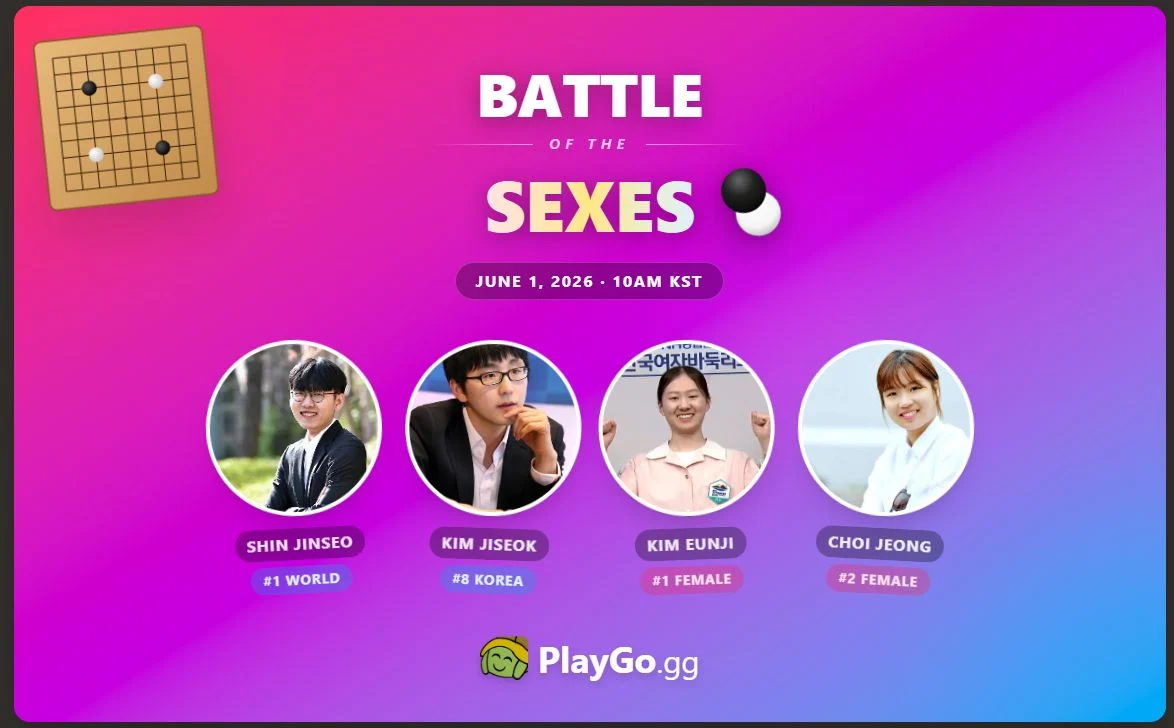
Seoul, South Korea – May 27, 2026 – In a landmark event poised to captivate the global Go community and spark broader conversations about gender equality in competitive mind sports, PlayGo.gg is set to host a high-stakes online tournament on June 1, 2026. Dubbed the "Battle of the Sexes," this unique four-player showdown will pit two of the world’s most dominant male Go professionals against two of the most celebrated female stars, live-streamed globally. While the title might evoke a bygone era, the tournament’s true mission is profoundly modern: to powerfully illustrate the rapidly diminishing gap between elite male and female Go players and celebrate the dawn of a new, more inclusive era for the ancient game.
The event, accessible worldwide via PlayGo.gg and its YouTube channel, features a double-elimination format, promising intense strategic battles and dramatic comebacks. Far from a mere exhibition, this tournament is designed to be a crucible where the boundaries of skill are tested, and the narrative of Go’s evolution is written in real-time. It’s a testament to a decade of transformative progress in female participation, performance, and recognition within the competitive Go landscape, signaling a pivotal moment for a game steeped in centuries of tradition.
Main Facts: A Convergence of Titans on the Digital Board
The upcoming "Battle of the Sexes" tournament, hosted by PlayGo.gg, is not merely another competition; it is a meticulously crafted showcase designed to highlight the profound advancements in competitive Go, particularly concerning gender parity at its highest echelons. Scheduled for June 1, 2026, and live-streamed across PlayGo.gg and YouTube (@PlayGo_gg), the event brings together an unparalleled quartet of talent, promising a spectacle of strategic depth and intellectual combat.
At its core, the tournament aims to dismantle long-held assumptions about gender differences in Go proficiency. For much of its storied history, a perceptible gap between the top male and female players was often accepted as an immutable truth. However, the last decade has witnessed a dramatic shift, fueled by increased access to training resources, greater professional opportunities, and a burgeoning global community that champions diversity. This event serves as a vivid demonstration of this evolution, presenting a direct confrontation between the best of both worlds.
Eric Wainwright, Marketing Director at PlayGo.gg, succinctly articulates the tournament’s dual purpose: "The event highlights the strategic depth and competitive evolution of Go, a classic strategy game that shares strong crossover appeal with Chess, Checkers, and other board games. It also demonstrates how, with greater access to resources and opportunities, the very best female players in the world can now compete with the very best male players – a development that has not been the case until very recently." This statement underscores the progressive intent behind the tournament, reframing the "Battle of the Sexes" not as a divisive contest, but as a celebratory affirmation of progress and equal opportunity.
The competition boasts a star-studded lineup, each player bringing a unique blend of experience, skill, and narrative significance to the digital board:
-
Shin Jinseo: Widely acknowledged as one of the greatest Go players of all time, the 26-year-old Korean prodigy has held the World #1 ranking for an astonishing seven consecutive years. With nine international major titles to his name, Shin Jinseo represents the pinnacle of contemporary Go excellence, setting the ultimate benchmark for any challenger. His participation immediately elevates the competitive stakes and provides a definitive measure of the evolving landscape.
-
Kim Jiseok: An esteemed veteran and strategic maestro, Kim Jiseok brings a wealth of experience to the tournament. As the 2014 Samsung Cup champion and former captain of Korea’s national team for eight years, his presence ensures a blend of seasoned wisdom and fierce competitive spirit. Kim Jiseok’s meticulous style and deep understanding of the game offer a formidable challenge to any opponent.
-
Choi Jeong: The undisputed most decorated female Go player of the modern era, Choi Jeong is a living legend. With seven women’s major titles, her career has been a relentless pursuit of excellence. Her groundbreaking achievement in 2022, becoming the first woman to reach a mixed major final after defeating top male professionals like Ichiriki Ryo, Yang Dingxin, and Byun Sangil before facing Shin Jinseo, solidified her status as a pioneer and a true contender on the global stage. Her journey is a direct testament to the tournament’s core message.
-
Kim Eunji: Representing the vibrant future of Go, Kim Eunji is a prodigious talent at just 19 years old. Already holding the current World #1 female player ranking and comfortably sitting within Korea’s top 20 overall, her rapid ascent has been nothing short of meteoric. Kim Eunji embodies the new generation of female players who are not only closing the gap but are confidently asserting their dominance and challenging established hierarchies from a young age.
The tournament format itself—double elimination—is designed to maximize competitive drama and ensure that every player has ample opportunity to demonstrate their prowess. This structure guarantees that losers receive a second chance through a lower bracket before the grand final, promising multiple high-stakes encounters and a thrilling path to victory. Viewers can engage with the community and discuss the unfolding drama on PlayGo.gg’s dedicated Discord server.
Chronology: From Ancient Roots to Modern Revolution
Go, or Weiqi as it is known in China, is an ancient strategy board game that originated in China over 4,000 years ago. Its complexity, elegant simplicity, and profound depth have captivated thinkers and strategists for millennia. Traditionally, Go was a pursuit largely dominated by men, particularly in professional circles. The game’s historical development in East Asian societies often mirrored broader societal structures, where opportunities for women in competitive or intellectual pursuits were limited.
For centuries, the professional Go circuit, particularly in powerhouses like Korea, Japan, and China, was almost exclusively male. While women played Go recreationally, the path to professional status – involving rigorous training, competitive tournaments, and recognition – was rarely accessible to them. This historical context meant that the pool of female talent remained largely untapped, and thus, a significant performance gap emerged, not necessarily due to inherent ability, but due to systemic barriers and lack of opportunity.
The late 20th and early 21st centuries began to see the nascent stages of change. The establishment of dedicated women’s professional leagues and tournaments, though initially separate from the main mixed-gender circuits, provided crucial platforms for female players to hone their skills and gain competitive experience. Figures like Rui Naiwei, a Chinese professional who achieved an unprecedented level of success in mixed-gender tournaments in the late 1990s and early 2000s, served as groundbreaking inspirations, demonstrating that women could indeed compete at the highest levels. Rui Naiwei’s achievements, including winning the Guksu title in Korea against male opponents, were isolated but potent signals of what was possible.
However, the true "revolution" in female Go professionalism has unfolded rapidly over the last decade. This period has been characterized by several critical developments:
- Increased Access to Training: The proliferation of online Go servers and advanced AI training tools has democratized access to high-quality instruction and sparring partners. This has been particularly beneficial for female players who might have faced geographical or social barriers to traditional training academies.
- Dedicated Support Systems: Go federations and private organizations have increasingly invested in programs specifically designed to nurture female talent, offering scholarships, mentorship, and structured training environments.
- Growing Prize Pools and Visibility: As women’s tournaments have gained more prestige, prize pools have grown, making professional Go a more viable career path for women. Simultaneously, increased media coverage and live-streaming of these events have boosted visibility, inspiring a new generation of girls to pursue the game professionally.
- Breakthrough Performances: The consistent success of players like Choi Jeong, who has not only dominated women’s Go but also made deep runs and defeated top-ranked male players in major mixed tournaments, has shattered previous perceptions. These victories are not anomalies but rather harbingers of a new competitive reality.
- Youth Movement: The emergence of young talents like Kim Eunji, achieving top rankings and competing fiercely at a very early age, signifies a systemic shift. These players are growing up in an environment where professional Go is increasingly inclusive, and the expectation of competing against the best, regardless of gender, is becoming the norm.
The "Battle of the Sexes" tournament on PlayGo.gg is therefore not an isolated event but the culmination of these historical and contemporary developments. It is a moment to pause, reflect on the journey, and celebrate the incredible progress that has transformed Go into a more equitable and fiercely competitive intellectual sport for all.
Supporting Data: Metrics of Progress and Individual Excellence
The assertion that "female participation, performance and prize pools globally have transformed over the last decade" is not merely anecdotal; it is supported by a palpable shift in the Go world’s competitive landscape. While precise global statistics on participation rates can be challenging to aggregate across different national federations, the evidence of heightened visibility and competitive success is undeniable.
Historically, the ratio of professional male to female players was heavily skewed. In many major Go-playing nations, the number of active female professionals was a fraction of their male counterparts. This disparity often translated into smaller prize pools and fewer dedicated events for women, creating a self-perpetuating cycle of limited opportunity. However, over the past ten years, there has been a concerted effort by national Go associations, international bodies, and platforms like PlayGo.gg to foster a more inclusive environment. This has led to:
- Increased Professionalization: More women are successfully navigating the rigorous path to professional Go status, reflecting improved access to early training and sustained career support. This is evident in the burgeoning number of young female talents entering the professional ranks in Korea, China, and Japan.
- Growth in Women’s Tournaments: Beyond the mixed-gender events, the prestige and prize money for women-only international tournaments have seen significant boosts. Events like the Bingsheng Cup, the Women’s Guksu, and various regional women’s championships now offer substantial incentives and platforms for female players to shine, contributing to a more robust competitive ecosystem.
- AI Training and Online Platforms: The advent of advanced Go AI, such as AlphaGo and its successors, coupled with the ubiquity of online Go servers, has democratized high-level training. Players, regardless of location or gender, can now access powerful analytical tools and play against opponents of any skill level from anywhere in the world. This has been particularly transformative for female players who might have faced barriers to accessing traditional, often male-dominated, training academies.
- Mentorship and Role Models: The success of pioneering female professionals has created a powerful ripple effect. Younger players now have an abundance of visible role models who demonstrate that reaching the pinnacle of the sport is achievable. This creates a virtuous cycle where success inspires more participation, which in turn fuels greater competitive depth.
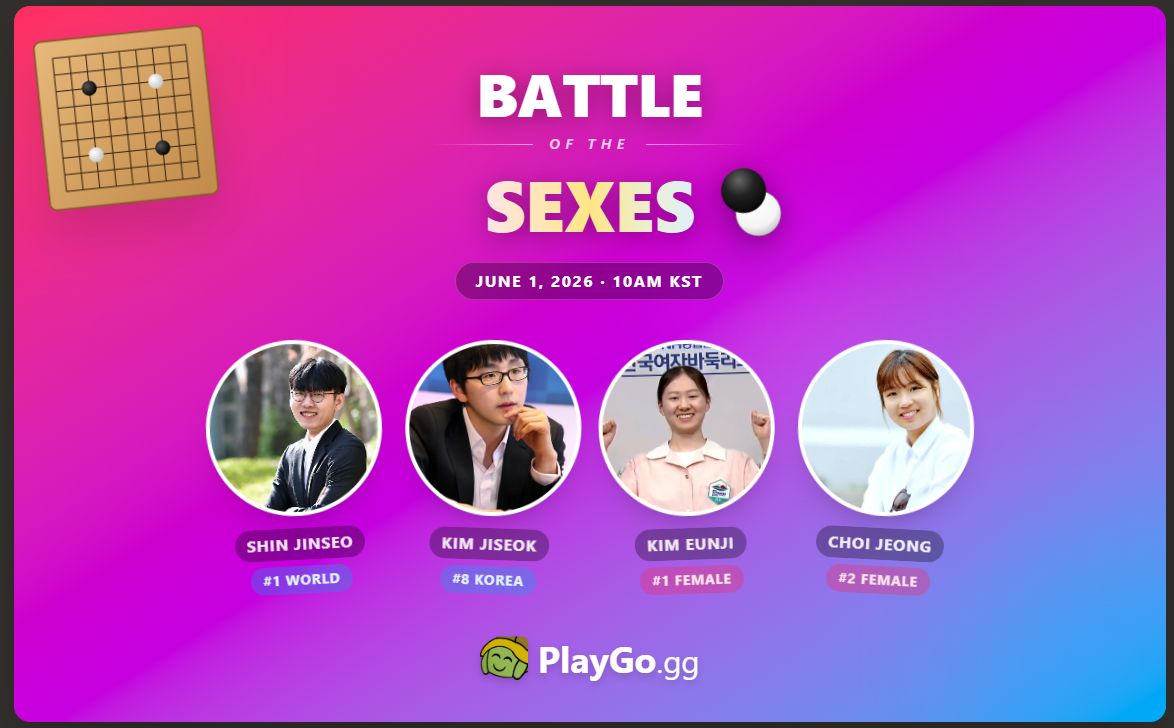
The competing players in the "Battle of the Sexes" tournament serve as direct evidence of this paradigm shift. Their profiles are not just résumés; they are testaments to an evolving sport:
-
Shin Jinseo (World #1, Male): His presence as the reigning titan provides the ultimate benchmark. Shin Jinseo’s unprecedented dominance—seven consecutive years as World #1, nine international majors at just 26—underscores the immense skill required to excel in Go. For the female players to compete effectively against him, it signifies a truly exceptional level of play. His consistent victories against the world’s best male players make him the yardstick against which the "closing gap" is most profoundly measured.
-
Kim Jiseok (Veteran Champion, Male): As a former Samsung Cup champion and long-standing captain of Korea’s national team, Kim Jiseok represents the established male elite. His inclusion provides a contrast of experience and style, demonstrating the enduring strength and strategic depth of the top male professional circuit. His pedigree ensures that the female players are not just facing strong opponents, but opponents who have proven their mettle at the highest levels over many years.
-
Choi Jeong (Pioneer & Champion, Female): Choi Jeong’s career is arguably the most compelling narrative supporting the tournament’s premise. Her seven women’s major titles already mark her as a legend. However, it was her historic run in 2022, reaching a mixed major final after vanquishing a gauntlet of top male professionals (Ichiriki Ryo, Yang Dingxin, and Byun Sangil) before her showdown with Shin Jinseo, that truly announced a new era. This wasn’t an isolated upset; it was a sustained demonstration of consistent, world-class play against the absolute best, proving that the ceiling for female players had been dramatically raised. Her ability to consistently challenge and defeat top male pros provides concrete data that the "gap" is indeed closing.
-
Kim Eunji (Rising Star & World #1 Female): At just 19, Kim Eunji is the embodiment of the future. Her current World #1 female ranking and her placement within Korea’s overall top 20 signifies a new generation of female talent that is emerging younger, stronger, and more integrated into the overall professional landscape. Her rapid ascent suggests that the pathways to success for female players are becoming more efficient and effective, allowing prodigious talents to reach their peak potential at an earlier age. She is a testament to the increased opportunities and resources available to young female players today, enabling them to compete at a level that would have been unthinkable for a woman her age even a decade ago.
The double-elimination format further supports the competitive integrity of the event. It ensures that victory is earned through consistent performance, mitigating the impact of a single bad game and allowing for more comprehensive evaluation of each player’s skill under pressure. This rigorous structure underscores that the "Battle of the Sexes" is a serious professional tournament, not a mere exhibition, where every move carries significant weight.
Official Responses: Voices from the Heart of Go
The enthusiasm surrounding the "Battle of the Sexes" is palpable, particularly from the organizers at PlayGo.gg, who see this event as a critical milestone in their mission to promote Go globally. Eric Wainwright, Marketing Director, has been a particularly vocal proponent of the tournament’s vision.
"For too long," Wainwright elaborates, "the Go community, and indeed the broader world, viewed the gender gap in top-tier Go as an inherent characteristic of the game. Our goal with this tournament is to fundamentally challenge that perception. It’s not just about showcasing incredible games; it’s about shifting mindsets. We want to inspire the next generation of players, especially young girls, to see that there are no limits to what they can achieve in Go."
Wainwright emphasizes the strategic alignment of the event with PlayGo.gg’s broader objectives. "PlayGo.gg is committed to making Go accessible and exciting for everyone. This tournament is a perfect embodiment of that. By bringing the world’s best to a global online stage, we’re not only providing top-tier entertainment but also demonstrating the sport’s progressive evolution. The data, the performances of players like Choi Jeong and Kim Eunji, speak for themselves. This is about celebrating skill, dedication, and the breaking down of barriers." He further suggests that the platform’s ability to host such high-profile events online is a game-changer, democratizing access for both players and spectators worldwide. "We’re leveraging technology to tell a story of human achievement and progress," he adds.
While direct quotes from the competing players are typically reserved for pre-match press conferences, the sentiment within the professional Go community regarding such initiatives is generally positive and forward-looking. Players like Choi Jeong and Kim Eunji have consistently expressed their desire to compete against the best, regardless of gender. Their focus remains squarely on the game itself, on strategy, and on personal improvement.
"I train relentlessly to be the best player I can be," Choi Jeong has previously stated in interviews, reflecting a sentiment common among elite athletes. "My opponents’ gender doesn’t change the board or the complexity of the game. I welcome any opportunity to test my skills against top professionals, and if my participation inspires others, then that is an added bonus." This perspective aligns with the tournament’s deeper intent: to move beyond the "battle of the sexes" framing and towards a celebration of individual excellence that transcends traditional categories.
Similarly, the younger generation, exemplified by Kim Eunji, appears to view mixed-gender competition as a natural progression. Having grown up in an era of increasing inclusivity, these players are less burdened by historical limitations. Their ambition is simply to climb the ranks and win. The community on PlayGo.gg’s Discord channel is already buzzing with anticipation. Discussions range from strategic predictions to reflections on the historical significance of the event. Commentators and analysts are preparing to dissect every move, not just for its technical brilliance, but for what it signifies for the future trajectory of Go. The official responses collectively paint a picture of a sport eagerly embracing change, celebrating diversity, and looking towards a future where talent, not gender, is the sole determinant of success.
Implications: Reshaping Go’s Future and Beyond
The "Battle of the Sexes" tournament on PlayGo.gg carries implications that extend far beyond the immediate results on the Go board. This event is a powerful statement about the evolving nature of competitive mind sports, gender equality in high-performance fields, and the transformative potential of online platforms.
Firstly, for the game of Go itself, this tournament solidifies a new paradigm. It moves beyond the theoretical discussion of whether women can compete with men at the elite level and provides empirical proof in real-time. This can have several profound effects:
- Inspiring Future Generations: The visibility of Choi Jeong and Kim Eunji competing against titans like Shin Jinseo will serve as an immense source of inspiration for countless young girls contemplating a career in Go. Seeing successful female role models actively challenging the highest echelons of the sport can dismantle perceived barriers and encourage greater participation from a younger age, ultimately enriching the talent pool for the entire game.
- Normalizing Mixed-Gender Competition: While women’s tournaments remain important for fostering specific talent, events like this help normalize mixed-gender competition at the highest levels. The goal is for a player’s skill to be the only relevant factor, not their gender, and this tournament accelerates that acceptance.
- Increased Global Appeal: A narrative of progress and inclusivity makes Go more appealing to a broader, more diverse global audience. As a sport that champions intellect and strategy, demonstrating its commitment to equality enhances its modern relevance and appeal, attracting new fans and potential players from demographics previously underserved.
Secondly, the event speaks to broader societal implications regarding gender equality in competitive domains. The challenges faced by female Go players—historical lack of access, fewer opportunities, and sometimes implicit bias—mirror struggles in many other fields, from STEM professions to mainstream sports. The success story unfolding in Go offers a compelling case study that with deliberate effort, investment in resources, and a commitment to equal opportunity, significant progress can be made. This tournament becomes a beacon, suggesting that "inherent differences" are often manifestations of systemic inequalities rather than biological destiny.
The role of online platforms like PlayGo.gg is also a critical implication. These platforms have democratized access to Go in unprecedented ways. They allow for global competition, high-quality training tools (including AI), and the creation of vibrant communities. For mind sports, where physical presence is not always mandatory, online platforms are instrumental in breaking down geographical and socio-economic barriers. They enable events like the "Battle of the Sexes" to reach millions, fostering engagement and growth in ways traditional offline tournaments often cannot. The ability to stream such a high-profile event globally and facilitate community discussion on platforms like Discord amplifies its impact exponentially.
Finally, the deliberate choice of the title, "Battle of the Sexes," despite its acknowledged "70s" connotation, is a calculated move with significant implications. It’s a provocative title that immediately grabs attention, but its reinterpretation by PlayGo.gg as a celebration of closing the gap rather than reinforcing division is crucial. It acknowledges the historical context while firmly pointing towards a progressive future. It invites discussion, allowing the organizers to frame the narrative as one of progress and empowerment. The underlying message is that while the "battle" for recognition and opportunity might have been real in the past, the current era is one where skill reigns supreme, and gender is increasingly irrelevant to competitive prowess.
In conclusion, the PlayGo.gg "Battle of the Sexes" is more than just a Go tournament. It is a powerful symbol of change, a testament to individual brilliance, and a blueprint for how traditional competitive fields can evolve to become more inclusive and equitable. As the players make their first moves on June 1, 2026, they will not only be vying for victory but also collectively charting a course for the future of Go and inspiring a wider dialogue about excellence in all its forms.




Leave a Comment