
The Architecture of Resistance: Arghavan Khosravi’s ‘What Remains’ and the Visual Language of Liberation
In the contemporary art world, few voices resonate with the specific, haunting clarity of Arghavan Khosravi. Her work, a sophisticated blend of three-dimensional sculpture and vibrant painting, serves as a bridge between the historical grandeur of Persian architecture and the solemnity of Western religious iconography. Her latest exhibition, What Remains, which opened recently at the Uffner & Liu gallery in New York, marks a pivotal moment in her career. It is a collection that does not merely depict struggle but architecturally constructs the experience of it.
Through a series of complex, multi-layered works, Khosravi explores the intersection of personal memory, religious dogma, and the indomitable spirit of Iranian women. As the artist navigates the liminal space between her home in Stamford, Connecticut, and her native Iran, What Remains emerges as a profound meditation on the structures—both physical and ideological—that tether the human spirit.

Main Facts: The Fusion of Form and Ideology
Arghavan Khosravi’s practice is defined by its refusal to be confined to a single plane. Her "sculptural paintings" utilize acrylic on canvas mounted on shaped wood panels, often incorporating found objects like leather cords, rubber, plexiglass, and even styrofoam. This materiality is not accidental; it reflects the fragmented and layered nature of identity for those living in the diaspora.
The Aesthetic Synthesis
The core of Khosravi’s visual language is a daring synthesis. She draws heavily from the tradition of Persian miniatures—characterized by their lack of linear perspective and vibrant, flat colors—and fuses them with the structural format of Christian altarpieces. Historically, altarpieces were designed to provide a visual narrative of the divine to a largely illiterate public. Khosravi subverts this tradition by using the format to tell secular, often painful stories of human restriction and female agency.

Themes of Restriction and Control
In What Remains, the recurring motif is one of tethering. Figures are physically bound to their environments. Whether it is a woman’s silhouette wrapped in gold cords or a face partially obscured by architectural shutters, the work speaks to the lack of autonomy faced by women under repressive regimes. However, Khosravi’s work is never purely pessimistic. By using "vibrant gradients" and meticulous craftsmanship, she suggests that beauty itself can be a form of protest—a "new paradigm" that persists even when political structures crumble.
Chronology: From Tehran to the Global Stage
To understand What Remains, one must trace the trajectory of Khosravi’s life and the shifting geopolitical landscape that informs her brushstrokes.

Roots and Displacement
Born in Iran, Khosravi’s formative years were spent navigating the complexities of a society governed by strict religious and social codes. This environment of censorship and "religious dogma," as noted in the exhibition’s literature, became the primary catalyst for her artistic inquiry. Her move to the United States provided the distance necessary to reflect on these structures, yet it also introduced a sense of "homesickness and longing" that permeates her current work.
The Development of ‘What Remains’
The body of work presented at Uffner & Liu has a specific, somewhat prophetic timeline. According to the gallery, the pieces were already in progress well before the escalation of the U.S. war against Iran (a contextual backdrop of the 2026 timeframe). This chronology is crucial; it establishes that Khosravi’s work is not a reactionary piece of "war art." Instead, it is a longitudinal study of a region that has lived in a state of "continual crisis" for decades.

The exhibition, which runs through July 2 in New York, represents several years of technical refinement. In her earlier series, Khosravi focused more on the flat surface of the canvas. In What Remains, the move toward the "shaped wood panel" and "wood cutouts" signifies an artist who is literally breaking out of the frame—much like the subjects she depicts.
Supporting Data: An Analytical Deep Dive into Key Works
The power of What Remains lies in its details. By examining specific works within the exhibition, we can decode the symbolic shorthand Khosravi uses to communicate complex sociopolitical realities.

‘Bearing’ (2026)
One of the most striking large-scale pieces is Bearing. This work features a seated woman who appears to be physically buttressing a traditional Persian building. The title is a double entendre, referring both to the physical weight the woman carries and her "bearing" or dignity in the face of it.
- Visual Data: A "thick, black, oil-like liquid" is seen seeping from the building’s foundation.
- Symbolism: This liquid can be interpreted as the corrupting influence of resource-wealth (oil) on the social fabric, or perhaps the "seepage" of trauma into the domestic sphere. The woman holds a broken hand mirror, suggesting a fractured self-image or a broken reflection of the state.
‘Suspended’ (2026)
This piece utilizes acrylic on canvas mounted on wood, accented with leather and rubber cords.

- Visual Data: A stack of books serves as a pedestal for a woman’s silhouette, which is bound tightly with gold cords.
- Symbolism: The presence of books suggests that even education and intellect can be weaponized as tools of restriction or can become heavy burdens in a society that censors thought. The "four blindfolded guards" standing atop the building in the detail of the work represent the omnipresence of state surveillance—a power that is both blind to the humanity of the citizen and absolute in its control.
‘Collision’ and ‘The Listener’ (2026)
These works move the conversation toward the senses.
- Collision: Features a shelf-like sculpture with two eyes peering at each other through a frame, separated by a birdcage. It captures the tension of internal conflict and the "collision" of different worldviews.
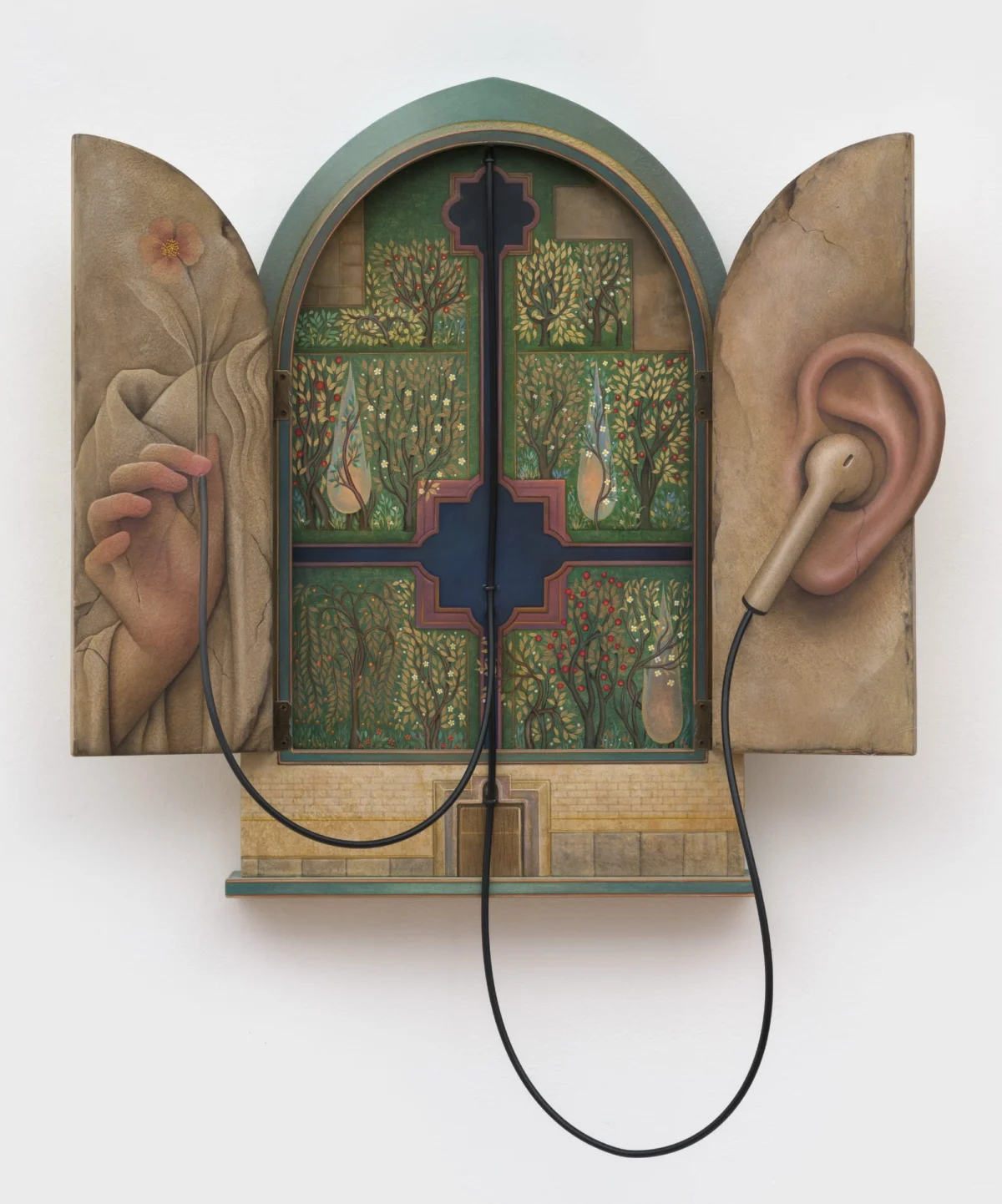
- The Listener: An architectural sculpture of a Persian window with shutters opened to reveal a hand. A headphone cord runs to an ear on the side. This work highlights the importance of subversive communication—listening to the "whispers" of resistance that the state attempts to drown out.
Official Responses: The Gallery and the Critical Context
Uffner & Liu has positioned What Remains as a "timely acknowledgment" of the human condition in the Middle East. The gallery’s official statement emphasizes that Khosravi’s work transcends the immediate headlines of conflict.

The Gallery’s Perspective
The curators at Uffner & Liu highlight the "physically separated" nature of Khosravi’s figures. They note that the use of "hinged shutters" and "tiny visages tucked into unassuming openings" creates a sense of voyeurism. The viewer is not just looking at a painting; they are peering into a private, restricted world. The gallery maintains that this body of work is a testament to the "beauty and self-empowerment" that can be found even amid "government overreach."
Critical Reception
Art critics have praised Khosravi for her ability to make the political feel deeply personal. By focusing on "domestic objects and space," she brings the grand narratives of geopolitics down to the level of the home. Critics note that her use of "vibrant gradients" serves as a psychological counterpoint to the themes of binding and restriction. The colors suggest a life force that cannot be entirely extinguished by the "leather cords" or "wire mesh" that appear in her constructions.

Implications: Art as a Paradigm for Change
The implications of Khosravi’s work extend far beyond the walls of the New York gallery. What Remains challenges the viewer to reconsider the role of the artist in times of geopolitical upheaval.
Redefining Resistance
Khosravi suggests that resistance is not always a loud, external act. In works like Bound, where three women are shown in various stages of braiding their hair, resistance is found in the maintenance of tradition, the solidarity of shared experience, and the refusal to let one’s identity be erased. The act of braiding hair—a powerful symbol in the "Woman, Life, Freedom" movement—becomes a metaphor for the strength found in intertwined lives.

The Enduring Nature of Beauty
Perhaps the most significant implication of the exhibition is the idea that "beauty and self-empowerment can still trigger a new paradigm." In a world where news cycles are dominated by "chaos and destruction," Khosravi’s meticulous craft offers a different kind of truth. It suggests that while political regimes are temporary, the human impulse toward creation and freedom is permanent.
Future Outlook
As Khosravi continues to gain international acclaim, her work serves as a vital touchstone for the Iranian diaspora. It provides a visual language for those who feel "suspended" between two worlds. The success of What Remains indicates a growing appetite in the West for art that is unapologetically political yet technically masterful.

In conclusion, Arghavan Khosravi does not just paint the world; she deconstructs it and rebuilds it with a new foundation. What Remains is a haunting reminder of what is lost in conflict, but more importantly, it is a celebration of what survives. Through her sculptural paintings, Khosravi ensures that the voices of those who are tethered, bound, or silenced are given a monumental, inescapable presence in the heart of the global art capital.


Leave a Comment