
The Architecture of Memory: The Visual Philosophy and Evolving Legacy of Christian Quintin
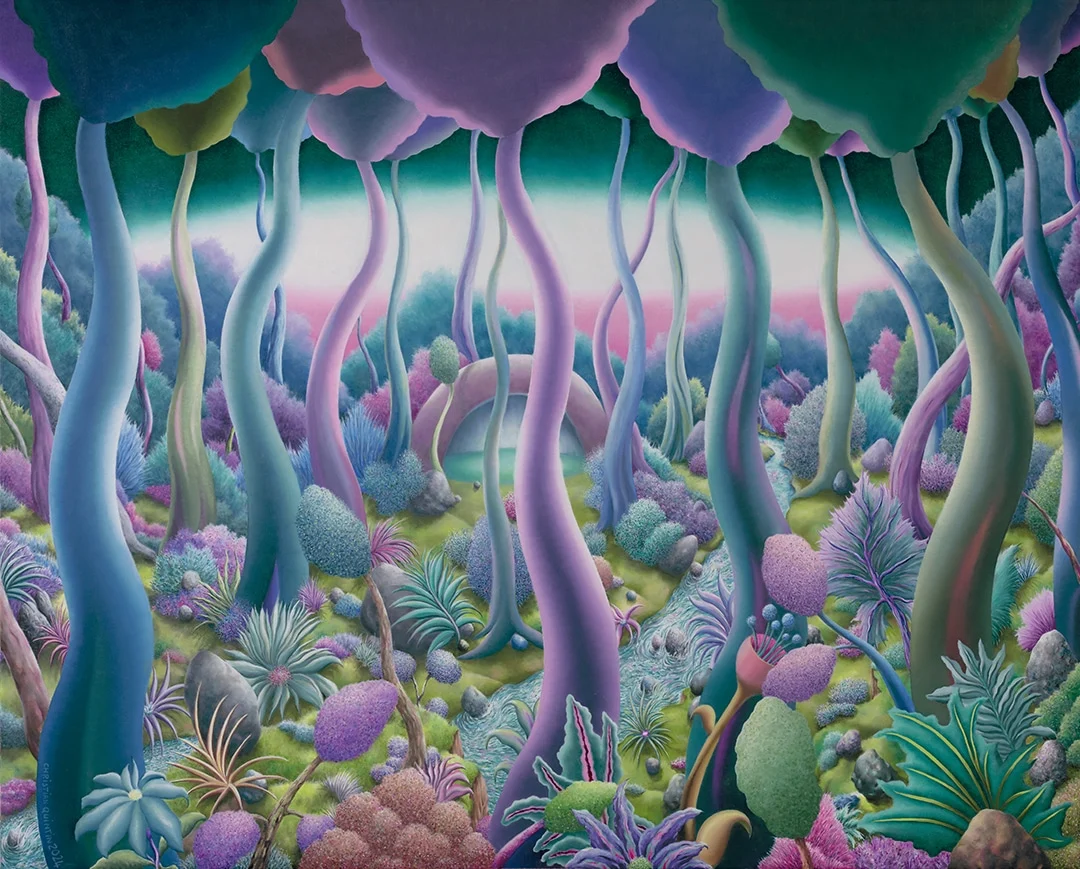
For over four decades, the Franco-American artist Christian Quintin has occupied a unique position in the contemporary art world, operating at the intersection of classical draftsmanship, French Surrealism, and the visionary ecology of Northern California. His work does not merely represent the visible world; rather, it synthesizes what he describes as "kaleidoscopic consciousness"—a state where the boundaries between the human psyche and the natural landscape dissolve into a unified, symbolic language.
In an era often dominated by the fast-paced and the digitally ephemeral, Quintin’s practice remains a testament to the "slow-burn" of artistic mastery. His meticulously crafted compositions, which can take upwards of seven months to complete, serve as a bridge between the romantic traditions of 19th-century Europe and the introspective, spiritual aesthetics of the American West.
Main Facts: A Unified Vision of Inner and Outer Terrain
Christian Quintin’s body of work defies easy categorization, yet it is held together by a singular philosophical thread: the belief that art should function as a "wondrous sanctuary for the soul." His portfolio is broadly divided into two primary modes—surrealist "mental landscapes" and emotive, romantic naturalism—though he maintains that these are not separate practices but two eyes viewing the same truth.

The Surrealist Mode
Quintin’s surrealism is distinct from the Freudian "shock" tactics of the early 20th century. Instead of focusing on the grotesque or the jarringly nonsensical, his work explores "interior constellations." These pieces, often rendered in pen and ink or oil, feature layered metaphors where human anatomy and botanical forms merge. A neck becomes a tree trunk; a face becomes a room; hair unfurls into a forest canopy.
The Romantic Landscapes
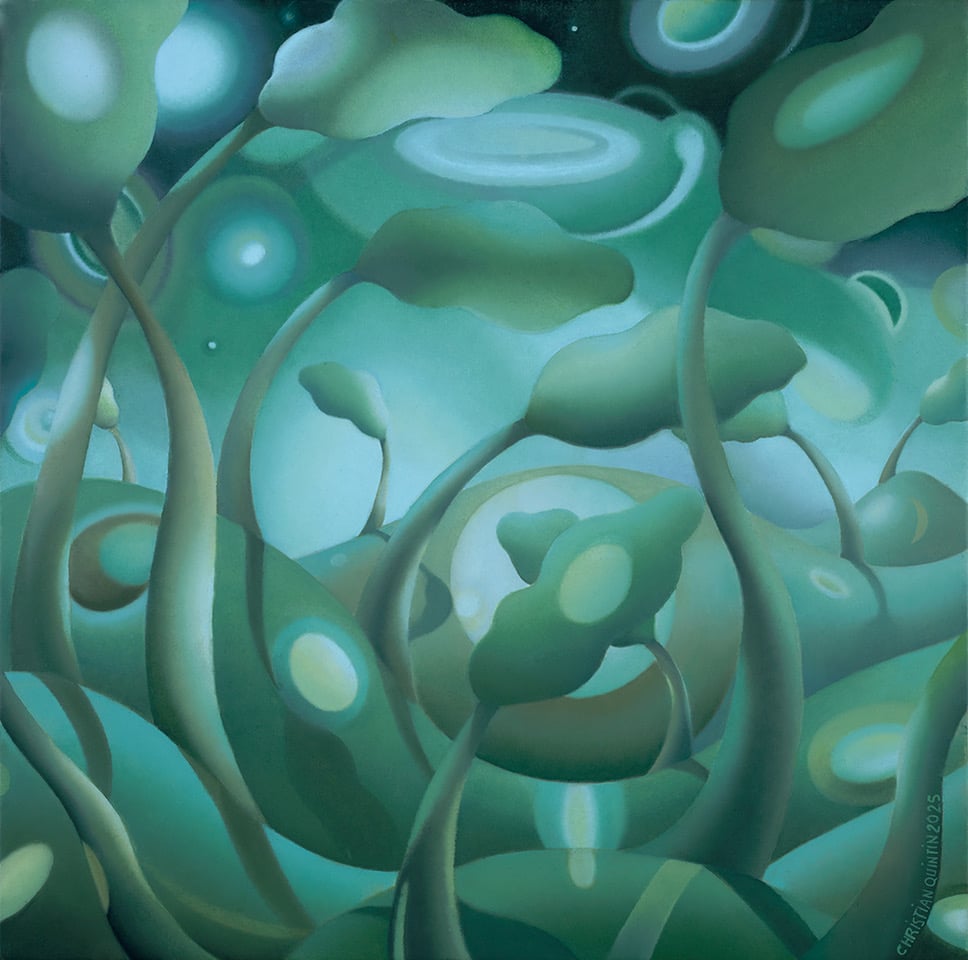
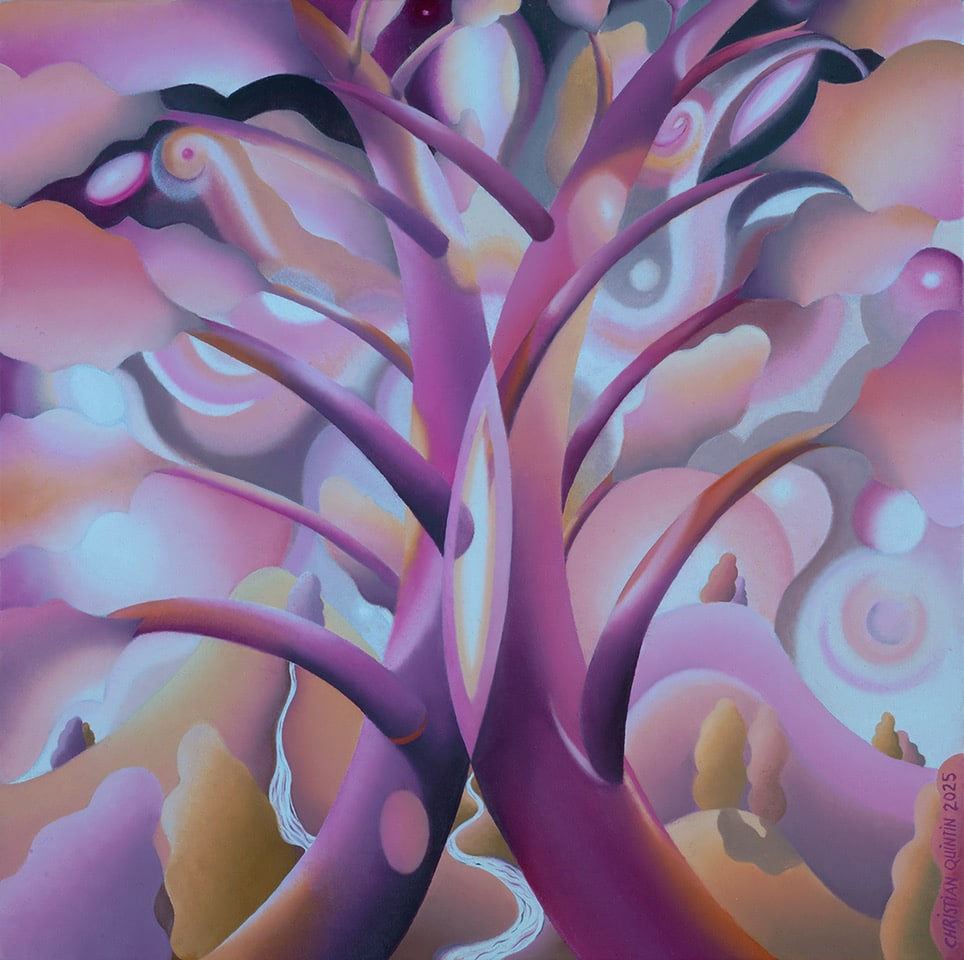
Parallel to his surrealist work, Quintin produces luminous landscapes in oil and pastel. These are not topographical documentations of specific locations but are "emotional terrains." In these works, nature is anthropomorphized—trees sway like dancers, and rivers carry the weight of memory. His palette is frequently non-representational, utilizing "emerald lakes" and "violet-brown skies" to convey mood over literal accuracy.
Technical Discipline
Quintin is a master of diverse media, including graphite, ink, pastel, and oil. His process is defined by an almost monastic patience. Works such as La Porte Ouverte or The Aviary are the result of months of intricate crosshatching and layering, a technical rigor he acquired during his formative years in the prestigious ateliers of Paris.

Chronology: From the Cliffs of Brittany to the Valleys of Sonoma
The evolution of Christian Quintin’s art is inextricably linked to his geographical journey, a migration that allowed him to layer the myths of the Old World onto the ecology of the New World.
1957–1975: The Formative Years in Brittany
Born in 1957 in Saint Brieuc, a port town on the northern coast of Brittany, France, Quintin’s early life was shaped by a landscape of ruined castles, storm-lashed cliffs, and moody Atlantic vistas. One specific location, L’Île de la Comtesse, became a recurring motif in his later work—a "mythic point of return" representing solitude and storybook aura. This period instilled in him a sensitivity to nature’s grandeur and its inherent melancholy.
1975–1981: The Parisian Discipline
In 1975, Quintin moved to Paris to study at the Beaux Arts Academy. It was here that his romantic instincts were tempered by classical discipline. He mastered the legacy of French Surrealism, Symbolism, and Romanticism, learning that technique is the necessary vehicle for intuition. During this time, he developed the precise draftsmanship that would become his hallmark, moving away from the "automatic writing" of early surrealists toward a more constructed, intentional imagery.

1981–1999: The California Resonance
In 1981, Quintin relocated to Northern California, settling in Sonoma County. The shift from the gray, rocky coast of Brittany to the golden hills, vineyards, and ancient redwoods of the American West provided a second vocabulary. He found a "sacred ecology" in the California landscape that mirrored his internal state. This era saw the birth of his "kaleidoscopic consciousness" style, where he began to explicitly merge his own identity with the trees and skies of his new home.
1999–Present: Global Recognition and Mature Practice
A major turning point occurred in 1999 when the Vorpal Gallery—noted for introducing M.C. Escher to the United States—began representing Quintin. This association validated his position as an artist who combines mind-bending concepts with flawless execution. In the 2020s, his work expanded internationally through Lorin Gallery, reaching audiences in Seoul, Hong Kong, Paris, and Los Angeles.
Supporting Data: The Mechanics of the "Kaleidoscopic Consciousness"
To understand the impact of Quintin’s work, one must look at the data of his process and the specific symbolic structures he employs. His work is supported by a rigorous "technique-follows-intuition" methodology.

Case Study: The Aviary
The Aviary serves as a prime example of his surrealist precision. The piece took six months to complete. In it, Quintin’s own face emerges from within a crystal, with his neck transitioning into a tree trunk. This is not a self-portrait in the traditional sense; it is a visual data map of the self as an ecosystem. The use of pen and ink in such works allows for a level of detail that forces the viewer into a state of "slow looking," counteracting the modern tendency toward rapid visual consumption.
The Rumi Influence
Quintin often draws from literary and philosophical sources. His work La Porte Ouverte (The Open Door) was inspired by the 13th-century Persian poet Rumi. The painting spent seven months on the easel, translating Rumi’s question—"Why stay in prison when the door is wide open?"—into a complex visual meditation. This indicates that his work is not merely aesthetic but is deeply rooted in the "Visionary Continuum," seeking to unlock doors of perception through symbolic representation.
Media and Medium
Quintin chooses his medium based on the "vibration" of the idea:

- Pastels: Used for soft, atmospheric landscapes where light is the primary subject.
- Oil: Reserved for works requiring depth, longevity, and a rich, saturated palette.
- Ink/Graphite: Employed for the most complex surrealist works where line and shadow must carry the philosophical weight.
Official Responses: Critical Acclaim and Gallery Perspectives
The art world’s response to Christian Quintin has been characterized by a recognition of his defiance against modern cynicism. Critics and curators have consistently highlighted his role as a purveyor of "beauty as a necessity."
The "Mental Landscape" Diagnosis
Critic Suzanne Munich famously titled her review of Quintin’s work "Mental Landscapes," a term that has since become synonymous with his style. This suggests that his work acts as a mirror for the viewer’s own internal state. Similarly, Alhia Warren described his compositions as a "beautiful intimate mystery," noting that the work invites participation rather than passive observation.
The Vorpal and Lorin Legacy
The Vorpal Gallery’s decision to show Quintin’s work was a significant "official" endorsement, placing him in the lineage of Escher and other "intellectual" artists. In more recent years, a 2022 review from the Calabi Gallery noted: "In an era largely devoid of it, his work is beautiful. We could all use more beauty in our lives." This sentiment reflects a growing critical movement that values Quintin’s work as a corrective to the irony-heavy trends of contemporary art.

Institutional Presence
Quintin’s work is not limited to private collections; his public commissions across California—from hospital lobbies to city murals—demonstrate his ability to translate intimate, psychological imagery into a public, communal scale. His representation by Lorin Gallery (Los Angeles/Paris) and upcoming exhibitions at Morrison Gallery (Connecticut) signify a sustained and growing institutional interest in his "slow" art.
Implications: Art as Resistance and the Visionary Legacy
The implications of Christian Quintin’s career extend beyond the frames of his paintings. He represents a specific philosophical stance in the 21st-century art dialogue: Beauty as Defiance.
A Bridge Between Traditions
Quintin serves as a bridge between the European Surrealist movement and the Northern California Visionary Art movement. While the latter is often associated with the psychedelic 1960s, Quintin brings a "classical quietude" to the genre. He shows that visionary experiences do not have to be chaotic; they can be structured, precise, and deeply rooted in natural history.
The Rejection of Didacticism
Unlike many contemporary artists who use their platform for social slogans or political manifestos, Quintin offers no "message." His work implies that the act of feeling—of wandering into an image as one would a poem—is a radical act in itself. This rejection of didacticism allows his work to remain timeless, avoiding the "expiration date" that often affects art tied too closely to current events.
The Future of "Slow Art"
As the art world continues to grapple with the rise of Artificial Intelligence and digital generation, Quintin’s "hand-made" philosophy gains new relevance. The fact that a single piece takes seven months of human labor is, in itself, a form of resistance against the commodification of creativity. His legacy will likely be defined by this commitment to the "soul-made" image—a reminder that the most profound landscapes are the ones we carry within us.
Conclusion: Sanctuary for the Soul
Christian Quintin’s art is a reentry into a hidden dimension of reality. By synthesizing the discipline of the Old World with the expansive spirit of the New World, he has created a visual language that is both ancient and modern. His work remains a "wondrous sanctuary," proving that when art is made with enough attention and soul, it ceases to be a mere object and becomes a living, breathing experience.
For further exploration of his portfolio, visit christianquintin.com.



Leave a Comment