Beyond the Void: How Infinidream.ai is Reimagining the Digital Canvas
In the modern era, the average professional spends upward of eight hours a day staring at a glowing rectangle. Yet, there is a recurring, silent phenomenon that occurs in every home and office: the "dead screen." It is that moment when a user steps away for a coffee, takes a phone call, or lapses into thought, and the monitor—once a portal to global information—fades into a black vacuum or, perhaps worse, displays a utilitarian digital clock.
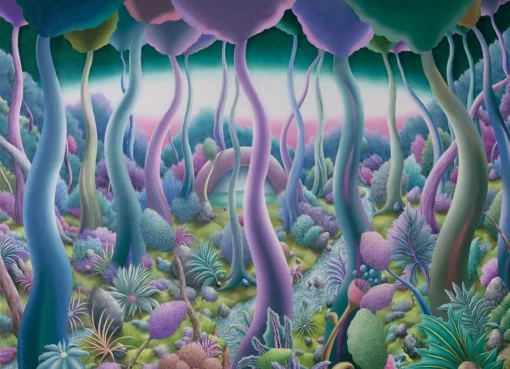
Enter Infinidream.ai, a newly launched application for Mac and Windows that seeks to abolish the digital void. Developed by legendary generative artist Scott Draves, Infinidream.ai transforms idle displays into "living paintings." Unlike traditional screensavers that rely on static images or repetitive video loops, this platform utilizes cutting-edge artificial intelligence to create art that breathes, shifts, and evolves in real-time. It is an ambitious attempt to turn the personal computer into a piece of kinetic furniture, ensuring that even when a device is "idle," it remains a source of aesthetic value.
Main Facts: The Emergence of Ambient AI Art
Infinidream.ai is not merely a gallery of AI-generated images; it is a sophisticated engine designed for "ambient intelligence." The application allows users to select from a curated library of styles provided by dozens of professional AI artists. Once activated, the software generates a continuous stream of visuals that morph through "latent space"—the mathematical territory between different data points in an AI model—creating a seamless, never-ending transition.
Key features of the platform include:
- Platform Versatility: Full compatibility with macOS and Windows, catering to both creative professionals and enterprise users.
- Generative Fluidity: The art is not pre-recorded. It is rendered in a way that ensures no two moments are ever exactly the same, mimicking the unpredictable nature of organic life.
- User Customization: Users can adjust the "tempo" of the art, ranging from a glacial, meditative crawl to a high-energy "burning fire" mode, depending on the desired mood of the room.
- Curated Excellence: Rather than relying on unguided algorithmic output, the platform features a collaborative ecosystem of artists who specialize in surrealism, abstraction, and hypnotic geometry.
By offering a free-to-try model, Infinidream.ai is positioning itself as the premier "digital wallpaper" for the AI era, targeting a demographic that values both high-tech innovation and interior design.
Chronology: From Distributed Fractals to Neural Networks
To understand the significance of Infinidream.ai, one must look back at the career of its creator, Scott Draves. A New York-based artist and software engineer, Draves has spent over three decades at the intersection of code and soul.
1999: The Birth of Electric Sheep
In 1999, long before the term "generative AI" entered the mainstream lexicon, Draves launched Electric Sheep. It was a pioneering project in distributed computing and algorithmic art. Named after Philip K. Dick’s novel Do Androids Dream of Electric Sheep?, the software functioned as a screensaver that linked hundreds of thousands of computers into a networked supercomputer. While a computer was idle, it would help render complex fractal animations known as "sheep." Users could vote on these animations, creating a form of "digital evolution" where the most popular patterns survived and "reproduced."
Electric Sheep was more than a technical feat; it was a cultural milestone, eventually being exhibited at prestigious institutions like the Museum of Modern Art (MoMA) and the Los Angeles County Museum of Art (LACMA). It ran for over twenty years, proving that there was a deep-seated human desire for "living art" on our devices.
2010s: The Rise of the Digital Frame
During the 2010s, the market saw the rise of hardware-based solutions for the "dead screen" problem. The Samsung "Frame" TV and various digital canvas startups attempted to bridge the gap between technology and decor. However, these were often limited by static imagery or high hardware costs. The software side remained largely neglected, with most computers still defaulting to black screens or simple slideshows.
2024: The AI Revolution and Infinidream
With the explosion of Generative Adversarial Networks (GANs) and Diffusion Models in the early 2020s, the tools available to digital artists expanded exponentially. Draves recognized that the "latent space" of AI models offered a new way to achieve the dream of Electric Sheep, but with far greater fidelity and artistic diversity. Infinidream.ai was conceived as the spiritual successor to his earlier work—leveraging the power of modern GPUs to create art that doesn’t just loop, but "thinks."
Supporting Data: The Psychology of the Ambient Screen
The need for a product like Infinidream.ai is backed by emerging research into "Environmental Psychology" and "Digital Wellness."
The Burden of the "Black Hole"
Architectural and interior design studies suggest that large, dark screens act as "visual anchors" that can dampen the energy of a room. In a home office environment, a dark monitor often signals the "end" of productivity or a "void" in the space. By replacing this with low-frequency, shifting visuals, Infinidream.ai utilizes the principles of Biophilic Design—the practice of connecting people with nature and organic patterns through technology.
Technical Performance and Latency
Unlike traditional video files, which can take up gigabytes of storage, Infinidream’s generative approach is remarkably efficient. By manipulating the parameters of an AI model in real-time, the software creates infinite variety without the need for massive downloads. Data from early beta testing indicates that the "slow-motion" setting uses minimal CPU/GPU resources, making it viable for laptops to run without significant battery drain or fan noise—a crucial factor for an ambient application.

The Curation Factor
In an era where AI art is often criticized for being "soulless" or "derivative," Infinidream.ai relies on a curated model. The platform features dozens of artists who "guide" the AI. This human-in-the-loop approach ensures that the output maintains a high level of aesthetic integrity, moving away from the "uncanny valley" and toward genuine fine art.
Official Responses: A Vision for Kinetic Sculpture
Scott Draves describes the philosophy behind the app not as a "distraction," but as a "presence."
"There’s a moment every few hours when your computer just sits there," Draves noted during the launch. "Scott Draves thinks that moment is wasted. We wanted to create something that feels like a Calder mobile or a kinetic sculpture—art that has duration as well as form. It’s about adding ambient, living energy to your room."
Art critics have noted that Infinidream.ai solves the "demand problem" of traditional art. Most art asks the viewer to stop, stand, and stare. Infinidream, conversely, is designed to be seen out of the corner of one’s eye. It is "slow tech" at its finest. The official stance from the development team is that the screen is "on anyway," so it might as well serve as a window into a dreaming machine rather than a reminder of a machine that is turned off.
Collaborating artists have also praised the platform for giving their work a "permanent home." In the fast-paced world of social media, an AI-generated image might be viewed for two seconds before being scrolled past. Infinidream allows these works to exist in a state of perpetual transformation, giving them a life span that far exceeds a standard digital post.
Implications: The Future of the Digital Home
The launch of Infinidream.ai carries significant implications for the future of how we interact with our living and working spaces.
1. Screens as Furniture
We are moving toward an era where the distinction between "device" and "decor" is blurring. As displays become thinner and more integrated into our homes, the software that runs on them must evolve. Infinidream.ai suggests a future where our walls are dynamic, changing their "mood" based on the time of day, the weather, or the user’s emotional state.
2. The Democratization of Fine Art
By making high-end generative art available as a free-to-try desktop application, Infinidream.ai is democratizing an art form that was previously reserved for high-end galleries or tech-savvy collectors. It moves AI art away from the "prompt-and-post" cycle and into the realm of lived experience.
3. Digital Wellness and Focus
In a world of constant notifications and "attention economy" traps, there is a growing movement toward "Calm Technology." Infinidream.ai fits perfectly into this niche. By providing a visual experience that has "no notifications and no interface," it allows the brain to rest. The slow morphing of colors and shapes can act as a form of visual meditation, potentially reducing the stress associated with the very screens that often cause it.
4. A New Revenue Model for Digital Artists
As the platform grows, it provides a potential sustainable ecosystem for AI artists. By curating specific styles, Infinidream.ai creates a "Spotify-like" model for visual art, where artists can reach a global audience of users who want to "live" with their work rather than just own it as a static file.
Conclusion: The End of the Dark Screen
The "Dead Screen Problem" is a relic of an era when computers were strictly tools—boxes to be turned on for work and off for life. In 2024, our computers are central to our environment. Infinidream.ai represents a shift in consciousness, acknowledging that our digital tools can—and should—contribute to the beauty of our physical surroundings.
Whether it is the haunting, shifting landscapes of a surrealist dream or the rhythmic pulsing of abstract geometry, Infinidream.ai offers a glimpse into a future where technology doesn’t just serve us—it dreams with us. For those tired of the black void of an idle monitor, the solution is now only a download away. Your screen is on; it’s time to let it live.