
Inanna: The Multifaceted Queen of Ancient Mesopotamia and Her Enduring Legacy
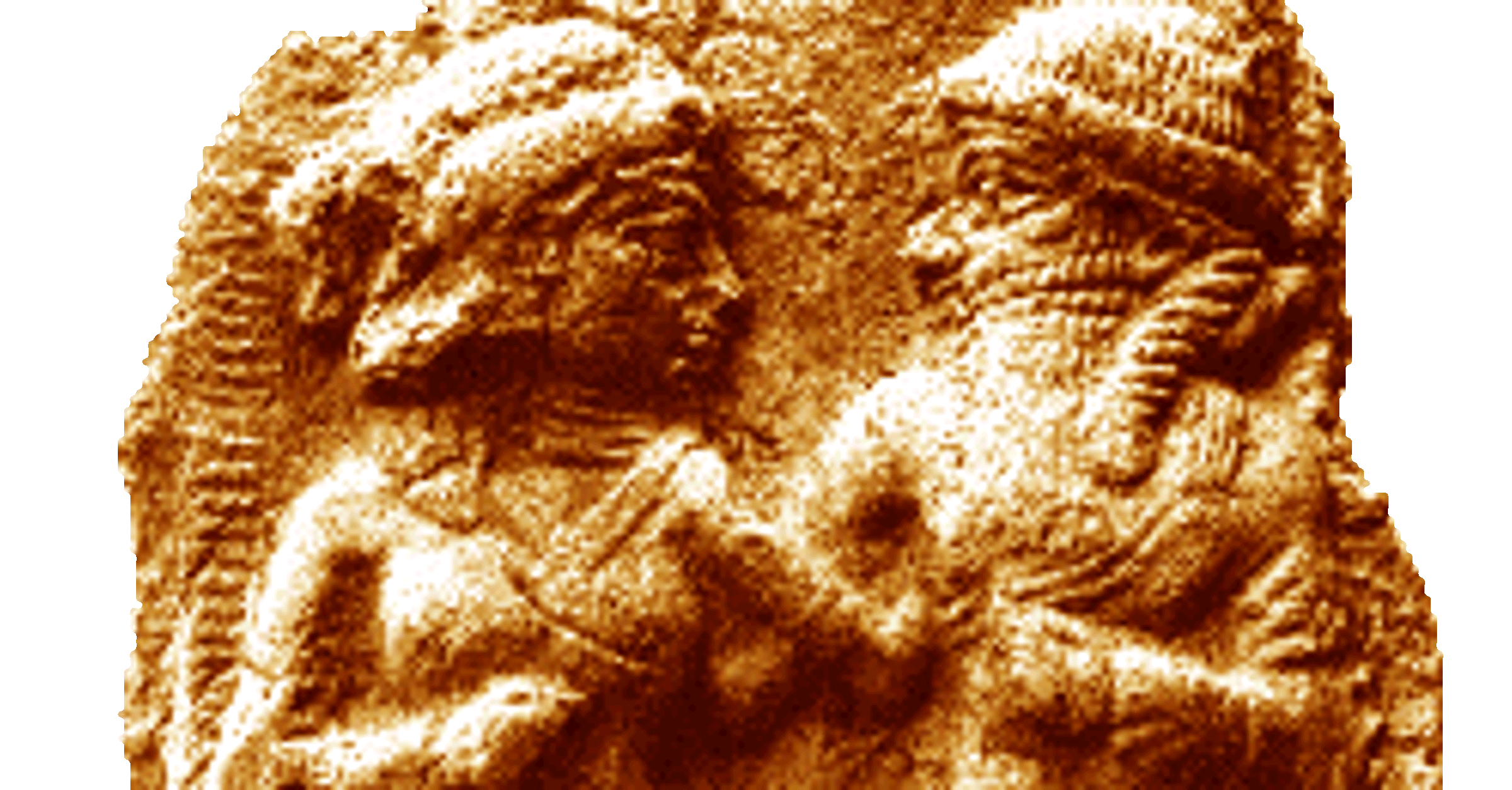
Uruk, Mesopotamia – From the dawn of civilization in ancient Sumer, a deity of unparalleled complexity and dynamism emerged, captivating the hearts and minds of millions across millennia. Inanna, the Sumerian goddess, stood as a paradoxical figure embodying the vibrant forces of love, sensuality, fertility, and procreation, yet simultaneously wielding the formidable power of war. Her influence transcended the borders of Sumer, evolving through subsequent empires and pantheons, leaving an indelible mark on the religious and cultural landscape of the ancient Near East.
Inanna’s legacy is a testament to the fluidity of ancient religious belief, her identity morphing and merging with goddesses of various cultures. She was later revered by the Akkadians and Assyrians as Ishtar, a name that would become synonymous with her formidable power. Further west, her essence resonated with the Hittite Sauska, the Phoenician Astarte, and ultimately found expression in the Greek Aphrodite, among a host of other divine counterparts. Beyond terrestrial myth, Inanna was intrinsically linked to the celestial sphere, identified as the bright star of the morning and evening – Venus – a connection so profound it persisted into Roman mythology. Her enigmatic presence is also conjectured to be the subject of the famed Burney Relief, also known as The Queen of the Night, a magnificent terracotta relief from the reign of Hammurabi of Babylon (1792-1750 BCE), though some scholars posit her sister, Ereshkigal, as the more likely figure depicted.
The Divine Lineage: Origins and Family
The genealogy of Inanna within the Mesopotamian pantheon is as varied and multifaceted as her attributes, reflecting regional differences and evolving theological perspectives across ancient Sumerian and Akkadian traditions. In some myths, she is presented as the formidable daughter of Enki, the god of wisdom, fresh water, magic, and a myriad of other fundamental aspects of life. This lineage aligns her with deep intellectual and creative forces. Conversely, other narratives depict her as the daughter of Nanna, the revered moon god, also associated with wisdom, thus connecting her to celestial cycles and profound insight.
However, the most prevalent depiction places Inanna as the granddaughter of the supreme air god Enlil and the niece of Enki, establishing her firmly within the highest echelons of the divine hierarchy. As the daughter of Nanna, she is often celebrated as the twin sister of the radiant sun god Utu-Shamash, creating a cosmic balance between lunar and solar forces. Intriguingly, in certain epic poems, most notably Gilgamesh, Enkidu, and the Netherworld, Inanna is even portrayed as the sister of the legendary hero Gilgamesh, weaving her into the fabric of humanity’s greatest mythological sagas. Regardless of her specific familial ties, a defining characteristic that consistently permeates all tales of Inanna is her undeniable power and an often-provocative nature, which she wields with assertive confidence.
From Local Deity to Queen of Heaven: Inanna’s Ascent
Inanna’s journey from a localized agrarian deity to the preeminent "Queen of Heaven" and the most widely venerated goddess across Mesopotamia is a narrative deeply intertwined with political shifts and the visionary work of a singular individual. It was through the monumental efforts of the Akkadian poet and high priestess Enheduanna (circa 2300 BCE), daughter of the legendary Sargon of Akkad (reign 2334-2279 BCE), that Inanna’s prestige soared. Sargon’s reign, marking a significant unification of Sumerian city-states under Akkadian rule, saw Inanna become intimately associated with the Semitic goddess Ishtar, a syncretism that amplified her martial aspects and broadened her appeal.
Scholar Gwendolyn Leick offers valuable insight into Inanna’s foundational importance:
"Inanna was the foremost Sumerian goddess, patron deity of Uruk. Her name was written with a sign that represents a reed stalk tied into a loop at the top. This appears in the very earliest written texts from the mid-fourth millennium B.C. She is also mentioned in all the early god lists among the four main deities, along with Anu, Enki, and Enlil." (Leick, 89)
Leick further elucidates how Inanna’s role evolved, noting:
"In the royal inscriptions of the early Dynastic Period, Inanna is often invoked as the special protectress of kings. Sargon of Akkad claimed her support in battle and politics. It appears that it was during the third millennium that the goddess acquired martial aspects that may derive from a syncretism with the Semitic deity Ishtar. Inanna’s main sanctuary was the Eanna (‘House of Heaven’) at Uruk, although she had temples or chapels in most cities." (Leick, 89)
This transformation cemented Inanna’s status not merely as a goddess of fertility but also as a powerful patron of kings and a formidable force in warfare. Her sacred precinct, the Eanna, meaning "House of Heaven," in Uruk, became her central cult center, symbolizing her celestial authority and earthly presence. Yet, her worship was not confined to Uruk; temples and chapels dedicated to her dotted the landscape of Mesopotamia, a testament to her widespread veneration.

Inanna in Myth: A Tapestry of Power and Ambition
Inanna’s character truly comes alive within the rich tapestry of ancient Mesopotamian myths, where her intelligence, ambition, and often audacious actions drive pivotal narratives. She is celebrated in foundational stories such as Inanna and the Huluppu-Tree, an early creation myth that highlights her role in the natural world.
Perhaps one of the most celebrated tales illustrating her cunning and drive for cultural advancement is Inanna and the God of Wisdom. In this myth, Inanna journeys to Eridu, the city of Enki, the god of wisdom. Through clever manipulation, and capitalizing on Enki’s drunken state, she persuades him to bestow upon her the meh – the divine decrees and gifts of civilization, encompassing everything from kingship and priesthood to music and craftsmanship. She then triumphantly brings these meh to her beloved city of Uruk, thereby enriching its culture and elevating its status, showcasing her role as a bringer of knowledge and progress.
Her personal life, particularly her relationship with the vegetation god Dumuzi, is explored in The Courtship of Inanna and Dumuzi, a lyrical tale of divine romance and agricultural cycles. However, her most famous and perhaps most profound mythological journey is recounted in The Descent of Inanna (circa 1900-1600 BCE), an epic poem where the Queen of Heaven ventures into the perilous underworld, ruled by her sister Ereshkigal, a journey fraught with peril and ultimately leading to profound consequences for herself and Dumuzi.
Beyond these major narratives, Inanna’s character was further elaborated and glorified through the intricate and deeply personal hymns penned by Enheduanna. Works like Inninsagurra ("The Great-Hearted Mistress"), Ninmesarra ("The Exaltation of Inanna"), and Inninmehusa ("Goddess of the Fearsome Powers") were not mere praises but powerful theological statements that profoundly influenced generations of Mesopotamians, elevating Inanna from a powerful local deity to a supreme, universally recognized goddess.
Scholar Jeremy Black underscores Inanna’s inherent ambition:
"Violent and lusting after power, she stands beside her favourite kings as they fight. In a Sumerian poem, Inanna campaigns against Mount Egih. Her journey to Eridu to obtain the meh and her descent to the underworld are both described as intended to extend her power." (Black, 108)
This ambition is vividly portrayed in Inanna and the Huluppu-Tree. When confronted with intractable pests infesting her sacred tree, and failing to secure assistance from her brother Utu-Shamash, Inanna strategically draws the attention of Gilgamesh. He successfully rids the tree of its nuisances. In gratitude, she gifts him magical objects (possibly a sacred drum and drumsticks). This act, seemingly benevolent, eventually sets in motion a chain of events leading to Enkidu’s journey to the underworld to retrieve them in Gilgamesh, Enkidu, and the Netherworld, and his subsequent description of the afterlife, profoundly shaping Gilgamesh’s quest for immortality. Inanna, thus, becomes an indirect catalyst for one of the greatest ancient epics.
In The Epic of Gilgamesh (circa 2100-1000 BCE), Inanna appears as Ishtar, depicted with a more volatile and vengeful temperament. Her attempt to seduce Gilgamesh is met with a scathing rejection, as he enumerates her many former lovers who met tragic fates at her hands. Enraged, Ishtar unleashes the Bull of Heaven, Gugulana (her sister Ereshkigal’s husband), to wreak havoc upon Gilgamesh’s realm. The bull’s slaying by Enkidu, Gilgamesh’s beloved companion, results in Enkidu’s divine condemnation and death, which in turn propels Gilgamesh on his desperate quest for meaning and immortality. In this epic, Inanna/Ishtar, through her actions and reactions, is undeniably central to the narrative’s profound themes.
The Dynamic Goddess: Aspects and Iconography
Inanna’s visual representation and symbolic associations are as rich and varied as her mythological roles. She is frequently depicted alongside or even riding a lion, an animal symbolizing courage, ferocity, and royal power, thereby underscoring her supremacy over the "king of beasts" and her indomitable spirit. In her aspect as a goddess of war, Inanna is strikingly portrayed in male battle attire, armed with a quiver and bow, a warrior goddess who leads her chosen kings into conflict. This martial imagery led to her identification with the Greek goddess Athena Nike, a deity of wisdom, warfare, and victory.
Beyond her warrior guise, Inanna’s multifaceted nature also connected her to other significant divine figures. She has been associated with Demeter as a fertility deity, especially through her link to agricultural abundance. Furthermore, her mythological journey to the underworld and subsequent return, particularly in The Descent of Inanna, established a parallel with Persephone, positioning her as a "dying and reviving god" figure, a clear echo of her original incarnation as a rural goddess tied to the cycles of agriculture and seasonal renewal.
It is crucial to differentiate Inanna from the traditional "mother goddess" archetype, a role commonly attributed to deities like Ninhursag. Inanna was never primarily seen as a maternal figure. Scholar Jeremy Black clarifies this distinction:
"One aspect of [Inanna’s personality] is that of a goddess of love and sexual behaviour, but especially connected with extra-marital sex and – in a way which has not been fully researched – with prostitution. Inanna is not a goddess of marriage, nor is she a mother goddess. The so-called Sacred Marriage in which she participates carries no overtones of moral implication for human marriages." (Black, 108)
Instead, Inanna emerges as an archetypal independent woman, one who acts according to her desires, often with a disregard for societal norms or the potential consequences of her actions. Her preferred methods for resolving difficulties, often self-created, involve manipulation, threats, or seduction. No extant myths, poems, or legends portray her in a domestic or maternal light, consistently reinforcing her image as a powerful, autonomous, and at times, formidable force of nature.
The Enigmatic Pantheon: Genealogical Variations and Rituals
The fluid nature of Inanna’s lineage within the Mesopotamian pantheon is a fascinating aspect of her divine persona, reflecting the dynamic evolution of religious beliefs across different eras and city-states. While she is sometimes identified as the daughter of the supreme sky god Anu, other traditions firmly establish her as the offspring of the moon god Nanna and his consort Ningal. Alternately, she appears as the daughter of Enki, the god of wisdom, making her the sister of Ereshkigal, the formidable goddess of the underworld. She is also widely known as the twin sister of the sun god Utu-Shamash and the sister of Ishkur (also known as Adad), the god of storms. These diverse genealogies highlight the regional variations in worship and the syncretic nature of ancient Mesopotamian theology.
Her relationship with Dumuzi, her husband, is central to some of the most profound fertility rituals of Mesopotamia. Dumuzi, who tragically suffers for Inanna’s impulsive choices in The Descent of Inanna, transforms over time into the "dying and reviving god" Tammuz. Annually, at the autumn equinox, the sacred marriage rites of Inanna and Dumuzi (or Ishtar and Tammuz in later traditions) were celebrated. This ritual symbolized Dumuzi’s return from the underworld to mate with Inanna, a sacred union believed to revitalize the land and ensure its fertility for the coming year. This sacred marriage was a cornerstone of important festivals, such as the Akitu festival in Babylon, often re-enacted by the king and a high priestess, either through actual sexual intercourse or a symbolic pantomime, underscoring its vital role in the prosperity of the realm.
The Cult of Inanna: Worship and Clergy
The worship of Inanna was characterized by a vibrant and inclusive cult that diverged significantly from later, more rigid religious structures. Her temple at Uruk, the Eanna, served as her central cultic hub, but her influence permeated throughout Mesopotamia, with numerous temples and shrines dedicated to her across various cities. A striking feature of Inanna’s cult was the diversity of her clergy, which included not only male and female priests and priestesses but also a "third gender," which in modern terms would be defined as transgender individuals.
The existence of kurgarra (male transgenders who castrated themselves) and galatur (females who identified as males) within her clergy highlights a profound acceptance of gender fluidity within her worship. These individuals were believed to have been either directly transformed by Inanna/Ishtar herself or specially created by the Father God Enki to assist Inanna during her perilous journey to the underworld. The Descent of Inanna explicitly states that Enki made them "neither male nor female," a divine mandate that her clergy honored by embodying these gender identities.
Scholar Colin Spencer provides a nuanced view of the temple practices:
"Sacred prostitution was the central part of the ritual in the Temple. The priestess performed a sacred marriage to ensure the fertility of the country and the great fortune of the new king, for the king copulated with the holy priestess at the beginning of his reign. There were lesser priestesses who were also musicians, singers, and dancers, certainly some of these were men who also copulated with both men and women." (Spencer, 29)
Spencer further notes the divine origin attributed to some of these roles:
"The goddess Ishtar had turned these men into women as a demonstration of her awesome powers. Yet though Ishtar was an all-powerful presence and through prostitution was revered and was also an important economic factor in the running of the Temple, women’s role in society began to be secondary to that of men." (Spencer, 29)
This observation points to a fascinating paradox: Inanna, a powerful and independent female deity, presided over a cult that embraced diverse gender identities and celebrated female sexual agency, even as the broader societal status and rights of women in Mesopotamia began to decline.
Decline and Enduring Influence
Inanna’s widespread popularity and prestige faced challenges with the changing tides of Mesopotamian socio-political structures. The reign of the Amorite king Hammurabi of Babylon, known for his comprehensive legal code, also coincided with a noticeable decline in the prestige of female deities, as male gods increasingly dominated the pantheon. This shift, as scholar Samuel Noah Kramer notes, often paralleled a broader loss of status and rights for women within society.
Despite this broader trend, Inanna demonstrated remarkable resilience. Her adoption by the mighty Assyrian and Neo-Assyrian empires as Ishtar, goddess of war and sex, ensured her continued veneration on a grand scale. While many other goddesses, such as Nisaba (formerly the scribe of the gods and patroness of the written word), were assimilated into male deities like Nabu under Hammurabi’s reforms, Inanna/Ishtar retained her distinct identity and formidable power. Her enduring presence inspired similar deities across the Near East and beyond, embedding her characteristics into the religious imagination of countless cultures.
The Enduring Goddess: A Legacy of Power and Independence
Inanna holds a unique position as one of the oldest recorded deities in ancient Sumer, listed among the foundational seven divine powers alongside Anu, Enlil, Enki, Ninhursag, Nanna, and Utu. These primordial deities laid the groundwork for many characteristics attributed to subsequent gods and goddesses, and Inanna, in particular, served as a profound inspiration for countless similar figures across various cultures.
Her personality stands in stark contrast to the traditional "mother goddess" archetype, epitomized by figures like Ninhursag. Inanna is consistently portrayed as a brash, independent young woman – impulsive yet calculating, capable of both kindness and a striking carelessness towards others’ feelings, property, or even their lives. Jeremy Black eloquently summarizes her distinct relationship with the masculine:
"The fact that in no tradition does Inanna have a permanent male spouse is closely linked to her role as the goddess of sexual love. Even Dumuzi, who is often described as her ‘lover’, has a very ambiguous relationship with her and she is ultimately responsible for his death." (Black, 108)
The very conception of such a goddess by the Sumerians speaks volumes about their cultural values and their understanding of femininity during that era. Sumerian society, particularly in its earlier phases, held women in high regard, and their pantheon reflected this, featuring numerous significant female deities like Gula, Ninhursag, Nisaba, Nanshe, and Ninkasi. However, as Mesopotamian history progressed, the status of goddesses, and by extension, women in society, gradually diminished.
Inanna’s survival and continued prominence, even as other goddesses faded or were subsumed, can be attributed to her inherent accessibility and dynamic nature. Both women and men found aspects of themselves reflected in this powerful deity, leading to diverse forms of service in her temples, from priests and priestesses to sacred prostitutes of various genders. Inanna commanded devotion not merely for what she offered, but for who she was – a goddess unbound, a force of nature, love, and war. Her close association with the morning and evening star, Venus, cemented her place in the cosmos, a celestial beacon that continues to shine, even if today, fewer remember her by her ancient Sumerian name. Inanna’s enduring legacy is a powerful reminder of the complex, resilient, and deeply human dimensions of ancient divine belief.


Leave a Comment