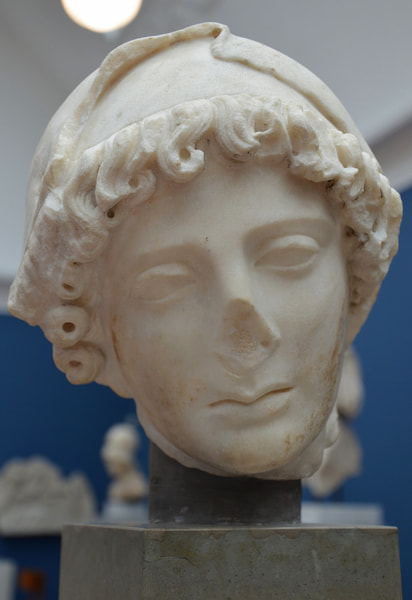
ATHENS, GREECE – In the vast tapestry of Greek mythology, few figures resonate with the complexity and enduring strength of Penelope, the revered wife of Odysseus, King of Ithaca, and mother of Telemachus. Her narrative, masterfully immortalized in Homer’s epic poem, The Odyssey (circa 750 BCE), stands as a testament to unwavering fidelity, sharp intellect, and profound resilience in the face of prolonged absence and relentless pressure. For two decades, while her husband navigated treacherous seas and mythical beasts on his arduous journey home from the Trojan War, Penelope deftly protected her household and her son, employing cunning strategies to evade a horde of avaricious suitors vying for her hand and throne.
Main Facts: The Steadfast Queen of Ithaca
Penelope’s identity is inextricably linked to her role as Odysseus’s devoted wife and the queen of Ithaca. Her story is fundamentally one of endurance and strategic defense of her family and kingdom during her husband’s unprecedented 20-year absence. She is celebrated for her exceptional loyalty, a virtue often tested to its limits, and her ingenious "weaving trick" – a ploy to indefinitely delay remarriage by feigning the creation of a funeral shroud. Beyond these defining traits, Penelope also embodies a deep maternal love for Telemachus and a steadfast piety towards the gods, particularly Athena, who frequently intervenes on her behalf. Her character provides a crucial counterpoint to Odysseus’s heroic journey, highlighting the domestic struggles and the steadfastness required to maintain order and hope on the home front.
Chronology: A Queen’s Decades-Long Vigil
Origins and a Strategic Marriage:
Penelope’s lineage traces back to Sparta, where she was born the daughter of King Icarius and the naiad nymph Periboia. She shared her upbringing with five brothers: Thoas, Damasippos, Imeusimos, Aletes, and Perileos. Her marriage to Odysseus was not a mere love match but a product of strategic diplomacy. Odysseus, initially one of the many suitors vying for the hand of the famously beautiful Helen of Sparta, recognized the potential for conflict among the numerous powerful contenders. He struck a deal with Helen’s father, Tyndareus: in exchange for Tyndareus’s help in securing Penelope’s hand, Odysseus would devise a plan to prevent a bloody feud among Helen’s rejected suitors. Following Odysseus’s sagacious counsel, Tyndareus compelled all suitors to swear an oath: they would collectively defend Helen’s chosen husband if he ever faced harm or challenge concerning his marriage. True to his word, Tyndareus then arranged for Penelope to marry Odysseus. This union, steeped in political foresight, produced their only son, Telemachus, born shortly before the fateful Trojan War summoned Odysseus away.
The Mournful Wife and the Suitors’ Encroachment:
The opening books of The Odyssey plunge the reader directly into Penelope’s prolonged agony. For ten years, Odysseus fought at Troy, and for another ten, he was lost at sea. During this agonizing two-decade span, Penelope found herself trapped in a palace under siege, not by an external army, but by a parasitic host of over a hundred ambitious suitors. These noblemen from Ithaca and neighboring islands, presuming Odysseus dead, openly vied for Penelope’s hand and, by extension, the throne and wealth of Ithaca. They shamelessly consumed the royal stores, slaughtered Odysseus’s livestock, and reveled in the palace, turning a once-proud home into a scene of gluttony and disrespect.
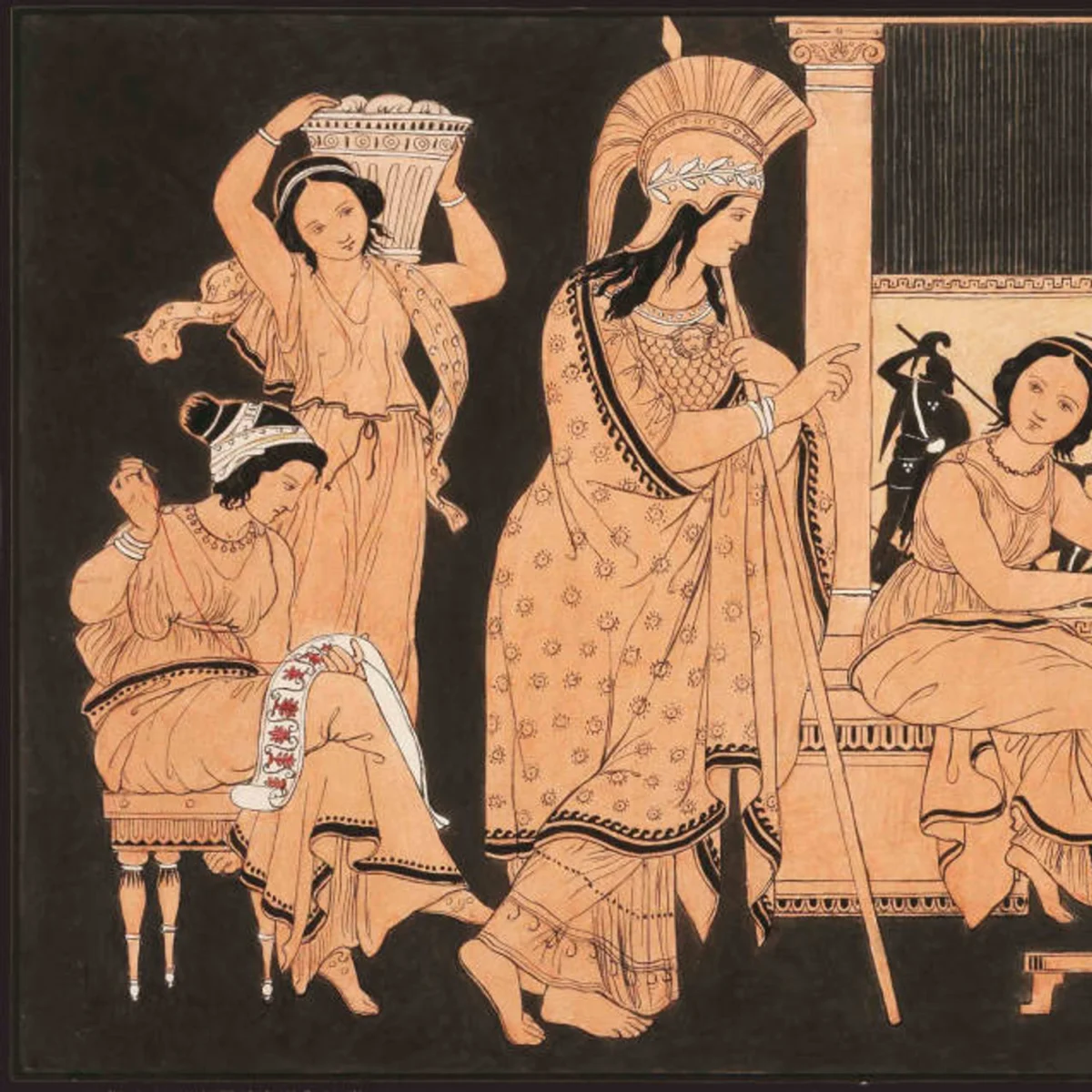
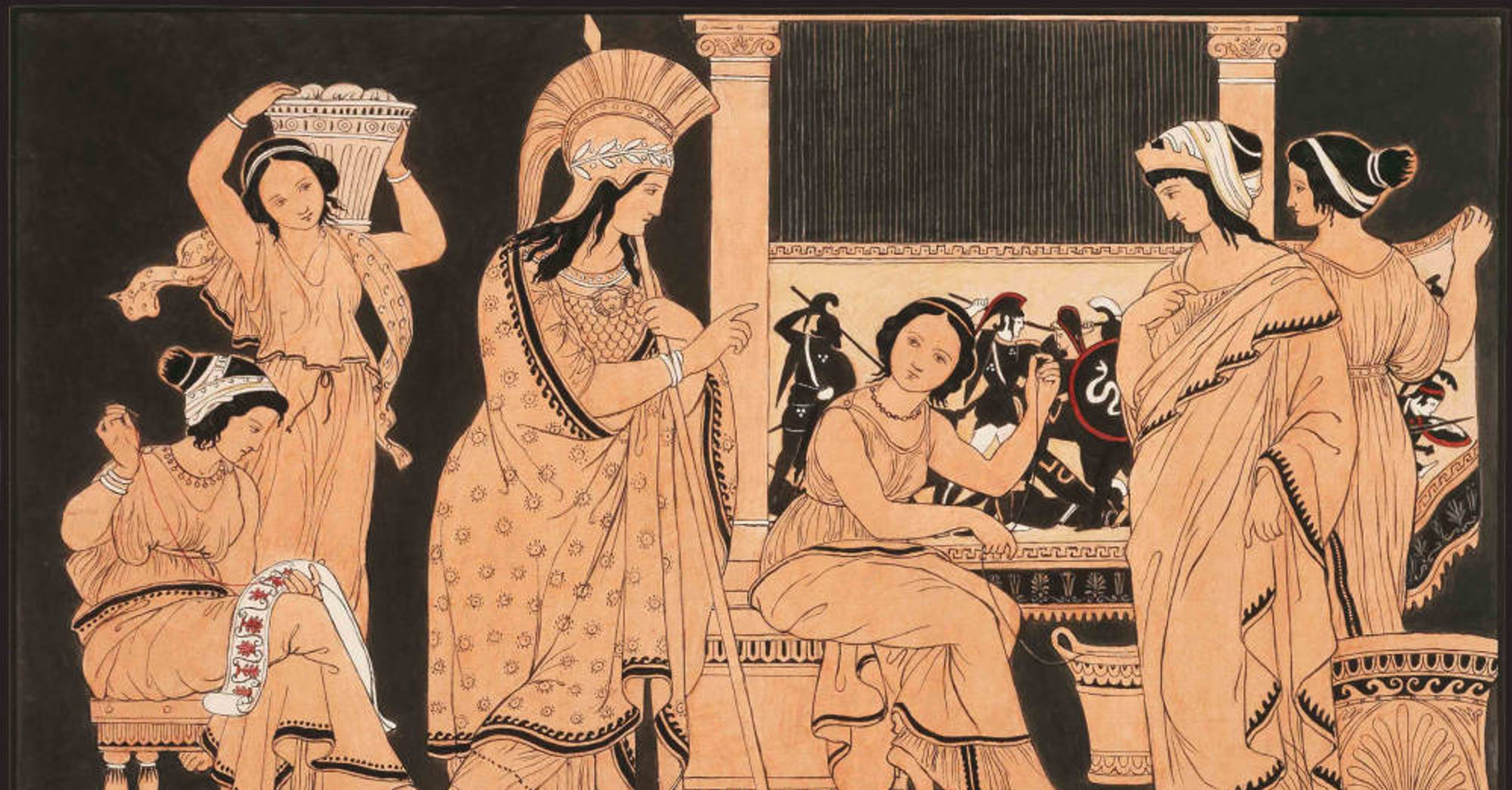
Penelope’s despair is palpable. One evening, as the bard Phemius sings of the Achaeans’ ill-fated return from Troy, a melody that echoes her own profound loss, Penelope descends from her chambers, accompanied by her loyal handmaidens. She pleads with Phemius to cease his lament, the pain of her husband’s memory too acute to bear:
"How I long for my husband — alive in memory, always,
That great man whose fame resounds through Hellas
Right to the depths of Argos!"
(Homer, The Odyssey, 1.395-398)
Her young son, Telemachus, still struggling to assert his authority, attempts to comfort his mother and sends her back to her chambers, where she weeps until the goddess Athena, ever watchful over the house of Odysseus, grants her the solace of a blissful sleep.
The Ingenious Weaving Deception:
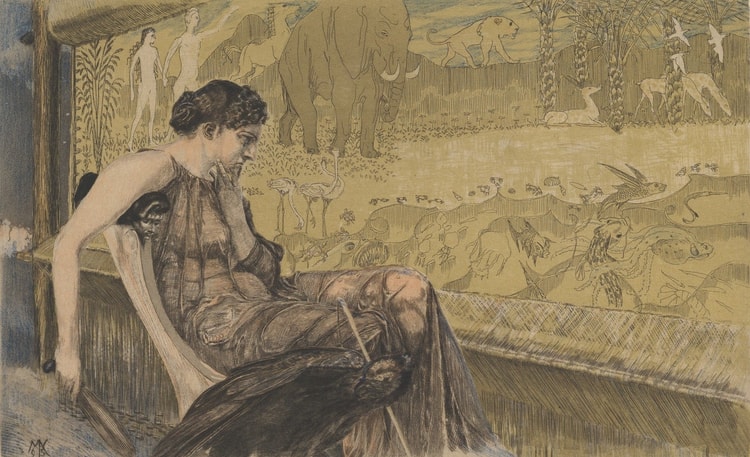
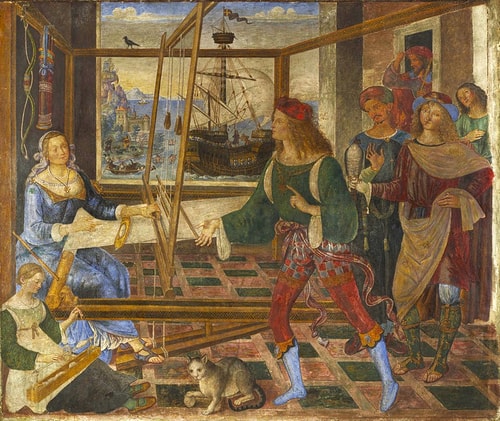
Faced with relentless pressure to choose a new husband, Penelope, a woman of sharp wit and resourcefulness, devised a brilliant strategy to buy time. She promised the suitors she would select one of them only after she completed weaving a grand funeral shroud for her aging father-in-law, Laertes. For three years, she diligently worked on the loom in the royal halls, seemingly making progress. However, her true cunning lay in her nightly ritual: under the cloak of darkness, she would meticulously unravel the day’s work, effectively starting anew each morning. This clever deception kept the impatient suitors at bay, offering them a glimmer of hope while prolonging her widowhood.
Her secret, however, could not remain hidden indefinitely. In the fourth year, one of Penelope’s disloyal maids betrayed her, revealing the nightly unraveling to the suitors. Antinous, the most arrogant and aggressive of the suitors, expressed his outrage at this "cunning" and "trickery" to Telemachus during an assembly. He acknowledged Penelope’s remarkable intelligence and skill, but condemned her for "giving the men false hope." Once exposed, Penelope was forced to complete the shroud, removing her most effective delaying tactic. Antinous then urged Telemachus to send his mother back to her father’s house in Sparta, where Icarius could force her to marry a suitor of his choosing, thus ridding Ithaca of their presence.
Telemachus’s Stirrings and Penelope’s Fears:
Telemachus, incensed by Antinous’s audacity and the suitors’ continued insolence, defiantly refused to send his mother away, asserting his rightful place in the palace. He invoked Zeus’s wrath upon the suitors for their disrespect. In a dramatic omen, Zeus sent two eagles to fight violently overhead, a clear sign interpreted by the elder Halitherses as a prophecy of Odysseus’s imminent return and the suitors’ demise. Though the suitors scoffed, Telemachus vowed to embark on a quest to find news of his father, promising to give Penelope’s hand to another only if he received definitive proof of Odysseus’s death after a year. To protect his mother from further distress, Telemachus ensured she remained unaware of his voyage until he was safely at sea.
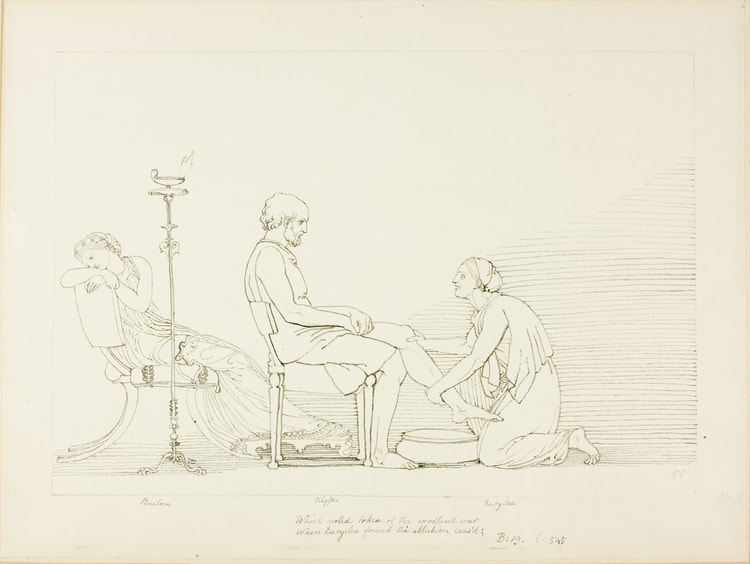
News of Telemachus’s secret departure, however, eventually reached Penelope through the herald Medon, who overheard the suitors plotting an ambush to kill him upon his return. Penelope was understandably devastated, collapsing in grief and anger, fearing for her only son’s life after already losing her husband. Her old nurse, Eurycleia, revealed she had known of Telemachus’s journey but had sworn an oath of silence. She implored Penelope to pray to Athena for her son’s safety. Heeding this advice, Penelope offered a heartfelt prayer:
"Hear me, daughter of Zeus whose shield is thunder –
tireless one, Athena! If ever, here in his halls,
resourceful King Odysseus
burned rich thighs of sheep or oxen in your honour,
oh remember it now for my sake, save my darling son,
defend him from these outrageous, overbearing suitors!"
(The Odyssey, 4.859-864)
Athena responded by sending a phantom of Penelope’s sister, Iphthime, to comfort her in a dream, reassuring her that Telemachus was under divine protection. This divine intervention brought Penelope a much-needed moment of peace amidst her torment.
Confrontation and the Beggar’s Arrival:
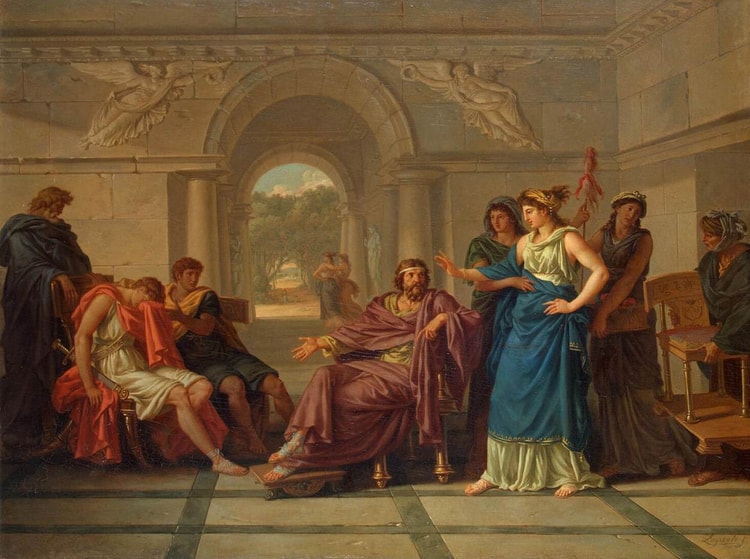
Upon Telemachus’s safe return, Penelope, emboldened by a renewed sense of purpose, confronted the suitors directly. Entering the great hall surrounded by her handmaidens, she singled out Antinous, fiercely condemning his character and reminding him of his father’s past refuge in the Ithacan palace, which Antinous now sought to usurp. Though Eurymachus, another leading suitor, attempted to placate her with false promises of protecting Telemachus, Penelope remained resolute, retreating to her chambers to weep once more for Odysseus, again finding solace in Athena-induced sleep.
Unbeknownst to Penelope, the "guest" Telemachus brought back to Ithaca was her husband, Odysseus, cunningly disguised as an old beggar by Athena to assess the loyalty of his household and plan his revenge. While some suitors showed a modicum of pity, Antinous, demonstrating his inherent cruelty, struck the disguised Odysseus with a footstool. Penelope, hearing of this outrage, prayed to Apollo to strike Antinous down. She commanded her swineherd, Eumaeus, to bring the beggar to her, hoping he might carry news of her long-lost husband. The disguised Odysseus agreed to meet her at sunset, seeking privacy for their fateful conversation.
The Test of the Bow and the Massacre:
Before meeting the beggar, Penelope, having been divinely enhanced by Athena’s magic, appeared before the suitors, captivating them with her refreshed beauty. She subtly criticized their lack of traditional courtship, lamenting that past suitors would bring gifts, whereas these men merely consumed her household’s wealth. Odysseus, observing from the shadows, swelled with pride at his wife’s sharp retort. The suitors, eager to impress, showered her with lavish gifts – robes, amber necklaces, earrings, and chokers – which Penelope accepted, further demonstrating her strategic engagement.
Her private meeting with the disguised Odysseus was a masterpiece of dramatic tension. Penelope confided in him about her weaving trick, her despair, and her yearning for her husband. The beggar, maintaining his disguise, recounted a fabricated story of meeting Odysseus on his way to Troy, subtly weaving in truths that resonated deeply with Penelope. She wept, questioning him further, and though he reassured her of Odysseus’s imminent return, a part of her heart, hardened by years of false hope, struggled to believe.
Inspired by Athena, Penelope announced a monumental test for her suitors: whoever could string Odysseus’s mighty bow and shoot an arrow cleanly through the holes of twelve aligned axe-heads would win her hand. This challenge was designed to be impossible for any but Odysseus himself. One by one, the arrogant suitors failed miserably. When the disguised beggar requested his turn, the suitors erupted in scorn. Penelope, however, granted him the chance, promising him fine clothes and safe passage if he succeeded. Telemachus, now aware of the impending bloodshed, discreetly sent Penelope to her chambers before Odysseus, with the aid of Telemachus and loyal servants, revealed his true identity and unleashed a brutal massacre upon the unsuspecting suitors.
The Poignant Reunion:
Following the bloody purge, Penelope was roused from her sleep by her old nurse, Eurycleia, who joyfully declared Odysseus’s return and the suitors’ demise. Penelope, fearing her nurse’s sanity after years of longing, struggled to believe. She descended to the great hall, confronting a transformed Odysseus, bathed and divinely enhanced by Athena to appear truly god-like. Telemachus urged her to acknowledge him, but Penelope, ever cautious, insisted on a secret sign, a testament to their unique bond.
Odysseus, frustrated by her apparent coldness, accused her of being unfeeling. Penelope, however, had one final, brilliant test. She instructed Eurycleia to move "their" bed out of the bridal chamber. Odysseus, enraged, retorted, "Who dares move my bed? No mortal man could move it!" He then passionately described how he had carved their marital bed directly from the trunk of a living olive tree, anchoring it immovably to the earth. This intimate, secret detail, known only to them, was the final, irrefutable proof. Penelope’s resistance crumbled, and she rushed into his arms, both weeping tears of joy and relief after two decades of separation. Odysseus then recounted his epic adventures, and Penelope, captivated, did not close her eyes until she had heard every word, their reunion sealing the long, arduous journey home. Odysseus also revealed one final trial: a journey to appease Poseidon, the sea god who had tormented him. Penelope, with her husband finally home, expressed hope for a long and happy life together.
Supporting Data: Homer’s Voice and Penelope’s Depth
Homer’s Odyssey is the primary source for Penelope’s narrative, providing rich detail through vivid descriptions and direct dialogue. The epic itself serves as the foundational "supporting data" for her character. The passages quoted earlier directly illustrate her profound grief and reliance on divine solace. The description of the suitors’ excesses, their consumption of "their livestock" and "their wine," underscores the economic drain and blatant disrespect they inflicted upon the Ithacan household, elevating Penelope’s struggle beyond mere marital fidelity to the preservation of her kingdom’s very fabric. Her dialogue, though sometimes brief, reveals her sharp wit and strategic mind, such as when she critiques the suitors for their lack of traditional gifts, subtly shaming them while subtly prompting their generosity to further enrich her household. The narrative also consistently portrays her piety, her prayers to Athena serving as a recurring motif of her trust in divine justice and protection.
Official Responses: Alternative Views and Scholarly Debates
While Homer’s portrayal of Penelope as the epitome of loyalty and chastity became the dominant narrative, other ancient sources presented alternative, often contrasting, views that challenge this idealized image.
Penelope as Pan’s Mother: The lyric poet Pindar (circa 518 BCE) and the Greek historian Hecateus of Miletus (circa 550-476 BCE) both mention Penelope as the mother of Pan, the god of the wild, shepherds, and flocks. However, they attribute his paternity differently, suggesting Hermes, Apollo, or even Mercury (the Roman equivalent of Hermes).
The "Unfaithful" Penelope: More controversially, the historian Duris of Samos (circa 350 BCE) wrote that Pan’s birth was the result of Penelope sleeping with all her suitors, a stark contrast to Homer’s narrative. This scandalous account was echoed by the travel writer Pausanias (circa 110-180 CE), who recounted a Mantinean tradition in the Peloponnese where Odysseus returned to find Penelope unfaithful and consequently banished her from Ithaca. In this version, she fled to Mantineia, where she later died.
A Victim of Seduction: Many authors, however, pushed back against the narrative of a promiscuous Penelope, instead presenting her as a victim of seduction, either by her suitors collectively or by a specific god like Hermes, thereby preserving her inherent chastity while explaining the paternity of Pan.
Modern scholarship widely believes that the "Penelope" who was associated with Pan’s birth was likely a distinct nymph sharing the same name. Over time, this nymph’s story was mistakenly conflated with that of the more famous Queen Penelope of Ithaca, leading to these conflicting narratives. These alternative traditions highlight the fluidity of myth and the diverse interpretations that could arise even in antiquity, often reflecting regional biases or attempts to rationalize different mythological lineages.
Implications: Penelope’s Enduring Legacy
Penelope’s story transcends the confines of ancient Greece, making her a timeless figure admired across cultures and centuries. Her attributes of loyalty, wisdom, patience, and resilience have cemented her status as more than just Odysseus’s wife; she evolved into a heroine in her own right, a symbol of domestic strength and fidelity.
Ancient Reverence: The Etruscans featured her in their art, recognizing her significance. The Roman poet Ovid (circa 43 BCE to 17 CE) lauded her as an emblem of enduring love and faithfulness, and Roman women frequently aspired to emulate her wisdom and steadfastness. Her fame even reached ancient Egypt, underscoring the widespread impact of Homeric epics.
Modern Interpretations: In contemporary literature and scholarship, Penelope continues to inspire and evolve. Authors frequently revisit her character, exploring her inner world and agency. Margaret Atwood’s acclaimed 2005 novel, The Penelopiad, offers a powerful, feminist retelling of The Odyssey from Penelope’s perspective, with Penelope narrating her life story from Hades in the 21st century. This work, along with others, reclaims Penelope as a potent, complex woman whose intelligence and resilience were central to the epic’s outcome, challenging patriarchal interpretations that might relegate her to a passive role. Modern authors and scholars celebrate her as a powerful woman, acknowledging her crucial, active role in safeguarding Ithaca and ensuring the eventual restoration of her family.
Cultural Resurgence: The enduring appeal of Homer’s epic continues to resonate in popular culture. The original source text mentions that director Christopher Nolan’s much-anticipated movie The Odyssey is reportedly set for release in July 2026, featuring an A-list cast. American actress Anne Hathaway is slated to portray Penelope, a casting choice that promises to bring this iconic figure to a new generation, further cementing her legacy as one of the most compelling and influential women in the Western literary canon.
Penelope’s journey, marked by sorrow, strategic brilliance, and ultimate triumph, remains a powerful narrative of hope, devotion, and the unyielding spirit of a queen who, against all odds, preserved her home and awaited her hero’s return.
Introduction: Main Facts For centuries, the popular image of the Vikings has been one of sudden, brutal emergence from the misty northern lands, their longships appearing without warning to raid and c
Mesopotamia, the cradle of civilization, gave birth to a pantheon of deities whose stories shaped the understanding of the cosmos, human existence, and the very fabric of society. Among these revered
London, UK – From the depths of ancient seas to the intricate chambers of the human heart, folklore continues to captivate and instruct. A groundbreaking new compendium, "Fascinating Folklore,&qu