
A Cosmic Milestone: Hubble’s 36th Anniversary and the Reimagined Trifid Nebula
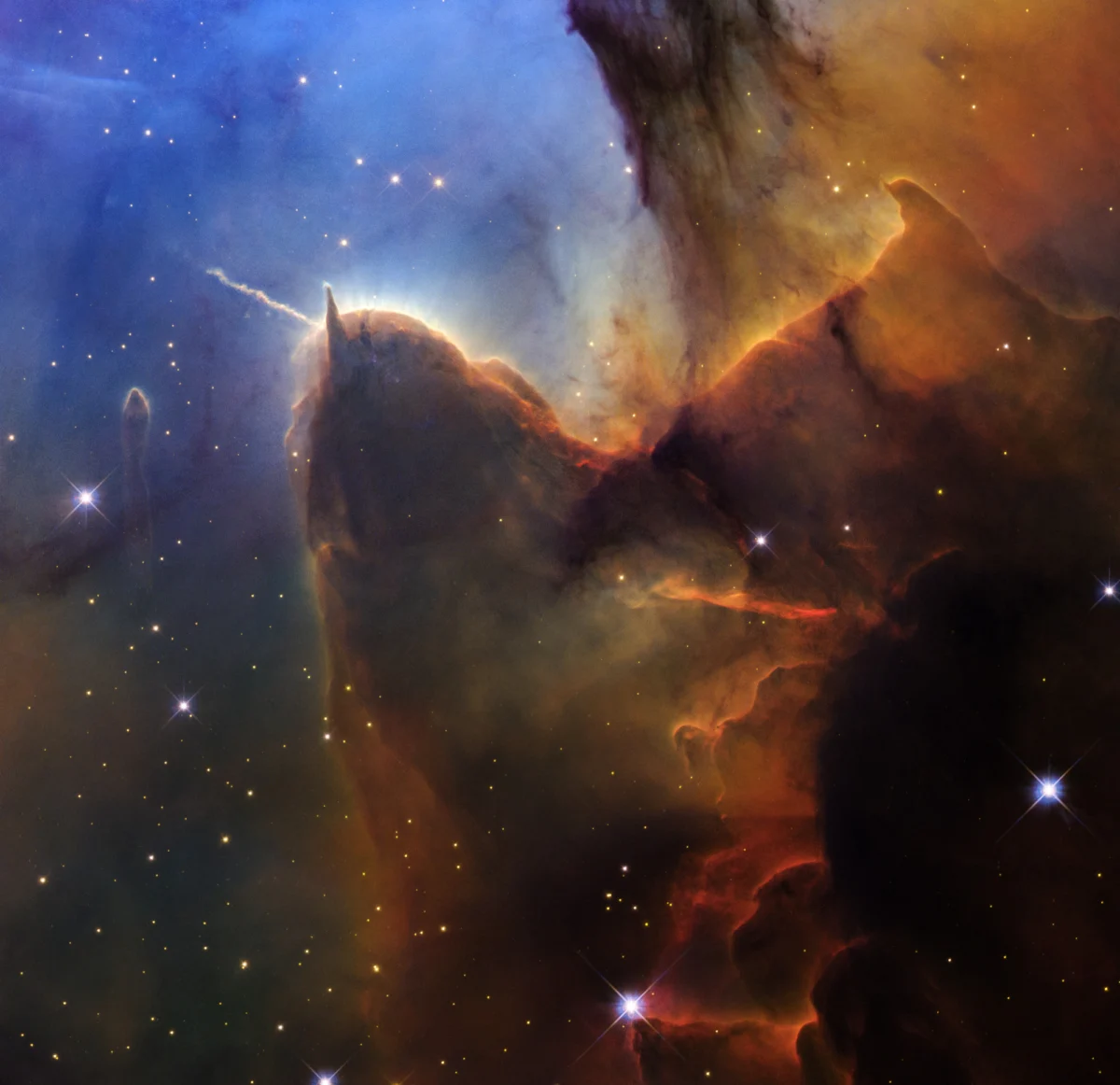
On April 24, 2026, the National Aeronautics and Space Administration (NASA) and the European Space Agency (ESA) celebrated a monumental achievement in the history of space exploration: the 36th anniversary of the Hubble Space Telescope. To commemorate nearly four decades of peerless service, the telescope was directed toward one of the most iconic structures in the night sky—the Trifid Nebula. This newly released high-definition portrait not only showcases the staggering beauty of the cosmos but also serves as a critical data point for astronomers tracking the rapid evolution of star-forming regions.
Main Facts: A Masterpiece in Sagittarius
The Trifid Nebula, also known as Messier 20 (M20), is located approximately 5,000 light-years from Earth in the constellation Sagittarius. It is a rare celestial object that combines an emission nebula, a reflection nebula, and a dark nebula into one complex. The name "Trifid" refers to its three-lobed appearance when viewed through smaller telescopes, a structure created by lanes of dark, obscuring dust.
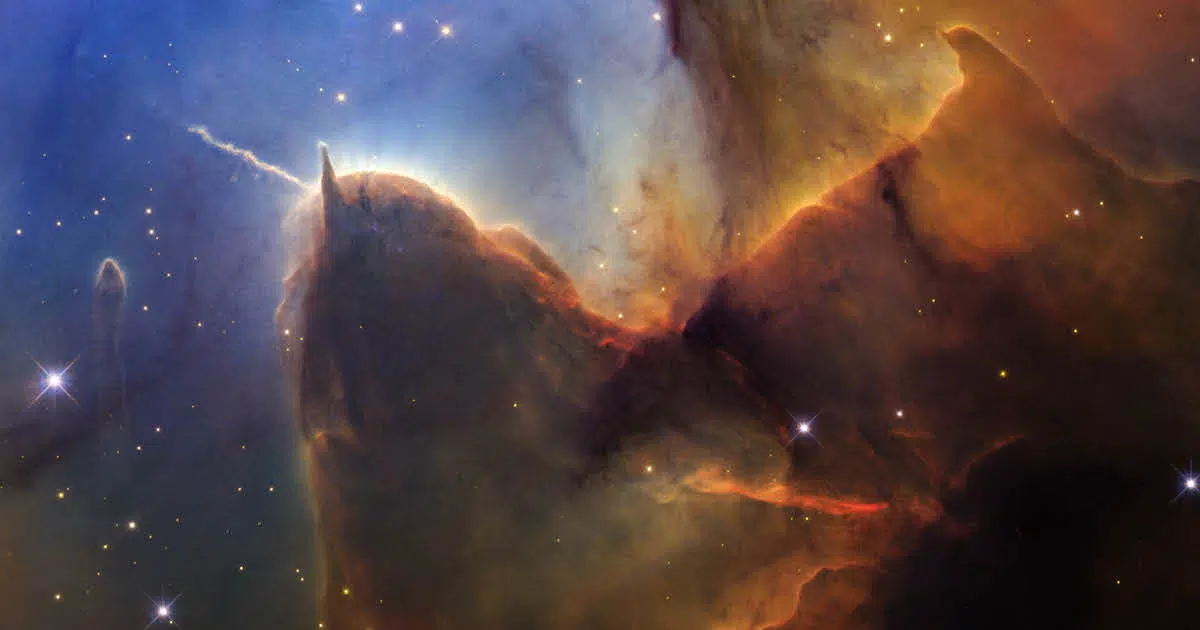
The anniversary image released by NASA focuses on a small, high-activity section of the nebula. It reveals a landscape dominated by "rust-colored dust trails," "shimmering newborn stars," and a massive, translucent bubble carved out by the ferocious stellar winds of nearby massive stars. At the heart of the image lies a peculiar, undulating cloud of gas and dust. NASA scientists have described this formation as resembling a "marine sea slug" or "sea lemon" gliding through a prismatic cosmic ocean.
This "sea slug" is not merely an aesthetic curiosity; it is a laboratory for stellar birth. The structure features two prominent "horns" at its apex, each representing a different stage or mechanism of star formation. The left horn is part of a high-velocity plasma jet known as Herbig-Haro 399 (HH 399), while the right horn houses a deeply embedded protostar surrounded by what appears to be a circumstellar disk—the cradle of a potential future solar system.
Chronology: Thirty-Six Years of Perspective
The 36th-anniversary image is more than a standalone photograph; it is the latest chapter in a long-term observational study. Hubble first captured this specific region of the Trifid Nebula in 1997. By revisiting the site 29 years later in 2026, astronomers have gained a rare opportunity to observe celestial changes on a human timescale.
1990: The Launch of a Legend
Hubble was launched into low Earth orbit on April 24, 1990, aboard the Space Shuttle Discovery. Despite early setbacks regarding its primary mirror, subsequent servicing missions equipped the telescope with increasingly advanced optics and sensors.
1997: The First Glimpse
In 1997, Hubble utilized its Wide Field and Planetary Camera 2 (WFPC2) to capture the Trifid Nebula. This image became one of the telescope’s most famous early works, revealing the Herbig-Haro jets and the dark dust lanes in unprecedented detail.
2026: The Anniversary Portrait
The 2026 image leverages Hubble’s modern imaging capabilities, providing higher resolution and a broader spectral range. By comparing the 1997 and 2026 datasets, researchers can measure the physical movement of the HH 399 jet. Because these jets travel at hundreds of kilometers per second, the three-decade gap is sufficient to see the jet’s "flicker" and its expansion into the surrounding interstellar medium.
Supporting Data: The Anatomy of a Star-Forming Region
The technical details of the Trifid Nebula image provide a wealth of information regarding the lifecycle of stars and the physics of ionized gases.
Herbig-Haro 399 and the Plasma Jet
The "left horn" of the sea-slug-shaped cloud is a plasma jet designated HH 399. These jets are a byproduct of star formation. As a young protostar accretes matter from its surrounding disk, magnetic fields and centrifugal forces eject a portion of that material at supersonic speeds from the star’s poles. The 2026 image allows scientists to calculate the energy dissipation of this jet as it "plows" into the surrounding gas, creating a bow shock that glows with ionized light.
The Circumstellar Disk
The "right horn" contains a faint red dot—a young star still shrouded in its natal cocoon. A green arc of light enshrines this star, which NASA identifies as a possible circumstellar disk. These disks are rotating flattened structures of gas, dust, and rocky fragments. Over millions of years, the material within these disks clumps together under gravity to form planets, moons, and asteroids. Observing these disks in the Trifid Nebula helps researchers understand how planetary systems form in high-radiation environments.
The Prismatic Sea of Color
The colors in the Hubble image are not just artistic choices; they represent specific chemical and physical processes:
- Deep Blue/Violet: This hue, dominant in the top-left of the image, is caused by ionized gas. Ultraviolet (UV) radiation from massive, hot stars nearby strips electrons from gas atoms (primarily hydrogen and oxygen), causing them to glow.
- Pitch Black/Dark Brown: These areas represent dense, cold dust. These "Bok globules" are so thick that they block all visible light from behind them. These are the densest parts of the nebula where gravity is most likely to trigger the collapse of new stars.
- Bright Yellow/Gold: At the interface where the UV light meets the dark dust, a yellow glow appears. This is the "evaporation" of the dust cloud—a process known as photoevaporation.
Official Responses: Celebrating an Enduring Legacy
NASA and the Space Telescope Science Institute (STScI) have emphasized that Hubble’s longevity is a testament to international cooperation and engineering excellence.
In a press release accompanying the image, NASA officials stated, "This image is a perfect example of ultraviolet light plowing into dark brown dust, stripping and dismantling the gas. Many ridges and slopes of dark material will remain for a few million years as the stars’ ultraviolet light slowly eats away at the gas."
The agency also highlighted Hubble’s staggering statistical impact on the scientific community. To date:
- Hubble has conducted over 1.7 million observations.
- Data from the telescope has fueled the publication of nearly 29,000 peer-reviewed science papers.
- The telescope continues to operate in tandem with the James Webb Space Telescope (JWST), providing the "visible and ultraviolet" context that complements Webb’s infrared capabilities.
"Hubble remains a cornerstone of modern astrophysics," said a spokesperson for the ESA. "While newer telescopes look further back in time, Hubble’s ability to capture the high-energy processes of the local universe in visible light is irreplaceable."
Implications: What the Trifid Nebula Tells Us About Our Future
The study of the Trifid Nebula has profound implications for our understanding of the universe and our own origins.
Understanding Stellar Feedback
The interaction between the massive stars in Trifid and the surrounding gas is a process known as "stellar feedback." By observing how the UV radiation "eats away" at the gas clouds, astronomers can predict how long a star-forming region will last before it is dispersed. This helps in modeling the evolution of entire galaxies.
The Search for Habitable Worlds
By identifying circumstellar disks in regions like Trifid, scientists can assess how common planet formation is. The Trifid Nebula is a "harsh" environment compared to the nebula that birthed our Sun. If planets can successfully form amidst the intense UV radiation and stellar winds of M20, it suggests that planetary systems—and potentially life—could be even more common in the galaxy than previously estimated.
The Longevity of Hubble
The success of the 36th-anniversary mission reinforces the argument for continued support of the Hubble Space Telescope. Despite its age, Hubble’s unique vantage point above the Earth’s atmosphere allows it to see ultraviolet light that is blocked from ground-based observers. As long as its gyroscopes and instruments remain functional, Hubble will continue to provide the "gold standard" of cosmic imagery.
In conclusion, the 2026 image of the Trifid Nebula is more than a birthday present for a famous telescope. It is a bridge between the past and the future of astronomy. It connects the observations of 1997 with the cutting-edge science of the mid-2020s, proving that in the vast, slow-moving theater of the cosmos, Hubble is our most dedicated and sharp-eyed witness. As the "sea slug" of gas and dust continues its slow dance 5,000 light-years away, Hubble stands ready to capture every ripple and every new star that emerges from the dark.



Leave a Comment