
The Architecture of Memory: The Surrealist Vision and Romantic Legacy of Christian Quintin
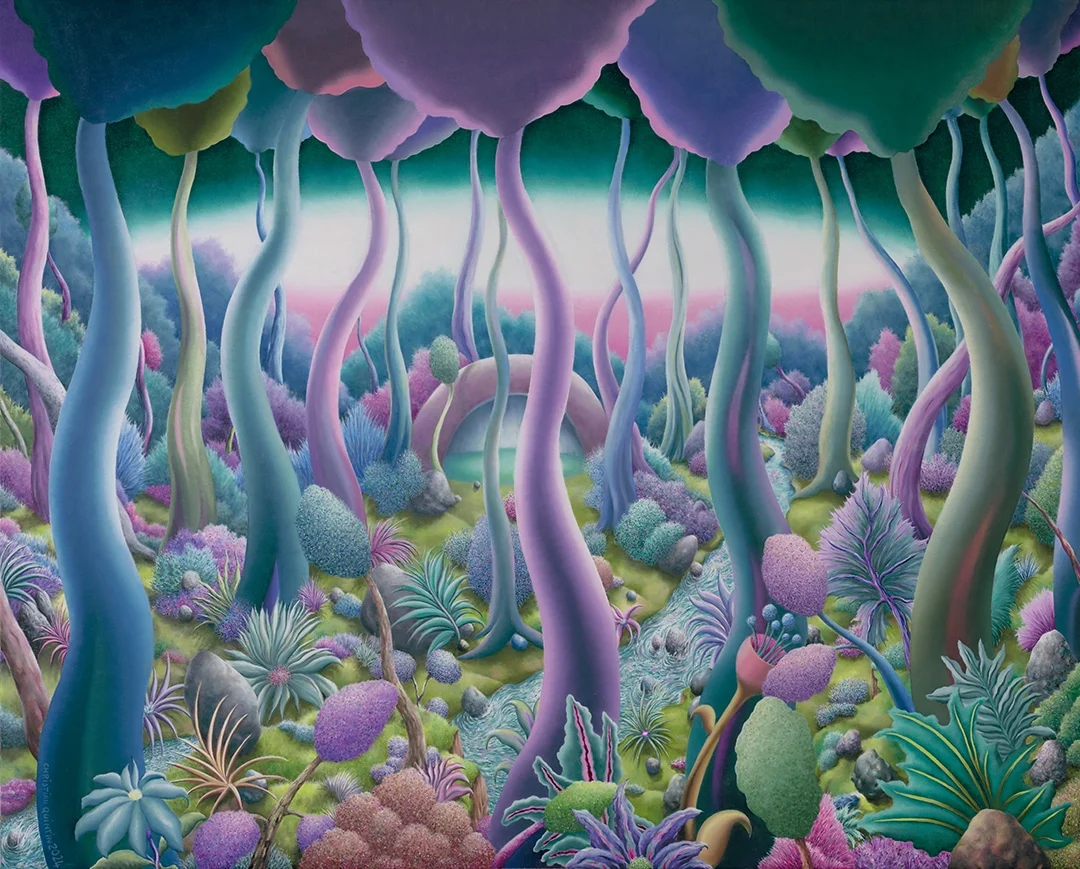
For over four decades, the Franco-American artist Christian Quintin has occupied a singular space in the contemporary art world, operating at the intersection of meticulous classical draftsmanship and the boundless fluidity of the subconscious. Born in the rugged coastal landscapes of Brittany and seasoned in the sun-drenched valleys of Northern California, Quintin has cultivated a visual language that defies the cynical trends of postmodernity. His work—ranging from intricate pen-and-ink surrealism to luminous, emotive landscapes—serves as a bridge between the French Symbolist tradition and the visionary ecology of the American West.
As Quintin’s career experiences a significant international resurgence through high-profile exhibitions in Los Angeles, Paris, Seoul, and Hong Kong, critics and collectors alike are rediscovering a philosophy that prioritizes beauty as a form of resistance. This article explores the life, technical mastery, and enduring influence of an artist who paints not merely what is seen, but what is remembered and felt.
Main Facts: A Dual Heritage of Spirit and Form
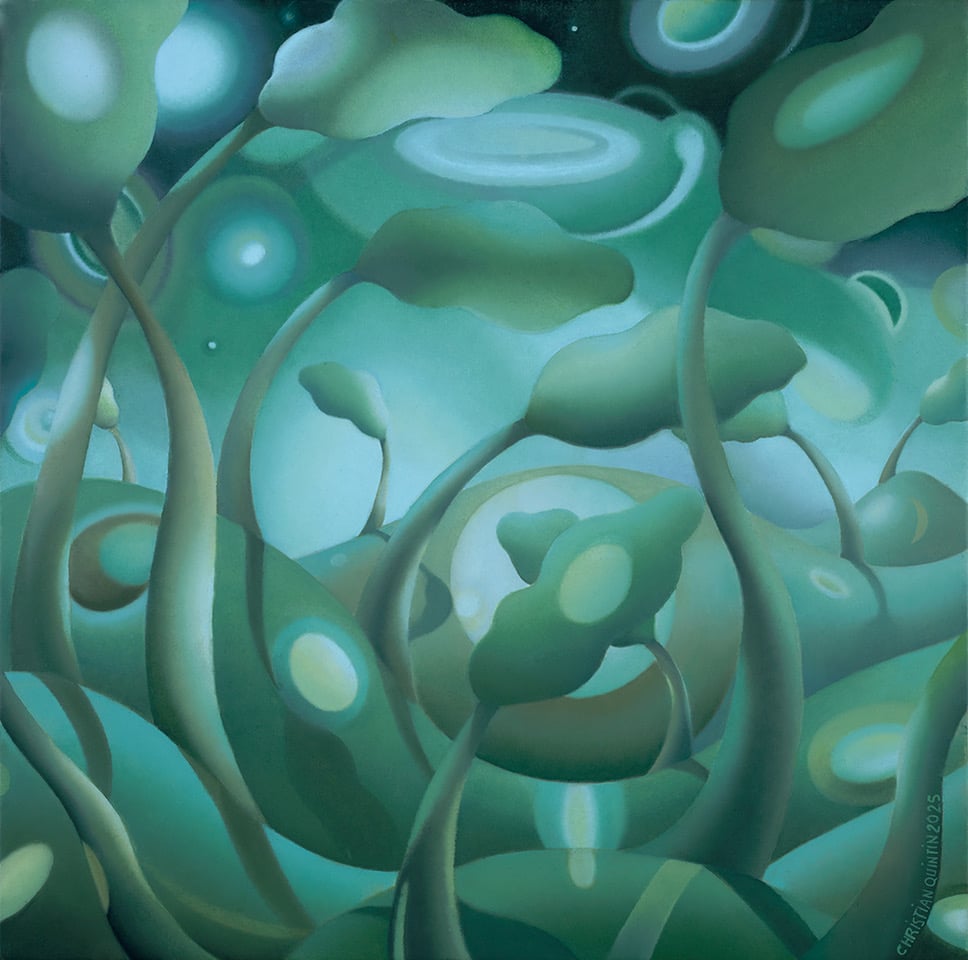
Christian Quintin’s oeuvre is defined by two primary modes: the surrealist "mental landscape" and the romantic "emotive scenery." While these categories might appear distinct, they are unified by a singular philosophical thread—the belief that the internal psyche and the external natural world are mirrors of one another.

Technical Precision and Temporal Depth
Quintin is a master of "slow art." In an era dominated by digital immediacy, his process is a testament to patience. His major works often require six to seven months of daily labor. Utilizing media such as oil, pastel, graphite, and pen-and-ink, he employs techniques like dense cross-hatching and layered glazing to achieve a depth that invites prolonged contemplation.
The Kaleidoscopic Consciousness
A recurring theme in Quintin’s work is the dissolution of boundaries. In his "kaleidoscopic consciousness" paintings, human anatomy often merges with botanical and architectural forms. A face might unfurl into a forest canopy; a neck might transform into a gnarled trunk. This is not the "shock" surrealism of the early 20th century, but a "revelatory" surrealism intended to awaken the viewer’s intuition.
Global Market Presence
After decades of established success in California, Quintin’s work has recently entered the global stage. Represented by Lorin Gallery (Los Angeles/Paris), his art has been featured at major international fairs, including Art Central in Hong Kong and KIAF in Seoul, signaling a shift in the art market toward works that combine high technical skill with spiritual resonance.

Chronology: From the Celtic Coast to the California Vineyards
The evolution of Christian Quintin’s style is inextricably linked to his geography. His life is a tale of two coastlines, each providing a unique vocabulary for his art.
1957–1974: The Brittany Roots
Born in 1957 in Saint Brieuc, a port town in northern Brittany, Quintin’s early years were shaped by the "moody" atmosphere of the French coast. The region, known for its ruined castles, storm-lashed cliffs, and Celtic myths, instilled in him a sense of the "storybook aura." One specific location, L’Île de la Comtesse, became a recurring motif in his later work—a symbol of solitude and architectural mystery.
1975–1980: The Parisian Discipline
In 1975, Quintin moved to Paris to study at the prestigious Beaux-Arts Academy. Here, his romantic instincts were refined by classical rigor. He mastered the draftsmanship and control of form that would become his hallmark. During this period, he absorbed the legacies of the French Surrealists and Symbolists, but he was equally drawn to the Romantics, whose focus on the sublime in nature resonated with his coastal upbringing.

1981–1998: The California Transition
In 1981, Quintin moved to Northern California, eventually settling in the vineyards and valleys of Sonoma County. This transition was transformative. The "grey and violet" palette of Brittany met the "gold and emerald" light of the American West. He began to apply his surrealist techniques to the California landscape, treating trees and rivers as sentient beings. In 1987, he received the Grumbacher Award, followed by the Award of Excellence from the California State Fair in 1990, cementing his reputation as a formidable presence in the regional art scene.
1999–Present: Institutional Recognition and Global Expansion
A pivotal moment occurred in 1999 when the Vorpal Gallery—noted for introducing M.C. Escher to the United States—began representing him. This association placed Quintin in a lineage of "visionary" artists who prioritized mathematical or psychological precision. In the 2020s, his partnership with Lorin Gallery expanded his reach to European and Asian markets, proving that his "beautiful intimate mysteries" had a universal appeal.
Supporting Data: The Anatomy of a Masterpiece
To understand Quintin’s impact, one must look at the data of his production. His works are not "sketches" but "constructions."

Case Study: The Aviary
The Aviary serves as a quintessential example of Quintin’s "kaleidoscopic consciousness." In this piece, the artist’s face emerges from a crystalline structure, his hair transitioning into a leafy canopy.
- Time to Completion: 6 months.
- Medium: Pen and ink.
- Symbolism: The integration of the human mind with the ecosystem, suggesting that consciousness is not separate from nature but an extension of it.
Case Study: La Porte Ouverte
Inspired by the poetry of Rumi ("Why stay in prison when the door is wide open?"), this work occupied Quintin for seven months.
- Technique: Meticulous cross-hatching.
- Visual Strategy: The use of "symbols that blur the edges of logic," requiring the viewer to "read" the image like poetry rather than a literal depiction.
The Medium as the Message
Quintin selects his medium based on the "emotional temperature" of the subject:

- Pastels: Used for luminous, atmospheric landscapes where light is the primary subject.
- Oil: Used for works requiring rich texture and "emotive sceneries."
- Graphite/Ink: Reserved for the most complex psychological maps, where line and shadow dictate the narrative.
Official Responses: Critical Reception and Gallery Perspectives
The art world’s response to Quintin has been characterized by a sense of relief—a recognition that his work fills a void left by the often-impersonal nature of contemporary conceptual art.
The "Beauty" Diagnosis
A 2022 review from the Calabi Gallery noted: "In an era largely devoid of it, his work is beautiful. We could all use more beauty in our lives." This sentiment has been echoed by various critics who view Quintin’s work as a "sanctuary."
Critical Commentary
- Alhia Warren: Described his compositions as a "beautiful intimate mystery," highlighting the way his works invite the viewer into a private, meditative space.
- Suzanne Munich: Titled her review "Mental Landscapes," focusing on the way Quintin maps the geography of the psyche onto the physical world.
- Dan Taylor (The Press Democrat): Noted the "emerging beauty" in his public commissions and murals across California, suggesting that Quintin’s work has a civic value in its ability to inspire wonder.
The Lorin Gallery Perspective
Curators at Lorin Gallery have emphasized Quintin’s role as a "bridge" artist. By showing his work in Paris and Los Angeles simultaneously, they highlight the dual nature of his identity—the European intellectual rigor combined with the expansive, spiritual freedom of the California "Visionary" movement.

Implications: Art as Sanctuary in the Modern Age
Christian Quintin’s enduring career and recent global rise carry significant implications for the trajectory of contemporary surrealism and the broader role of art in society.
The Rejection of Irony
For much of the last half-century, the art world has prioritized irony, critique, and deconstruction. Quintin’s work represents a "return to the sacred." By rejecting didacticism—the desire to "teach" or "preach" to the viewer—he returns the power to the individual’s intuition. This shift suggests a growing appetite among collectors for art that provides emotional and spiritual sustenance.
The Visionary Continuum
Quintin occupies a unique place in the "Visionary Art" continuum. While he shares the technical DNA of Dalí, Magritte, and Escher, his intent is different. Where traditional surrealism often sought to "unsettle" or "shock" the viewer into realizing the absurdity of life, Quintin seeks to "awaken" the viewer to the beauty and interconnectedness of life. He is a "gentle surrealist," offering a vision that is restorative rather than disruptive.
Legacy of the "Inner/Outer" Unified World
As climate change and digital saturation alter our relationship with the physical world, Quintin’s "emotional terrains" take on a new urgency. His work reminds us that the environment is not just a resource to be managed, but a landscape that "breathes" and "speaks." By painting trees as dancers and lovers, he advocates for a deep, empathetic ecology.
Conclusion: Beauty as Defiance
Christian Quintin’s art is a testament to the power of the "slow burn." He did not change his style to meet the demands of the market; instead, the world eventually caught up to his vision. His work stands as a reminder that beauty, when executed with profound technical mastery and soul, is not an escape from reality. It is a reentry into reality’s most vital and hidden dimensions. In a culture of speed and spectacle, Quintin’s work remains a "wondrous sanctuary for the soul," proving that art’s oldest mission—to inspire wonder—is still its most radical.
To explore more of Christian Quintin’s work and upcoming exhibitions, visit christianquintin.com.


Leave a Comment