The art world is currently witnessing a historic moment as a long-lost masterpiece by the British-born Mexican Surrealist Leonora Carrington emerges from decades of obscurity. The painting, titled Villa Pilar (1940), is set to make its public debut at London’s Freud Museum this summer, providing a harrowing yet transformative window into one of the most tumultuous periods of the artist’s life.
As part of the landmark exhibition, Leonora Carrington: The Symptomatic Surreal, the canvas represents more than just a rediscovered artifact; it is a profound testament to the intersection of trauma, psychoanalysis, and creative resilience. Originally scheduled to conclude in late June, the exhibition’s closing date has been extended to August 10, 2024, to accommodate the anticipated surge of interest following the painting’s inclusion starting July 1.
Main Facts: A Discovery Decades in the Making
For over eighty years, Villa Pilar existed only in the footnotes of art history and the memories of a private family in Spain. Its emergence is the result of exhaustive investigative work by the organizers of the Freud Museum exhibition, who sought to reconstruct Carrington’s output during her 1940 incarceration in a psychiatric asylum in Santander, Spain.
The painting was discovered in the possession of an heir to Dr. Luis Morales, the psychiatrist who treated Carrington during her breakdown. In a gesture that blurs the lines between patient and protégé, Carrington had gifted the work to Morales upon her release. While her other major work from this period, also titled Down Below (1940), has long been recognized as a cornerstone of her oeuvre, Villa Pilar remained a "ghost" work—referenced in memoirs but unseen by the public eye until now.
The exhibition at the Freud Museum—housed in the final residence of Sigmund Freud—serves as a poignant venue for the work. The museum’s mission to explore the relationship between the mind and cultural expression provides a uniquely fitting backdrop for a painting born from the depths of a psychological crisis.
Chronology: From the French Avant-Garde to the Santander Asylum
To understand the weight of Villa Pilar, one must trace the harrowing journey Carrington took in the months leading up to its creation.
1937–1939: The Idyllic Years in France
In the late 1930s, Leonora Carrington was the "golden girl" of the Surrealist movement. Having fled her restrictive upper-class British upbringing, she lived in Saint-Martin-d’Ardèche, France, with her lover and mentor, the renowned German painter Max Ernst. During this time, she established herself as a formidable talent, blending Celtic folklore with Surrealist dreamscapes.
1940: The Descent into "Down Below"
The outbreak of World War II shattered this idyll. Max Ernst was arrested by French authorities as an "undesirable alien" and later by the Gestapo. Left alone and traumatized by the encroaching Nazi occupation, Carrington fled to Spain. The stress of Ernst’s imprisonment, combined with the horrors of the war, triggered a severe mental breakdown in Madrid.
Under the orders of her father—a wealthy British industrialist—Carrington was forcibly institutionalized at the Sanatorio Morales in Santander. The treatments she endured there were nothing short of medieval. She was subjected to Cardiazol, a drug that induced violent convulsive shocks, often described as more terrifying than the electroconvulsive therapy (ECT) that would later replace it. In her later memoir, Down Below, she described the experience as a form of living death, a descent into a hellish underworld.
1940–1941: Survival Through Art
It was during this period of confinement that Dr. Luis Morales, recognizing Carrington’s genius, encouraged her to paint as a form of therapy. Despite her suffering, she produced a series of sketches and two definitive oil paintings: Down Below and the recently recovered Villa Pilar. These works acted as anchors to reality, allowing her to externalize the "symptomatic" visions of her fractured psyche.
Supporting Data: Analyzing the "Symptomatic Surreal"
The title of the exhibition, The Symptomatic Surreal, suggests that Carrington’s art was not merely a stylistic choice but a clinical manifestation of her internal state. Villa Pilar offers a striking visual vocabulary that contrasts sharply with the more whimsical Surrealism of her earlier French period.
Iconography and Symbolism
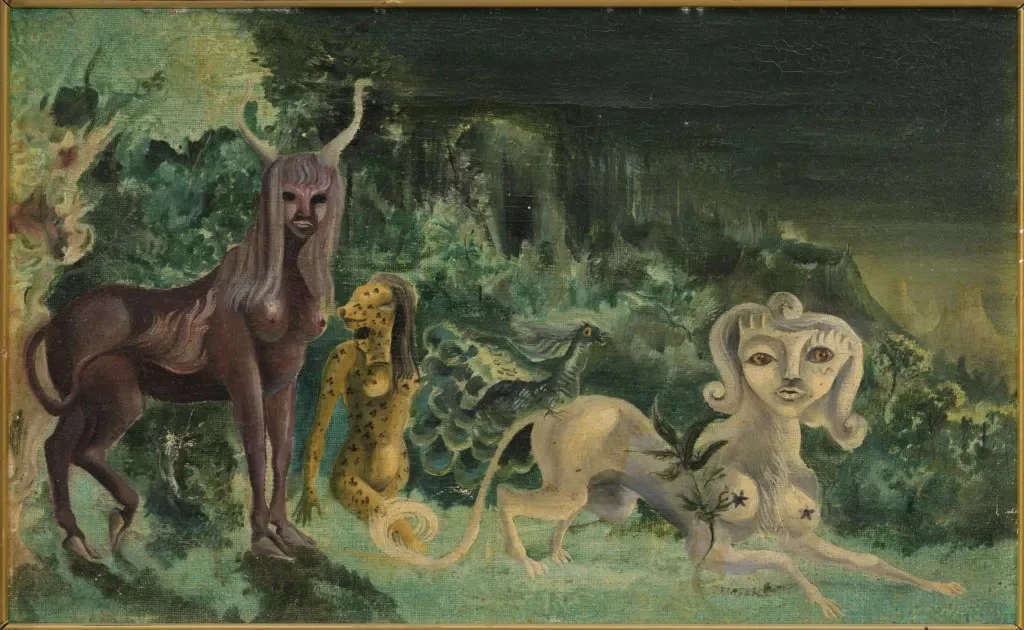
Both Down Below and Villa Pilar share a haunting aesthetic. They depict the Santander hospital not as a place of healing, but as a shadowy, subterranean realm. Key features of Villa Pilar include:
The Green Sky: A recurring motif in her asylum works, the sickly green firmament suggests a world where the natural order has been inverted.
Hybrid Figures: The painting is populated by breasted human-animal hybrids. These figures are not the playful chimeras of her later Mexican work; instead, they evoke the occupants of a zoo or a safari under duress.
The Menagerie of Trauma: Observers have noted references to lions, leopards, peacocks, and buffaloes. These animals, often depicted in states of captivity or watchful stillness, mirror Carrington’s own sense of being a caged specimen under the gaze of medical authorities.
Technical Significance
The recovery of Villa Pilar allows art historians to see a "missing link" in Carrington’s technical evolution. The brushwork is urgent and dense, reflecting the precariousness of her environment. While Surrealism often sought to tap into the unconscious through "automatic" techniques, Carrington’s asylum paintings are more deliberate—they are attempts to map a mind that is actively being dismantled by trauma and chemical intervention.
Official Responses: A Chapter Revisited
The discovery and subsequent exhibition have drawn significant praise from both the British and Spanish cultural sectors. The collaboration between the Freud Museum and Spanish institutions highlights the international importance of Carrington’s legacy.
Daniel Vega Pérez de Arlucea, the director of Faro Santander (the arts center where the exhibition will travel in September), emphasized the historical gravity of the homecoming. In a statement to The Guardian, he noted:
“This is not simply a matter of showcasing the work of one of the most important surrealist artists, but of recognizing and revisiting a chapter of her life deeply rooted in this city. Her time in Santander was transformative, albeit painful, and seeing these works return to the place of their origin is a monumental event for Spanish heritage.”
Curators at the Freud Museum have also noted that the inclusion of Villa Pilar provides a necessary counter-narrative to the "muse" trope that often plagued female Surrealists. By focusing on her time in the asylum, the exhibition frames Carrington as a survivor and a master of her own psychological narrative, rather than just a tragic figure in the shadow of Max Ernst.
Implications: Carrington’s Resurgence in the 21st Century
The unveiling of Villa Pilar comes at a time when Leonora Carrington is experiencing a massive global re-evaluation. For decades, she was a cult figure, primarily celebrated in Mexico (where she lived from 1942 until her death in 2011). However, recent years have seen her ascend to the top tier of the global art market and critical canon.
The Market Context
In May 2024, Carrington’s painting Les Distractions de Dagobert sold for $28.5 million at Sotheby’s, making her one of the most expensive female artists in history and the highest-priced British-born Surrealist. The discovery of Villa Pilar is likely to further decouple her identity from her male contemporaries and solidify her status as a singular visionary.
The Intersection of Art and Mental Health
The exhibition also contributes to a broader cultural conversation about the relationship between creativity and mental illness. By displaying Villa Pilar at the Freud Museum, the curators invite the public to look at "madness" not as a void, but as a site of intense intellectual and artistic production. Carrington’s ability to transmute the "excruciating treatments" of the Sanatorio Morales into a structured, symbolic language remains a powerful case study for modern psychology.
Future Legacy
When the exhibition moves to Faro Santander in September, it will mark the first time these "asylum paintings" have been seen together in the city where they were created. For the city of Santander, it is a reckoning with a dark chapter of its medical history; for the art world, it is the completion of a puzzle that has been missing a piece for eighty-four years.
Villa Pilar is more than a painting; it is a survivor’s map. Its journey from a doctor’s private gift to a public museum centerpiece mirrors Leonora Carrington’s own journey from the depths of "down below" to her current standing as a titan of 20th-century art. As the public gathers in London this July to witness the work for the first time, they will be looking at the very moment a great artist refused to be silenced by the shadows of her own mind.
In the heart of the urban sprawl, where the rigid geometry of concrete and steel dominates the horizon, the human psyche often yearns for the organic unpredictability of the natural world. For residen
In the rapidly evolving landscape of generative media, where the prevailing trend often veers toward the hyper-realistic, the clinical, and the unnervingly "uncanny," a new movement is begin
The art world mourns the loss of Mary Lovelace O’Neal, a titan of American abstraction, a tireless civil rights activist, and a barrier-breaking educator who died on May 10, 2026, in Mérida, Mexico. S




Leave a Comment