
The Unseen Battle: How Internal Conflict Fuels Compelling Narratives Over External Foes

In the sprawling landscape of storytelling, a common pitfall for aspiring authors lies in mistaking the roar of external conflict for the heart of the narrative. While the clash of swords, the race against time, or the confrontation with a formidable antagonist undeniably capture attention, the true engine of a resonant story is often found within the protagonist’s inner world. The dynamic interplay between internal and external conflict reveals the profound journey of character development, urging protagonists to shed the burden of external blame and embrace the transformative power of personal responsibility and agency.
At its surface, most storytelling appears to be a grand spectacle of external struggles. We witness heroes battling villains, adventurers overcoming perilous obstacles, and detectives solving intricate mysteries. This outward focus, however, can serve as a potent misdirection, subtly masking the deeper psychological purpose of these external challenges: to create a crucible for the protagonist’s internal battles. Often, what begins as an external crisis is, at its core, a manifestation of unresolved inner turmoil that the characters have yet to acknowledge. The fundamental difference between internal and external conflict thus boils down to a crucial distinction: projecting responsibility outward versus claiming personal agency and accountability.
When stories inadvertently frame the antagonist as the sole architect of a narrative’s problems, they risk diminishing the protagonist’s power. The resolution, in such cases, appears to rest solely with the antagonist’s defeat. However, compelling narratives shift this focus back to the protagonist’s choices, their capacity for growth, and their inherent potential for change. This redirection amplifies the character arc, transforming the internal conflict from a mere prerequisite for defeating external opposition into a journey of self-discovery and empowerment. It’s in this space that characters move beyond projecting their struggles onto external circumstances and step into the demanding, yet ultimately rewarding, territory of claiming personal power.
The Interdependent Dance: Internal Versus External Conflict
External and internal conflicts are not disparate entities but rather interdependent layers that weave together to form the fabric of a story. The external struggle drives the visible plot, dictating the sequence of events and the unfolding action. Simultaneously, the internal struggle imbues these plot points with contextual meaning, explaining why these events matter to the characters and the audience.

Resonant stories masterfully braid these two forces. The external conflict acts as a relentless pressure, compelling characters to confront their internal demons. Conversely, the resolution of internal conflict often paves the way for a satisfying resolution of the external conflict, offering a conclusion that is both morally and practically fulfilling.
The emphasis placed on internal versus external conflict can vary significantly depending on the genre. An action-packed thriller might foreground the external stakes, while a character-driven drama might delve deeply into the psychological landscape. Regardless of genre, a fundamental truth remains: most stories require both elements to propel a dynamic narrative. The notion of choosing between plot and character is a false dichotomy; both are essential for a story to breathe and move forward.
In essence, plot serves as the proving ground for a character’s arc. It dramatizes the consequences of their internal moral struggles, showcasing the efficacy of their belief systems and virtuous capacities through their impact on the external world. Even a story heavily reliant on action can subtly reveal a character’s inner conflict. By demonstrating how a character’s actions, stemming implicitly from their internal perspective and choices, navigate and impact the external conflict, writers can powerfully convey their psychological state without explicit exposition. Conversely, even the most introspective narratives often require some semblance of external action to provide tangible consequences and proof for the characters’ internal ponderings.
The Peril of Externalizing All Conflict
While understanding the interplay between internal and external conflict is crucial, writers can stumble into a subtle yet significant pitfall: overemphasizing the antagonist’s responsibility for the conflict. This tendency, whether intentional or not, can inadvertently sap the lifeblood from a story, regardless of whether the narrative’s primary focus is on external action or internal character development.

The core of this mistake lies in making the antagonist the sole architect of every problem. It’s a seductive simplification, reducing complex narratives to the elementary formula of "hero defeats villain." However, the deeper satisfaction audiences crave often stems from the hero’s journey towards moral capability. When a story excessively attributes blame to the antagonist, it can paradoxically weaken the protagonist.
Even when the protagonist appears actively engaged in thwarting the antagonist’s schemes, this overreliance on external blame can leave their internal landscape feeling flat, shallow, or even hypocritical. The most impactful stories are not merely about whether the protagonist defeats the antagonist, but whether the protagonist becomes someone capable of achieving that victory. This transformation is the true measure of their arc.
Projection: The Shadow Behind External Conflict
The underlying issue with assigning all culpability for external conflict to the antagonist is a psychological phenomenon known as projection. In psychological terms, projection is an unconscious defense mechanism where individuals displace undesirable qualities, emotions, or impulses onto others. Instead of acknowledging these aspects as part of themselves, their minds instinctively externalize them, perceiving them as originating from an external source. This serves as a protective measure, helping to maintain a stable self-image by redirecting inner tension outward.
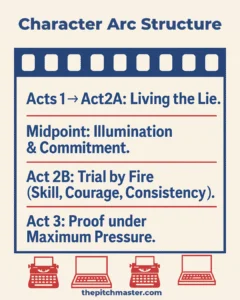
While we all engage in projection to some degree, and it can be a necessary starting point for personal maturation, its pervasive influence in storytelling can be detrimental. A significant portion of character development, particularly the movement from a limited perspective (the "lie") to a more expansive understanding (the "truth"), can be viewed as a reclamation of these projections. A successful character arc necessitates a broadening awareness of the traits, both positive and negative, that the character has unconsciously projected onto the external world.

Writers often grapple with how to seamlessly integrate external and internal conflict, aiming for a cohesive narrative whole. The external conflict can serve as a potent thematic metaphor for the character’s internal struggles, a concept that holds true whether the narrative emphasizes the external or internal dimensions.
When a protagonist projects undesirable qualities onto an antagonistic force, they are likely also projecting responsibility for the conflict. This manifests as the internal monologue, "It’s all the antagonist’s fault!" While this might hold a degree of practical truth – a detective may not have prompted a murder, a romantic partner may not be directly responsible for another’s insecurities – overemphasizing external blame can significantly limit a story’s depth.
The Limits of Blame: Why Stories Thrive on Agency
The critical reason why projecting all blame onto external obstacles, however implicitly, limits a story is that it weakens the protagonist’s practical agency and, more importantly, their moral responsibility. This isn’t necessarily about the antagonist being less dangerous or evil; rather, it’s about the fundamental nature of storytelling.
Stories are not primarily about antagonists; they are about protagonists. Specifically, they are about protagonists who possess agency, who have the potential to enact external change because they have first demonstrated the capacity for internal change. This internal transformation is only possible when protagonists expand their personal capacity for responsibility.

Even when a story culminates in a victory, it can feel hollow if the narrative overemphasizes the antagonist’s culpability at the expense of the protagonist’s personal evolution. The question then arises: what if the protagonist wasn’t directly responsible for the wars, murders, or broken relationships that form the external conflict?
This is precisely where the opportunity lies to deepen the cohesion of the fundamental storytelling triangle: plot (the antagonistic force), character (the protagonist), and theme (the connection between them). The most compelling stories often prioritize the protagonist’s culpability over the antagonist’s, even when the antagonist bears a greater objective responsibility.
Consider Anthony Doerr’s novel, All the Light We Cannot See. One of its central characters is a young German man serving in the Nazi army during World War II. While he is undeniably less culpable than the regime that enslaved him, the story’s poignancy lies in his internal struggle with his own complicity. The backdrop of a truly evil antagonist provides the context, but the narrative’s true focus is on the protagonist’s grappling with morality, emphasizing his capacity for agency and responsibility even within severely limited circumstances.
This principle extends beyond stories of war and oppression. In overtly heroic narratives, it can be easy to fall into the trap of emphasizing external conflict, where villains must be defeated simply because they "deserve" it or as mere obstacles to a happy ending. While sacrifices may occur, such stories often lack the profound resonance of true psychological transformation. This transformation is only possible when individuals are willing to confront their own responsibility as the most significant catalyst within a conflict.

From Projection to Personal Power: The Character Arc’s Core
When protagonists become excessively fixated on the "bad guy" – on their actions and their inherent villainy – they often fail to examine themselves. They neglect to recognize their own weaknesses, foibles, and the very traits that, at some level, could position them as antagonists themselves. Projection often manifests as an intense focus on the qualities in others that we are most resistant to acknowledging within our own "shadows."
Crucially, unclaimed projection can lead characters to cede their personal power to the antagonist. Their fixation shifts to the antagonist as the one who needs to be fixed, or who must be compelled to change. If the antagonist fails to self-correct, they become an external force that must be acted upon.
This perspective blinds characters to a far more critical element: their capacity to change their internal circumstances. This might translate into practical actions, such as leaving a destructive relationship or acquiring new skills for professional success. More profoundly, it signifies a journey of evolving beyond the antagonist’s ability to dictate the protagonist’s internal state.
In essence, when stories are viewed metaphorically, meaningful change in the external conflict occurs in tandem with shifts in the protagonist’s interiority. Protagonists cannot truly overcome an antagonist’s malevolence without achieving sovereignty over themselves. This is a recurring theme in mythical narratives, where the "kingdom" often symbolizes the entirety of the self. These ancient tales are less about defeating an external tyrant and more about the protagonist’s ability to claim dominion within.

Stories that miss this mark often rely on the protagonist’s legitimacy solely from their opposition to "bad people," rather than from demonstrating inner alignment or earned authority. These narratives tend to explore why "someone else" is to blame, rather than delving into the richer complexities of personal autonomy.
Recenter Your Narrative: The Protagonist as the Power Source
The subtle yet pervasive issue with stories that externalize all responsibility, autonomy, and agency lies in their implicit problematic framing. By fixating on the antagonist’s transgressions, these narratives project more than just blame; they project the very essence of power and control.
This is particularly evident in stories where protagonists share traits with the antagonist that they must confront and overcome. However, it becomes even more pronounced in narratives where protagonists are actively avoiding personal responsibility. This intense focus on external problems prevents them from breaking free from a form of thralldom to the antagonist. This thrall can be literal – the antagonist actively harming, controlling, or obstructing the protagonist – or it can be incidental, with the fixation on the problem consuming more energy than the pursuit of a solution.
While some of what is projected onto the antagonist may indeed represent genuine external issues, true power is ultimately found in the protagonist’s ability to recognize these projections. Only then can the protagonist initiate internal transformation and reclaim their power from the antagonistic force.

By reclaiming responsibility, we reclaim agency. By reclaiming agency, we reclaim sovereignty. By reclaiming sovereignty, we reclaim power. And by reclaiming power, particularly within the transformative realm of story, protagonists can enact change from the inside out.
Nine Questions to Unmask Projection in Your Narrative
To discern whether your story’s conflict strengthens your characters’ agency or encourages them to project responsibility outward, consider these guiding questions:
- Reaction vs. Choice: Is your protagonist primarily reacting to the antagonist’s actions, or are they making increasingly conscious choices that shape the conflict’s direction?
- Source of Problems: Does your protagonist firmly believe the story’s problems stem solely from the antagonist, or will they be compelled to confront how their own limitations impact the outcome?
- Defeat vs. Transformation: Is your protagonist’s primary goal merely to defeat the antagonist, or is the story asking them to change fundamentally to resolve the central conflict?
- Resolution by Removal vs. Development: Does the conflict’s resolution occur solely because the antagonist is eliminated, or does it resolve because the protagonist develops the inner capacity to forge a different outcome?
- Power Relinquishment: Where might your protagonist be surrendering personal power by fixating on uncontrollable elements instead of cultivating what they can control internally?
- Avoided Responsibility: What personal responsibilities might your protagonist be sidestepping by exclusively concentrating on the external conflict?
- Exposed Weaknesses: In what ways does the antagonist expose personal weaknesses, fears, or misconceptions that the protagonist would rather not confront within themselves?
- Earned Authority: Does your protagonist earn moral authority through growth and difficult choices, or is their legitimacy simply bestowed by opposing the villain?
- Reclaiming Agency: Where does your protagonist need to reclaim agency for the story’s ending to feel truly earned and resonant?
The Enduring Truth of Internal Power
Enduring stories are rarely about the simple eradication of darkness, but rather about the expansion of consciousness – a concept that, in many ways, is the same thing. When conflict is understood through this lens, the true engine of character arc becomes clear: a movement away from projection and towards the reclamation of responsibility. This profound internal shift, even when implicit, allows a story’s conclusion to feel not just satisfying, but profoundly true. The true power of narrative lies not in vanquishing external foes, but in witnessing the protagonist’s internal evolution, a testament to their growing agency and their capacity to shape their own destiny.



Leave a Comment