A Journey Through Shared Worlds: The Treasury of Folklore Unveils its Grand Compendium
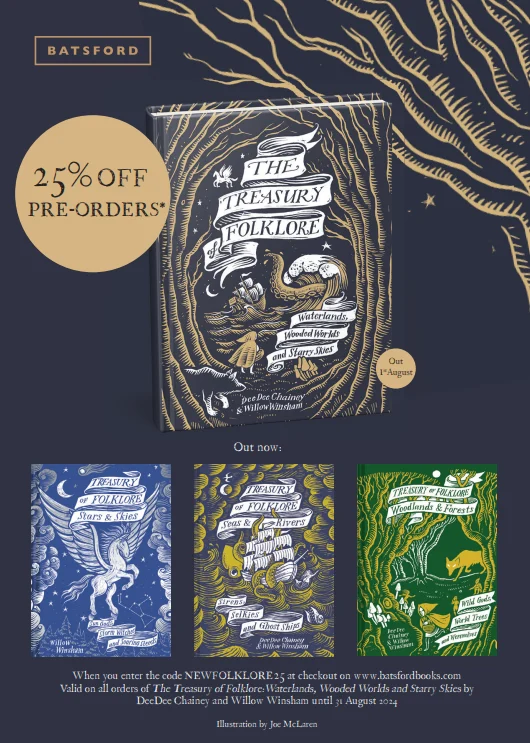
LONDON, UK – July 23, 2024 – For nearly a decade, the "Treasury of Folklore" series has captivated readers with its insightful exploration of humanity’s enduring connection to the natural world through myth and legend. What began as an ambitious vision for a single, expansive volume has now come full circle, culminating in the highly anticipated release of "The Treasury of Folklore: Waterlands, Wooded Worlds and Starry Skies." This magnificent new compendium, a meticulously curated collection of the most beloved tales and beliefs from the original acclaimed trilogy, is set to be released on August 1st, 2024, and is currently available for pre-order.
The authors, deeply inspired by the vibrant global community fostered by the #FolkloreThursday movement, embarked on a quest to understand the universal threads that bind human experience across diverse landscapes. Their journey unearthed a profound truth: despite geographical distances and cultural variances, humanity shares fundamental fears, dreams, and an innate awe for the mysteries of existence. This overarching theme is elegantly woven throughout the new volume, making it more than just a collection of stories, but a testament to our collective spirit.
A Decade-Long Vision Realised: From Trilogy to Tome
The genesis of the "Treasury of Folklore" project dates back almost ten years, when its creators first conceived of a single, monumental work that would encompass the rich tapestry of folklore tied to every conceivable physical landscape inhabited by humans worldwide. This initial, grand vision, however, quickly proved too vast for a single binding. The sheer volume and depth of material uncovered necessitated a broader canvas, leading to the development of the three distinct, yet interconnected, volumes that formed the original series: Seas and Rivers, Trees and Woodlands, and Stars and Skies. Each book delved into the myths, customs, and beliefs associated with its specific domain, revealing the intricate ways in which humans have interpreted and interacted with their environments.
The overwhelming popularity and heartwarming reception of these three original books served as a powerful affirmation of the series’ core premise: that folklore offers a universal language for understanding ourselves and our place in the world. Readers embraced the journey through ancient waterways, enchanted forests, and celestial realms, finding resonance in tales both familiar and exotic. This success laid the groundwork for a return to the initial dream.
When the idea of a comprehensive compendium was first proposed, the authors immediately recognised it as an unparalleled opportunity to fulfil their founding ambition. The process of compiling "The Treasury of Folklore: Waterlands, Wooded Worlds and Starry Skies" was an extensive undertaking. It involved revisiting and rereading thousands of words, texts that were already intimately familiar, but now viewed "with fresh eyes." The challenge lay not just in aggregation, but in discerning what to include and what to judiciously omit, ensuring that the new single volume maintained narrative cohesion and thematic integrity while capturing the essence of the entire series.
The result, a "hefty tome" as lovingly described by its creators, has surpassed all expectations. "To say we have been blown away by the end result is an understatement," the authors express, "and we are utterly thrilled to be able to share this beautifully bound volume with you." The physical embodiment of this vision is celebrated for its imposing size, a cover that seamlessly integrates the themes of water, land, and sky, and the luxurious feel of its cream paper. This is a book designed not just to be read, but to be held, admired, and cherished.

It is important to note for existing fans that this new compendium does not introduce new material. Instead, it meticulously curates and presents extracts directly from the existing three books, offering a definitive collection for those who wish to experience the series in its originally conceived, unified form. Structured into three distinct sections, mirroring the original trilogy, the compendium is further enriched by the wonderful original illustrations of Joe McLaren, whose evocative artwork has become synonymous with the series’ immersive quality. This volume promises to be a beautiful addition to any bookcase or coffee table, serving as both a captivating read and a compelling conversation starter, fostering connections through shared stories.
Supporting Lore: Echoes of Humanity in Myth
To truly appreciate the richness of "The Treasury of Folklore: Waterlands, Wooded Worlds and Starry Skies," one must delve into the tales themselves. The compendium masterfully brings together diverse narratives that illuminate humanity’s primal relationship with nature, its fears of the unknown, and its aspirations for meaning. Here, we explore some tantalising extracts, showcasing the depth and breadth of the book’s content.
Water Horses: Majestic and Malevolent Creatures from the Depths
The folklore of water horses serves as a potent reminder of the treacherous beauty of aquatic environments. Across cultures, these mythical steeds embody both allure and danger, often acting as cautionary figures against recklessness near water. The compendium introduces us to these perilous beings, inviting us to ponder the fine line between enchanting illusion and deadly reality.
One of the most iconic is the Scottish Kelpie. While often used interchangeably with the broader term "water horse," the book clarifies the distinction: kelpies primarily inhabit rivers, while the more malevolent each-uisge lurks in the deeper, darker lochs and lakes. The kelpie’s modus operandi is chillingly consistent: it lures unwary travellers, particularly children, with its beautiful appearance, then drags them beneath the surface to a watery grave. Yet, folklore also offers glimmers of hope and defiance. Tales exist of kelpies being seemingly tamed, forced to do a human’s bidding with a bridle marked by a cross. However, this control is depicted as fragile and temporary, with the creature invariably returning to its domain, sometimes taking its rider with it. Intriguingly, one legend suggests the kelpie can be killed, a feat accomplished with the potent folkloric weapon of red-hot iron, a common bane for many supernatural entities. The enduring power of the kelpie in Scottish imagination is strikingly evident in the monumental 30-meter-tall sculptures near Falkirk, a modern tribute to an ancient legend, and its continued presence in contemporary literature, from Lari Don to J.K. Rowling’s Fantastic Beasts and Where to Find Them.
Curiously, the authors highlight a geographical anomaly: England’s folklore notably lacks water horses of any kind, a stark contrast to its Celtic neighbours. This deficit is more than compensated for in Wales, where the Ceffyl Dŵr held a prominent place in belief well into the 19th century. This Welsh water horse displayed regional variations: in the north, it was a shapeshifting spirit, prone to violence, while in the south, it consistently appeared as a small, enchanting horse that lured people onto its back. Common to all tales was its incredible speed, covering vast distances in impossibly short times before vanishing, leaving its hapless rider to drown. A fascinating exception reveals a touch of denominational equality: clergymen of any creed were said to be immune to its malevolent tricks, often reaching their destinations unharmed while their accompanying deacons or clerks were abandoned or cast into the water. This detail speaks to the intertwining of Christian belief with older pagan folklore.
From Scandinavia emerges the Bäckahäst, or "brook horse," often sighted in foggy conditions. Described as majestic and luminous, it, too, beguiles riders before plunging into the water, its victims unable to dismount. A recurring motif in Bäckahäst tales involves children as its primary victims, perhaps to heighten the sense of peril and tragedy. One popular story recounts a group of boys playing on a frozen river who encounter a beautiful horse. As they all climb on, the last child, in awe, exclaims a colloquial phrase that accidentally rhymes with "Jesus Christ." The utterance of the sacred name causes the horse to disappear, leaving the boys sore but saved, illustrating the creature’s aversion to Christian symbols. Like the kelpie, the Bäckahäst could sometimes be tricked into labour, demonstrating a universal human desire to exert control over the wild. These water horse myths serve not only as thrilling narratives but also as ancient lessons on respecting the power of nature and exercising caution in unfamiliar terrains.

Lords of the Wild: Shapeshifting Guardians of the Forest
Leaving the watery depths, the compendium ventures into the verdant heart of the forest, the domain of the Lords of the Wild. These powerful spirits and creatures, found in woodlands and jungles across the globe, encapsulate humanity’s complex relationship with untamed nature. They can be malevolent, wreaking destruction, or benevolent, acting as protectors of flora and fauna. The book meticulously uncovers their true forms, peering through the leafy shadows that often conceal them.
From Finnish mythology comes Tapio, also known as Metsähine or Hiisi, the venerable king of the forest realm. He is depicted as tall and thin, his body covered in ermine fur or moss, his head crowned with a hat. Akin to the European Green Man, Tapio peers from beneath bushy eyebrows of moss and lichen, often sporting a great beard of straggling black hair. His back, it is said, resembles a gnarled tree, highlighting his profound connection to the forest itself. Tapio is both the personification and the protector of the woods. In ancient times, hunters meticulously sought his blessing before a chase, promising reverence for the land and its creatures, hunting quietly and respectfully. It was believed that Tapio held dominion over all forest creatures, possessing the power to grant a bountiful hunt or curse a hunter to return empty-handed. His Estonian equivalent shares many traits but, like the Norse god Odin, possesses only one eye. Tapio is not a solitary figure; he has a family. His wife, Mielikki (or Kuurikki when malevolent), and their children, Nyrikki, who guides hunters with marks, and Tulikki, who directs prey, further illustrate the intricate web of Finnish forest deities.
The Leshy (or leshii, lyeshy) is a pivotal figure in Slavic folklore, a tutelary spirit of the woods and a guardian of its inhabitants. While some traditions claim him as a guardian of wolves, others describe him as a servant to his favoured animal, the bear, with whom he shares the habit of hibernating in winter. Known by many names, all signifying his connection to the forest, the Leshy is often likened to Greek satyrs, with a human upper body, horns, claws, and a bushy beard that can appear forest green or entirely moss-covered. He is a master shapeshifter, capable of changing size and form at will, appearing taller than a tree or as small as a blade of grass, or even mimicking familiar humans, animals, or plants. When in human form, the Leshy has tell-tale signs: no eyelashes or brows, shoes worn on the wrong feet, clothing wrapped opposite to local fashion (as in Yaroslavl Province, Russia), and sometimes only one eye. All Leshies, however, are covered in wild hair and possess the cloven feet of fauns or even the Devil himself. Regional variations even attribute wings, a black furred tail, or perpetually swollen eyes.
The Leshy’s presence is announced by his bellowing, which whips up great winds and sends creatures fleeing in terror. Those who trespass in his domain and ignore his warnings—shrieking laughter, clapping, or howling—risk being lost forever, confused and disoriented by his trickery. A true trickster figure, the Leshy can mimic voices, luring victims to their demise, sometimes by tickling them to death. His voice can also imitate creaking branches or rustling leaves. Beyond mischief, Leshies inflict illness, abduct women for marriage, and snatch children cursed by their parents or found wandering. Their wrath could extend to entire farms, sucking milk from cattle, leading farmers in districts like Olonetsky, Russia, to offer annual cow sacrifices for protection. However, a prayer before entering the forest or offerings of bread and tobacco could ensure safety. Leshies can live alone or with their wives, the lesovikha, and children, sometimes in woodland huts. They are not above battling their own kind with clubs, tearing up trees in their wake. One Vologda District Leshy was even known to frequent taverns, driving his wolf pack, and downing whole buckets of vodka. They are notorious gamblers, often bargaining with squirrels and enjoying card games, though notably avoiding decks with clubs, which too closely resemble the Christian cross. Protection against Leshies, similar to other fae folk, often involves disorienting them: turning clothes inside out, wearing shoes on the wrong feet, or even stripping naked and redressing backwards. Swearing remorselessly can also banish them with laughter, as can making the sign of the cross. For those daring enough to summon a Leshy, the method is simple: cut young trees (birch preferred), arrange them in a circle with tops touching, stand in the centre without Christian symbols, and call out to the "grandfather of the forest." These tales highlight a deep-seated respect and fear of the wild, and the intricate ways humans sought to navigate its dangers.
The Hare: Celestial Messenger and Moral Mirror
Finally, the compendium turns our gaze skyward, focusing on the moon, a celestial body that has inspired countless myths and images across time and place. A particularly widespread motif is that of a rabbit or hare living on the moon, with the Sea of Tranquillity often seen as its head, and the seas of Fertility and Nectar as its ears. This universal image forms the basis for rich storytelling, often imbued with profound moral lessons.
One prominent narrative is found in the Buddhist Sasa-jātaka, where the hare, alongside its friends (an otter, jackal, and monkey), champions the virtue of giving alms. On a forthcoming fast day, the hare instructs its companions to offer food to any beggar. When the deity Sakka, ruler of the Trāyastriṃśa heaven and protector of Buddhism, descends to earth disguised as an old man to test them, the otter, jackal, and monkey readily provide their gathered food. The hare, having only grass, offers the ultimate sacrifice: himself, upon a fire, for Sakka to eat. Moved by such unwavering faithfulness, Sakka saves the hare, plucking him from the flames and placing him in the moon for all eternity. In some versions, Sakka squeezes a mountain to extract its essence and draws the hare’s image onto the moon, ensuring its lasting recognition. Similar tales of self-sacrificing hares, with varying companions, echo across other cultures, underscoring a universal appreciation for selfless generosity.

A parallel tale emerges from Sri Lanka, where Buddha, lost and hungry in a wood, encounters a hare. The hare offers to guide him, but Buddha, claiming poverty, cannot pay. The hare immediately offers himself as sustenance. When Buddha lights a fire, the hare leaps in, only to be saved by Buddha’s divine powers and subsequently placed in the moon as a reward for its selflessness. In Japan, the motif appears as Tsuki no Usagi, or the "Moon Rabbit." Here, the Man in the Moon descends as a beggar, and while other animals offer food, the rabbit, with only grass, sacrifices itself on the fire. The beggar then reveals his true form and takes the rabbit to live with him on the moon. This poignant Japanese tale is a cherished narrative, frequently shared with children in September during the Harvest Moon and the Mid-Autumn Festival, linking celestial observation with moral instruction.
In a dramatically different vein, a tale from South Africa attributes humanity’s mortality to the hare. The Moon, wishing to convey the cyclical nature of life and death—that humans, like herself, would "die" only to return—sends Hare with this vital message. However, the flighty Hare misdelivers the message, telling people only that they would die, omitting the promise of return. Enraged upon learning of Hare’s blunder, Moon attacks him with a hatchet, intending to cleave him in two. She only manages to split his lip. In retaliation, Hare lashes out with his claws, scarring the Moon’s face, marks that are said to be visible in the dark shapes on the moon even today. This story serves as a potent myth of origin, explaining both a physical feature of the moon and the tragic finality of human life, attributing it to a moment of careless communication. The diverse narratives surrounding the moon hare reveal how humanity projects its deepest philosophical questions about life, death, sacrifice, and consequence onto the celestial bodies above.
A Unifying Tapestry of Human Experience
The release of "The Treasury of Folklore: Waterlands, Wooded Worlds and Starry Skies" is more than just the launch of a new book; it is the culmination of a decade-long endeavour to illuminate the profound and unifying power of folklore. The authors’ initial dream of a single volume that captures the essence of human connection to the world has been realised in a breathtaking physical form, a "beautifully bound volume" that is both substantial and exquisite. Their gratitude to the readers who embraced the original trilogy is palpable, underscoring the collaborative spirit between creators and audience that has driven this project.
The book, with its rich narratives and the "wonderful original illustrations of Joe McLaren," is designed to be a tangible link to our shared past and a catalyst for future conversations. It stands as a testament to the enduring relevance of ancient tales in a modern world, reminding us that no matter where we live or what challenges we face, we are all bound by common experiences: the awe of nature, the fear of the unknown, the longing for connection, and the contemplation of our fleeting existence under the glimmer of ancient stars.
As a conversation starter and a way to connect, this compendium transcends its role as a mere collection of stories. It is a mirror reflecting humanity’s universal primal fears and dreams, a celebration of our collective imagination, and a powerful reminder that beneath the surface of diverse cultures, we are, in so many fundamental ways, inherently the same. This "hefty tome" not only preserves cultural heritage but also actively invites readers to embark on their own journeys of discovery, fostering a deeper understanding of themselves and the wider world through the timeless magic of folklore.
"The Treasury of Folklore: Waterlands, Wooded Worlds and Starry Skies" is now available for pre-order and will be officially released on August 1st, 2024. For those seeking to add this magnificent collection to their library, a special 25% discount is available when ordering directly from Batsford Books using the code NEWFOLKLORE25. This is an invitation to explore the deep rivers of human imagination, wander through the ancient woods of belief, and gaze up at the starry skies of shared dreams.