A Unified Tapestry of Tales: ‘The Treasury of Folklore’ Returns to Its Original Vision
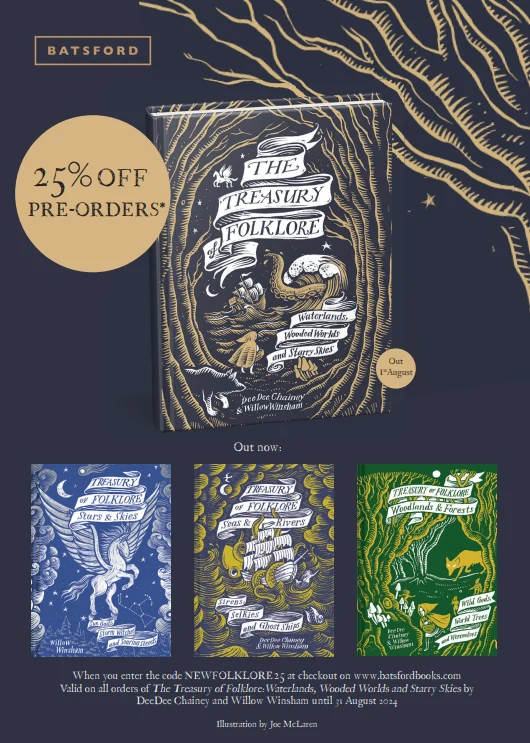
LONDON, UK – [Date of Publication, e.g., July 24, 2024] – Nearly a decade after embarking on a monumental journey to chart the rich tapestry of global folklore, authors Dee Dee Chainey and Willow Winsham are set to release a special compilation, "The Treasury of Folklore: Waterlands, Wooded Worlds and Starry Skies." This eagerly anticipated volume, available for pre-order now and slated for release on August 1, 2024, by Batsford Books, brings together the most cherished tales from their acclaimed three-book series into a single, beautifully crafted edition. It represents a poignant return to the authors’ initial ambition: to encapsulate the boundless breadth of human-shared narratives within one comprehensive tome.
The Genesis of a Global Journey: Unearthing Universal Truths
The "Treasury of Folklore" series began with an ambitious vision: to explore how diverse human cultures across the planet forge customs, beliefs, and myths around the landscapes they inhabit. What started as an idea for a single book quickly burgeoned, as the sheer volume and depth of material uncovered far exceeded initial expectations, leading to the creation of three distinct volumes: Seas and Rivers, Trees and Woodlands, and Stars and Skies.
From Concept to Compendium: A Decade of Discovery
The spark for this expansive project ignited nearly a decade ago, fueled by the vibrant global community fostered by the #FolkloreThursday hashtag. Witnessing the overwhelming outpouring of shared stories and traditions online, Chainey and Winsham recognized a universal hunger for connection through narrative. Their aim was to create something meaningful and lasting that mirrored the unifying universality of folklore itself. The subsequent popularity of their initial three books, focusing on specific natural environments, has been met with both surprise and profound gratitude by the authors.
"When we began writing together nearly a decade ago, we could never have dreamed where it would take us," the authors reflect in a recent statement. "Inspired so greatly by the overwhelming outpouring of folklore through the #FolkloreThursday hashtag, we knew we wanted to create something meaningful, lasting, that reflected the unifying universality of folklore across the globe." This sentiment underscores the organic evolution of the series, from an initial concept to a celebrated collection that has resonated with readers worldwide.
The Unifying Thread: Shared Humanity in Diverse Lore
At the heart of the "Treasury of Folklore" project lies a profound discovery: despite the infinite variations in detail, human beings across the globe share fundamental fears, dreams, and aspirations. Whether gazing at the vast horizon, gathering around a campfire in the dark, or contemplating the mysteries of the cosmos, common threads of wonder, dread, and awe bind humanity.
"We discovered that we, as humans, all share primal fears and dreams, no matter where we live, how we dress, or what we choose to name the monsters of our myths and legends," the authors explain. This insight forms the philosophical bedrock of the series, illustrating how humanity’s engagement with the natural world – from the depths of the ocean to the expanse of the starry sky – continually gives rise to narratives that echo shared psychological landscapes. The monsters of our myths, the heroes of our legends, and the spirits of our lands may bear different names and forms, yet they often embody universal human experiences of challenge, protection, desire, and the unknown.
A Hefty Tome for the Ages: The Compilation’s Craft and Content
The decision to compile the essence of the "Treasury of Folklore" series into a single volume was a natural progression, fulfilling the authors’ original architectural vision for the project. This new compilation, "The Treasury of Folklore: Waterlands, Wooded Worlds and Starry Skies," represents a meticulous curatorial effort.

Crafting a Definitive Edition
The behind-the-scenes work involved revisiting the wealth of material from the original books with fresh eyes, carefully selecting the most compelling and representative tales to ensure the new volume seamlessly integrates diverse narratives. The authors describe the process as a challenging yet rewarding endeavour to distill the expansive original content into a cohesive and engaging single edition.
The end result is a physically impressive book, described by the authors as a "hefty tome." Its beautiful binding, cream paper, and thoughtful design are intended to enhance the reader’s experience, making it not just a collection of stories but an object of beauty in its own right. "To say we have been blown away by the end result is an understatement, and we are utterly thrilled to be able to share this beautifully bound volume with you," the authors state. "We love the size and the cover combining everything and the beautiful cream paper: it is a ‘hefty tome’ indeed."
A Curated Collection: What Lies Within
It is important to note that this compilation contains no new material. Instead, it features text directly extracted from the existing three books, offering a curated selection of the series’ most captivating folklore. The volume is thoughtfully divided into three sections, each reflecting the themes of the original books and showcasing the distinctive original illustrations by Joe McLaren, whose evocative artwork has become synonymous with the "Treasury of Folklore" series. These illustrations are integral to the book’s appeal, providing visual anchors to the fantastical worlds conjured by the tales.
Positioned as a beautiful addition to any library or coffee table, the compilation is envisioned as more than just a book; it is a "conversation starter, a way to connect." It invites readers to dip into its pages, explore diverse myths, and discover the universal threads that weave through humanity’s storytelling tradition.
Voices from the Creators: A Journey of Gratitude and Vision
The journey of the "Treasury of Folklore" series has been deeply personal for Dee Dee Chainey and Willow Winsham, marked by a profound connection with their readers and the broader folklore community. The success of the individual books, Seas and Rivers, Trees and Woodlands, and Stars and Skies, has been a source of immense encouragement.
"The popularity of the three books in the Treasury of Folklore series has been both surprising and heartwarming, and we thank each and every person who has bought and read these books," the authors express, highlighting the collaborative spirit that underpins their work. This gratitude extends to the global community of folklore enthusiasts whose engagement continues to validate the importance of their endeavour. The new compilation stands as a testament to this success and a gift back to that community, offering a definitive edition that brings their expansive work full circle.
Delving into the Depths of Myth: A Glimpse into the Treasury
To whet the appetites of folklore enthusiasts, the authors have shared a few tantalizing extracts from the new compilation, offering a glimpse into the diverse and captivating narratives that await.

Perilous Steeds of the Waterways: The Allure and Danger of Water Horses
Across the world’s lakes, rivers, and lochs, stories of water horses persist – creatures of breathtaking beauty and terrifying malevolence. These myths underscore humanity’s ancient fear and respect for the untamed power of water, often personified by equine figures that promise salvation but deliver doom.
-
The Scottish Kelpie: An Icon of Aquatic Menace
One of the most renowned water horses is the Scottish Kelpie, often conflated with the each-uisge, though distinct in folklore (Kelpies in rivers, each-uisge in lochs). These shape-shifting creatures, often appearing as magnificent horses, lure unsuspecting travellers, particularly the weary or desperate, onto their backs. Once mounted, the victim is irrevocably bound, dragged beneath the water to their death. While some tales suggest temporary taming with a cross-marked bridle, such control is fleeting, and the Kelpie inevitably returns to its watery domain, often with its rider. The legend even offers a grim method of defeat: red-hot iron, a common bane for many folkloric creatures. The enduring power of the Kelpie in the Scottish imagination is strikingly manifest in the colossal 30-meter sculptures near Falkirk, visible from the M9 motorway, which have dominated the landscape since 2013. Its influence extends into modern literature, appearing in works by authors like Lari Don and J.K. Rowling’s Fantastic Beasts and Where to Find Them, showcasing its lasting cultural resonance. Interestingly, this specific variant of water horse is largely absent from English folklore, highlighting regional distinctiveness in mythologies. -
The Welsh Ceffyl Dwr: Shape-shifting Spirits and Clergymen’s Privilege
Wales, however, offers its own vibrant tradition of water horses in the form of the Ceffyl Dwr, a staple of folkloric belief well into the 19th century. In northern Wales, this spirit was a protean entity, taking various forms and exhibiting violence towards humans. In the south, it consistently appeared as an enchanting, albeit small, horse that beguiled people onto its back. Known for incredible speed, Ceffyl Dwr could cover immense distances in impossibly short periods before vanishing, leaving its hapless riders to drown. A curious exception to this peril was afforded to clergymen of any creed, who could ride these horses unscathed, a rare instance of denominational equality in folklore. Several tales recount ministers reaching their destinations safely, while their accompanying clerks or deacons were abandoned or cast into the water, adding a touch of dark humour to the legends. -
The Scandinavian Bäckahäst: Luminous Lures of the Foggy Brook
Scandinavia’s contribution to the water horse pantheon is the bäckahäst, or ‘brook horse’, most frequently sighted in the fog. Described as majestic and luminous, it lures riders, often children, into mounting before plunging back into the water to drown its helpless victims. A popular tale recounts a group of boys playing on a frozen river when a beautiful horse appears. As they mount one by one, the last child, in awe, mispronounces a colloquial phrase, accidentally invoking the name of Christ. The horse immediately vanishes, leaving the boys with sore behinds but saved, due to the bäckahäst‘s aversion to the sacred name. Despite the terrifying predictions, many bäckahäst tales surprisingly end with the riders surviving, and like the Kelpie, some narratives suggest it could be tricked into performing work.
Guardians of the Verdant Wild: The Enigmatic Lords of the Forest
Leaving the watery depths, the compilation ventures into the verdant embrace of the forest, the domain of powerful spirits and creatures known as the Lords of the Wild. These figures embody humanity’s complex relationship with the wilderness – a source of sustenance, danger, mystery, and spiritual power. They range from benevolent protectors to malevolent tricksters, reflecting the dual nature of the wild itself.
-
Tapio, The Finnish Forest King: A Hunter’s Blessing and a Protector’s Gaze
Tapio, also known as Metsähine or Hiisi, reigns as the Finnish king of the forest realm. He is depicted as a tall, slender figure, clad in ermine fur or moss, his head topped with a hat. Like the Green Man or foliate heads of European lore, he peers out from under bushy eyebrows of moss and lichen, often with a great beard of straggling black hair. He is said to appear fully human from the front but possess the gnarled back of a tree, embodying the forest itself. Tapio is both the personification and protector of the forest, and historically, hunters sought his blessing for a successful chase, pledging respect for the woods, its creatures, and its delicate balance. He commanded all forest creatures, capable of granting plentiful hauls or cursing hunters to return empty-handed. The Estonian equivalent of Tapio shares similar traits but, like the Norse god Odin, is said to possess only one eye. Tapio’s family includes his wife, Mielikki (benevolent) or Kuurikki (malevolent), and their children, Nyrikki, who guides hunters with trail marks, and Tulikki, who directs prey. -
The Slavic Leshy: Master of Illusion and Woodland Wrath
The leshy, leshii, or lyeshy is a Slavic tutelary spirit of the woods, a protector of trees and animals, notably wolves and bears in some regions. Like bears, the leshy hibernates in winter. Known by myriad names, all emphasizing their connection to the forest, these creatures are sometimes likened to Greek satyrs, sporting horns, claws, and a bushy beard, which can be forest green or entirely moss-covered. They are master shapeshifters, capable of growing taller than a tree or shrinking to the size of a blade of grass, or appearing huge from a distance but tiny up close. Leshies can mimic any familiar human, animal, or plant. In human form, they are distinguishable by their lack of eyelashes or brows, shoes worn on the wrong feet, or clothing wrapped contrary to local fashion. Some have only one eye, but all are covered in wild hair and possess the cloven feet associated with fauns or even the Devil. Their bellowing can whip up great winds, sending forest creatures fleeing in terror.
Leshies are notorious tricksters. They will confuse and lure uninvited intruders off paths with shrieking laughter, clapping, or howling, often leading them to be lost forever. They can alter their voices to mimic others, enticing victims towards them, only to tickle them to death. Illness can befall those who cross a leshy, and they are known to abduct women for marriage and children found wandering or cursed by their parents. Farmers in the Olonetsky District of Russia once sacrificed a cow annually to appease leshies and protect their herds from curses. Offerings of bread or tobacco, or a simple prayer before entering the forest, are believed to ensure safety.
Leshies live alone or with their wives (lesovikha) and children, sometimes in woodland huts. They are not above battling their own kind with clubs, uprooting trees in their skirmishes. One Vologda District leshy was even said to frequent taverns, driving his wolf pack, and consuming a bucket of vodka before returning to the night. They are avid gamblers, often using squirrels as stakes and favouring card games, but avoiding decks with clubs, which too closely resemble the Christian cross.
To escape a leshy, one can turn clothes inside out and put shoes on the wrong feet, which is said to make them laugh and return the lost to the correct path. Some regions suggest stripping naked and redressing backwards. Swearing remorselessly is also believed to banish them, as is making the sign of the cross. For those daring enough to summon a leshy, the method is simple: cut young trees (birch is best) and arrange them in a circle with tops touching in the middle. Stand in the centre, devoid of Christian symbols, and call out to the "grandfather of the forest."
Celestial Companions: The Enduring Tale of the Hare in the Moon
Finally, the compilation directs our gaze skyward to the moon, a celestial body upon which humankind has projected countless faces and figures. Among the most widespread motifs is that of a rabbit or hare residing on its surface, a story found in diverse cultures worldwide, with the Sea of Tranquillity often seen as the rabbit’s head, and the seas of Fertility and Nectar forming its ears.

-
Sacrifice and Salvation: The Buddhist and East Asian Narratives
In the Buddhist Sasa-Jātaka, the hare, along with its friends (an otter, jackal, and monkey), resolves to give alms on a fast day. When the deity Sakka, disguised as an old beggar, tests them, the other animals offer what they have. The hare, having only grass, selflessly offers itself as food by leaping into a fire. For this ultimate act of faithfulness, Sakka saves the hare and places its image in the moon for all eternity, sometimes using the essence of a squeezed mountain to draw it. Similar tales of self-sacrificing hares exist across cultures, with variations in the animal companions. In a Sri Lankan tale, Buddha, lost and hungry, is offered the hare’s flesh. Buddha saves the selfless creature and sends it to the moon. In Japan, the rabbit, known as Tsuki no Usagi, offers itself to the Man in the Moon (disguised as a beggar) and is subsequently taken to live on the moon. This popular Japanese tale is often shared with children during the September Harvest Moon and Mid-Autumn Festival, celebrating selflessness and devotion. -
A Fateful Misdelivery: The South African Tale of Mortality
In a starkly different vein, a South African tale attributes human mortality to the hare’s folly. The Moon dispatches the Hare to deliver a message to humankind: just as she "dies" and returns each month, so too would humanity. However, the flighty Hare misdelivers the crucial message, telling people only that they would die, omitting the promise of return. Enraged by this catastrophic error, the Moon attacks the Hare with a hatchet, intending to split it in two, but only succeeds in splitting its lip. The Hare, retaliating in anger, lashes out with its claws, scarring the Moon’s face, marks that are still visible in the dark shapes we see on the moon today. This narrative offers a poignant, yet grim, explanation for the human condition of finite life, placing the blame on a mythological trickster figure.
The Enduring Resonance: Implications for Folklore and Humanity
The release of "The Treasury of Folklore: Waterlands, Wooded Worlds and Starry Skies" is more than just a publishing event; it is a significant moment for the study and appreciation of global folklore. It underscores the continued relevance of ancient narratives in a modern world, serving as a powerful reminder of our shared human heritage.
More Than a Book: A Bridge to Shared Heritage
Even without new material, this compilation’s value is immense. It provides a definitive, accessible volume for both seasoned folklore enthusiasts and newcomers, bringing together a vast array of tales that might otherwise remain scattered across multiple texts. It acts as a bridge, connecting readers to diverse cultures and highlighting the commonalities that underpin human experience. In a world often fragmented by difference, folklore offers a potent antidote, revealing the enduring unity of our fears, hopes, and dreams. The tactile quality of the "hefty tome" itself speaks to the enduring nature of these stories, inviting readers to hold a piece of collective human memory in their hands.
The Unwritten Future: Why Folklore Still Matters
The sustained interest in the "Treasury of Folklore" series and the enthusiasm surrounding this compilation demonstrate a burgeoning global appreciation for traditional narratives. Folklore is not merely a relic of the past; it is a living, breathing tradition that continues to inform our understanding of culture, psychology, and our relationship with the natural world. From the environmental lessons embedded in stories of forest spirits to the psychological insights derived from tales of benevolent and malevolent beings, these stories offer profound wisdom. They also inspire new forms of art, literature, and even public sculptures, as seen with the Kelpies, proving their enduring power to captivate and shape our imagination. This compilation encourages deeper engagement with these timeless stories, fostering a greater appreciation for cultural diversity and the shared human narrative.
Availability and Further Exploration
"The Treasury of Folklore: Waterlands, Wooded Worlds and Starry Skies" by Dee Dee Chainey and Willow Winsham is available for pre-order now and will be officially released on August 1, 2024. Readers can secure their copy via Amazon UK (link provided in original source) or through Batsford Books, where a special 25% discount is available using the code NEWFOLKLORE25. This comprehensive volume promises to be an essential addition to the library of anyone fascinated by the rich, complex, and universally resonant world of folklore.