Day 6 of "7 Days of Gratitude": Cultivating Profound Self-Appreciation
[City, State] – [Date] – As a global conversation increasingly shifts towards mental well-being and resilience, initiatives promoting positive psychology practices are gaining significant traction. Among these, structured gratitude challenges offer a powerful framework for individuals to re-center their perspectives. "Day 6: I Choose Gratitude" marks a pivotal moment in the popular "7 Days of Gratitude" program, encouraging participants to embark on what organizers describe as "the most important" exercise of the entire week: writing a heartfelt gratitude letter to oneself. This deeply personal practice aims to transcend superficial appreciation, guiding individuals toward an intrinsic understanding of self-worth and the profound mystery of existence.
The core message resonating through Day 6 is a transformative philosophy: "Gratitude is what remains when I stop meeting life as a problem to solve and begin meeting it as a mystery to inhabit." This profound statement encapsulates the shift from a reactive, problem-oriented mindset to one of open acceptance and wonder, laying the groundwork for a more resilient and appreciative approach to daily living.
Main Facts: The Essence of Self-Gratitude
Day 6 of the "7 Days of Gratitude" challenge zeroes in on an often-overlooked yet critical aspect of well-being: self-gratitude. Participants are tasked with composing a letter detailing all the ways they are grateful to themselves, for themselves, and for their lives. This exercise moves beyond acknowledging external blessings to an internal recognition of one’s own journey, strengths, and inherent value.
The challenge posits that a single week has the potential to fundamentally alter one’s outlook. By Day 6, after five preceding days of cultivating appreciation for external factors, relationships, or general life circumstances, the focus turns inward. This deliberate pivot is designed to solidify an internal foundation of appreciation, ensuring that gratitude becomes less a fleeting emotion and more a steadfast internal state.
Beyond the letter, the day’s activities include a continuous, self-directed inquiry: "What am I grateful for right now?" This question serves as a constant anchor, designed to interrupt habitual negative thought patterns and redirect attention towards present-moment blessings, no matter how small. This ongoing practice is complemented by a structured "Ten Minute Meditation," guiding individuals through a systematic process of identifying and internalizing feelings of gratitude, progressing from one discovered item to many.
The overarching theme, encapsulated in the mantra "I Choose Gratitude," emphasizes gratitude not as a passive response to favorable conditions, but as an active, conscious decision. It is portrayed as a powerful tool for navigating life’s inevitable difficulties, revealing an inner strength that transcends external circumstances.
Chronology: A Journey Towards Inner Appreciation
The "7 Days of Gratitude" program is meticulously designed as a progressive journey, each day building upon the last to deepen the participant’s understanding and practice of gratitude. While the specific daily themes for Days 1-5 are not explicitly detailed, Day 6’s profound self-focus suggests a carefully constructed arc.
The initial days likely guide participants through foundational gratitude practices, such as acknowledging loved ones, appreciating nature, recognizing opportunities, or reflecting on positive experiences. These initial steps help individuals establish a routine of mindful observation, training their minds to actively seek out reasons for appreciation in their environment and interactions. This gradual acclimatization to a gratitude mindset prepares the ground for the more introspective and challenging work of Day 6.
By the sixth day, participants are presumably more attuned to the nuances of positive emotion and more comfortable with structured reflection. This readiness makes the task of writing a gratitude letter to oneself particularly potent. It’s not an isolated exercise but the culmination of a week’s worth of cultivating an appreciative lens. Placing this self-directed gratitude near the end of the challenge highlights its importance as a synthesizing practice, integrating external appreciation with internal self-worth.
The daily inquiry, "What am I grateful for right now?" is presented as a continuous thread throughout the entire challenge, but its reinforcement on Day 6 underscores the importance of consistent, real-time application. This iterative questioning helps to hardwire new neural pathways, making gratitude a more automatic response rather than a forced effort. The Ten-Minute Meditation further ritualizes this daily engagement, providing a dedicated space for quiet introspection and emotional processing, solidifying the lessons learned over the preceding days.
The structured progression ensures that by the end of the seven days, participants are equipped not just with a momentary feeling of gratitude, but with a sustainable practice and a rewired perspective, capable of facing life’s complexities with a renewed sense of inner strength and appreciation.
Supporting Data: The Science and Psychology of Gratitude
The principles underlying the "7 Days of Gratitude" challenge, particularly the emphasis on self-gratitude and conscious choice, are strongly supported by a growing body of scientific research in positive psychology and neuroscience. Studies consistently demonstrate that practicing gratitude offers a myriad of benefits, impacting mental, emotional, and even physical health.
Psychological Benefits:
Research by Dr. Robert A. Emmons and Dr. Michael E. McCullough, pioneers in gratitude research, has shown that regularly practicing gratitude can lead to increased levels of alertness, enthusiasm, and determination. Grateful individuals report higher levels of positive emotions, feel more alive, and experience fewer symptoms of depression and anxiety. The act of writing down what one is grateful for, as prescribed on Day 6, is a particularly effective method. This cognitive act forces the brain to actively search for positive aspects, shifting focus away from perceived deficits or problems.
Self-gratitude, though less extensively studied than gratitude towards others, is crucial for fostering self-compassion and healthy self-esteem. In a society often plagued by self-criticism and comparison, taking time to acknowledge one’s own efforts, resilience, and unique qualities can significantly boost mental well-being. It helps individuals internalize their worth, reducing the dependence on external validation. The instruction to write a letter to oneself taps into the therapeutic benefits of expressive writing, allowing for deeper emotional processing and self-discovery.
Neuroscientific Insights:
Neuroimaging studies suggest that gratitude activates brain regions associated with reward, social bonding, and moral cognition, such as the medial prefrontal cortex. When individuals engage in grateful thinking, these areas show increased activity, contributing to feelings of contentment and well-being. Furthermore, consistent gratitude practice can alter brain structure over time, potentially strengthening neural pathways associated with positive emotions and empathy. This explains how a "one week challenge" can initiate lasting changes in perception and emotional regulation.

Physical Health Impacts:
Beyond psychological benefits, gratitude has been linked to improved physical health. Grateful individuals often report better sleep quality, reduced blood pressure, and a stronger immune system. The reduction in stress hormones like cortisol, often observed in those who practice gratitude, contributes significantly to these physiological improvements. By reframing challenges and choosing an appreciative stance, individuals can mitigate the detrimental effects of chronic stress.
The Power of Choice:
The poem’s assertion, "Now, I practice gratitude because I refuse to allow the difficult parts of my life to have the final word on what it means to be alive," aligns with cognitive behavioral therapy (CBT) principles. It emphasizes cognitive restructuring, where individuals consciously challenge and change unhelpful thought patterns. Choosing gratitude, especially when circumstances are difficult, is a powerful act of agency. It’s not about ignoring pain but about recognizing that pain doesn’t define the entirety of one’s existence, allowing for the acknowledgment of enduring good amidst adversity. This choice enables individuals to loosen "the grip of suffering" and receive life fully, rather than waiting for external conditions to change.
The Ten-Minute Meditation, with its structured progression from one grateful item to three, and then to "ten thousand," mirrors mindfulness practices that train attention and cultivate present-moment awareness. The invitation to "notice the frequency and vibrations of gratitude moving through your whole being" encourages a somatic experience of emotion, integrating mind and body in the practice of appreciation. This holistic approach amplifies the impact of gratitude, making it a deeply felt experience rather than a mere intellectual exercise.
Official Responses and Program Philosophy
The "7 Days of Gratitude" program, spearheaded by "Uplift," articulates a clear philosophy rooted in intentional living and holistic well-being. The poem titled "I CHOOSE GRATITUDE" serves as a powerful manifesto, an "official response" to the human condition, guiding participants through the profound shift from conditional gratitude to an unconditional, deliberate choice.
The poem directly addresses a common misconception: that gratitude is merely an exchange for good fortune. It states, "I once believed gratitude depended on what life placed in my hands; that somehow it was an exchange for the cards I was dealt." This acknowledgment sets the stage for the program’s transformative aim – to reframe gratitude as an inherent, internal capacity rather than a reaction to external events.
The core of the program’s philosophy is the assertion that choosing gratitude "loosens the grip of suffering" and challenges the belief that life "must become different before it is fully received." This is a radical call to acceptance, urging individuals to embrace life as it is, with all its imperfections, and still find reasons for heartfelt thanks. It differentiates between merely thinking or speaking gratitude and truly feeling it, emphasizing the experiential aspect as key to unlocking its power.
The program champions gratitude as independent of external miracles or achievements. It "does not demand certainty," nor does it wait for success, healing, or a lottery win. Instead, it positions gratitude as "the way the miracle of life feels inside me," transforming an external phenomenon into an internal state. This perspective offers immense resilience, especially during challenging times. As the poem illustrates, even "when my body wakes carrying stones, when uncertainty sits at my table," choosing gratitude reveals an inner strength, a remembrance that "I am larger than the conditions surrounding me."
This isn’t about ignoring challenges; it’s about preventing them from consuming one’s entire perspective. "Gratitude doesn’t erase my challenges; it simply refuses to let challenges become my whole landscape." Instead, it turns attention to "what remains": the breath, the body’s patient work, the constancy of nature, the enduring warmth of human and animal connection. This philosophy culminates in the idea that gratitude allows one to meet life "as a mystery to inhabit" rather than a problem to solve, fostering a sense of wonder and presence.
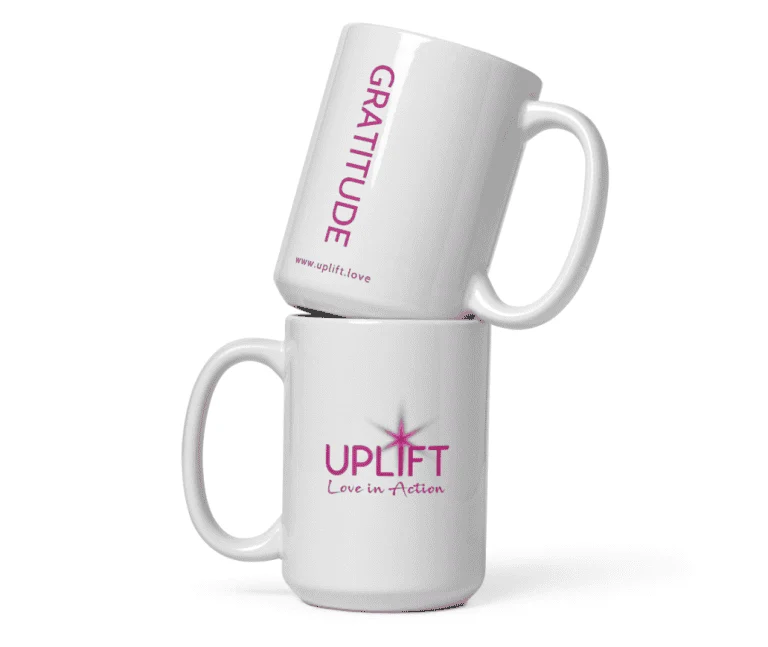
Uplift extends its mission beyond the challenge itself through additional initiatives. The "Take 5 Deep Breaths" encouragement reinforces mindfulness and self-care, linking personal well-being to a broader positive impact. The "Financial Contribution" section highlights the organization’s commitment to "Love in Action projects," indicating a philanthropic dimension where participants’ engagement can contribute to wider community upliftment. Furthermore, the "Send a Blessing" portal provides a channel for participants to extend their newfound sense of gratitude and positive energy outward, fostering a ripple effect of kindness and connection. These supporting elements underscore Uplift’s holistic approach, integrating personal growth with collective good. The promotional offer for UPLIFT Mugs also ties into this, presenting a tangible reminder of the daily practice and a way to support the organization’s broader mission.
Implications: A Transformed Approach to Life
The profound implications of embracing the philosophy and practices outlined in "Day 6: I Choose Gratitude" extend far beyond the seven-day challenge, influencing individual well-being, interpersonal relationships, and potentially broader societal shifts.
Enhanced Personal Resilience: By consciously choosing gratitude, especially in the face of adversity, individuals develop a robust sense of resilience. This isn’t about denying pain but about cultivating an internal landscape where challenges, while acknowledged, do not define one’s entire existence. This mindset fosters a greater capacity to navigate stress, recover from setbacks, and maintain a sense of hope and purpose even amidst difficult circumstances. The ability to find gratitude for "what remains"—basic functions, simple joys, enduring connections—provides an unshakeable foundation for emotional stability.
Improved Mental and Emotional Health: Consistent gratitude practice, particularly self-gratitude, can significantly reduce symptoms of depression, anxiety, and self-criticism. By regularly acknowledging one’s own worth, efforts, and the intrinsic value of one’s life, individuals build healthier self-esteem and foster a deeper sense of self-compassion. This internal shift can lead to more positive emotional states, greater life satisfaction, and a more optimistic outlook. The daily inquiry "What am I grateful for right now?" acts as a continuous cognitive reframing tool, training the brain to focus on positivity.
Richer Interpersonal Relationships: While Day 6 focuses on self-gratitude, the cumulative effect of a gratitude practice often spills over into relationships with others. Individuals who are more grateful tend to be more empathetic, forgiving, and willing to offer support. This leads to stronger, more fulfilling connections, as appreciation becomes a default mode of interaction. The ability to see others and their contributions through a grateful lens can transform dynamics, fostering deeper trust and understanding.
A Shift in Societal Values: On a broader scale, if more individuals adopt a chosen gratitude mindset, it could contribute to a significant cultural shift. A society that values appreciation, resilience, and inherent worth over constant striving, comparison, and material acquisition might foster greater collective well-being. Such a shift could lead to more compassionate communities, greater emphasis on mental health, and a more sustainable approach to life that values presence and connection over endless consumption. The "Love in Action projects" and the "Send a Blessing" portal offered by Uplift exemplify how individual gratitude can be channeled into collective good, creating a ripple effect of positive change.
Ultimately, "Day 6: I Choose Gratitude" is more than just an exercise; it’s an invitation to a different way of living. It encourages individuals to stop "living as though existence is something to earn" and instead embrace life as a precious gift, worthy of "wholehearted thanks" in every moment. This profound paradigm shift offers a pathway to a life lived with greater joy, peace, and an enduring sense of interconnectedness, irrespective of external conditions. The "7 Days of Gratitude" challenge serves as a powerful catalyst for this transformation, equipping participants with the tools and mindset to not just experience gratitude, but to embody it as a fundamental choice.