Echoes of Empire: Unpacking the Anglo-Boer Wars and Their Enduring Legacy
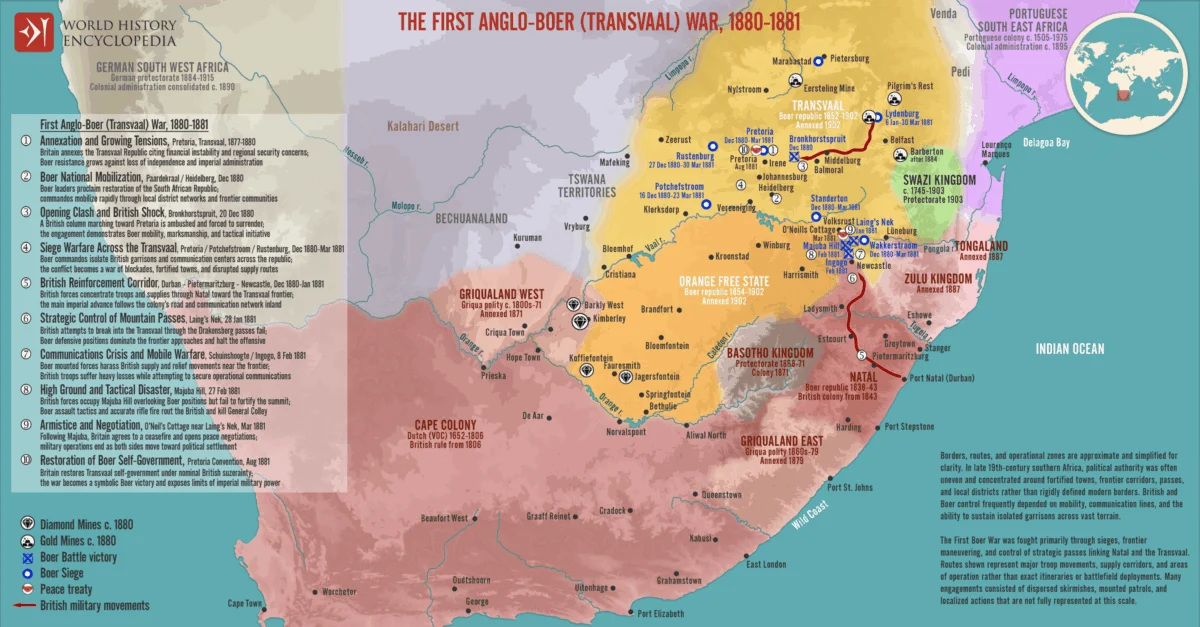
Pretoria, South Africa – June 8, 2026 – A newly highlighted historical gallery from the World History Encyclopedia delves into one of the most defining and costly periods of 19th and early 20th-century Southern African history: the Anglo-Boer Wars. Through a curated collection of images and detailed historical accounts, the gallery meticulously chronicles the fierce rivalry between British and Boer settlers, a struggle that not only reshaped the geopolitical landscape of the region but also laid foundational stones for the complex social and political structures that would define South Africa for decades to come.
Published by the non-profit World History Encyclopedia, an organization dedicated to providing free, meticulously researched historical content, this latest feature underscores the significant financial and human costs of imperial ambition. The organization, currently engaged in its 2026 Server Costs Fundraiser, highlights its reliance on public support to maintain its vast digital archive, with an annual operational cost of $20,000, of which $5,120 has been raised to date.
Main Facts: A Century of Contention and Conflict
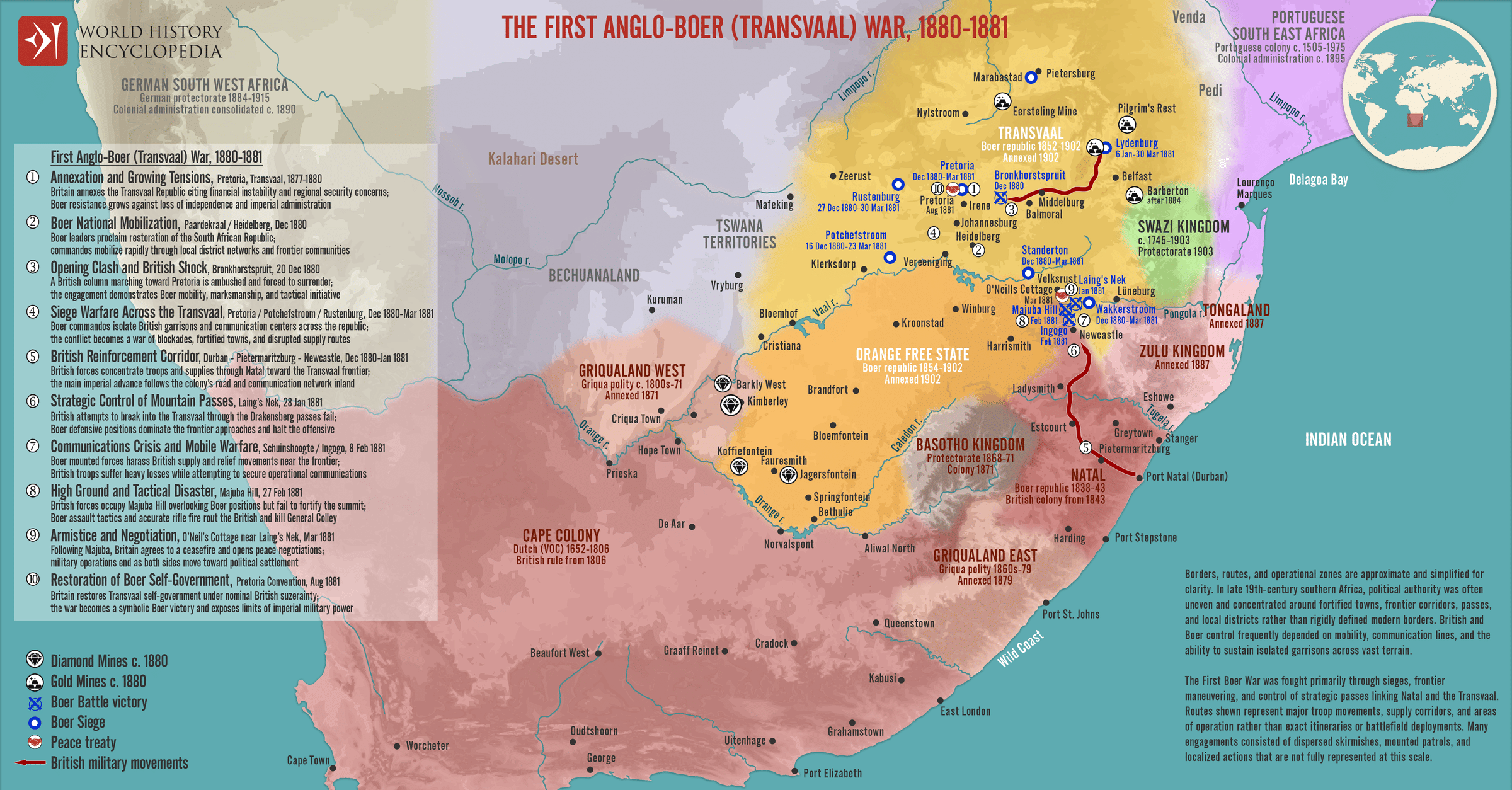
The Anglo-Boer Wars represent a pivotal chapter in the history of British imperialism and the formation of modern South Africa. Beginning in the early 19th century, a simmering tension between British colonial expansion and the fiercely independent spirit of the Boers – descendants of primarily Dutch, French Huguenot, and German settlers – escalated into open conflict on two distinct occasions: the First Anglo-Boer War (1880-1881) and the Second Anglo-Boer War (1899-1902).
These conflicts were rooted in a complex interplay of land, resources, political autonomy, and imperial ambition. As the British solidified their control over strategic coastal territories like the Cape Colony (established 1806) and Natal (established 1843), the Boers sought to escape British authority, embarking on the "Great Trek" of the 1830s to establish their own independent republics in the interior: the South African Republic (Transvaal, 1852) and the Orange Free State (1854). This westward and northward migration, often at the expense of indigenous African populations, set the stage for inevitable clashes.
The discovery of vast diamond fields in Kimberley in 1867 and the Witwatersrand gold reefs in 1886 dramatically intensified British interest in the Boer republics. These mineral riches transformed the agrarian Boer states into highly coveted territories, drawing an influx of foreign workers, known as "Uitlanders," primarily British, whose presence and lack of voting rights became a key casus belli for the second, much larger, and more devastating conflict.
The Second Anglo-Boer War, in particular, was a brutal and costly affair for all parties involved. It introduced modern warfare tactics, including widespread use of trenches, long-range artillery, and guerrilla warfare, but also saw the controversial implementation of concentration camps by the British. These camps, initially intended to house Boer women and children displaced by the "scorched earth" policy aimed at countering guerrilla fighters, became sites of immense suffering and death due to disease and starvation. The conflict ultimately culminated in a British victory, leading to the incorporation of the Boer republics into the British Empire and the eventual formation of the Union of South Africa in 1910.
The economic toll was staggering. The Second Boer War alone cost Britain an estimated £200 million, a sum equivalent to approximately £21 billion in today’s currency. Beyond the financial burden, the wars exacted a heavy human cost, not only among British and Boer combatants but, critically, among the tens of thousands of indigenous Africans who were drawn into the conflict or displaced by it, often suffering the harshest consequences yet remaining largely invisible in contemporary historical narratives. The World History Encyclopedia’s gallery, curated by Mark Cartwright, serves as a vital resource for understanding the multifaceted dimensions of this critical period.
Chronology: A Timeline of Tension and Transformation
The trajectory of British-Boer relations in Southern Africa is best understood through a chronological examination of key events:
- 1652: Dutch East India Company establishes a refreshment station at the Cape of Good Hope, marking the beginning of European settlement and the ancestry of the Boers (later Afrikaners).
- 1795: British seize the Cape Colony from the Dutch during the Napoleonic Wars. Although temporarily returned to the Dutch, it is permanently ceded to Britain in 1806.
- 1806: British formally establish the Cape Colony, introducing British law, language, and administrative practices, which clash with existing Boer customs.
- 1830s-1840s: The "Great Trek" begins. Dissatisfied with British rule, particularly its abolition of slavery and perceived interference in their way of life, thousands of Boers migrate inland, away from the Cape Colony. This monumental journey is vividly depicted in a relief sculpture by Peter Kirchhoff at the Voortrekker Monument in Pretoria, featured in the World History Encyclopedia’s gallery, published on June 5, 2026. This migration leads to conflicts with various indigenous African groups and the establishment of independent Boer republics.
- 1843: Britain annexes Natal, further encroaching on Boer territories and leading to more eastward migration.
- 1852: The Sand River Convention recognizes the independence of the South African Republic (Transvaal).
- 1854: The Bloemfontein Convention recognizes the independence of the Orange Free State. For a time, a fragile peace prevails, with Britain focused on maintaining coastal control and the Boers developing their inland republics.
- 1867: Diamonds are discovered in Kimberley, triggering a diamond rush and increasing British interest and intervention in the region, particularly around the Griqualand West area claimed by both Britain and the Orange Free State.
- 1877: Britain annexes the Transvaal, citing financial instability and the need to protect Boers from Zulu threats. This act is a major catalyst for the First Anglo-Boer War.
- 1880-1881: First Anglo-Boer War. The Boers, under figures like Paul Kruger, resist British annexation. Key engagements include the Battle of Majuba Hill, where a British force suffers a decisive defeat. The war is relatively short, and Britain, under Prime Minister William Gladstone, grants the Transvaal self-government under British suzerainty through the Pretoria Convention (1881) and later the London Convention (1884).
- 1886: Gold is discovered on the Witwatersrand in the Transvaal. This discovery transforms the region, attracting massive foreign investment and an influx of "Uitlanders" (foreigners), primarily British, who quickly outnumber the Boers in the gold-mining areas. The Transvaal government, led by President Paul Kruger, restricts Uitlander political rights and imposes taxes, fueling British resentment and imperial ambitions.
- 1895: The Jameson Raid. Cecil Rhodes, then Prime Minister of the Cape Colony and a fervent imperialist, sponsors an unsuccessful attempt by Dr. Leander Starr Jameson to instigate an Uitlander uprising in Johannesburg against the Transvaal government. The raid is a humiliating failure but further poisons Anglo-Boer relations.
- 1899-1902: Second Anglo-Boer War (or Boer War). Escalating tensions, British demands for Uitlander rights, and Kruger’s refusal to concede lead to war. The Boers launch preemptive strikes into British colonies.
- Phase 1 (October 1899 – December 1899): Boer sieges of Ladysmith, Mafeking, and Kimberley. Initial British setbacks, culminating in "Black Week."
- Phase 2 (January 1900 – June 1900): Massive British reinforcements arrive under commanders like Lord Roberts and Lord Kitchener. British relieve the sieges and occupy Bloemfontein and Pretoria. Conventional Boer resistance collapses.
- Phase 3 (June 1900 – May 1902): Boers switch to highly effective guerrilla warfare. The British respond with a "scorched earth" policy (burning farms, destroying crops) and the controversial establishment of concentration camps to intern Boer civilians and prevent them from supporting the guerrillas. African civilians also suffer immensely in separate, often worse, camps.
- 1902: Treaty of Vereeniging. The Boers surrender, accepting British sovereignty but gaining promises of eventual self-government and financial assistance for reconstruction. The issue of African voting rights is postponed until self-government is granted.
- 1910: The Union of South Africa is formed, uniting the former British colonies of the Cape and Natal with the former Boer republics of the Transvaal and Orange Free State into a single self-governing dominion within the British Empire. This union, however, entrenches racial segregation and disenfranchises the vast majority of the African population.
Supporting Data: The Human and Economic Toll
The Anglo-Boer Wars, particularly the second conflict, left an indelible mark on all involved, with devastating human and economic costs that resonated for generations.
Financial Burden: The World History Encyclopedia’s gallery highlights the staggering financial cost to Britain: £200 million for the Second Boer War alone. When adjusted for inflation, this figure translates to approximately £21 billion today. This immense expenditure placed a significant strain on the British treasury, leading to increased taxes and public debt. The sheer scale of this cost prompted considerable debate within Britain about the prudence and morality of imperial expansion, as noted by economist and social scientist J. A. Hobson. In his influential work, "Imperialism: A Study" (1902), Hobson argued that imperialism was driven by the financial interests of a small elite rather than the broader national interest, and that it diverted resources from domestic social reform.
Human Casualties:
- British Forces: Approximately 22,000 British and imperial soldiers died, primarily from disease (typhoid, dysentery) rather than battle wounds.
- Boer Forces: Around 6,000 Boer commandos were killed in action.
- Boer Civilians: The concentration camps established by the British became a humanitarian catastrophe. Over 26,000 Boer women and children, representing roughly 10-15% of the Boer population, died in these camps from disease, malnutrition, and poor sanitation. Emily Hobhouse, a British welfare activist, played a crucial role in exposing these conditions to the British public, leading to reforms but not before immense loss of life.
- African Civilians: Often overlooked in historical accounts, the impact on indigenous African populations was equally, if not more, severe. It is estimated that between 14,000 and 20,000 African civilians died in separate British concentration camps. Many more suffered displacement, loss of land, and disruption of their livelihoods. Africans also fought on both sides of the conflict, often serving in non-combatant roles but sometimes taking up arms. Their contributions and suffering were largely unacknowledged in the peace treaties and post-war settlements.
Social and Political Impact: The wars profoundly shaped the political identity and future trajectory of South Africa. For the Boers (who increasingly identified as Afrikaners), the experience of the wars, particularly the concentration camps and the "scorched earth" policy, forged a powerful sense of national grievance and martyrdom that fueled Afrikaner nationalism for the next century. This sentiment would later contribute to the rise of apartheid. For the British, the wars exposed weaknesses in their military and logistics, and the moral cost of the concentration camps tarnished the image of the Empire, contributing to growing anti-imperialist sentiment at home and abroad. The treatment of non-white populations during and after the war solidified racial hierarchies, ensuring that political power remained firmly in the hands of the white minority.

Official Responses: Justification, Condemnation, and Consequence
Throughout the protracted period of Anglo-Boer rivalry and conflict, official responses from both sides, as well as from international observers, reflected a spectrum of motivations, justifications, and condemnations.
British Official Stance: The British government, driven by a blend of imperial expansionism, strategic concerns (control of the Cape sea route), and economic interests (diamonds and gold), consistently framed its actions as necessary to protect British subjects (Uitlanders) and maintain stability in the region. Lord Alfred Milner, the High Commissioner for Southern Africa, was a key architect of British policy leading up to the Second Boer War, advocating for a strong, unified British South Africa. His dispatches and public statements often emphasized Boer intransigence, their alleged mistreatment of Uitlanders, and the need to assert British paramountcy. The initial response to revelations about concentration camp conditions was defensive, attempting to downplay the severity, but public outcry, fueled by figures like Emily Hobhouse and parliamentary debates, eventually forced the government to implement reforms, albeit belatedly. The ultimate "official response" was the Treaty of Vereeniging (1902), which, while asserting British sovereignty, also offered significant concessions to the defeated Boers, including financial aid and a path to self-government, largely to prevent a lingering insurgency and to integrate them into the larger imperial framework.
Boer Official Stance: The leaders of the Boer republics, particularly President Paul Kruger of the Transvaal, championed their independence and the preservation of their unique cultural and religious identity. Their official responses to British demands often invoked their right to self-determination and their Calvinist heritage, viewing British interference as an assault on their freedom and their God-given land. Kruger’s famous "ultimatum" in October 1899, demanding the withdrawal of British troops from their borders, marked the official commencement of the Second Boer War. Their guerrilla tactics, while militarily effective, were also an official response to the overwhelming numerical superiority of the British, demonstrating a fierce commitment to resistance even in the face of conventional defeat.
International and Domestic Scrutiny: While not "official responses" in the governmental sense, the widespread international condemnation of British actions, particularly regarding the concentration camps, represented a significant external pressure. Public opinion in various European countries was often sympathetic to the Boers, viewing them as a smaller nation fighting for freedom against a powerful empire. Domestically, within Britain, the wars sparked significant intellectual and moral debate. J.A. Hobson’s critique of imperialism, as mentioned, was a powerful "unofficial response" that challenged the very foundations of British foreign policy, questioning its economic rationale and moral legitimacy. This intellectual ferment contributed to a growing anti-imperialist movement that would gain momentum in the decades that followed.
Implications: A Lasting Legacy for South Africa and Beyond
The Anglo-Boer Wars cast a long shadow, shaping not only the future of South Africa but also influencing the broader trajectory of the British Empire and the development of international thought on imperialism.
For South Africa: The most profound implication was the establishment of the Union of South Africa in 1910. While ostensibly uniting the country, the terms of this union enshrined a political system that privileged white minorities (both British and Afrikaner) and systematically disenfranchised the vast African majority. The seeds of racial segregation and the institutionalized discrimination that would later become apartheid were firmly planted in this post-war settlement. Afrikaner nationalism, forged in the crucible of conflict and resentment, became a dominant political force, eventually leading to the National Party’s rise to power in 1948 and the formal implementation of apartheid. The economic structures established during and after the gold rush, with a dependence on cheap African labor, further entrenched racial inequalities. Land ownership patterns, heavily skewed in favor of white settlers, remain a contentious issue in contemporary South Africa.

For the British Empire: The wars represented a Pyrrhic victory. While the British Empire ultimately expanded its territorial control, the cost in blood and treasure was immense. The wars exposed logistical and tactical shortcomings in the British military, prompting significant reforms. More importantly, the moral stain of the concentration camps and the critiques from figures like Hobson led to a re-evaluation of imperial policies. The wars contributed to a growing sense that the "burden" of empire might outweigh its benefits, fostering a more introspective and critical view of imperial expansion within Britain itself. This shift in perception contributed to the gradual decline of overt imperialist fervor and laid some groundwork for future decolonization movements.
For Global History and International Relations: The Anglo-Boer Wars served as a precursor to the large-scale industrial warfare of the 20th century, introducing elements like total war, concentration camps, and sophisticated guerrilla tactics. The international outrage over British actions highlighted the emerging power of public opinion and humanitarian concerns in global affairs, even if these concerns were often selectively applied. The debates surrounding the wars contributed to a growing body of anti-colonial thought, influencing future independence movements across Africa and Asia.
The Enduring Relevance of Historical Preservation: The World History Encyclopedia’s ongoing commitment to making such complex histories accessible is a crucial implication. By digitizing and presenting detailed accounts, images, and analysis of events like the Anglo-Boer Wars, the non-profit organization plays a vital role in global historical education. The current Server Costs Fundraiser 2026, with an annual goal of $20,000 and $5,120 raised so far, underscores the constant financial challenge of maintaining such a valuable public resource. The continued support for organizations like the World History Encyclopedia ensures that these critical historical narratives, including the often-overlooked experiences of indigenous African populations, remain available for present and future generations to study, learn from, and understand the profound implications of past conflicts on contemporary societies. The ongoing need for donations at www.worldhistory.org/donate/ and membership at www.worldhistory.org/membership/ directly links the preservation of this historical memory to the sustained functioning of the platform.