
From Anthological Ambitions to Stylistic Revolution: Robert Rodriguez’s Cinematic Evolution and the Genesis of Sin City
Introduction: The Enduring Power of the Author-Directed Adaptation
The landscape of cinema is constantly reshaped by directors who not only interpret existing narratives but imbue them with their unique authorial voice. This is particularly true when a filmmaker, already established for their distinct style, tackles material that resonates deeply with their artistic sensibilities. The journey of Robert Rodriguez, from his early experimental anthology project to the groundbreaking visual tapestry of Sin City, offers a compelling case study in this phenomenon. His collaboration with Frank Miller on the 2005 neo-noir masterpiece not only redefined the possibilities of comic book adaptations but also cemented Rodriguez’s reputation as a visionary who could translate the essence of the page to the screen with unparalleled fidelity and stylistic innovation. This article delves into the evolution of Rodriguez’s approach to filmmaking, tracing the path from the ambitious yet flawed Four Rooms to the definitive adaptation of Sin City, exploring the creative philosophies, technological advancements, and critical reception that shaped this transformative period in his career.
The Genesis of an Idea: Anthology Aspirations and Early Collaborations
The 1990s marked a fertile period for independent cinema, a movement often dubbed "Indiewood," which saw a new generation of filmmakers challenging the established norms of Hollywood. Among these emerging talents were Quentin Tarantino and Robert Rodriguez, whose creative energies often intersected. While their collaboration on the vampire-horror flick From Dusk Till Dawn is widely recognized, their earlier joint venture, the anthology film Four Rooms (1995), provided a crucial, albeit initially underappreciated, stepping stone in their respective directorial journeys.
Four Rooms was an ambitious undertaking, bringing together four distinct but interconnected stories, all set within the confines of a single, mysterious hotel on New Year’s Eve. The directorial lineup was a veritable who’s who of the era’s indie darlings: Tarantino, Rodriguez, Allison Anders, and Alexandre Rockwell. For Rodriguez, the opportunity to engage in short-form filmmaking and collaborate with his peers was an appealing prospect. He saw it as a chance to explore different narrative structures and to flex his creative muscles in a contained environment.
However, the critical and commercial reception of Four Rooms proved to be a sobering experience. Despite the star power of its directors and the intriguing premise, the film failed to resonate with audiences and critics alike. The inherent challenges of the anthology format, which often struggles to maintain narrative momentum and thematic coherence across its disparate segments, were starkly apparent.
Chronology of Creative Development:
-
1995: Four Rooms
- Premise: An anthology film comprising four interconnected stories, each directed by a different filmmaker (Quentin Tarantino, Robert Rodriguez, Allison Anders, Alexandre Rockwell), set in a single hotel on New Year’s Eve.
- Rodriguez’s Role: Directed one of the four segments.
- Reception: Mixed to negative critical reviews and underperformance at the box office. Many viewers found the anthology structure disjointed and lacking in overall impact.
- Rodriguez’s Reflection: In later interviews, Rodriguez acknowledged the inherent difficulties of the anthology format, stating, "Anthologies never work." He attributed this to the audience’s potential difficulty in engaging with multiple narrative beginnings, leading to a feeling of constant restarting.
-
Post-Four Rooms Reflection and Refinement:
- Despite the initial disappointment, Rodriguez did not abandon the concept of multi-narrative storytelling. Instead, he analyzed the shortcomings of Four Rooms and began to conceptualize ways to improve the format.
- He expressed a desire to make the anthology concept "work," recognizing that the audience’s disconnect stemmed from the fragmentation.
-
Early 2000s: The Sin City Conception
- Rodriguez’s mind began to focus on a more cohesive approach, envisioning a project that retained the spirit of multiple interwoven tales but with a singular directorial vision and a more structured narrative flow.
- He considered reducing the number of segments and maintaining a unified directorial voice. This thinking was directly influenced by his desire to overcome the perceived limitations of Four Rooms.
-
2005: Sin City
- Collaboration: Co-directed with Frank Miller, the creator of the original graphic novel series.
- Adaptation Approach: Aimed for a faithful "translation" of Miller’s visual style and narrative voice, rather than a conventional adaptation.
- Technological Innovation: Extensive use of green screen technology to meticulously recreate the stylized, high-contrast aesthetic of the comic books.
- Reception: Critically acclaimed for its visual innovation, stylistic fidelity, and bold narrative structure. It became a significant commercial success and a landmark in the comic book movie genre.
The "Indiewood" Ethos and the Quest for a Unified Vision
Rodriguez’s reflections on Four Rooms were not merely about the failure of a single project; they were about a deeper understanding of narrative structure and audience engagement. He candidly admitted, "Anthologies never work," during a later interview with Lex Fridman. His reasoning was insightful: audiences often struggle to connect with films that repeatedly reset their narrative trajectory. The constant cycle of introductions, developments, and conclusions within each segment of an anthology can dilute the overall impact and create a sense of discontinuity.
However, Rodriguez was not one to be deterred by initial setbacks. The experience with Four Rooms, rather than extinguishing his interest in multi-part storytelling, served as a catalyst for refinement. He began to ponder how the anthology concept could be reimagined to be more cohesive and impactful. His internal dialogue led him to a pivotal question: "What if it’s three stories, like a three-act structure, not four, same director, not four different directors?" This contemplation, occurring approximately a decade after Four Rooms, revealed a clear desire to exert greater control over the narrative flow and thematic unity of such a project. The underlying sentiment was, "I had already done one and figured out how I could do it better."
This shift in thinking directly paved the way for his next ambitious endeavor: Sin City. While Four Rooms had featured multiple directors, Rodriguez envisioned a project where a single director, himself, could orchestrate the entire experience, ensuring a consistent tone and style. This desire for authorial control and a unified vision became the bedrock of his approach to adapting Frank Miller’s seminal noir comic book series.
Sin City: A Translation, Not Just an Adaptation
The emergence of Sin City in 2005 marked a significant departure from conventional comic book adaptations and a profound realization of Rodriguez’s evolving directorial philosophy. While the genre of comic book movies had become increasingly commonplace, Sin City offered something fundamentally different: a film that looked and felt precisely like its source material. This was not a mere interpretation; it was a deliberate and masterful "translation," as described by Danny Boyd in the CinemaSlatix video that accompanies this analysis.
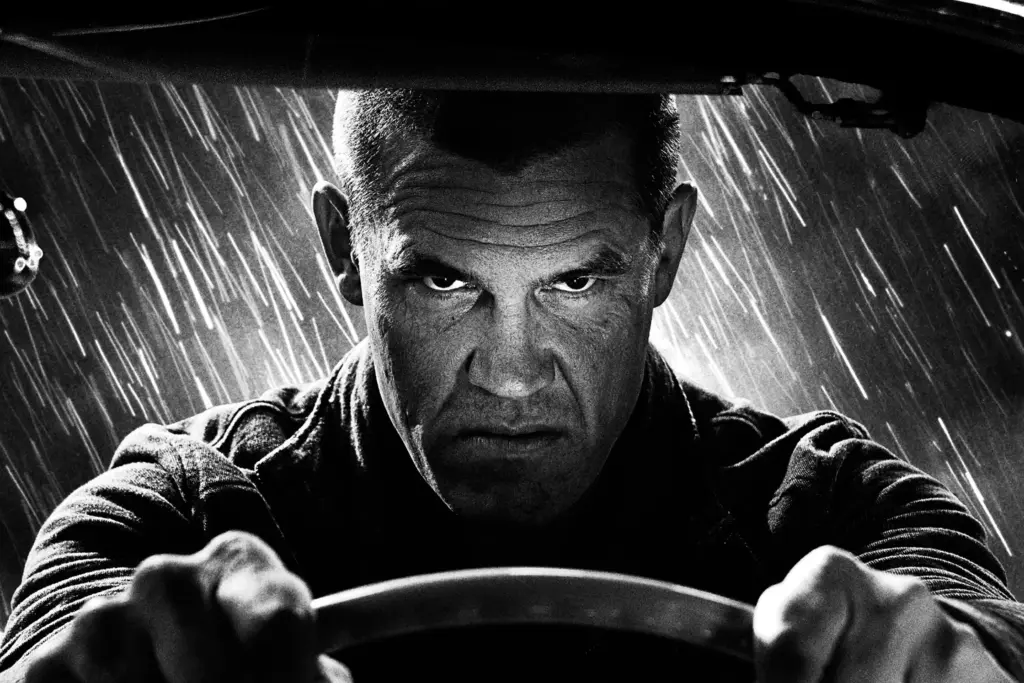
Rodriguez himself viewed the process less as bringing the page to the screen and more as "taking cinema and turning it into a book." This inversion of perspective is crucial. Instead of adapting a literary work into a cinematic medium, Rodriguez aimed to distill the very essence of cinematic language that Frank Miller had already embedded within his graphic novels. This meant preserving the stark black-and-white aesthetic, punctuated by selective splashes of color, the exaggerated chiaroscuro lighting, the hard-boiled dialogue, and the stylized violence that are hallmarks of Miller’s work.
Ironically, Frank Miller’s intention in creating the Sin City comics was partly to create something that would be notoriously difficult to adapt for Hollywood. He deliberately pushed the boundaries of visual storytelling, making the comics as "un-filmable" as possible. However, he hadn’t anticipated the confluence of technological advancements and Rodriguez’s audacious "DIY ethos" that would eventually make his vision a cinematic reality.
Rodriguez’s early career, notably his debut feature El Mariachi, a "$7,000 movie" where he single-handedly handled all technical aspects, instilled in him a deep understanding of how digital filmmaking could empower individual creators. This experience fostered a spirit of resourcefulness and innovation that would prove instrumental in the realization of Sin City.
Supporting Data: The Technological Backbone of Sin City
The visual triumph of Sin City was inextricably linked to the groundbreaking use of digital filmmaking technologies, particularly extensive green screen compositing. This technique allowed Rodriguez and Miller to meticulously recreate the stylized, hyper-real environments of Basin City.
-
Green Screen Technology:
- Purpose: To enable the placement of actors into any imaginable setting, allowing for the creation of environments that defied the limitations of physical sets and locations.
- Rodriguez’s Vision: He saw green screen as a means to replicate the "layers of unreality" inherent in a "flamboyantly stylized work of ultra-noir" like Sin City.
- Creative Application: Far from being a cheap substitute for practical effects, the green screen in Sin City was used to construct an entirely new reality, one that mirrored the two-dimensional, ink-and-paper aesthetic of the graphic novel. This involved:
- Controlled Lighting: Mimicking the dramatic, high-contrast lighting of noir films and comic book panels.
- Selective Color: Strategic and impactful use of color to highlight specific elements, a direct translation of Miller’s artistic choices.
- Exaggerated Perspectives: Creating a visually dynamic and often distorted sense of space that echoed the graphic novel’s framing.
-
Digital Compositing and Visual Effects:
- The seamless integration of live-action footage with meticulously crafted digital backgrounds and effects was paramount. This allowed for:
- Urban Landscapes: The creation of the perpetually dark and rain-slicked streets, towering gothic architecture, and grimy dive bars of Basin City.
- Stylized Action Sequences: The ability to choreograph and execute fight scenes and chases with a heightened sense of dynamism and visual flair, often employing impossible physics and dramatic camera angles.
- Character Integration: Ensuring that actors, often filmed against green screens, appeared seamlessly integrated into these fantastical environments.
- The seamless integration of live-action footage with meticulously crafted digital backgrounds and effects was paramount. This allowed for:
-
Rodriguez’s DIY Ethos:
- This inherent inclination towards self-sufficiency and resourcefulness meant that Rodriguez was not afraid to experiment and push the boundaries of what was technically possible with the available technology. He embraced the limitations and turned them into stylistic advantages, creating a unique visual language for Sin City.
The successful implementation of these technologies allowed Rodriguez and Miller to achieve a level of fidelity to the source material that had previously been unimaginable. They were not merely adapting a story; they were creating a living, breathing embodiment of Frank Miller’s artistic vision.
The Author Directs: Quentin Tarantino’s Guest Turn and the Synergy of Vision
A testament to the collaborative spirit and the unique nature of the Sin City production was the involvement of Quentin Tarantino, not just as a fellow director, but as a guest director for a specific sequence. This decision underscored Rodriguez’s confidence in his own vision while also recognizing the complementary talents of his frequent collaborator.
Rodriguez, having mastered the art of translating Miller’s work through extensive use of green screen, saw an opportunity to bring in Tarantino to direct a particular segment. This was not a delegation of a major plotline but a specific, focused contribution. Tarantino directed the scene where Dwight (Clive Owen) is driven by Jackie Boy (Benicio del Toro) and his gang, a pivotal moment that allowed Tarantino to inject his signature dialogue and pacing into the Sin City universe.
This guest directorial turn by Tarantino served several crucial purposes:
- Leveraging Unique Talents: Tarantino is renowned for his mastery of sharp, witty dialogue and his ability to craft memorable, character-driven scenes. His involvement allowed for a specific scene to benefit from his unique directorial strengths, enhancing the overall richness of the film.
- Reinforcing the "Translation" Concept: By allowing Tarantino to direct a segment, Rodriguez demonstrated that the film was not a rigid, monolithic creation but a vibrant tapestry woven from different artistic threads, all unified under a shared vision. Tarantino’s contribution, while distinct, was still framed within the overarching stylistic and narrative parameters established by Rodriguez and Miller.
- A Nod to the "Indiewood" Collective: The collaboration with Tarantino was also a symbolic continuation of the spirit of "Indiewood," where filmmakers often supported and influenced each other. It was a demonstration of creative synergy and mutual respect.
- Enhancing Authenticity: By having Tarantino direct a scene that felt authentically "Tarantino-esque" within the world of Sin City, it further blurred the lines between adaptation and original creation, making the film feel like a genuine fusion of distinct artistic voices working in concert.
The fact that Rodriguez could seamlessly integrate Tarantino’s direction into the film without disrupting the overall aesthetic or narrative flow speaks volumes about his control over the project and his ability to orchestrate complex creative collaborations. It was a calculated move that paid off, adding another layer of depth and intrigue to an already groundbreaking film.
Critical Acclaim and Lasting Impact: The Legacy of Sin City
Upon its release, Sin City was met with widespread critical acclaim, lauded for its audacious visual style, its faithful yet cinematic adaptation of Frank Miller’s graphic novels, and its compelling narrative structure. Critics and audiences alike recognized the film as a significant achievement in the realm of comic book adaptations and a bold statement in filmmaking innovation.
Key Aspects of Critical Reception:
- Visual Innovation: The film’s groundbreaking use of green screen technology and its meticulous recreation of the comic book’s aesthetic were universally praised. Reviewers highlighted the "translation" of Miller’s art to the screen as a remarkable feat, creating a visual experience unlike anything seen before.
- Stylistic Fidelity: The film was commended for its unwavering commitment to the noir sensibilities of the source material, capturing the dark, gritty, and often brutal atmosphere of Basin City. The selective use of color, the stark black-and-white cinematography, and the stylized performances all contributed to this fidelity.
- Narrative Structure: The interwoven storylines, which had been a challenge in Four Rooms, were seen as a strength in Sin City. The film’s ability to weave together multiple narratives into a cohesive and engaging whole was a testament to Rodriguez’s directorial control and Miller’s masterful storytelling.
- Genre Redefinition: Sin City was widely considered to have elevated the comic book movie genre beyond simple blockbuster entertainment, demonstrating that these adaptations could be vehicles for artistic expression and stylistic experimentation.
Supporting Data: Critical and Commercial Performance
- Box Office Success: Sin City grossed over $158 million worldwide against a production budget of $40 million, marking a significant commercial success that validated its ambitious approach.
- Awards and Nominations: The film garnered numerous accolades, including nominations for the Palme d’Or at the Cannes Film Festival, and won several awards for its technical achievements, particularly in visual effects and cinematography.
Implications and Lasting Influence:
The impact of Sin City on subsequent filmmaking cannot be overstated. It served as a powerful demonstration of how digital technology could be harnessed to create highly stylized and visually distinctive cinematic experiences. Its success inspired a new wave of filmmakers to experiment with similar techniques, leading to a greater acceptance of non-traditional visual approaches in mainstream cinema.
- Influence on Comic Book Adaptations: Sin City set a new benchmark for how comic books could be adapted for the screen, proving that a faithful translation of the source material’s visual language was not only possible but could be a source of immense artistic merit. This paved the way for more visually adventurous adaptations in the years that followed.
- Advancement of Green Screen Technology: The film showcased the potential of green screen technology beyond simple background replacement, demonstrating its capacity to construct entirely new visual realities and enhance narrative storytelling.
- Rodriguez’s Cinematic Identity: Sin City solidified Robert Rodriguez’s reputation as a director with a unique and uncompromising vision. It showcased his ability to blend technical innovation with artistic integrity, and his talent for collaborating with other creative forces.
- The Authorial Voice in Adaptation: The film underscored the importance of a strong directorial voice in adaptation, demonstrating how a filmmaker’s personal style and vision can elevate source material and create something truly original. The "translation" approach, as opposed to a purely literal adaptation, proved to be a potent formula for cinematic success.
In conclusion, Robert Rodriguez’s journey from the fragmented ambitions of Four Rooms to the stylized revolution of Sin City is a compelling narrative of creative evolution. Through his willingness to learn from past experiences, embrace technological innovation, and collaborate with visionary artists like Frank Miller and Quentin Tarantino, Rodriguez not only redefined the possibilities of comic book adaptations but also left an indelible mark on the landscape of modern cinema. Sin City stands as a testament to the power of an author’s vision, proving that by translating the essence of a beloved work rather than merely adapting its plot, a filmmaker can create a cinematic experience that is both faithful to its origins and breathtakingly original.




Leave a Comment