From the Ashes of Discourse: Pentagram’s Osh Gallery Marks a Decade Since the Brexit Referendum
LONDON — A decade has passed since the United Kingdom stood at a historical crossroads, casting a vote that would dismantle forty years of geopolitical alignment and trigger a period of profound national introspection. To mark the tenth anniversary of the June 2016 European Union referendum, Pentagram’s Osh Gallery in London is currently hosting a landmark exhibition that seeks to transform the remnants of past debates into a new visual language for the future.
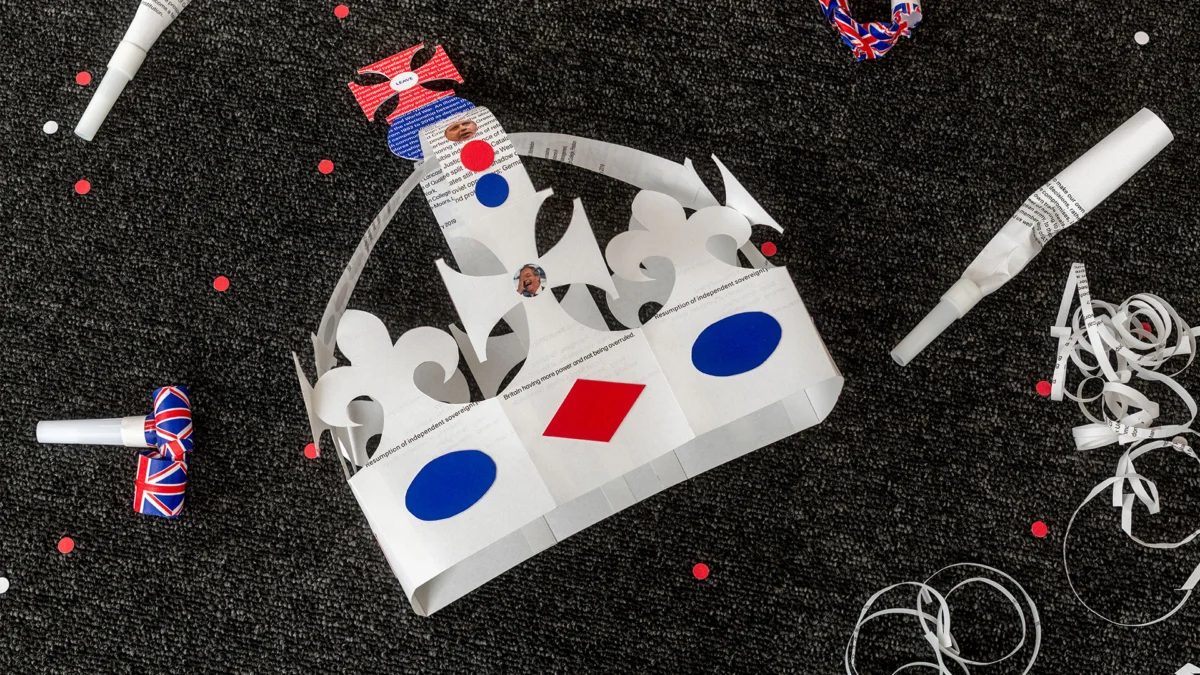
Titled The Other Side: Ten Years after the Referendum / Ten Designers Respond, the exhibition presents a series of provocative works born from the physical deconstruction of a 2020 publication. By repurposing "The Other Side: An Emotional Map of Brexit Britain"—originally published by GraphicDesign&—ten leading artists and studios have created a retrospective that is as much about the evolution of the British psyche as it is about the materiality of graphic design.
Main Facts: A Post-Mortem in Paper and Ink
The exhibition, which runs through Friday, June 26, 2026, serves as a creative post-mortem of the Brexit era. The central conceit of the project is "intertextuality"—the idea that new meaning can be derived from the literal and figurative destruction of old narratives.
When the original distributors of the 2020 book The Other Side suggested that the remaining stock be "pulped"—a standard industry term for destroying unsold books to recycle the paper—GraphicDesign& co-founder Lucienne Roberts saw an opportunity for a different kind of recycling. Rather than allowing these voices to be eradicated, the publishers invited ten designers to use the physical books as raw material.

The resulting collection includes a diverse array of media, from furniture and textiles to sculptures and typographic experiments. Each piece functions as a personal commentary on the state of the nation ten years after the vote, utilizing the benefit of hindsight to examine whether the "emotional map" of 2020 still holds true in the mid-2020s.
Chronology: From Ballot Box to Gallery Floor
To understand the significance of the Osh Gallery exhibition, one must trace the timeline of the UK’s emotional and political landscape over the last decade.
2016: The Seismic Shift
On June 23, 2016, the UK voted by 51.9% to 48.1% to leave the European Union. The immediate aftermath was characterized by shock, celebration, and a deep-seated polarization that split families, regions, and generations. The referendum did not merely change a trade agreement; it fundamentally altered the British identity.
2020: Capturing the Raw Emotion
Four years after the vote, the publishers at GraphicDesign& released The Other Side: An Emotional Map of Brexit Britain. The book was a monumental effort to document the lived experiences of people on both sides of the divide. It was designed to be an archive of perspectives, capturing the nuance that was often lost in the "Leave" vs. "Remain" binary. However, by 2020, the UK was also grappling with the onset of the COVID-19 pandemic and the final legalities of the withdrawal, making the book’s release a poignant moment of reflection amidst further chaos.

2026: The Ten-Year Retrospective
By 2026, the dust has largely settled on the legislative front, but the social and economic ripples of the referendum remain a central theme in British life. The decision to revisit the 2020 book was spurred by the realization that "pulping" the remaining copies would be a form of historical erasure. Instead, the "Ten Designers Respond" project was launched to see how the passage of time has reshaped those original 2020 perspectives.
Supporting Data: Deconstructing the "Emotional Map"
The exhibition features a prestigious roster of contributors, each bringing a unique disciplinary lens to the project. The participants include:
- Sarah Boris: Known for her bold typographic and flag-based works.
- Michael Marriott: A product designer whose work often explores the utility of found objects.
- Stefanie Posavec: A data illustrator who specializes in making complex information tangible.
- Casper Mueller Kneer Architects: Bringing a spatial and structural perspective to the medium of paper.
- F37® Foundry: Exploring the evolution of the written word and letterforms.
- Additional contributors: Ella Krispel, Hugh Miller, YiMiao Shih, Oyin Falade, Stella Jaques, and Yusuf Uddin (Store).
Notable Artworks
Among the most striking pieces in the gallery is a "conversation chair." Created from the structural elements of the books, the chair is designed to facilitate face-to-face dialogue—a literal seat for the "other side." This piece serves as a symbolic antidote to the digital echo chambers that many believe fueled the original divisions of 2016.
Another significant installation features curtains made from shredded pages. The designers took testimonies of opposing views from the 2020 book and shredded them into uniform strips, weaving them together. From a distance, the curtain appears as a cohesive, neutral texture; up close, the fractured sentences of hope, anger, and regret remain visible, suggesting that the national fabric is made of inextricably linked, yet fundamentally different, strands.

A third piece is a hanging textile-esque sculpture where the word "OUT" is woven from hundreds of paper strips. The work plays with the permanence of the word that defined the referendum, yet renders it in a fragile, ephemeral form that sways with the movement of visitors in the gallery.
Official Responses: Resisting the "Pulp"
The project’s philosophy is best articulated by the organizers themselves. Lucienne Roberts, co-founder of GraphicDesign& and a fellow of the Alliance Graphique Internationale, emphasized the importance of preservation through transformation.
"Our distributors got in touch, asking if we would like the few remaining copies of the book pulped," Roberts explained during the exhibition’s opening. "It was soon to be the 10-year anniversary of the vote and so, no, we didn’t want these voices eradicated—instead we wanted them to become something new."
This sentiment reflects a broader movement within the design community to treat political ephemera as vital historical records. By refusing to pulp the books, the publishers have asserted that even "failed" or "outdated" political discourse has value as a tool for future learning.

Representatives from Pentagram’s Osh Gallery noted that the exhibition has drawn a diverse crowd, ranging from design students to political historians. "The beauty of this project is that it takes a very heavy, often painful subject and makes it tactile," said a gallery spokesperson. "It allows people to engage with the referendum not through a news screen, but through the physical act of seeing how paper can be torn, folded, and rebuilt."
Implications: Design as a Mirror to National Identity
The The Other Side exhibition carries significant implications for how we process political trauma and national shifts through the arts.
1. The Role of the Designer as Historian
The exhibition suggests that graphic designers are not merely decorators of information but are active participants in history-making. By repurposing the 2020 book, these designers have acted as "editors of the past," choosing which elements of the Brexit debate to highlight and which to deconstruct.
2. Reflexivity in the Public Sphere
The project serves as a reminder of the importance of reflexivity. In a political climate often characterized by "doubling down" on beliefs, the act of taking a book of one’s own views and cutting it up requires a certain level of intellectual humility. The exhibition encourages visitors to reexamine their own 2016 beliefs with the "benefit of hindsight," asking: How has my map changed?

3. Materiality in a Digital Age
In an era where political debates happen largely in the ephemeral space of social media, the physical nature of this exhibition is a powerful statement. The weight of the paper, the smell of the ink, and the permanence of the printed word contrast sharply with the "delete" button of the digital world. The fact that these books were nearly destroyed (pulped) but were instead saved and transformed highlights the durability of human experience over political cycles.
4. A New Aesthetic for Discourse
Finally, the exhibition offers a glimpse into a post-Brexit aesthetic. It is an aesthetic of fragments, textures, and reconstructions. It suggests that the "Other Side" is no longer a distant enemy to be defeated, but a part of the same material from which the future must be built.
As the UK moves further into its second decade outside of the European Union, The Other Side: Ten Years after the Referendum stands as a testament to the power of design to heal, to provoke, and, most importantly, to remember.
Exhibition Details:
- Location: Osh Gallery, Pentagram London, 11 Needham Rd, London W11 2RP.
- Dates: Open now until Friday, June 26, 2026.
- Online: oshgallerylondon.com | Instagram: @oshgallerylondon