Resonance and Rupture: The Sonic Architecture of ‘La Bola Negra’
The journey from a completed "picture lock" to the prestigious red carpet of the Cannes Film Festival is typically a marathon of meticulous adjustments, often spanning several months of post-production. However, for the creative team behind La Bola Negra (The Black Ball), the latest magnum opus from directors Javier Ambrossi and Javier Calvo—affectionately known as "Los Javis"—this marathon was condensed into a high-octane thirty-day sprint.
Tasked with the monumental responsibility of crafting the soundscape for one of the most ambitious Spanish films in recent history, supervising sound designers Alejandro López and Anna Harrington faced a daunting challenge. They had to weave together three distinct historical periods, each requiring a unique sonic identity, while maintaining a cohesive emotional thread that honors the legacy of Spain’s most celebrated poet, Federico García Lorca.
Main Facts: A Sonic Race Against Time
La Bola Negra is not merely a film; it is a sprawling, multi-generational epic that bridges the gap between pre-Civil War Spain and the digital anxiety of the modern era. The film centers on the rediscovery of a lost play by Federico García Lorca, a narrative device that allows the directors to explore themes of queer identity, political repression, and the enduring power of art.
The sound design team, led by López and Harrington, had worked with Los Javis previously on the critically acclaimed series Veneno. That established rapport proved vital when they were given just four weeks to finalize the audio for a film that shifts between 1932, 1937, and 2017. The project required more than just technical proficiency; it demanded an intuitive understanding of the "Lorquian" universe—a world where the elements of nature (wind, earth, and water) are as much characters as the actors on screen.
The film’s premiere at Cannes marked a triumph for the Spanish film industry, signaling a new era of high-budget, artistically rigorous storytelling. The sound design has been cited by critics as a primary driver of the film’s immersion, transforming historical trauma and contemporary anxiety into a visceral auditory experience.

Chronology of Sound: Three Eras, Three Identities
To navigate the complex narrative of La Bola Negra, López and Harrington developed a tripartite sonic strategy. Each timeline was treated with a specific technical and emotional palette to reflect the psychological state of its protagonists.
1932: The Sound of Repression in Granada
The earliest timeline follows Carlos (played by Milo Quifes), a closeted young man in 1932 Granada attempting to gain entry into his father’s exclusive, members-only casino. In this segment, the sound design is intentionally expressive and heightened.
López and Harrington used sound to mirror Carlos’s internal agitation. The clink of crystal, the shuffle of cards, and the muffled whispers of the elite are amplified to create a sense of claustrophobia. This era serves as the "origin story" for the lost Lorca play, and the audio reflects the burgeoning tension of a society on the brink of collapse. The sound here is "thick" and emotional, leaning into the melodrama of Carlos’s struggle against a society that demands his invisibility.
1937: The Invisible War and Lorquian Chaos
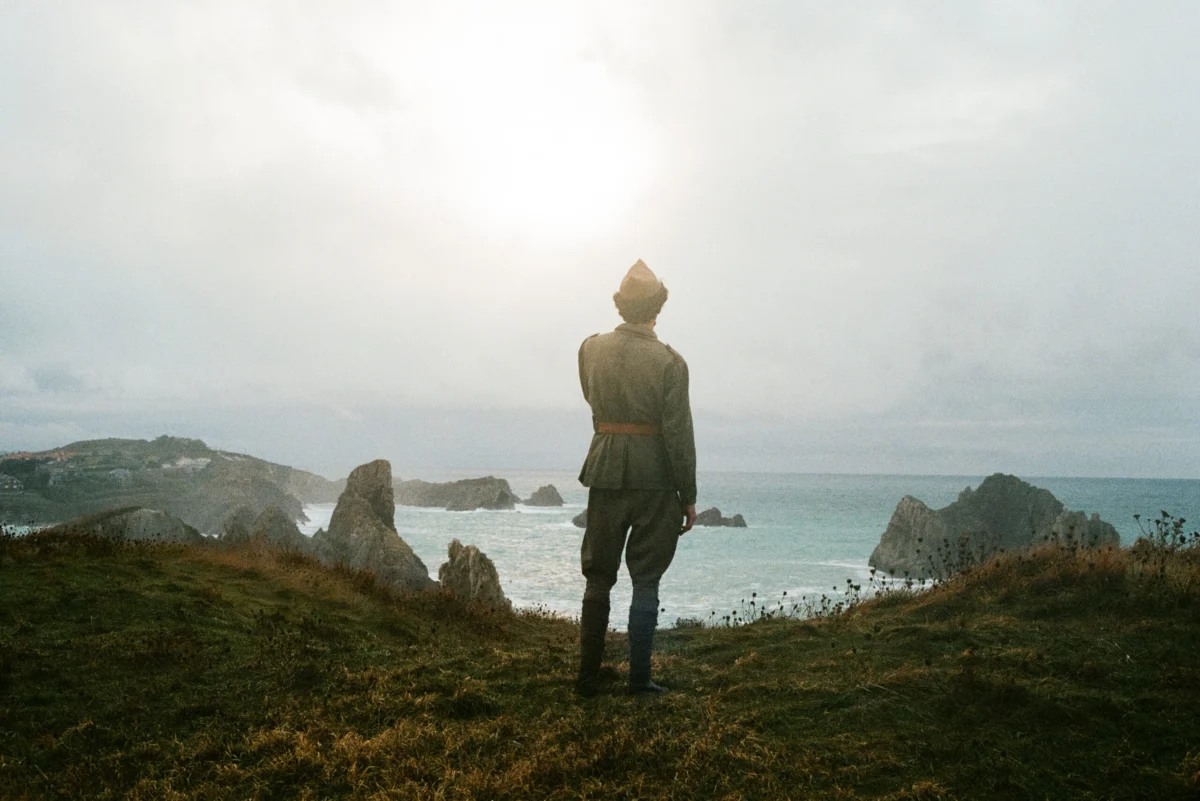
The second timeline, set during the height of the Spanish Civil War in 1937, focuses on Sebastian (Guitarricadelafuente). Sebastian is tasked with rescuing the lost play while navigating a dangerous romance with Rafael (Miguel Bernardeau), a former lover of Lorca himself.
In this section, sound becomes an "invisible storytelling partner." Set against the backdrop of the Battle of Santander, the designers opted to keep the violence largely off-screen. The "oppressive atmosphere," as López describes it, is built through a "strident tide" of distant gunshots, the rhythmic marching of fascist boots, and the low rumble of military vehicles.

Anna Harrington spent significant time sculpting the Automated Dialogue Replacement (ADR) for this section. The goal was not just clarity, but the creation of a "Lorquian chaos"—a tragic, poetic cacophony that threatens to drown out the intimate whispers of the two lovers.
2017: Digital Anxiety and Modern Noise
The contemporary storyline follows Sebastian’s grandson, Alberto (Carlos González), as he uncovers the play his grandfather died to protect. To contrast with the historical segments, Harrington and López designed the 2017 audio to be "irritatingly digital."
Alberto is a character defined by anxiety, and his world is one of constant sensory overload. The soundscape is filled with the "jitter" of notifications, the hum of city traffic, and a persistent digital hiss. Harrington noted that Alberto "cannot think straight" because he is perpetually surrounded by noise. This sonic clutter represents the modern struggle to find meaning and silence in an age of information saturation.
Supporting Data: The Technical Artistry of Contrast
The technical execution of La Bola Negra relied heavily on the contrast between film formats and their corresponding audio textures. The historical segments were shot on 35mm film, which Harrington suggests "asks for a certain kind of sound."
35mm vs. 4K Audio Palettes
- 35mm (1932/1937): The sound designers allowed the audio to be "unbounded" and more expressive. The textures are warmer, utilizing analog-style resonances that mimic the grain of the film.
- 4K Digital (2017): For the contemporary scenes, the sound was designed with surgical precision. Every object in the frame has a corresponding, sharp sound, creating a hyper-realistic but exhausting environment for the audience.
The "Telluric" Resonance
One of the most praised sequences in the film occurs when Sebastian finds a wounded Rafael in a hospital. The scene is devoid of music, relying instead on what López calls "telluric" sounds—noises that seem to emanate from the Earth itself.

The team utilized "ASMR-style" recording techniques to capture the close-up sounds of breathing and skin-on-skin contact. To add a layer of Lorquian mysticism, they mixed in a low-frequency rumble and the resonance of the Sierra Nevada winds. This "leitmotif" of wind and waves serves as a bridge between the physical world and the poetic spirit of Lorca that haunts the film.
Official Responses: A Collaborative Triumph
The success of the film’s sound design was predicated on an unprecedented level of collaboration between departments, forced by the tight thirty-day deadline. In interviews, the creative team emphasized that the project’s speed required a total lack of ego.
"Everybody worked like 200%, helping each other," Anna Harrington told IndieWire. She described a constant exchange of ideas between herself, López, composer Raül Refree, and editor Alberto Gutiérrez. "There was no time at all, so we were calling the editor constantly to see how the cuts were evolving in real-time."
López echoed this sentiment, noting that the "Lorquian universe" provided a clear roadmap for their creative choices. "In Lorca’s universe, there are constant references to sound—the ocean, the wind, the sound of the moon. We used these as our North Star."
The directors, Javier Ambrossi and Javier Calvo, have publicly praised the sound team for capturing the "epic yet intimate" scale of the story. They noted that without the immersive audio, the transitions between the three timelines might have felt jarring; instead, the sound acts as the "connective tissue" of the narrative.

Implications: A New Standard for Spanish Cinema
The release of La Bola Negra and the critical reception of its technical craft have significant implications for the future of Spanish cinema and the role of sound design in international festivals.
1. The Elevation of Sound Design
Traditionally, sound is the "invisible" art of cinema, often overlooked in favor of cinematography or acting. However, the buzz surrounding La Bola Negra has put López and Harrington’s work at the forefront of the conversation. Their ability to deliver a world-class soundscape in thirty days sets a new benchmark for what is possible in post-production.
2. The Global Reach of "Los Javis"
With La Bola Negra, Ambrossi and Calvo have transitioned from television icons to major players in global cinema. The film’s success at Cannes and its subsequent theatrical run demonstrate that their brand of "emotive, queer, and historically grounded" storytelling has a massive international audience.
3. Reclaiming Historical Narratives
By centering the film on a lost Lorca play, the production has sparked a renewed interest in Spain’s "Historical Memory" laws and the cultural trauma of the Civil War. The use of sound to evoke the "oppressive atmosphere" of the 1930s serves as a powerful reminder of the silencing of queer voices in the past—a silence that the film’s sound design ironically and effectively breaks.
La Bola Negra is currently playing in theaters worldwide. It stands as a testament to the fact that even when the clock is ticking, the marriage of technical expertise and poetic intuition can produce a masterpiece that resonates long after the credits roll.