
The Architecture of a Crisis: How Game Design Decoded the Mathematics of a Pandemic
By [Journalist Name]
Special Report
Six years after the initial shockwaves of the COVID-19 pandemic reshaped global society, a retrospective analysis reveals an unexpected intersection between public health communication and interactive entertainment. While world leaders and economists struggled to convey the gravity of exponential viral growth to a skeptical public, a group of game designers, led by industry veteran Raph Koster, turned to the mechanics of simulation to bridge the gap between abstract statistics and visceral reality.
This report examines the genesis of "pandemic gaming" as an educational tool, the mathematical realities that necessitated its creation, and the lasting implications of using systems design to prepare for future biological threats.
Main Facts: The "Systemic" Failure of Public Perception
In late 2019 and early 2020, a fundamental disconnect emerged between epidemiological data and public understanding. While "numerate" professionals—statisticians, Wall Street quants, and game designers—observed the looming shadow of an exponential curve, the general population struggled to grasp the implications of a virus with a high $R$ value (reproduction number) and a significant Infection Fatality Rate (IFR).
Raph Koster, the visionary behind Ultima Online and Star Wars Galaxies, became a vocal advocate for systemic clarity. Observing the discourse on social media, Koster noted that the public was "utterly clueless about the mathematics of how a highly infectious virus spread." His early projections, which suggested millions could die based on a low-average death estimate of 0.4% and a 60% herd immunity threshold, were met with widespread derision and denial.
The failure was not merely one of communication but of "ludic literacy"—the ability to understand how complex variables interact within a system. To solve this, Koster proposed a "design sketch": a simple, interactive simulation that would allow users to "feel the challenges in their bones."
Chronology: From Facebook Sketch to Global Simulation
The evolution of these educational tools moved with the same rapid velocity as the virus itself. The following timeline outlines the transition from a theoretical design to a global educational resource:
- November 2019: Early reports of a novel respiratory illness in China begin circulating in niche professional circles.
- March 24, 2020: Raph Koster publishes a "design sketch" on Facebook. He outlines a game involving "little circles on a plain field" that bounce and infect one another, emphasizing the importance of humanizing data by giving each circle a name and a statistical chance of a comorbidity.
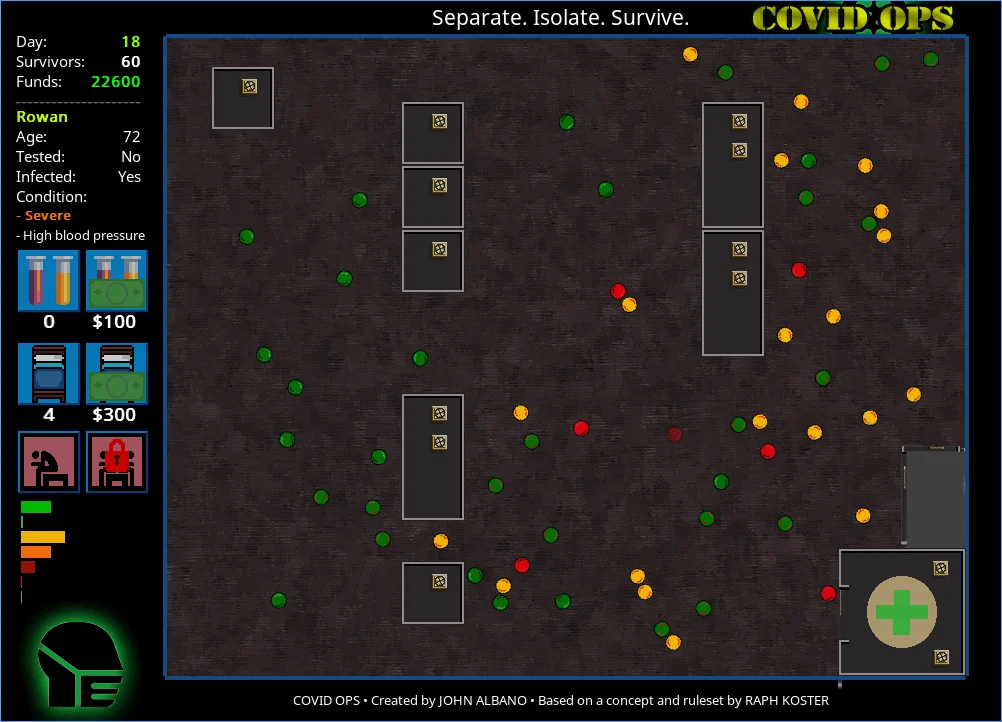
- March 30, 2020: Just six days after Koster’s post, developer John Albano releases Covid Ops on Itch.io. The game allows players to manage resources, test populations, and witness the direct impact of age and health conditions on survival rates.
- April 6, 2020: A team led by Khail Santia in Cebu City, Philippines, enters "Jamdemic 2020," developing the first iteration of In the Time of Pandemia.
- July 2020: In the Time of Pandemia launches on Newgrounds. Developed by a team of 48 contributors, including mathematical epidemiologists and medical professionals, the game tops the charts and becomes a viral sensation in the Pacific Rim.
- 2021–2025: These simulations are integrated into college curricula and used by public health advocates to explain "flattening the curve."
Supporting Data: The Math of Mortality
The necessity of these games was rooted in the grim mathematics of the pandemic, which Koster and his peers tracked via complex spreadsheets. The data highlights why the "soft" response of early 2020 led to catastrophic outcomes.
The Myth of the "Low Risk" Population
One of the primary goals of the simulations was to debunk the idea that only a small sliver of the population was at risk. According to data integrated into the games from the American Heart Association and the ADA:
- Hypertension: Approximately 108 million adults (45%) in the United States have high blood pressure.
- Diabetes: Over 34 million Americans (10.5%) are diabetic, with another 88 million being pre-diabetic.
- Obesity: Roughly 42.4% of the U.S. adult population is classified as obese.
When these factors are combined with age-related risks, the "vulnerable" population ceases to be a minority. Koster’s simulations demonstrated that because the disease spreads primarily within households, protecting these groups required either total isolation of the vulnerable or a forceful, concertedly managed lockdown of the entire social unit.
Final Toll vs. Early Predictions
Koster’s early math, once laughed at by social media critics, proved tragically accurate.
- U.S. Estimated Toll: 1.2 to 1.4 million deaths.
- Global Estimated Toll: 15 to 28.5 million deaths.
- The "Soft" Response: Koster argues that the economic and educational hits of lockdowns were exacerbated by their leniency. A "harder" initial response, the math suggests, could have shortened the duration of the crisis and saved millions more lives.
Official Responses: Validation from the Medical and Academic Communities
Unlike many commercial "plague" games, Covid Ops and In the Time of Pandemia were subjected to rigorous peer review and professional validation. The response from the health and education sectors was overwhelmingly positive, noting the games’ ability to teach "systems thinking."
Dr. Mariane Faye Acma, a resident physician who consulted on In the Time of Pandemia, emphasized the game’s role in developing critical decision-making skills. "The game will make players realize how challenging the work of the health sector is," she stated. "You decide who is high risk, who needs to be isolated, and how much funds to allocate."
Gregg Victor Gabison, Dean of the University of San Jose-Recoletos, utilized the simulation in a classroom setting. He noted that the game provided a "storyline that connects with reality," allowing students to engage with the crisis through a lens of substance rather than just headlines.
In the Philippines, the game’s viral success led to extensive press coverage across the Pacific Rim, including IGN Southeast Asia and The Star, further solidifying the role of indie developers as essential contributors to public health messaging.
Implications: The "Ludenic" Future of Public Health
The legacy of the 2020 pandemic games extends beyond the COVID-19 era. As the world faces new threats, such as the emergence of the H5N5 bird flu in humans, the lessons learned from these simulations remain vital.
1. Games as "Visceral" Empathy Engines
The inclusion of names from "baby books" for each dot in Koster’s design was a masterstroke of psychological engineering. By turning a data point into "Rowan, age 72," the simulations forced players to confront the human cost of their policy decisions. This "visceral understanding" is something that a flat bar graph can rarely achieve.
2. The Necessity of Systems Literacy
The pandemic revealed a global deficit in systems thinking. Most people view events linearly; however, viruses operate exponentially. Games are uniquely positioned to teach this because they are, by definition, engines of interaction and feedback loops. Moving forward, "systemic literacy" may become as important as traditional literacy in public health education.
3. The Developer as a First Responder
The stories of John Albano and Khail Santia illustrate that during a global crisis, the "work" of a game developer can be a form of service. Santia noted that the development process allowed him to "transcend the chaos outside," creating a "thread connecting a diversity of talents." For the developers, making the game was a way to process the trauma of the pandemic; for the players, it was a way to survive it.
Conclusion: No Retreat to the Old Ways
As Raph Koster reflected in his retrospective, there is no returning to the pre-pandemic status quo. The "World War" of our generation has been fought not with ballistics, but with biology and information. The simulations born in the spring of 2020 serve as a digital archive of our struggle to understand a complex enemy.
In the face of future outbreaks, these games stand as a testament to the power of human ingenuity. They remind us that when the math is terrifying and the wall of denial is high, the best way to reach people is to let them play through the problem, one bouncing circle at a time.
As Koster concludes, "There is only through." And sometimes, the path through is paved with pixels and spreadsheets.



Leave a Comment