The Architecture of Memory: Christian Quintin and the Evolution of Visionary Surrealism
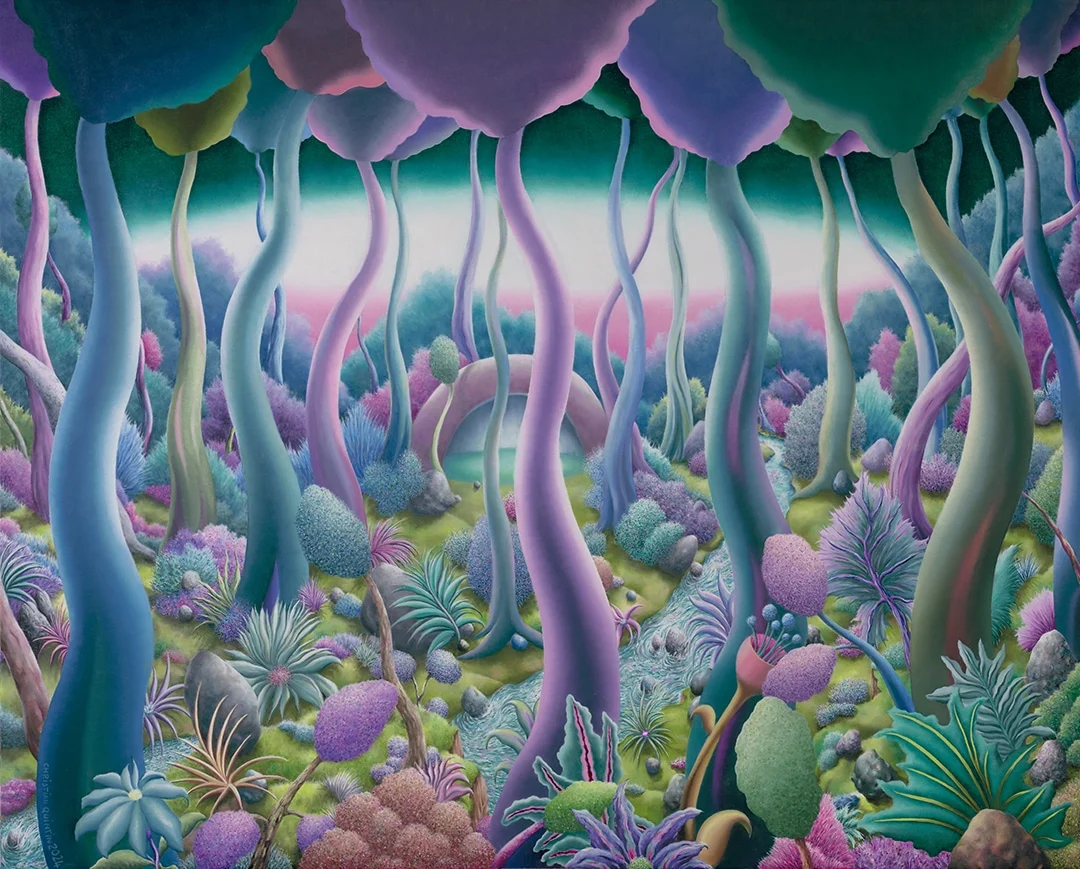
In an era of contemporary art often defined by rapid-fire digital execution and conceptual irony, the work of Christian Quintin stands as a profound anomaly. For over four decades, the French-born, California-based artist has cultivated a visual language that bypasses the intellect to speak directly to the pre-verbal psyche. Quintin does not merely paint what he sees; he maps the cartography of human emotion, blending the rugged coastlines of his childhood Brittany with the golden, rolling hills of Northern California. His portfolio represents a "visionary continuum"—a seamless integration of classical discipline and surrealist exploration that challenges the modern observer to slow down and rediscover the restorative power of beauty.

I. Main Facts: The Synthesis of Two Worlds
Christian Quintin’s body of work is characterized by a dual commitment to technical virtuosity and philosophical depth. Working across diverse media—including oil, ink, graphite, and pastel—Quintin has developed a style that critics frequently categorize as "Romantic Surrealism." However, his work defies such easy labels. Unlike the jarring, often nightmarish imagery of traditional Freudian surrealism, Quintin’s compositions are harmonious, seeking to reconcile the "inner landscape" of the mind with the "outer landscape" of the natural world.
His practice is defined by extreme patience. Some of his most celebrated pen-and-ink works, such as The Aviary or La Porte Ouverte, require six to seven months of meticulous crosshatching and layering. This slow-burn approach results in images that possess a holographic quality: a face that dissolves into a forest canopy, a river that flows with the rhythm of a circulatory system, or a landscape where the clouds hold the soft features of a dreaming god. Quintin’s central philosophy is a rejection of the didactic; he offers no manifestos or slogans, instead inviting the viewer to "read his art as one would read poetry," allowing for a personal, intuitive wandering through the imagery.

II. Chronology: From the Armorican Coast to the Pacific Slope
The trajectory of Quintin’s life is essential to understanding the atmospheric layers of his work. Born in 1957 in Saint Brieuc, a port town on the northern coast of Brittany, Quintin was raised amid a landscape steeped in myth and melancholy. The region’s ruined castles, storm-battered cliffs, and the solitary L’Île de la Comtesse provided his initial visual vocabulary. These early impressions of nature’s grandeur and the haunting presence of the past remain a recurring motif in his work, appearing as "mythic points of return."
In 1975, Quintin moved to Paris to study at the prestigious École des Beaux-Arts. This period was foundational, tempering his romantic instincts with the rigors of classical discipline. Under the tutelage of masters, he perfected the draftsmanship and control of form that allow him to render impossible dreams with photographic conviction. While in Paris, he absorbed the legacies of French Symbolists and Surrealists, yet he found himself more drawn to the revelatory power of the image rather than the shock tactics of the avant-garde.

The most significant pivot in his career occurred in 1981 when he relocated to Northern California. Settling in the vineyards and valleys of Sonoma County, Quintin encountered a landscape that mirrored the spiritual resonance he felt in Brittany but offered a new, expansive light. This geographic shift unified his practice. The sacred ecology of the American West became a second vocabulary, leading to his "Kaleidoscopic Consciousness" series, where the boundaries between the human form and the botanical world are entirely erased.
III. Supporting Data: The Mechanics of "Mental Landscapes"
Quintin’s work is often divided into two primary modes: his intricate surrealist compositions and his luminous, emotive landscapes. However, a closer analysis reveals these are two sides of the same coin.

Technical Precision as Meditation
Quintin’s surrealist works, often executed in pen and ink, are marvels of technical endurance. In The Aviary, Quintin’s own visage emerges from a crystal structure, with his neck transforming into a tree trunk and his hair unfurling into a leafy canopy. The six-month production cycle for this piece highlights his belief that "intuition comes first, but technique must follow." This labor-intensive process acts as a form of meditation, where each stroke is a negotiation between the artist’s spirit and the physical medium.
The Anthropomorphic Nature
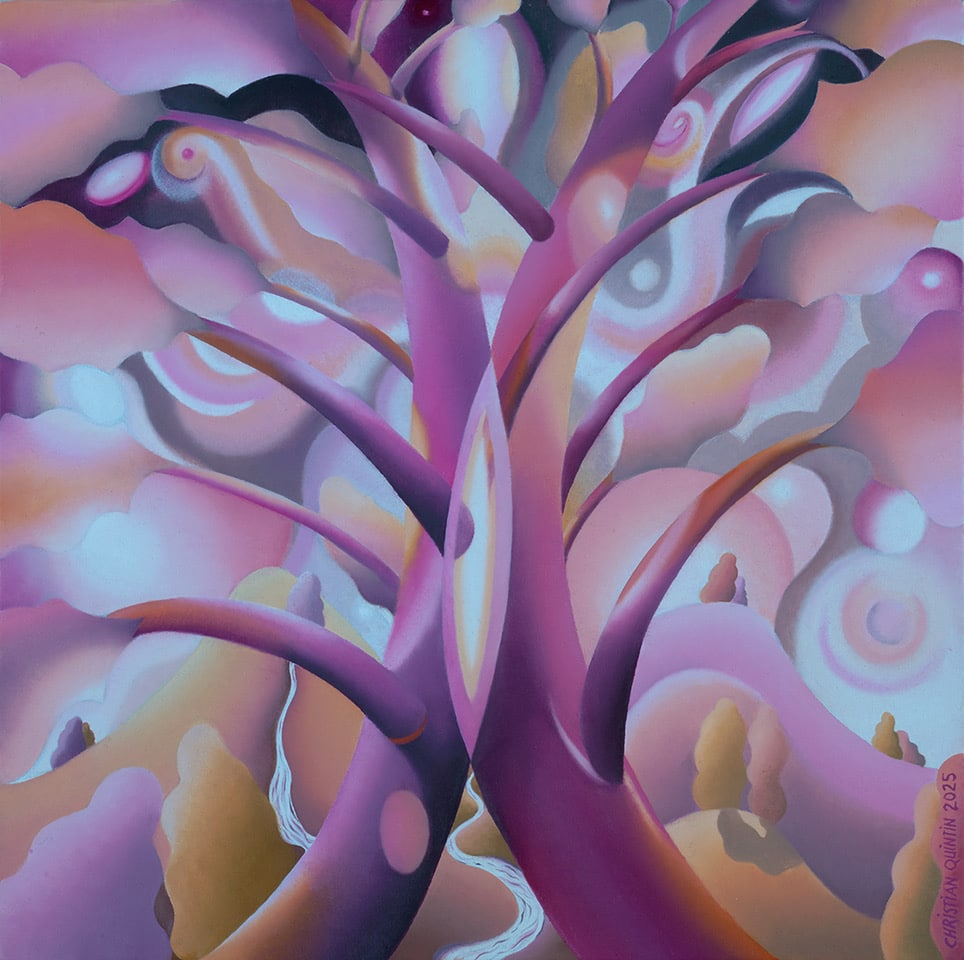
In his landscapes, such as Leaves of Absence or Les Amants (The Lovers), Quintin employs a technique of "emotional terrain." Trees are not mere biological specimens; they sway with the grace of dancers or lean into one another in an embrace. In West Sonoma County, a floating face emerges from the cloud line, its lips forming an island in a sea of mist. This recurring theme—the "eruption of life"—suggests a philosophy wherein consciousness is not limited to humans but is an inherent property of the soil, the water, and the air.

Color as Narrative
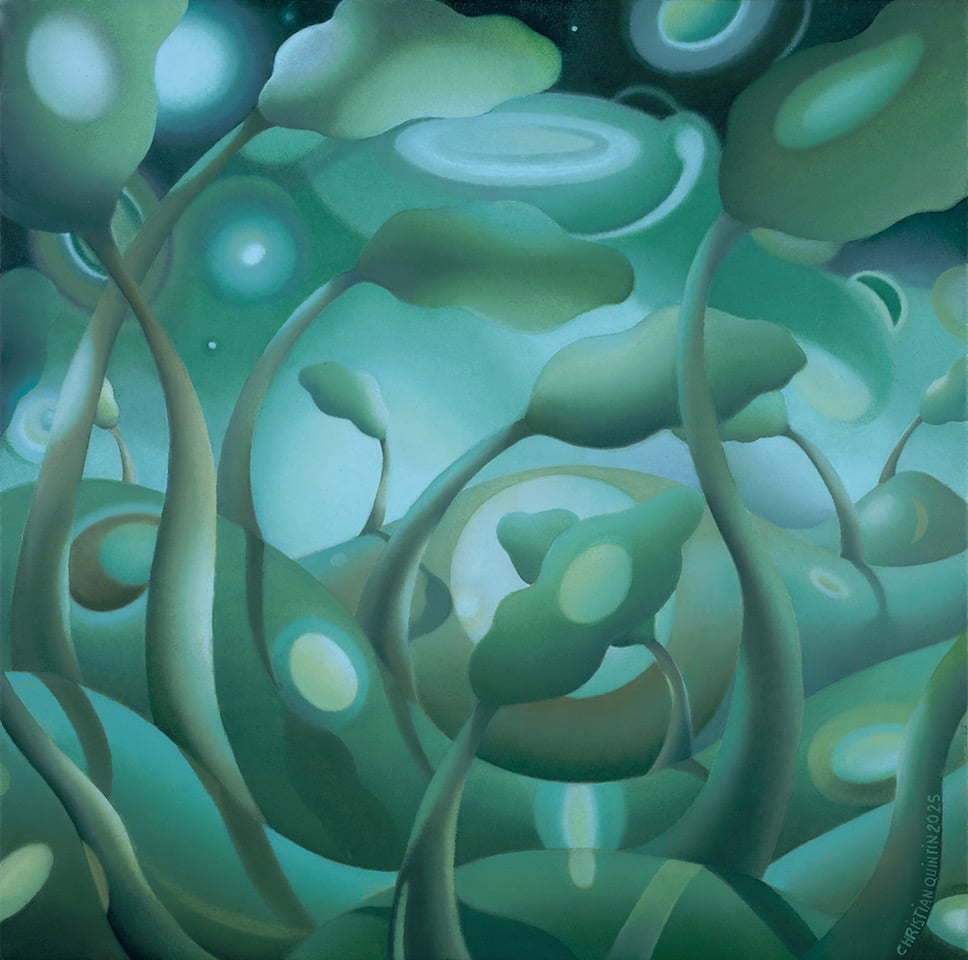
Quintin’s use of color is rarely literal. In A Lake Color of Emeralds, he describes a sky of brown-orange and violet over an olive-green sea. By detaching color from its expected naturalistic role, he forces the viewer to engage with the "feeling" of the scene rather than its geographic accuracy. This approach aligns him with the Symbolist tradition, where color and shape serve as metaphors for the internal state of the soul.
IV. Official Responses: Critical Acclaim and Curatorial Perspective
For decades, Quintin’s career was a "slow-burn" success within the California art scene. He received early recognition with the Grumbacher Award in 1987 and an Award of Excellence from the California State Fair in 1990. However, his entry into the international "visionary" canon was solidified by his association with the Vorpal Gallery in 1999. The Vorpal Gallery was famous for introducing M.C. Escher to the American public, and by representing Quintin, they positioned him as a direct successor to the lineage of artists who combine mathematical precision with metaphysical inquiry.

Critics have consistently pointed to the "redemptive" quality of his work. Writing for the Press Democrat, Dan Taylor characterized his style as "emerging beauty," while reviewer Suzanne Munich aptly titled her analysis "Mental Landscapes." A 2022 review by the Calabi Gallery touched upon a vital cultural nerve, stating: "In an era largely devoid of it, his work is beautiful. We could all use more beauty in our lives." This sentiment highlights a growing critical consensus that Quintin’s work serves as a necessary antidote to the cynicism of the contemporary art market.
In the 2020s, his representation by Lorin Gallery (Los Angeles/Paris) has brought his work to a global stage. His appearances at KIAF in Seoul and Art Central in Hong Kong demonstrate that his "symbolic language" transcends cultural boundaries, finding resonance in both Eastern and Western aesthetic traditions.
V. Implications: Art as Sanctuary and Resistance
The rise of Christian Quintin’s profile in the international art world suggests a shift in public appetite. As digital fatigue and social fragmentation increase, there is a renewed interest in art that requires "slow looking" and offers a "sanctuary for the soul."
A Bridge Between Traditions
Quintin serves as a bridge between the European Surrealist tradition and the Northern California Visionary Art movement. While the latter often leans toward the psychedelic and the chaotic, Quintin brings a classical restraint and a "sacred geometry" to the exploration of consciousness. He proves that one can be a visionary without abandoning the rigors of the Beaux-Arts tradition.
Beauty as a Form of Defiance
Perhaps the most significant implication of Quintin’s work is his unapologetic embrace of beauty. In modern art theory, "beauty" was often dismissed as decorative or intellectually shallow. Quintin’s work argues the opposite: that beauty is a form of resistance against the speed, spectacle, and irony of modern life. By creating images that require months of attention, he demands a reciprocal attention from the viewer, fostering a moment of stillness that is increasingly rare.
Conclusion: The Echo of the Invisible
Christian Quintin’s legacy is one of "reentry." He does not offer a detour from reality, but a way back into its hidden dimensions—the parts of existence that we feel when standing under a storm-lit sky or staring into the depths of a forest. As he prepares for upcoming exhibitions at the Morrison Gallery in Connecticut and continues his work in the quiet hills of Sonoma, Quintin remains a steadfast guardian of the "intimate mystery."
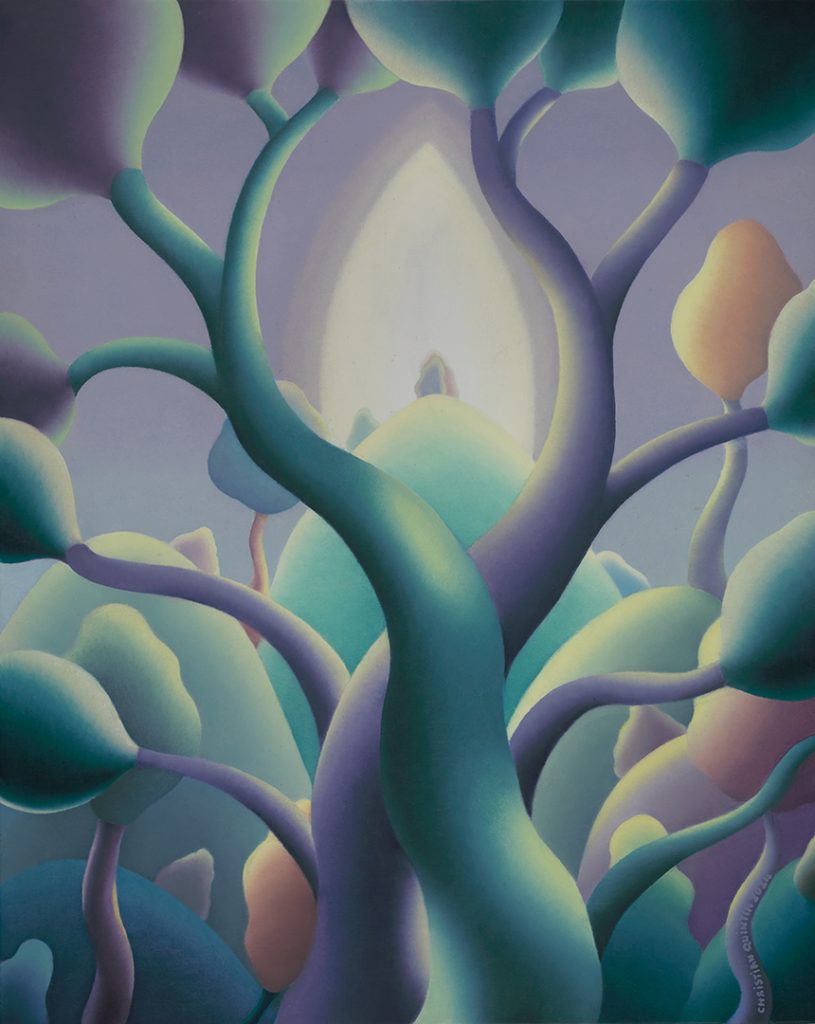
His career serves as a testament to the fact that the art world eventually catches up to those who remain true to their internal compass. For Quintin, the message is simple: art should not tell us what to think; it should give us the space to feel. In doing so, he has created a body of work that acts as a "wondrous sanctuary," reminding us that the most profound landscapes are the ones we carry within ourselves.