
The Concrete and the Petal: Chris ‘Daze’ Ellis and the Eternal Pulse of New York City
NEW YORK — In the hallowed, white-walled sanctuary of the PPOW Gallery, a bridge is being built between the grimy, adrenaline-fueled subway tunnels of the 1970s and the sophisticated contemporary art world of the 21st century. Chris “Daze” Ellis, a foundational figure in the graffiti movement that redefined urban aesthetics, has returned with his third solo exhibition, Orchid Rain on the Underground.
Running through April 25, 2026, the exhibition is more than a mere collection of new works; it is a sprawling, multimedia odyssey that serves as both a memoir of a vanished New York and a manifesto for its enduring creative spirit. Through a series of large-scale paintings, a site-specific mural, and an immersive installation, Daze demonstrates how a practice born in the shadows of train yards has matured into a meticulous, world-class studio discipline.
Main Facts: A Five-Decade Evolution on Display
Orchid Rain on the Underground represents a pinnacle in the career of Chris Ellis, known globally by his moniker "Daze." The exhibition is characterized by a sophisticated duality: it harnesses the raw spontaneity of the 1970s and 80s graffiti movement while showcasing a technical proficiency honed over fifty years of professional practice.
The show is structured around three primary pillars:
- New Paintings: A series of works that blend urban realism with lyrical abstraction, utilizing both acrylic and spray paint.
- Site-Specific Mural: A transitionary work that brings the outdoor "all-city" aesthetic into the interior gallery space, physically guiding viewers through the narrative of the exhibition.
- Multimedia Installation: A sensory-rich environment featuring a light-up dance floor, disco balls, authentic subway seating, and a curated soundtrack that encapsulates the nightlife of Daze’s youth.
At the heart of the exhibition is the theme of resilience. Daze explores how the "bygone era" of 1980s New York—often remembered for its crime and decay—was simultaneously a fertile ground for unprecedented artistic innovation. By juxtaposing images of urban rubble with vibrant, technicolor orchids, Daze suggests that beauty is not merely a byproduct of order, but often a defiant response to chaos.
Chronology: From the High School of Art and Design to the Global Stage
To understand the weight of Orchid Rain on the Underground, one must trace the trajectory of Chris Ellis’s life, which mirrors the evolution of the graffiti movement itself.
The Formative Years (1962–1976)
Born in Brooklyn in 1962, Ellis grew up during a period of profound fiscal and social crisis in New York City. However, for a young artist, the city was a vast, unclaimed canvas. In the mid-1970s, while attending the prestigious High School of Art and Design, Ellis found himself at the epicenter of a burgeoning subculture. He was mentored and inspired by the first generation of "style masters," including Blade, Lee Quiñones, and PHASE 2. During these years, the subway system became his primary medium, and the "Daze" moniker began to appear on the sides of train cars moving through the five boroughs.
The Nightlife as a Laboratory (1970s–1980s)
As Daze established his reputation on the tracks, his social and artistic world expanded into the burgeoning club scene. He became a fixture at legendary venues such as the Lit Lounge in the East Village, Danceteria on West 21st Street, and the Mudd Club in Tribeca. These spaces were vital "nerve centers" where the boundaries between street art, punk rock, hip-hop, and fine art were blurred. It was in these clubs that Daze began to see his work not just as a localized act of rebellion, but as part of a broader dialogue with the history of art.
The Studio Transition (Early 1980s–Present)
By the early 1980s, Daze began a deliberate transition from the ephemeral nature of subway tagging to the permanence of the canvas. Unlike many of his peers who struggled to adapt to the gallery system, Daze embraced the studio practice with a scholarly intensity. He began to draw connections between his work and the traditions of early 20th-century American realism, eventually leading to his current status as a bridge between the "old school" and the contemporary vanguard.
Supporting Data: Stylistic Synthesis and Key Works
The works in Orchid Rain on the Underground are notable for their complex layering of influences. Daze does not merely paint "graffiti on canvas"; he synthesizes the grit of the Ashcan School with the fluidity of Abstract Expressionism.
The Influence of the Ashcan and WPA
Daze’s renderings of New York’s infrastructure—train car interiors, dark tunnels, and flickering stations—owe a debt to John Sloan and Reginald Marsh. Like the Ashcan School artists of the early 1900s, Daze finds dignity in the mundane and the "ugly." His paintings are psychological portraits of the city’s anatomy, capturing the specific lighting and atmosphere of the underground.
Lyrical Abstraction and Gesture
Simultaneously, the exhibition reveals a deep engagement with the likes of Joan Mitchell and Willem de Kooning. Daze utilizes gestural swaths of spray paint to create a sense of movement and "lyrical abstraction." This is most evident in his floral motifs, where the spray can is used not to tag a name, but to evoke the delicate, ethereal quality of an orchid petal.
Featured Work: ‘Gem Spa In the 80s’ (2025)
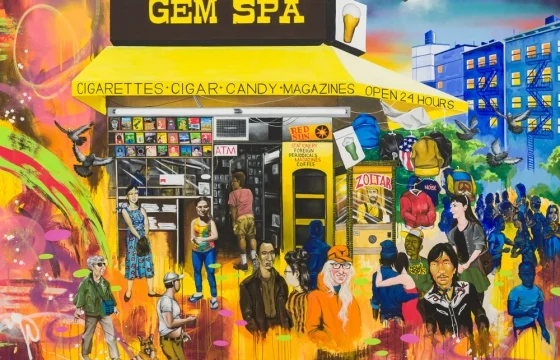
A centerpiece of the exhibition is the large-scale painting Gem Spa In the 80s. This work serves as a historical document, depicting the iconic newspaper stand and candy store that once stood at the corner of St. Mark’s Place and Second Avenue.
- Cultural Context: Gem Spa was famously described by Allen Ginsberg as a "nerve center" of the city.
- The Composition: Daze populates the scene with figures who were instrumental to his own development. Viewers can spot the critic and curator Carlo McCormick and the late artist Martin Wong emerging from the crowd.
- Symbolism: The painting acts as a "memorial" to a New York that has been largely erased by gentrification, yet Daze paints it with a vibrancy that suggests its ghost still haunts the current streets.
Official Responses and Curatorial Context
PPOW Gallery has positioned this exhibition as a vital correction to the narrative that graffiti was a fleeting trend. In their curatorial statement, the gallery emphasizes that Daze’s work "affirms the continued relevance of those figures and places" that defined the 80s.
Critics have noted that the exhibition’s title, Orchid Rain on the Underground, perfectly encapsulates the artist’s current headspace. The "underground" refers to both the literal subway and the subculture, while the "orchid rain" represents the infusion of beauty, growth, and organic life into a mechanical, concrete world.
Art historians viewing the preview have praised the multimedia installation in the gallery’s final room. By combining actual subway car seats with a curated track of house, disco, and hip-hop, Daze is credited with creating a "composite scene" that allows younger generations to experience the sensory overload of his youth. This installation is not merely nostalgic; it is an educational tool that contextualizes the paintings, showing the environment from which the brushstrokes (and spray strokes) were born.
Implications: The Legacy of the "All-City" Artist
The implications of Daze’s latest exhibition extend far beyond the walls of PPOW. As New York City continues to evolve into a more polished, corporate version of itself, the work of artists like Daze serves as a "cultural heartbeat" that refuses to be silenced.
Preservation of Subculture History
By including figures like Martin Wong and Carlo McCormick in his paintings, Daze is engaging in a form of visual historiography. He is ensuring that the architects of the downtown scene are remembered not just in textbooks, but as living, breathing components of the city’s aesthetic fabric.
The Validation of the Street Aesthetic
Orchid Rain on the Underground further solidifies the transition of graffiti from "vandalism" to a sophisticated genre of fine art. Daze’s ability to move between a site-specific mural on a gallery wall and a detailed, studio-bound canvas demonstrates that the "energy" of the street can be harnessed without losing its edge.
Hope Amidst Destruction
Perhaps the most profound implication of the exhibition is its message of optimism. In a world currently facing its own set of "urban rubble"—from economic inequality to social fragmentation—Daze’s flowers ascending from heaps of trash serve as a poignant metaphor. He suggests that the creative spirit is a perennial organism; it may be buried under the weight of the "underground," but it will always find a way to bloom when the "rain" falls.
As the exhibition continues through 2026, it stands as a testament to Chris "Daze" Ellis’s enduring mastery. He remains a quintessential New York artist, one who has never stopped exploring the daily life of his city, and who continues to find the extraordinary within the ordinary. For those who walk through the doors of PPOW, the message is clear: the New York of the 70s and 80s isn’t dead; it has simply evolved, much like Daze himself.



Leave a Comment