
The Enduring Enigma of Kiraz: A Deep Dive into HârnWorld’s Lost Dwarven Citadel
FOR IMMEDIATE RELEASE
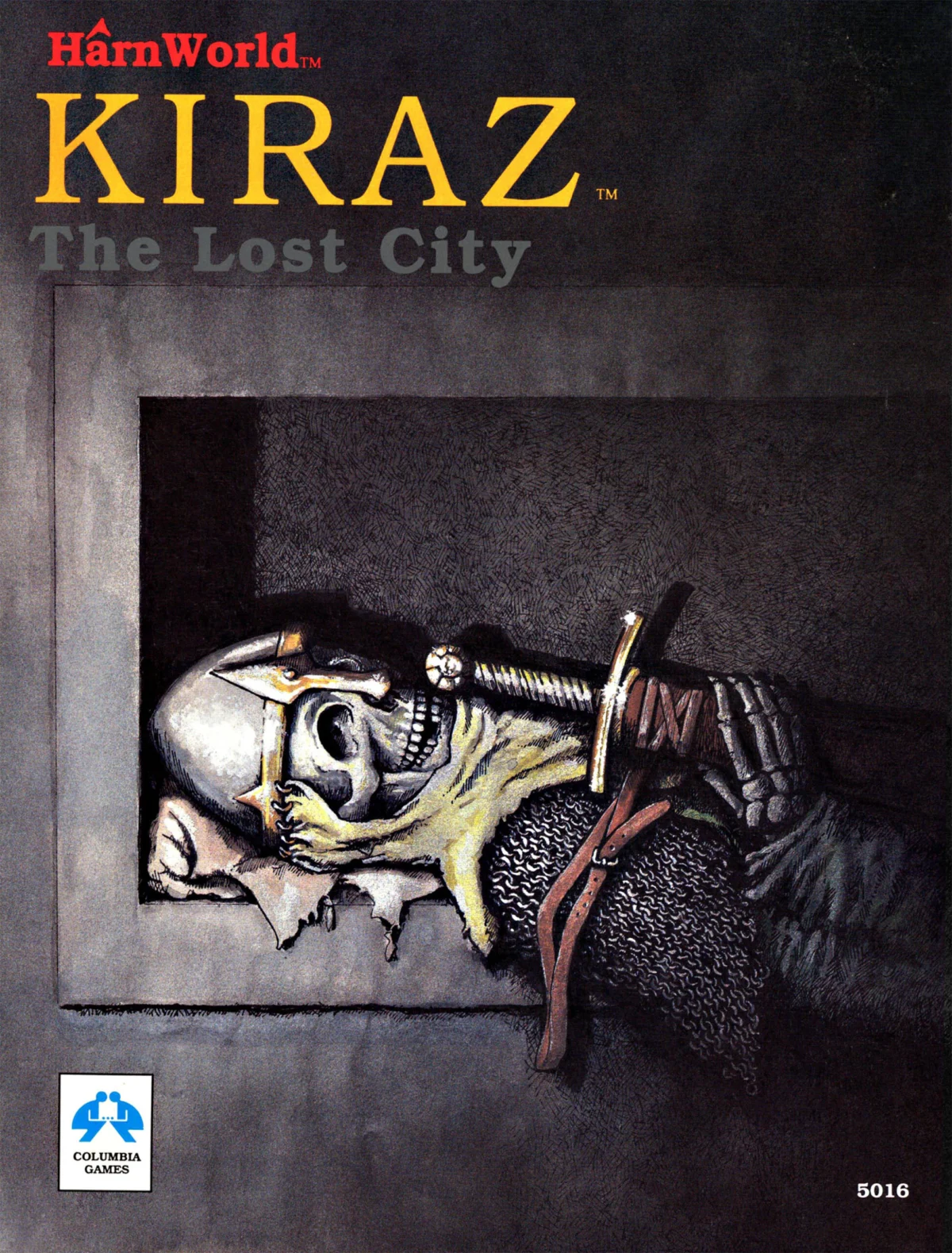
[City, State] – [Date] – In the rich tapestry of tabletop role-playing games, certain supplements stand as enduring testaments to imaginative world-building, even as they spark fervent debate over their practical utility. Among these is Kiraz: The Lost City, a HârnWorld module from Columbia Games, originally published in 1989. While universally lauded for its breathtaking detail and meticulous design, it remains a fascinating paradox, famously described as akin to "starving yourself for three days, and then eating a pecan" – a tantalizing taste of grandeur that ultimately leaves one yearning for more.
This article delves into the historical context, intricate content, and lasting implications of Kiraz: The Lost City, analyzing its unique position within the HârnWorld canon and the broader landscape of RPG supplement design.
Product Overview and Core Contradiction
Kiraz: The Lost City emerges from the creative mind of N. Robin Crossby, a foundational figure in the HârnWorld universe. Though ostensibly the second adventure in the In Search of Panaga trilogy of modules, its true identity, and indeed its enduring appeal, lies in its function as a detailed sourcebook for the eponymous lost dwarven city. The module’s genesis, as penned by Crossby himself in its preface, reveals a pragmatic convergence of creative and commercial pressures: "It was like this: Columbia wanted me to do Kiraz, and I wanted to complete the next volume of In Search of Panaga. Both modules were late. So, I thought, why not set the Horns of Ikarus in the Lost City?" This candid admission immediately signals the dual, sometimes conflicting, nature of the product.
Published by Columbia Games, Inc., Kiraz retailed for $14.98, a price point that, even for 1989, garnered scrutiny for a mere 28-page offering. The ISBN 0-920711-28-6 and Product Code 5016 identify it as a distinct entry in the esteemed Hârn line.
The core contradiction of Kiraz is stark: what it presents is exceptionally high-quality, meticulously crafted lore and geography. Yet, the sheer volume of what is not present often overshadows the brilliance of its inclusions. This dichotomy forms the crux of critical evaluation, then and now.
A Glimpse into the Past: Publication and Review Context
The original review, from which the central metaphor is drawn, was published on October 10th, 2001. This significant time gap – over a decade after the module’s initial release – offers a valuable perspective. The intervening years saw considerable evolution in the tabletop RPG industry, particularly in the expectations for published adventures and sourcebooks. While early modules often provided more skeletal frameworks, the turn of the millennium witnessed a growing demand for comprehensive, ready-to-play content that minimized GM preparation. The 2001 review, therefore, reflects a critique informed by a more mature understanding of what a "complete" supplement could, and arguably should, entail.
The reviewer, acknowledging their lack of familiarity with the other parts of the In Search of Panaga trilogy, deliberately focuses on the sourcebook aspect of Kiraz, recognizing it as the product’s primary value proposition and the reason for its acquisition. This immediate prioritization sets the stage for a review that praises the foundational elements while lamenting the superficiality of the adventure component.
Structure and Content Breakdown
Kiraz: The Lost City is neatly divided into three primary articles or modules, supplemented by crucial visual aids:
- Kiraz (14 pages): The undeniable centerpiece, detailing the history, geography, and key areas of the lost dwarven citadel.
- Ushet (4 pages): A smaller article focusing on a related hunting lodge and its strategic significance.
- Horns of Ikaras (5 pages): The adventure component, positioned as the second part of the In Search of Panaga trilogy.
Additionally, the module includes two pages of full-color illustrations, featuring maps of the areas surrounding Ushet and Kiraz, alongside player-facing visuals of key entrances. Two blank pages, thoughtfully labeled "GM Notes," offer space for GMs to fill in the very gaps the product is criticized for.
Kiraz: The Heart of the Dwarven Realm
The 14 pages dedicated to Kiraz form the undisputed core of this supplement, presenting a vision of dwarven civilization unparalleled in its detail and historical depth.
A Historical Epic: The Fall of Kiraz
Kiraz is not merely a dungeon; it is a monument to a bygone era, the oldest dwarven citadel in Hârn. Six centuries prior to the current HârnWorld timeline, it stood as the zenith of dwarven civilization – a sprawling, meticulously engineered complex brimming with life, industry, and cultural significance. Its history is stained by the tragic "Carnage of Kiraz," when Lothrim the Foulspawner, a name synonymous with dread in Hârn, laid siege to the city with an overwhelming army of orcs. Despite the dwarves eventually exacting their vengeance upon Lothrim, the sheer devastation and the grim memories forged within its halls led to Kiraz being sealed away, a somber tomb for a once-thriving society.
Today, much of Kiraz remains deserted, a silent testament to its tragic past. However, the lower levels have been breached, primarily by marauding orc tribes, hinting at the potential for conflict and rediscovery within its shadowed depths. This rich historical backdrop, succinctly presented in the initial three pages, immediately imbues Kiraz with a profound sense of loss, mystery, and opportunity for adventure.
Architectural Grandeur: Exploring the Citadel’s Layout
Following the historical overview, the module provides a vital two-page spread featuring a cut-away map of the entire complex and a one-page summary of its major features. This initial mapping and overview are crucial, offering GMs a foundational understanding of the citadel’s immense scale and intricate internal logic. Subsequent pages then delve into specific, named areas, each accompanied by its own detailed summary and map. These areas represent the functional and social heart of the ancient dwarven city:
- The High Halls: The seat of power, encompassing the Great Hall, the Royal Apartments, and the Council Chamber. These areas once pulsed with the affairs of state, royal decrees, and the lives of Kiraz’s ruling elite.
- Gallreda Complex: A residential district designed for the officers of the royal government, including the Hall of Galreda and the Hall of Zelanthu. This section offers a glimpse into the hierarchical structure and daily lives of the city’s upper echelons.
- West Gate: The primary point of ingress and egress, a heavily fortified entrance reflecting the dwarven mastery of defensive architecture. Its strategic importance would have been paramount during times of peace and siege alike.
- Ranzad Complex: The bustling heart of Kiraz’s social and economic life. As the largest cavern, it served as the grand marketplace and a central gathering place, a vibrant hub where commerce, news, and dwarven culture intertwined.
- Minehead: True to its name, this area was the industrial engine of Kiraz, providing access to the vast mining operations that fueled the dwarven economy. Workshops, ore storage, and related facilities would have been located here, showcasing the dwarves’ industrious nature.
- The Catacombs: More than just communal graves, this section includes the Royal Tombs, holding the remains of Kiraz’s most esteemed leaders. Deep within, the module reveals the Hall of the Godstone, an ancient Earthmaster site predating dwarven civilization. This sacred location is generally considered "the birthplace of the Hârnic Khuzdul [dwarves]," adding an unparalleled layer of ancient mystery and spiritual significance to Kiraz. It suggests secrets far older than the dwarves themselves, hinting at primordial forces and forgotten powers.
An additional page provides guidance on how GMs can develop the material, offering suggestions for integrating Kiraz into ongoing campaigns. Finally, two pages are dedicated to several artifacts and special locations, allowing GMs to strategically place these elements to enhance their adventures.
Beyond Par: The Unquestionable Quality of What Is Present
The reviewer’s praise for the Kiraz section is unequivocal and effusive. "All of the material which is found here is excellent. Beyond par." This isn’t merely a casual compliment; it speaks to a level of craftsmanship that transcends typical RPG supplements. The maps are singled out as "beautiful and superbly executed," a critical element for any location-based sourcebook, especially one depicting an intricate underground complex.
What truly elevates Kiraz, however, is the "meticulous" logic and detail infused into its design. Crossby "refuses to simply wave his hands in the construction of this city; instead insisting that the city make sense." This commitment to verisimilitude means that the layout, the function of each complex, and the historical narrative align to create a believable, lived-in (or once lived-in) environment. "By the time you are done reading through this article, you will have the sense that a place like Kiraz really could exist. This is, by no means, a small or unvaluable accomplishment." This commendation highlights the profound impact of well-researched and logically consistent world-building, transforming a fictional location into something tangible and immersive for the GM.
The Core Critique: A Feast Undelivered
Despite the exceptional quality of its foundational content, Kiraz: The Lost City falls prey to a critical flaw: the vast amount of information that is conspicuously absent. This isn’t an oversight but, as the module itself states, a deliberate design choice.
The "Starving Yourself" Metaphor: Unfulfilled Potential
The review’s iconic metaphor—"Reading Kiraz feels like starving yourself for three days and then eating a pecan"—perfectly encapsulates this frustration. The initial hunger for rich, detailed dwarven lore is satiated with exquisite, high-quality morsels, but the overall experience leaves one feeling profoundly unsatisfied. The grandeur of what is presented only amplifies the disappointment over what isn’t. GMs are given an incredibly detailed skeleton but are expected to provide all the muscle, sinew, and skin.
The Design Philosophy: Room for Customization vs. GM Burden
The stated design methodology of Kiraz attempts to justify this incompleteness: "In keeping with our long term policy, there is lots of room for the GM to customize his own version of the Golden City – even if a player should get hold of a copy of this module, it won’t help him much."
This statement, while understandable in its intent to foster GM creativity and maintain player secrecy, proved to be a significant point of contention. The reviewer unequivocally states, "Folks, this just doesn’t cut it for me. The whole point of buying a supplement is so that I don’t have to do design work." This sentiment resonates deeply with many GMs who purchase modules and sourcebooks precisely to offload the arduous task of world-building and adventure design. While customization is often desired, it typically involves adapting existing material, not creating it wholesale.
The distinction is crucial. Modifying an NPC’s personality, changing a monster’s stats, or relocating a key artifact is infinitely easier than inventing entire sub-factions, populating vast halls with encounters, or detailing the intricate social dynamics of a forgotten dwarven society from scratch. The module provides the framework but largely leaves the narrative, the inhabitants, and the immediate challenges to the GM’s invention. This approach, while arguably empowering for some highly creative and time-rich GMs, can be an immense burden for others, especially those with limited preparation time.
The reviewer draws a direct comparison to their own D20 module development process: Kiraz resembles their early outline, with rough notes and partial maps. What it should look like, in their view, is a fully developed text with complete maps and descriptive keys for every location – a product that minimizes GM workload rather than maximizing it. This critique highlights a fundamental tension in RPG product design: the balance between providing a rich, evocative setting and offering practical, ready-to-use content.
Ushet: The Outpost and the Orcs
The four-page article on the Rock of Ushet serves as a valuable, if less spectacular, component of the module.
Strategic Entry Point and Generic Template
Ushet was originally conceived as a dwarven hunting lodge, strategically connected to Kiraz through a network of disused mining tunnels. Following the "Carnage of Kiraz," this entrance, like others, was sealed, consigning Ushet to abandonment. However, in more recent times, orcish incursions have breached these seals, leading to the lodge becoming a new stronghold for these aggressive tribes.
The material presented on Ushet serves two distinct and practical purposes:
- Point of Entry for The Horns of Ikaras: For players embarking on the adventure within this module, Ushet functions as the most likely and convenient entry point into the lost city of Kiraz. This integration provides a clear narrative pathway for the adventure.
- Generic Template: Beyond its specific role, Ushet is designed to be a versatile resource. The area around Kiraz is dotted with numerous former dwarven hunting lodges, many of which are now contested territories between various barbarian tribes, both orcish and human. Ushet offers a fully detailed, generic template that GMs can easily adapt and populate to represent any of these other lodges, thereby multiplying the utility of these four pages.
Solid and Useful, Though Not Phenomenal
The reviewer notes that there is "nothing phenomenal in this section," but quickly qualifies this by stating that "it’s all solid material, and very useful as either a specific or generic resource." This assessment underscores Ushet’s practical value. While it may not inspire the same awe as the deep history of Kiraz, its straightforward utility and adaptability make it a commendable inclusion, providing concrete tools for GMs to expand their campaigns.
Horns of Ikaras: An Adventure in Outline
The Horns of Ikaras section, spanning five pages, is the adventure component of Kiraz: The Lost City. However, its presentation is more akin to an extended outline than a fully fleshed-out scenario.
The Challenge of a Fragmented Trilogy
The reviewer candidly admits to not owning or being familiar with the first and third parts of the In Search of Panaga trilogy. This immediately places a constraint on a complete evaluation of Horns of Ikaras as a cohesive narrative. Nevertheless, even as a standalone adventure, or as the central piece of a larger campaign, its shortcomings are apparent.
An Outline, Not an Adventure
The content of Horns of Ikaras is broken down as follows:
- A one-page summary of the events that transpired in the first adventure, providing necessary context.
- A one-page description of the Non-Player Character (NPC) who provides the hook for the current adventure, detailing their motivations and background.
- One page of player handouts, offering tangible in-game documents or clues.
- A single page briefly summarizing the adventure itself.
This structure leads the reviewer to conclude that what Crossby presents is "a four-page outline of an adventure, rather than an adventure." The plot, distilled to its bare essentials, can be summarized with "extreme accuracy" as: "Several months have passed since the last adventure. The PCs should have heard some rumors about the Big Bad Guy’s activities (kidnapping three beautiful women, stealing some rare animals, and burning town officials in Aleath). They go to Kiraz – most likely gaining entrance via Ushet – where they need to find a key to gain access to the room where the Horn is kept."
This concise summary reveals the profound lack of detail. There are no encounter descriptions, no suggested challenges, no intricate plot twists, no detailed enemy motivations or tactics, and no guidance on how to navigate the complex environment of Kiraz within the adventure’s context. The GM is left with a skeletal premise, expected to construct the entire narrative and all its interactive elements from minimal prompts. This reinforces the pervasive critique that Kiraz provides an exquisite setting but little in the way of actionable, pre-written adventure content.
Implications and Legacy: The Pecan’s Enduring Flavor
Despite its inherent incompleteness, Kiraz: The Lost City has carved out a distinct and influential niche within the HârnWorld ecosystem and the broader discourse on RPG design.
The Value Proposition: Quality Amidst Incompleteness
The reviewer’s ultimate recommendation, despite the biting critique, offers a crucial reconciliation: "Although I take issue with the fact that so many things are simply left undeveloped, what is developed here is – quite simply – superb." This statement is key to understanding Kiraz‘s enduring appeal. For $15 (in 1989/2001 terms), the product delivered unparalleled quality in its specific domain. The detailed history, the logical layout, the evocative descriptions, and the exceptional maps of Kiraz itself are, for many, worth the price of admission alone.
The recommendation specifically targets two groups: "anyone thinking of including a dwarven citadel in their own campaign could only hope to benefit from this book," and "Certainly anyone interested in Kiraz in and of itself as part of the world of Hârn should snatch up a copy of this book without a second thought." This highlights Kiraz‘s dual utility: a generic, high-quality template for dwarven strongholds in any fantasy setting, and an indispensable piece of lore for dedicated HârnWorld enthusiasts. Its value lies not in its completeness, but in the sheer excellence of its core contribution.
The RPG Design Debate: Fullness vs. Framework
Kiraz: The Lost City serves as a poignant case study in a perennial debate within the RPG industry: how much detail should a published supplement provide? On one end of the spectrum are "adventure path" style products that meticulously detail every encounter, NPC dialogue, and plot beat, often spanning hundreds of pages. On the other are more open-ended "setting books" or "toolkits" that provide frameworks, hooks, and rich lore, expecting the GM to flesh out the rest.
Kiraz firmly occupies the latter end, albeit with a unique twist: it provides exquisite detail in its setting, but minimal detail in its adventure. This approach caters to GMs who relish the creative freedom to populate a highly detailed world with their own stories and challenges. However, it frustrates those who seek pre-packaged, ready-to-run adventures that minimize preparation time. The "long term policy" of Columbia Games, aiming for GM customization, reflects a design philosophy that prioritizes robust world-building over comprehensive adventure scripting. This philosophical divide continues to shape how RPG products are conceived and consumed.
Enduring Relevance in HârnWorld
For the dedicated HârnWorld community, Kiraz: The Lost City is more than just a module; it’s a cornerstone of the setting’s deep lore. It defines one of the most significant dwarven locations, providing a rich historical backdrop and a wealth of potential adventure sites. Its influence can be seen in countless Hârn campaigns, as GMs and players alike have ventured into its sealed halls, navigated its orc-infested lower levels, and sought out the ancient secrets of the Godstone. The module’s meticulous detail, even if incomplete in parts, ensures its continued relevance as a foundational text for understanding Hârn‘s dwarven culture and history.
Reflecting on the Ratings: Style and Substance Reconsidered
The original review assigned Kiraz a "Style: 4" and "Substance: 4." The reviewer’s self-reflection, penned years later, offers further insight into these ratings: "Rereading this review, I was somewhat surprised to discover that I’d given it a rating of 4 in Substance. Flipping through my copy of the book, though, I understand where I was coming from: It was a little on the pricey side for 30 pages of material, but there’s a lot of great stuff in here and the maps are truly spectacular. The problems aren’t what’s on the page; it’s the mismatch between the scope of the product and the scope needed by the subject matter."
This retrospective analysis perfectly encapsulates the product’s paradoxical nature. The "Substance" rating of 4, despite the criticisms of incompleteness, acknowledges the sheer quality of the content that is present. The maps, the lore, the logical consistency—these elements are indeed substantial and of high caliber. The "Style" rating of 4 likely reflects the excellent presentation, clear writing (where it exists), and the aforementioned visual quality. The core issue, as the reviewer identifies, is the ambition of the subject matter—a vast, lost dwarven city—versus the limited scope of the product’s execution. It attempts to convey an epic with a concise novella.
Conclusion: A Valuable, Yet Vexing, Gem
Kiraz: The Lost City stands as a unique and compelling artifact in the history of tabletop role-playing games. It represents a bold, if at times frustrating, approach to supplement design. Its brilliance lies in its meticulous world-building, offering an unparalleled glimpse into the grandeur and tragedy of Hârnic dwarven civilization. The quality of its maps, historical narratives, and architectural logic remains exemplary, providing an incredibly rich foundation for any campaign.
However, its deliberate incompleteness, particularly in the adventure portion, places a significant burden on the Game Master, transforming what could have been a ready-to-play epic into a highly detailed framework requiring substantial creative input. It is a product that promises a feast but delivers only the most exquisite appetizers, leaving the discerning GM both inspired by its quality and exasperated by its brevity.
Ultimately, Kiraz: The Lost City is not for every GM. But for those willing to invest their own creative energy into populating its magnificently rendered halls, or for any enthusiast of the HârnWorld setting seeking to delve into its deepest lore, this "pecan" offers a concentrated burst of flavor that, despite its small size, leaves a lasting, albeit complex, impression. It remains a valuable, yet vexing, gem in the pantheon of classic RPG supplements.

Leave a Comment