
The Evolving Metagame of Commander: Beyond ‘The Beatdown’ to the ‘Table Police’
In the intricate dance of Magic: The Gathering, strategic paradigms constantly shift, adapting to new formats, card designs, and player philosophies. What was once considered gospel in competitive play may manifest in entirely new guises within the vibrant, multiplayer landscape of Commander. This evolution is particularly evident when examining the enduring principles laid out in Mike Flores’ seminal 1999 article, "Who’s the Beatdown." Flores meticulously dissected how players could identify their role in a matchup, whether they were the aggressor dictating the pace of life totals or the reactive player aiming to survive and turn the tide. His core insight—that the only life total that truly matters is the last, and resources should be managed accordingly—remains profoundly relevant.
However, the Commander format, with its unique multiplayer dynamics, increased starting life totals, and inherent variance, has profoundly recontextualized this foundational wisdom. The question is no longer merely "Who’s the Beatdown?" but rather, "Who is the ‘Table Police’?" This new designation refers to the player positioned, or expected, to rein in escalating threats, to be the opposite of the traditional beatdown. Paradoxically, this role often proves to be a strategic quagmire, especially when a player’s primary means of interaction resides conspicuously in their Command Zone. This article delves into why relying on Command Zone removal frequently backfires, leading to kingmaking and opportunistic "vulture" plays, and explores how a nuanced understanding of proactive, wide-reaching interaction can transform a perceived weakness into a potent strategic advantage.
From Aggression to Oversight: A Historical Perspective on Strategic Dominance
The strategic underpinnings of Magic: The Gathering have undergone a profound transformation since its inception. Understanding this evolution is crucial to appreciating the complexities of modern Commander strategy.
The Genesis of ‘Who’s the Beatdown’ (1999)
Mike Flores’ "Who’s the Beatdown" emerged from a competitive landscape dominated by two-player duels, often characterized by distinct archetypes: aggressive (aggro), controlling (control), and mid-range. Flores’ article was revolutionary because it shifted the focus from static deck archetypes to dynamic roles within a specific game. He argued that even a traditionally "control" deck might find itself in the "beatdown" role against an even slower, more ponderous opponent, needing to apply pressure to close out the game before its own resources ran dry. Conversely, an "aggro" deck might need to assume a defensive posture if its initial assault was thwarted and its opponent established a more resilient board state.
The core tenets of Flores’ philosophy revolved around understanding the "clock"—the number of turns remaining until one player could defeat the other—and allocating resources accordingly. If you were the beatdown, every card, every point of damage, pushed towards shortening that clock. If you were the control player, your resources were geared towards extending it, neutralizing threats, and eventually turning the corner. This analytical framework provided players with a powerful tool for in-game decision-making, transcending rote memorization of matchups and encouraging adaptive play.
The Emergence of Commander (Early 2000s onwards)
The Commander format, initially a casual variant known as Elder Dragon Highlander (EDH), quickly grew in popularity due to its emphasis on singleton deckbuilding, legendary creatures, and multiplayer interaction. This shift introduced several critical variables that challenged the straightforward "Beatdown" dichotomy:
- Multiple Opponents: Instead of a binary choice between beatdown or control, players now faced a dynamic tableau of three or more opponents, each pursuing their own strategy. Threat assessment became exponentially more complex, as targeting one opponent might inadvertently benefit another.
- Higher Life Totals: Starting at 40 life significantly extended game durations, making aggressive "turn 4 kill" strategies less universally dominant and allowing for more elaborate synergies and build-ups.
- The Command Zone: The introduction of a persistent, ever-present legendary creature (the Commander) fundamentally altered resource management. Commanders offered unique abilities, color identities, and a reliable source of card advantage, but also presented a known quantity that opponents could plan around.
- Social Contract: Commander often carries an implicit social contract, where players are encouraged to interact, build unique decks, and foster memorable game states, rather than exclusively optimizing for victory at all costs. This further complicated purely competitive strategic analyses.
These factors meant that simply identifying an "aggro" or "control" player was insufficient. A player might be aggressive against one opponent, controlling against another, and ignored by a third, all simultaneously.
The ‘Table Police’ Paradigm
Within this complex ecosystem, the role of the "Table Police" naturally emerged. This is the player who, either by virtue of their deck’s composition, their Commander’s abilities, or simply the current game state, is expected to intervene when another player "breaks the expected pace of value acquisition" and threatens to run away with the game. Like crabs in a bucket, when one crab starts to climb out, the others instinctively pull it back down.
The "Table Police" designation is fluid, shifting from game to game, and even turn to turn. It is, however, often tacitly assigned to players running Commanders with obvious interaction, particularly removal abilities. While seemingly advantageous to have consistent access to answers, this visibility often makes the "police" player a target themselves, or worse, a pawn in other players’ schemes. The very nature of Commander, with its emphasis on parallel strategies and proactive game plans, creates a fertile ground for "vulture theory," where players patiently await the "police" to expend their resources before swooping in for the win.
The Perils of Predictability: Analyzing Command Zone Removal
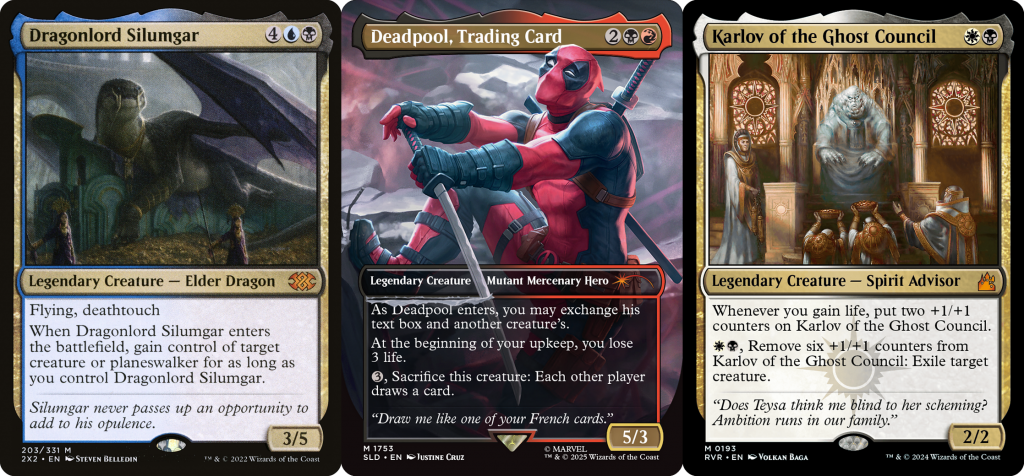
The allure of having interaction readily available in the Command Zone is undeniable. A Commander like Karlov of the Ghost Council, capable of exiling threats, or a hypothetical "Deadpool, Trading Card" (as mentioned in the original text, likely a placeholder for a known removal-focused commander), promises consistent answers. However, this apparent strength often masks significant strategic liabilities.
The ‘Crabs in a Bucket’ Dilemma
When a player at the table deploys a telegraphed combo piece, a potent doubler, or any other synergy that dramatically accelerates their game plan, the collective gaze of the table invariably turns to the player best equipped to neutralize it. If two Jund sacrifice decks are present, one led by Korvold, Fae-Cursed King, and the other by Sek’kuar, Deathkeeper, the dragon-led deck, with its explosive potential for card draw and damage, will almost always draw the most intense scrutiny. The player perceived as the "police" is then expected to act.
This expectation places an immediate burden. The "police" player is forced to spend valuable resources—mana, cards from hand—to address a threat that isn’t directly aimed at them alone, but at the entire table. This expenditure often benefits the other non-embattled players more than the intervener, creating a dangerous resource asymmetry.
Resource Asymmetry and Kingmaking
Single-target removal spells like Beast Within or counterspells require an investment. A player spending mana and a card to stop an opponent’s threat has just gone down in resources, while the other two players at the table have not. This imbalance is the fertile ground for "kingmaking." The player who intervenes often finds themselves in a position where their actions, while preventing one player from winning, inadvertently clear the path for another, stronger opponent to seize victory.
To mitigate this, the intervener often attempts to "make a deal," extracting some value beyond the immediate game state (e.g., "I’ll stop them if you promise not to attack me next turn," or "I’ll save you from this combo if you save me from the next"). While these negotiations are a hallmark of multiplayer Magic, they are often desperate measures born from a position of strategic weakness. The worst-case scenario is that the "police" player expends their resources, deals with the immediate threat, and then finds themselves unable to defend against the next player who "pops off."
Case Studies in Predictable Commanders
Consider a Commander whose primary ability is targeted removal, such as Karlov of the Ghost Council (who can exile creatures) or similar commanders designed for consistent interaction. The mere presence of such a Commander in the Command Zone signals to opponents that interaction is always available. This leads to two primary counter-strategies from explosive decks:
- Misdirection and Timing: Opponents will attempt to bait out the removal or deploy their threats when the "police" player is tapped out, has exhausted their other resources, or when another, more pressing threat diverts attention.
- Protection Overload: Alternatively, opponents will pack their decks with enough protection (e.g., Avacyn, Angel of Hope, Darksteel Forge, counterspells, hexproof/shroud enablers) to power through the known removal.
In either scenario, the game becomes more cautious from the explosive decks, but the "police" player often becomes a de-facto target. Whomever draws their ire first is likely to fail, making them feel less like a control player and more like a gatekeeper whose decisions dictate who else gets to win. Furthermore, players with Command Zone removal often make the critical mistake of running less removal in their 99-card deck, assuming their Commander will cover most interactive needs. This leaves them vulnerable when their Commander is taxed, removed, or when multiple threats emerge simultaneously. This strategic vulnerability directly feeds into "Vulture Theory."
Vulture Culture
"Vulture Theory" posits that players will conserve their resources and allow others to deal with threats, only striking when the path is clear and their opponents are depleted. When interaction lies in predictable, face-up answers like Seal of Cleansing or a Commander’s known ability, the early-to-mid game tends to slow down. Players are disincentivized from making bold plays, knowing they will be immediately dealt with. This protracted "buildup phase" often culminates in a "crescendo" where, after the "police" player has spent their resources dealing with the first threat, a different player, who wisely held back, swoops in to secure the win.
This phenomenon was aptly reflected upon by Gavin Verhey, a Senior Designer at Wizards of the Coast, regarding cards like Karlov. Such commanders, while powerful, can disincentivize players from "doing the thing" for fear of immediate reprisal, only for the next player to "do their thing" with impunity. Commander, being a game of parallel strategies rather than orthogonal ones, encourages powerful proactive game plans. Commanders that primarily offer single-target removal from the Command Zone suffer because they rely heavily on the 99 to contain robust win conditions. If the "police" player cannot parlay their interactive advantage into a direct path to victory, they risk becoming a kingmaker. The ultimate goal, then, is to have interaction that not only stops threats but also furthers your game plan, making you the "Beatdown" even in the role of the "Table Police."
Developer Insights and Community Discourse
The strategic conundrums surrounding interaction and threat assessment in Commander are not lost on either the game’s developers or its vast community.
Wizards of the Coast’s Stance on Interaction
Wizards of the Coast (WotC) designers are keenly aware of the delicate balance required in Commander. They aim to create powerful, exciting threats that encourage diverse strategies, while also ensuring that players have adequate tools to interact with those threats. The existence of cards like Smothering Tithe or Dockside Extortionist demonstrates a willingness to push the boundaries of power, but this is usually accompanied by a broad suite of answers across the color pie.
Gavin Verhey’s aforementioned reflections highlight a design philosophy that seeks to avoid "solitaire Magic" – games where players simply execute their own plans uninterrupted. Interaction is crucial for dynamic gameplay. However, the type of interaction and its accessibility are key. WotC often champions "equal opportunity" interaction – spells that can hit a wide range of permanents or affect multiple opponents, fostering a more engaging and less predictable game state. The challenge is designing Commanders that offer interaction without inadvertently creating kingmaker scenarios or stifling creativity. They want players to "do the thing," but also to be able to stop the thing if it gets out of hand, without penalizing the intervener disproportionately. The ideal Commander provides flexible interaction that can be leveraged proactively, contributing to the player’s own win condition rather than merely resetting the board for others.
Community Reaction and Meta-Gaming
The Commander community continually grapples with these strategic tensions. Online forums, podcasts, and local game stores are rife with discussions about "meta-gaming" – how players adapt their strategies based on known opponents or popular deck archetypes.
- Threat Assessment: A constant topic of debate is the subjective nature of threat assessment. What one player perceives as an immediate danger, another might view as a manageable nuisance. This often leads to heated discussions about who should have dealt with a particular threat.
- The "Social Contract" vs. "Winning": Many players struggle with the balance between playing to win and adhering to the format’s casual, social roots. Commanders that shut down specific strategies can feel oppressive, even if they are technically "police" cards.
- The Arms Race: As powerful threats are printed, so too are powerful answers. This creates an ongoing arms race in deckbuilding, where players constantly adjust their interaction suites to keep pace. The community generally favors interaction that is efficient, flexible, and can address a variety of threats without being overly narrow. The "police" role is acknowledged as necessary, but players are constantly seeking ways to make that role less thankless and more self-serving.
The consensus often leans towards interaction that is proactive, has a low opportunity cost, and can affect all opponents (or at least disrupt multiple threats), thereby reducing the capacity for "vulture" plays and promoting a more equitable distribution of consequences when a threat is neutralized. This brings us to a critical re-evaluation of what constitutes effective Command Zone interaction.
Reclaiming Control: Strategies for Effective Command Zone Interaction
The challenge, then, is to design or select a Commander that provides interaction without falling into the kingmaker trap. The solution lies in a paradoxical re-embrace of "The Beatdown" philosophy.
The ‘Beatdown’ as ‘Table Police’: A Paradoxical Solution
The best way to run removal in the Command Zone is not to be a passive reactive force, but to be "The Beatdown." This means using your Commander’s interactive capabilities not merely to stop threats, but to actively push for your own win condition, to form a "clock" that pressures opponents. They cannot be allowed to comfortably "rest on their laurels" and intend to be a vulture, or to leisurely build up redundancy. Instead, they ought to be forced to run headlong into your strategic "brick wall."
This requires interaction that is:
- Wide-reaching: Affects multiple opponents or permanents, reducing kingmaking potential.
- Proactive: Can be used to advance your game plan even when no immediate threat needs addressing.
- Flexible: Offers multiple modes or applications.
- Underappreciated/Unpredictable: Less likely to be meta-gamed against due to obscurity or subtle power.
Introducing Kagemaro, First to Suffer: A Masterclass in Proactive Interaction
This brings us to an underappreciated gem: Kagemaro, First to Suffer. This legendary Spirit Dragon embodies the principles of proactive, wide-reaching interaction, transforming the "Table Police" role into a potent beatdown strategy.
Kagemaro’s ability, "Kagemaro, First to Suffer’s power and toughness are each equal to the number of cards in your hand," coupled with "When Kagemaro, First to Suffer is put into a graveyard from play, each creature gets -X/-X until end of turn, where X is the number of cards in your hand," presents a unique and devastating package.
- Flexibility and Girth: Black excels at filling its hand. Cards like Veilborn Ghoul, Ovalchase Dragster, Exile into Darkness, and Death of a Thousand Stings, which might seem niche, become potent card advantage engines that fuel Kagemaro’s size and subsequent board wipe. Disciple of Bolas provides life gain and card draw, further synergizing with a large Kagemaro. This hand-filling capacity ensures Kagemaro is always a relevant threat, either as a massive blocker/attacker or a looming board wipe.
- Instant-Speed Board Wipe: The true genius lies in its death trigger. With cards like Undying Evil, Malakir Rebirth, or other similar "flicker" or "return to battlefield" effects, Kagemaro becomes a repeatable, instant-speed board wipe. You can cast Undying Evil on Kagemaro, then sacrifice it (or let it die in combat/to targeted removal), trigger its board wipe, and then have it return to the battlefield, ready to be a large threat again, or even to wipe the board twice in a single round. This capability sidesteps shroud and indestructible, as it’s a -X/-X effect, not destruction.
- Punishing Cautious Play: Unlike passive removal, Kagemaro’s looming presence as a massive creature and potential board wipe forces opponents to act. They can’t simply build their sandcastles indefinitely; Kagemaro’s growing size and the threat of its death trigger constitute a powerful clock. This proactive pressure means you are dictating the pace, making you "The Beatdown."
- Equal Opportunity Control: When Kagemaro wipes the board, it hits all creatures. This significantly reduces the kingmaking problem. While it might clear the path for a player with a creature-light combo, it also prevents other players from immediately capitalizing with their own value engines. You become an equal opportunity control player, ensuring that everyone feels the impact of the regicide.
- Commander Damage & Combo Potential: With an unlimited hand size, Kagemaro can easily grow to be a 21+ power creature, posing a legitimate Commander damage threat. Furthermore, Black’s suite of powerful card draw (e.g., Peer into the Abyss) combined with effects like Skirge Familiar (discard cards for mana) can lead to explosive turns, enabling massive Kagemaro activations or powerful combos that leverage the filled hand.
- Underappreciated Advantage: With only around 160 decks on EDHREC, Kagemaro is a Commander few players will recognize, granting you the element of surprise. This obscurity means opponents are less likely to have pre-planned strategies to counter it, making your "police" work even more effective.
In short, Kagemaro transforms Command Zone removal from a predictable liability into a proactive, wide-reaching, and flexible weapon that allows you to be "The Beatdown" while simultaneously being the "Table Police."
Broader Lessons for Commander Deckbuilding
The lessons gleaned from Kagemaro’s efficacy extend beyond a single card:
- Prioritize Flexible, Proactive Interaction: Seek out interaction that can do more than just answer a threat. Can it draw cards? Create tokens? Advance your board state?
- Balance Command Zone Interaction with Win Conditions: Your Commander’s interaction should feed into your win condition, not just stall the game. Ensure your 99 has the tools to close out the game once the threats are handled.
- Understand the Psychological Game: Commander is as much about politics and perception as it is about card advantage. Leverage your Commander’s known abilities to subtly influence opponents’ decisions.
Looking Ahead: Nita, Forum Conciliator and Future Strategies
This deep dive into Command Zone removal is but one facet of the complex Commander meta-game. The next Commander Focus will delve into Nita, Forum Conciliator, exploring a Rube Goldberg machine of a deck designed to hedge opposing removal against the table, while making ample use of the XX cost creatures so readily available via Orzhov’s tutor lineup. This approach further refines the concept of leveraging interaction proactively, ensuring that even your opponents’ answers inadvertently serve your strategic agenda. For control aficionados and those seeking to master the intricate dance of multiplayer Magic, keep an eye out for this upcoming analysis.
The strategic landscape of Commander is ever-shifting. By moving beyond a simplistic "Beatdown" vs. "Control" dichotomy and understanding the nuances of the "Table Police" role, players can transform perceived weaknesses into profound strengths, dictating the flow of the game and ensuring that their interaction leads not to kingmaking, but to their own inevitable triumph.
Have any questions or feedback? Drop us a note in the comments below or email us at [email protected]. Want articles like this linked in your inbox every Monday morning? Sign up for our newsletter. And don’t forget that you can support us on Patreon for backer rewards like early video content, Administratum access, an ad-free experience on our website, and subscriber-only content covering competitive Warhammer 40K!



Leave a Comment