
The Geometry of Contagion: How Game Design Decoded the Exponential Reality of COVID-19
Six years after the initial shockwaves of the COVID-19 pandemic, the global discourse has largely shifted toward the retrospective analysis of economic fallout and educational gaps. However, a significant chapter in the history of public health communication remains under-examined: the role of systems-thinking and interactive media in translating complex epidemiological data for a skeptical public. At the heart of this movement was Raph Koster, a veteran game designer whose March 2020 "design sketch" catalyzed a series of simulation games that sought to make the abstract math of mortality "visceral."
Main Facts: Bridging the Gap Between Data and Perception
In early 2020, a profound disconnect existed between the scientific community’s projections and public understanding. While epidemiologists tracked exponential growth and Infection Fatality Rates (IFR), the general public struggled to grasp how a virus with a seemingly low mortality rate could collapse global healthcare systems.
Raph Koster, known for his work on Ultima Online and Star Wars Galaxies, argued that certain professions are uniquely equipped to understand pandemics because they "live with exponential curves." This group includes Wall Street quants, statisticians, and game designers. Koster’s thesis was simple: if people could not understand the math through spreadsheets, they might understand it through play.
By proposing a simplified "design sketch" for a contagion simulator, Koster triggered the development of two notable indie titles: Covid Ops and In the Time of Pandemia. These games did not just simulate a virus; they simulated the agonizing trade-offs of public policy, testing capacity, and the "invisible" spread of asymptomatic carriers.
Chronology: From Rumors to Simulation
The timeline of this digital intervention began well before the lockdowns of March 2020, rooted in the early warning signs emanating from East Asia.
- Late 2019: Observers in the tech and systems-design sectors began tracking reports of a novel pneumonia in Wuhan, China. Koster notes his earliest social media warnings date back to November 2019.
- January – February 2020: As the virus spread internationally, a "wall of denial" met early mathematical models. Koster’s predictions of "millions dead"—based on a conservative 0.4% IFR and a 60% infection rate for herd immunity—were frequently met with online derision.
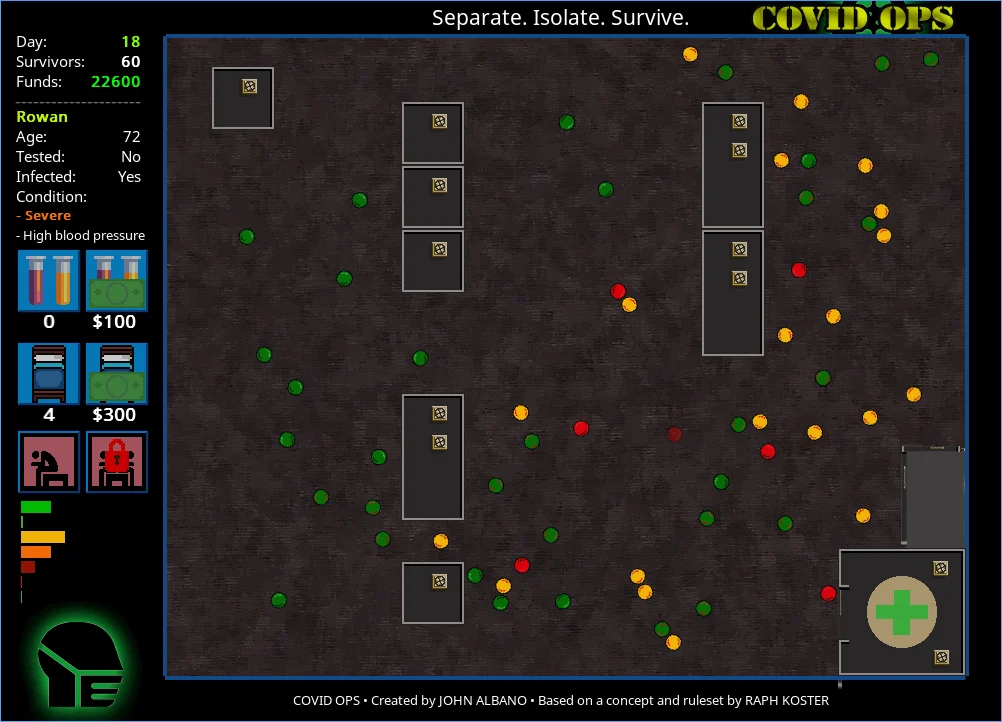
- March 24, 2020: Koster published a detailed "design sketch" on Facebook. He envisioned a game of "little circles on a plain field" where players managed lockdowns, testing, and hospital funding.
- March 30, 2020: Developer John Albano responded to the challenge, releasing Covid Ops on Itch.io just six days after the sketch was posted.
- April 6, 2020: A team in the Philippines, led by Khail Santia, entered "Jamdemic 2020," developing the first iteration of In the Time of Pandemia.
- July 2020: In the Time of Pandemia launched on Newgrounds, featuring a full team of 48 contributors, including medical experts and mathematical biologists. It quickly topped the platform’s charts and gained viral status across the Pacific Rim.
Supporting Data: The Mathematics of Mortality
The efficacy of these simulations rested on their adherence to real-world data. Koster’s original design insisted on "statistically valid" chances of infection and mortality, particularly concerning comorbidities.
The Comorbidity Factor
The simulations were designed to dispel the myth that the "at-risk" population was a small, isolated demographic. According to data integrated into the projects from the American Heart Association and the American Diabetes Association:
- Hypertension: Approximately 47% of U.S. adults (116 million) have high blood pressure.
- Diabetes: Over 34 million Americans are diabetic, with another 88 million categorized as pre-diabetic.
- Obesity: Clinical obesity affects over 42% of the U.S. population.
When these factors are mapped onto a simulation, the "vulnerable" population swells to include nearly half of the interactive "agents." The games demonstrated that because COVID-19 spreads primarily within households, protecting the vulnerable requires isolating not just the individual, but their entire social circle.
Validating the Death Toll
Koster’s early math, once mocked as alarmist, proved tragically accurate. With a low average death estimate of 0.4%, his models suggested millions of fatalities. In hindsight, the actual toll in the United States reached between 1.2 and 1.4 million, while worldwide estimates range from 15 to 28.5 million deaths. The simulations allowed players to see these numbers not as statistics, but as the result of specific systemic failures—such as "too soft" health responses or "too lenient" lockdowns.
Official Responses and Expert Validation
Unlike many entertainment-focused titles, In the Time of Pandemia received significant attention from the academic and medical communities, particularly in the Philippines, which was a global hotspot during the mid-2020 period.
Academic Endorsement:
Gregg Victor Gabison, Dean of the University of San Jose-Recoletos College of Information, Computer & Communications Technology, utilized the game for student play-testing. He noted that the game possessed a "storyline that connects with reality," providing a pedagogical tool that textbooks lacked.
Medical Plausibility:
Dr. Mariane Faye Acma, a resident physician consulted for the project, praised the game for developing "critical thinking, analysis, and multitasking." She emphasized that the game forced players to make the same impossible choices faced by health sectors: who to test, who to isolate, and how to allocate dwindling funds.
Global Press Coverage:
The project was featured by IGN Southeast Asia, The Star Malaysia, and Yahoo Style Singapore. The consensus among reviewers was that the game provided a "visceral understanding" of what it meant to "flatten the curve," a phrase that had become a ubiquitous but poorly understood slogan.
Implications: Games as Systems of Truth
The legacy of the 2020 COVID-19 simulations extends beyond the pandemic itself. It highlights a burgeoning field of "impact games" that serve as a bridge between high-level science and public behavior.
The "Feel it in the Bones" Philosophy
The primary implication of Koster’s work is that humans are generally poor at intuitive mathematics, especially regarding exponential growth. A spreadsheet showing a doubling every three days is an abstraction; a game screen filling with red dots that eventually stop moving is an experience. By giving every "circle" a name from a baby book and a specific age, the developers moved the discourse from "herd immunity" to "human loss."
Preparedness for Future Threats
As Koster notes, the emergence of the first human cases of H5N1 bird flu suggests that the window of "post-pandemic" peace may be closing. The framework established by Covid Ops and In the Time of Pandemia provides a blueprint for future crises. These games proved that a small group of dedicated developers could, in a matter of days, create a tool that validates scientific modeling and educates tens of thousands of people.
The Role of the Designer in Public Policy
The 2020 simulation movement suggests that game designers should have a seat at the table in public health communication. If the goal of a government is to ensure compliance with complex, counter-intuitive health measures, the interactive, systems-based approach of game design may be more effective than traditional top-down messaging.
Conclusion: A Legacy of "Thinking Through"
While some critics on platforms like Reddit have dismissed the listing of these "sketch-based" games on professional CVs as "pathetic," the real-world impact suggests otherwise. For the 48 people who built In the Time of Pandemia and the tens of thousands who played it, the project was a "thread connecting a diversity of talents" during a time of profound isolation.
As we face new zoonotic threats and the lingering effects of Long COVID, the lesson from 2020 remains clear: when the world faces a systemic crisis, we must use systemic tools to understand it. Raph Koster’s design sketch was more than a game idea; it was a call to "rise to the occasion" and recognize that in an interconnected world, there is no retreat to how things used to be. There is only the path through—and that path is paved with data, empathy, and the courage to look at the curves.


Leave a Comment